


| Topic | Key Facts |
|---|---|
| What it is | Fat stored deep in the abdominal cavity, surrounding internal organs |
| Healthy amount | Roughly 10% of total body fat; waist under 35 in (women) / 40 in (men) |
| Who is at risk | Adults with central weight gain, sedentary lifestyle, poor sleep, or metabolic conditions |
| Main health risks | Type 2 diabetes, cardiovascular disease, insulin resistance, hypertension |
| Best measurement tools | Waist circumference, waist-to-height ratio, DEXA scan, BIA scale |
| When to see a doctor | Waist above threshold, family history of metabolic disease, unexplained fatigue or blood sugar changes |
Most conversations about body fat focus on the number on the scale. But weight alone does not tell the full story. The healthy amount of visceral fat a person carries, and where that fat sits inside the body, turns out to matter as much as total body weight, and in some cases more. This guide explains what visceral fat is, what the numbers mean, how it can be measured at home and clinically, and what research says about bringing elevated levels down. If any measurements or symptoms raise concerns, a doctor near you can help interpret results in context.
What Is Visceral Fat vs Subcutaneous Fat?
Visceral fat is adipose tissue (stored fat) located inside the abdominal cavity, wrapped around organs including the liver, pancreas, intestines, and kidneys. Subcutaneous fat, by contrast, sits just beneath the skin and is the layer that can be pinched at the waist, thighs, or upper arms.

The two types of fat behave differently at a cellular level. According to a structural review published in Obesity Reviews (Ibrahim, 2010), visceral adipose tissue has a higher density of immune cells, a richer blood supply through the portal vein, and greater metabolic activity than subcutaneous fat, making it more responsive to hormonal signals and more capable of releasing inflammatory molecules into the bloodstream.
Subcutaneous fat has a largely mechanical role: insulation and energy reserve. Visceral fat, because of its direct drainage into the portal circulation, has a more immediate influence on liver function, insulin sensitivity, and systemic inflammation.
A practical distinction worth knowing: subcutaneous fat is the visible belly layer that can be pinched, while visceral fat is the deeper firmness underneath, sometimes described as a "hard belly." A person can have a relatively flat abdomen by appearance and still carry elevated visceral fat if their total body fat percentage is high.
Both types of fat exist in everyone, and both serve physiological purposes. The concern arises only when visceral fat accumulates beyond a functional threshold, a range covered in detail below.
Visceral Fat Levels: What the Numbers Mean
There is no single universal number for visceral fat because different measurement tools produce different units. Understanding what a scale score, percentage, or scan result means requires knowing which method generated it.
The 10% Rule
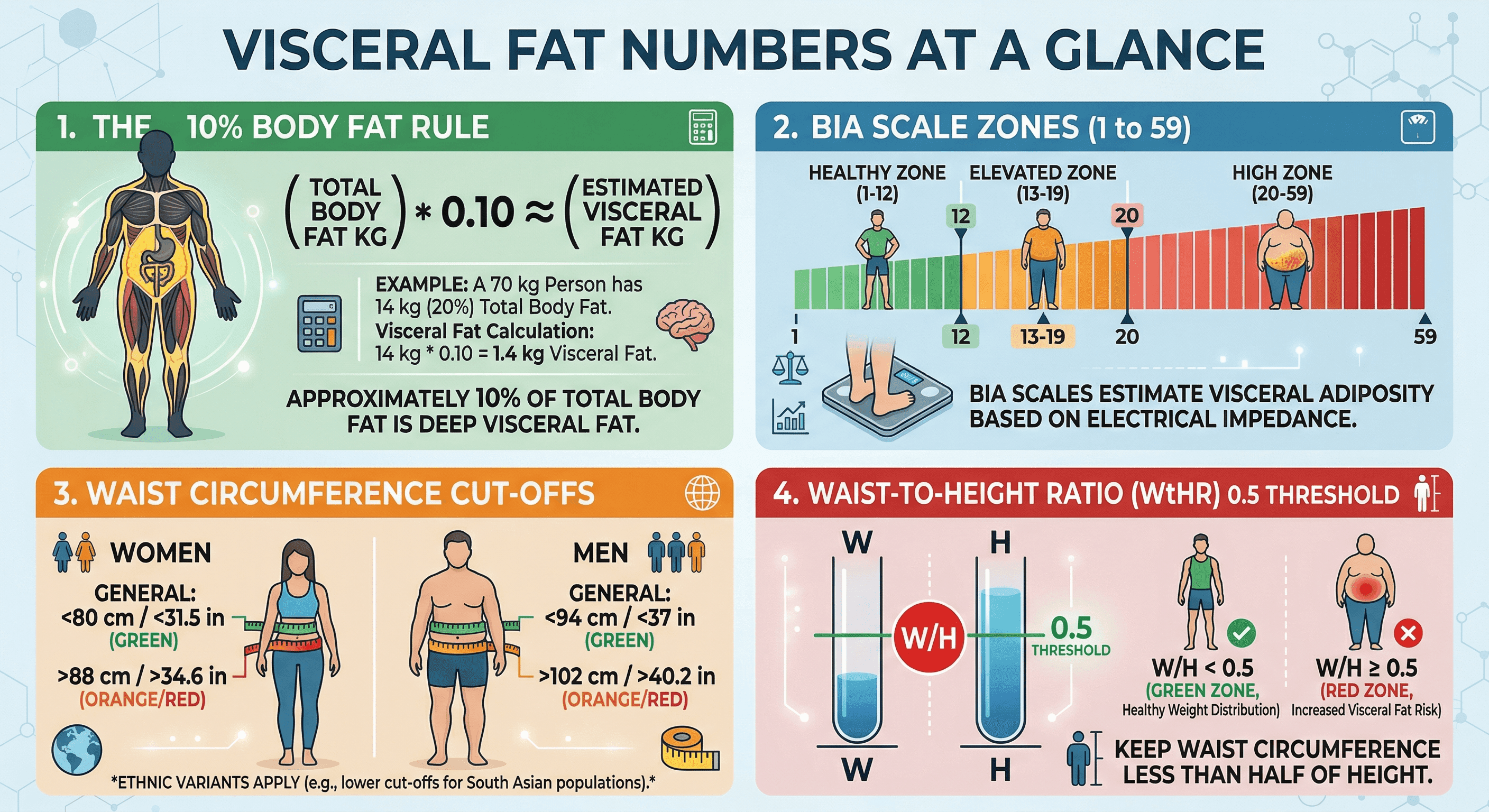
Harvard Health Publishing notes that visceral fat typically accounts for about 10% of a person's total body fat. A person with 25% total body fat, for example, would have roughly 2.5% of their body weight as visceral fat under this guideline. This proportion is the most widely cited clinical reference point for a normal level.
When total body fat percentage rises significantly above recommended ranges, visceral fat often rises in proportion, though this is not always the case. Some individuals with a normal BMI carry elevated visceral fat, a pattern sometimes called "normal-weight obesity" or TOFI (thin outside, fat inside).
Tanita and BIA Scale Scores (1 to 59)
Many home body composition scales, including those made by Tanita, use bioelectrical impedance analysis (BIA) to estimate visceral fat on a scale of 1 to 59. A rating between 1 and 12 is considered healthy by the manufacturer; 13 and above indicates excess.
One important caveat: a 2021 cross-sectional validation study published in PMC found poor agreement between single-frequency BIA and CT-measured visceral fat area in both men and women (R = 0.39 to 0.64). BIA readings also fluctuate with hydration status, meal timing, and body temperature. These devices are useful for tracking trends over time but should not be treated as standalone clinical measurements.
DEXA Scan
Dual-energy X-ray absorptiometry (DEXA) scans provide the most precise non-invasive measurement of visceral adipose tissue (VAT). DEXA reports visceral fat as a volume in cm³, a mass in pounds or grams, and a normalized VAT index. Clinicians generally use these values alongside waist circumference and metabolic markers rather than as isolated thresholds.
Waist Circumference
Waist circumference is the simplest proxy for visceral fat that can be done at home. According to Diabetes Care (Klein et al., 2007), waist measurement is a reliable indicator of abdominal adiposity and cardiometabolic risk. Standard thresholds for elevated risk are as follows:
| Population | Elevated Risk Threshold |
|---|---|
| Women (general) | 35 inches (88 cm) or more |
| Men (general) | 40 inches (102 cm) or more |
| Asian women (WHO Asia-Pacific) | 31.5 inches (80 cm) or more |
| Asian men (WHO Asia-Pacific) | 35.4 inches (90 cm) or more |
These ethnic-specific thresholds exist because research has shown that people of South Asian and East Asian descent develop metabolic complications at lower absolute waist measurements than the populations used to derive the original NCEP ATP III guidelines.
Waist-to-Height Ratio
The waist-to-height ratio (WHtR) is calculated by dividing waist circumference by height, both in the same units. A ratio above 0.5, meaning the waist is more than half of total height, is generally associated with elevated cardiometabolic risk across multiple populations and is considered more consistent across body sizes than waist circumference alone.
How Is Visceral Fat Measured?
Four main approaches are used to assess visceral fat, each with different levels of accuracy, accessibility, and cost.
Waist Tape Measure
A flexible tape measure placed around the bare abdomen at navel level, while standing and after a normal exhale, gives a waist circumference reading. It takes under a minute and requires no equipment beyond the tape. Its limitation is that it cannot distinguish between visceral and subcutaneous fat. Two people with identical waist measurements can have very different visceral fat levels depending on muscle mass and fat distribution.
Bioelectrical Impedance Analysis (BIA)
Home body composition scales and handheld devices that use BIA send a low-level electrical current through the body and estimate fat distribution based on resistance. As noted above, BIA is subject to hydration variability and has limited precision for clinical purposes. Measuring consistently at the same time of day, with the same hydration state, and before eating improves the reliability of trend data.
DEXA Scan
A DEXA scan uses low-dose X-rays to directly map and quantify fat compartments throughout the body, including VAT mass in the abdominal region. It is available at some radiology clinics, sports medicine practices, and specialist body composition providers. DEXA produces data on VAT volume (cm³), mass (lb or g), and a normalized VAT index that is not possible with tape measurement or BIA scales.
CT and MRI
CT scanning and MRI imaging are the gold-standard research methods for visceral fat measurement, capable of measuring visceral fat area at specific anatomical cross-sections. They are not ordered for routine visceral fat assessment outside clinical or research settings due to cost and, in the case of CT, radiation exposure.
For most people, a combination of monthly waist tape measurement and periodic DEXA (every three to four months when tracking a body composition change) gives the most useful ongoing picture. Questions about which approach fits a particular situation are best addressed with a healthcare provider.
What Is a Healthy Visceral Fat Range?
A healthy visceral fat range is one that keeps the body's organ-surrounding fat within a proportion that does not meaningfully increase metabolic or cardiovascular risk. Based on current evidence, this corresponds to:
- Visceral fat at or below approximately 10% of total body fat
- Waist circumference below 35 inches for women (31.5 inches for Asian women) and below 40 inches for men (35.4 inches for Asian men)
- Waist-to-height ratio below 0.5
- BIA scale score of 1 to 12 (as a trend indicator, not a precise clinical value)
These ranges are population averages derived from large cohort studies and are used as screening thresholds, not absolute cut-offs. A person sitting just above a waist threshold is not categorically at high risk. Their overall picture, including blood pressure, glucose, lipids, and lifestyle, is what matters most and is worth reviewing with a clinician.
Age also plays a role. Visceral fat accumulates progressively with age, even without weight gain, driven largely by hormonal shifts. In women, estrogen decline during perimenopause and menopause redistributes fat from peripheral stores in the hips and thighs toward the abdominal cavity. In men, declining testosterone has a similar effect, promoting visceral accumulation and reducing lean muscle mass. Regular exercise has been shown in multiple studies to significantly blunt age-related visceral fat gain.
There is also a lower end to consider. Very low visceral fat, as seen in cases of severe caloric restriction or certain medical conditions, can impair the cushioning and endocrine functions that this fat is meant to serve. The goal is not zero visceral fat. It is a functional amount within the ranges described above.
Health Risks of High Visceral Fat
High visceral fat is associated with a cluster of metabolic and cardiovascular conditions that are well-documented in large population studies.
A study published in the New England Journal of Medicine (Pischon et al., 2008) followed over 350,000 European adults and found that both general adiposity and abdominal adiposity independently predicted risk of premature mortality. Waist circumference and waist-to-hip ratio remained significant predictors even after adjusting for BMI, confirming that where fat is stored carries independent health implications beyond body weight alone.
Specific conditions associated with elevated visceral fat include:
Insulin Resistance and Type 2 Diabetes
Visceral fat releases free fatty acids directly into the portal vein, the blood vessel that feeds the liver. This impairs the liver's response to insulin, leading to insulin resistance, a condition in which cells require more insulin than normal to absorb glucose. Sustained insulin resistance is a primary pathway to type 2 diabetes, which carries its own set of downstream organ complications. The visceral fat and diabetes connection is covered in more detail in a section below.
Cardiovascular Disease
Visceral adipose tissue secretes pro-inflammatory cytokines, including interleukin-6 (IL-6) and tumor necrosis factor-alpha (TNF-alpha), that promote arterial inflammation, raise blood pressure, and alter lipid profiles toward higher LDL and triglycerides and lower HDL. Harvard Health Publishing notes that women with the largest waists had significantly higher heart disease risk than those with the smallest, even after controlling for other factors. These risks are well-documented but also meaningfully responsive to lifestyle change.
Non-Alcoholic Fatty Liver Disease (NAFLD)
Free fatty acids released by visceral fat into portal circulation are taken up directly by the liver. When this exceeds the liver's processing capacity, fat accumulates in liver cells, a condition called hepatic steatosis or non-alcoholic fatty liver disease. NAFLD can progress to a more inflammatory form of liver disease that requires ongoing medical management. A doctor can advise on individual cases where liver health is a concern.
Hypertension
Visceral fat has been shown to activate the renin-angiotensin-aldosterone system (RAAS), a hormonal pathway that regulates blood pressure. Excess activation raises baseline blood pressure independently of body weight, contributing to cardiovascular strain that is particularly pronounced when combined with other risk factors. In women, this effect can intensify around menopause, when visceral fat accumulation and blood pressure shifts often occur together.
Sleep Apnea
Visceral fat accumulation around the upper airway is associated with obstructive sleep apnea, a condition in which the airway partially collapses during sleep. Sleep disruption from apnea raises cortisol levels, which in turn promotes further visceral fat storage, creating a reinforcing cycle that can be addressed with clinical support.
It is worth noting that these associations describe population-level risk, not individual certainty. Many people carry moderately elevated visceral fat without developing any of these conditions, particularly when other risk factors such as smoking, uncontrolled hypertension, and poor diet are absent.
Visceral Fat and Diabetes: A Closer Look
The relationship between visceral fat and type 2 diabetes is one of the most studied links in metabolic medicine.
Visceral fat is metabolically active in a way that subcutaneous fat is not at the same intensity. It contains a higher concentration of beta-adrenergic receptors, which respond to stress hormones like epinephrine and cortisol by releasing stored fat as free fatty acids. Those fatty acids flow through the portal vein to the liver, where they interfere with insulin signaling.
The liver, under this chronic fatty acid load, begins producing more glucose than necessary and becomes less responsive to insulin's signal to stop. This is hepatic insulin resistance, and it is one of the earliest measurable steps on the path toward type 2 diabetes.

Importantly, this process can occur in people who are not clinically overweight. A person with a BMI in the normal range but elevated visceral fat can develop insulin resistance. This is why waist circumference and body fat distribution are now considered alongside BMI in metabolic risk screening by major clinical bodies including the American Diabetes Association.
Visceral fat reduction through diet, exercise, or both has been shown to improve insulin sensitivity measurably and is a recognized component of both diabetes prevention and management programs.
Body Fat Distribution Types Explained
Not everyone stores fat in the same pattern. These different types of body fat distribution reflect both genetics and hormonal influences.
Android (Apple Shape) Distribution
Android fat distribution concentrates fat in the abdominal region, giving the body a rounder midsection relative to the hips and thighs. This pattern is more common in men but also appears in postmenopausal women and is the distribution most associated with elevated visceral fat. People with android distribution typically have a higher waist-to-hip ratio.
Gynoid (Pear Shape) Distribution
Gynoid distribution concentrates fat in the hips, buttocks, and thighs, with relatively less in the abdomen. This is more common in premenopausal women and is associated with lower visceral fat and a comparatively lower cardiometabolic risk than android distribution, even at similar total body fat levels. Subcutaneous fat in the lower body has different hormonal properties than abdominal visceral fat.
Central Obesity Without Generalized Overweight
Some individuals carry significant abdominal fat without being classified as overweight by BMI. This pattern, sometimes called metabolically obese normal weight (MONW), is particularly common in certain ethnic groups and can be missed in standard clinical screening that relies only on BMI. Waist circumference and waist-to-height ratio are more useful screening tools in this group.
Muscle Under Fat
Physical appearance can be misleading. A person with substantial muscle mass may carry subcutaneous fat over developed muscle and still have low visceral fat. Conversely, a person who appears lean may have very little muscle and meaningful visceral accumulation. Body composition assessment, rather than weight or appearance alone, provides a more reliable picture.
How to Reduce Visceral Fat: Diet and Exercise
Visceral fat is more metabolically responsive than subcutaneous fat, which means it is also more responsive to lifestyle changes. The same interventions that reduce visceral fat also tend to improve insulin sensitivity, blood lipids, and blood pressure, making them broadly beneficial regardless of which specific risk is most relevant.
Exercise: Combining HIIT and Resistance Training
A 2018 meta-analysis published in Sports Medicine (Maillard et al.) found that high-intensity interval training (HIIT) produced significant reductions in visceral fat, often outperforming moderate-intensity continuous exercise over program durations of 8 to 12 weeks. Resistance training, which preserves and builds lean muscle mass, improves insulin sensitivity and basal metabolic rate, both of which support visceral fat reduction over time.
A practical weekly structure supported by the evidence: two HIIT sessions (20 to 30 minutes each) combined with two full-body resistance training sessions. Daily walking of 7,000 to 10,000 steps adds additional caloric expenditure and has independent cardiovascular benefits.
Diet: What to Reduce and What to Add
No single food eliminates visceral fat, but dietary patterns consistently associated with lower VAT include the following:
Reduce or limit:
- Ultra-processed foods, which are associated with increased visceral fat accumulation in multiple cohort studies
- Sugary beverages including juice, as liquid calories bypass satiety signals more readily than whole food calories
- Trans fats (found in partially hydrogenated oils), which are associated with visceral fat gain even without overall caloric excess
- Excess alcohol, particularly beer and sugary cocktails, which are associated with central fat accumulation
Include more of:
- Soluble fibre from sources such as beans, oats, flaxseed, and apples. The NIH Office of Dietary Supplements notes that soluble fibre supports metabolic health by slowing glucose absorption and improving lipid profiles, both relevant to visceral fat risk
- Whole grains, which research consistently associates with better metabolic markers compared to diets high in refined grains
- Lean protein at approximately 1.2 to 1.6 g per kg of body weight, which supports lean muscle preservation during caloric deficit and reduces the proportion of weight lost from muscle versus fat
Sleep and Stress
Sleep duration below seven hours per night is associated with elevated cortisol and disrupted ghrelin and leptin signalling, both of which promote visceral fat storage. Seven to nine hours of quality sleep is the evidence-based recommendation from the CDC. Stress management also supports cortisol regulation, given that cortisol activates fat storage in visceral depots specifically.
What to Expect Over Time
Lifestyle interventions typically produce metabolic changes, such as improved insulin sensitivity and reduced inflammatory markers, before visible changes in waist circumference occur. Waist circumference reductions generally become measurable within two to three months of consistent effort. Individual variation is significant and depends on starting visceral fat level, age, hormonal status, sleep quality, and adherence.
Consulting with a qualified healthcare provider before beginning a significant dietary or exercise change is advisable for anyone managing an existing metabolic condition. For some individuals, GLP-1 medications may be considered alongside lifestyle changes, under clinical supervision, as part of a broader visceral fat reduction plan.
Frequently Asked Questions
What is a healthy amount of visceral fat? A healthy visceral fat level is generally defined as visceral fat making up no more than 10% of total body fat, combined with a waist circumference below 35 inches for women (31.5 inches for Asian women) and below 40 inches for men (35.4 inches for Asian men). On a BIA scale such as Tanita, a score of 1 to 12 is considered within the healthy range, though BIA accuracy varies with hydration and is best used for trend tracking rather than a single clinical reading.
How do you lower visceral fat? The most evidence-supported approaches are a combination of regular exercise (particularly HIIT combined with resistance training), a diet lower in ultra-processed foods and sugary beverages and higher in fibre and lean protein, consistent sleep of seven to nine hours, and cortisol management through stress reduction. Visceral fat typically responds faster to lifestyle change than subcutaneous fat does.
What causes high visceral fat? Chronic caloric surplus, physical inactivity, poor sleep, chronic stress (via elevated cortisol), hormonal changes including menopause and declining testosterone, and genetic predisposition to central fat distribution all contribute to elevated visceral fat. Age is also a consistent factor, as visceral fat accumulates progressively with age even without significant weight gain.
How do you test for visceral fat? Practical options include waist circumference measurement (a tape at navel level), waist-to-height ratio calculation, BIA body composition scales, and DEXA scanning for the most accurate non-invasive result. CT and MRI are gold-standard research tools but are not used for routine clinical screening. A doctor or clinician can recommend the most appropriate assessment based on individual health history.
What is the best indicator of visceral fat? For clinical accuracy, DEXA scan is the most accessible high-precision measurement. For everyday monitoring, waist circumference combined with waist-to-height ratio provides a practical and well-validated proxy. A waist-to-height ratio above 0.5 is a useful screening flag across body sizes and ethnicities.
Where is visceral fat located? Visceral fat is located in the abdominal cavity, inside the peritoneal space that contains the digestive organs. It wraps around the liver, stomach, intestines, kidneys, and pancreas. It cannot be seen or pinched from the outside, which is why waist circumference measurements and body composition scans are used to estimate its amount.
This article is for informational purposes only and does not constitute medical advice. For personalized guidance on visceral fat, metabolic health, or body composition, consult a qualified healthcare professional. Find a doctor near you.


