

Whether a phone app just flagged a mole or a scroll through TikTok introduced the concept of "AI dermatology," most people arrive at this topic with the same question: can a camera and an algorithm actually tell what is happening to my skin?
AI skin diagnosis has moved from research labs into everyday use faster than almost any other digital health technology. Apps promise to analyze acne, classify rashes, and screen for skin cancer with a single selfie. Some of those claims are backed by rigorous clinical data. Others are not. Knowing the difference matters, especially when the stakes include a missed melanoma or an unnecessary biopsy scare.
This guide covers exactly that: what AI skin diagnosis tools actually do, which ones are built for clinical use versus cosmetic curiosity, how accurate the research shows them to be, who they work less well for, and the questions worth asking before submitting a photo of anything that worries you.
At a Glance
| Topic | Key Facts |
|---|---|
| What it is | AI systems that analyze skin images to identify conditions, flag suspicious lesions, or grade cosmetic concerns |
| Two main categories | Consumer/cosmetic apps vs. FDA-cleared medical-grade diagnostic tools |
| Top accuracy figure | CNN models achieve 91% sensitivity and 94% specificity for melanoma vs. benign lesions (2025 meta-analysis, 551 studies) |
| FDA-cleared example | DermaSensor: 96% sensitivity across 224 skin cancer types; cleared January 17, 2024 |
| Known limitation | Measurably lower accuracy for Fitzpatrick skin Types III to VI compared to Types I and II |
| Who it is for | Anyone tracking a skin concern, not a replacement for a board-certified dermatologist |
What Is AI Skin Diagnosis?
AI skin diagnosis refers to software systems that use machine learning to analyze images of skin and return a classification, a probability score, or a recommendation. The term covers a wide range of tools: a cosmetic app that grades oiliness and pore size sits in the same category as a medical device that screens for melanoma in a primary care setting. Those two things are not the same, and conflating them creates real misunderstanding about what AI can and cannot do for skin health.
The field grew directly out of advances in computer vision. Once deep learning models proved capable of classifying objects in photographs with superhuman accuracy, researchers began training those same architectures on large labeled datasets of dermoscopic (magnified, polarized light) and clinical skin images. The results were striking enough that the question shifted from "can AI read skin?" to "how do we get this into clinical practice responsibly?"
Consumer apps vs. medical-grade tools: a critical distinction
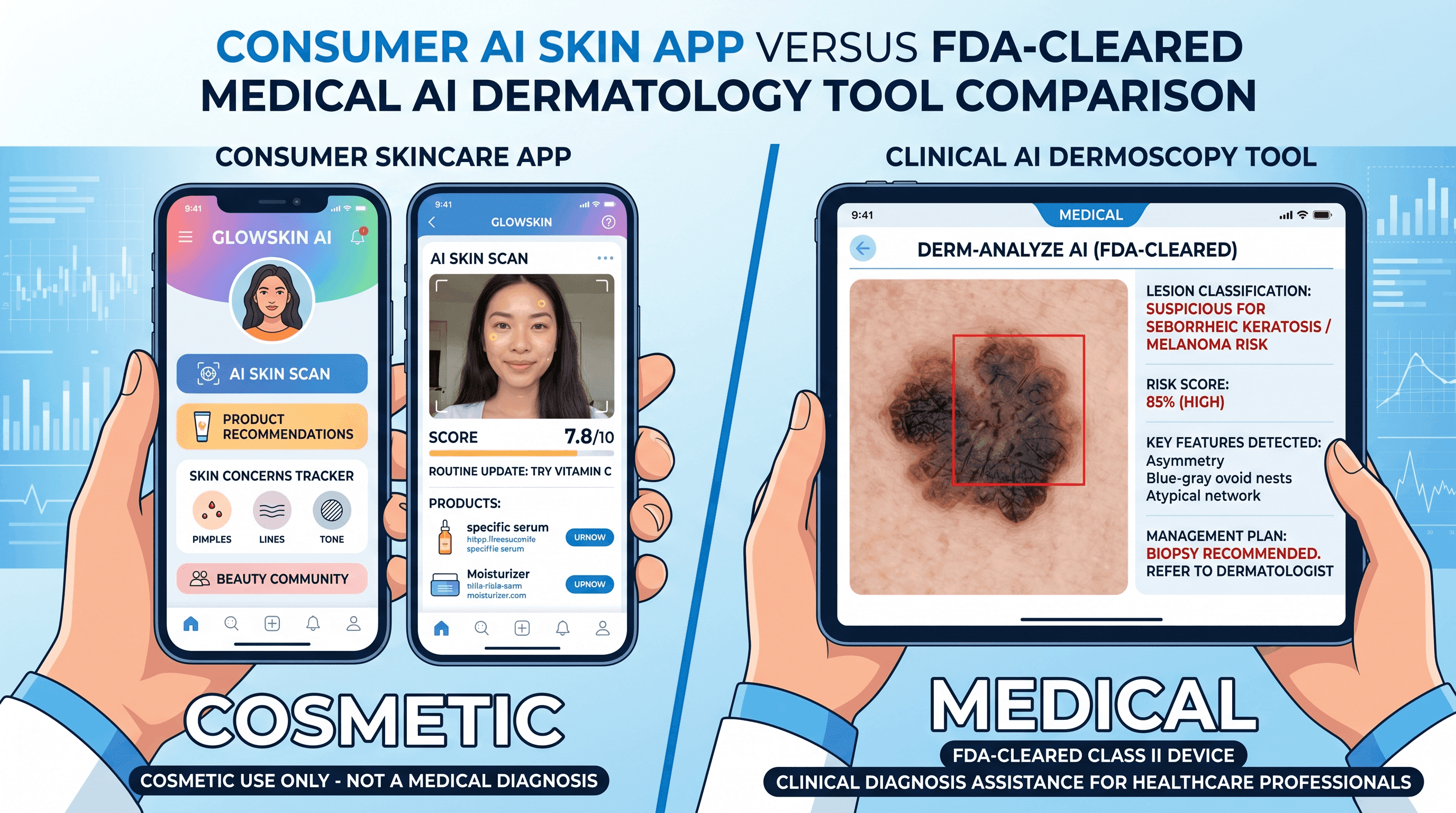
Consumer apps like L'Oréal Skin Genius and ModiFace, TroveSkin, and INKEY's Breakout Analyzer are designed to help people manage skincare routines. They analyze skin type, grade acne severity, assess hydration, and recommend products. These tools are not regulated as medical devices, and they are not designed or validated to detect skin cancer.
Medical-grade tools like DermaSensor, Legit.Health, and FirstDerm's Autoderm platform are built for clinical environments. They are validated against pathologically confirmed diagnoses, evaluated for sensitivity and specificity, and in some cases have cleared regulatory review as medical devices. A result from DermaSensor carries a different meaning than a result from a cosmetic selfie analyzer.
Understanding which type of tool is in front of you is the most important thing a person can know before acting on any AI skin analysis result.
How AI Skin Diagnosis Actually Works
At its core, every AI skin diagnosis system follows a similar technical pipeline: an image is captured, preprocessed to standardize lighting and resolution, passed through a convolutional neural network (CNN), and returned as a probability score for one or more conditions.
CNNs are a type of deep learning architecture particularly well-suited to image analysis. They learn to recognize patterns across millions of labeled training images, progressively identifying features from simple edges and color gradients at early layers to complex tissue textures and structural patterns at deeper layers. The model does not "understand" skin the way a dermatologist does. It learns statistical associations between visual patterns and diagnostic labels at a scale no human expert could match.
The quality of the input image matters enormously. Dermoscopic images, captured with a handheld device that eliminates surface reflection and provides 10x to 400x magnification, produce far more clinically useful data than a smartphone photo taken in bathroom lighting. This is one reason that AI tools built on dermoscopic training data consistently outperform those trained on standard photographs, particularly for subtle findings like early-stage melanoma.
What the AI is actually looking at: patterns, not pixels
Dermatologists have long used the ABCDE framework to evaluate potentially suspicious lesions: Asymmetry, Border irregularity, Color variation, Diameter greater than 6mm, and Evolution over time. CNNs trained on large dermoscopic datasets have effectively learned to quantify these features at scale.
Where a clinician mentally notes that a lesion's border is irregular, a CNN identifies pixel-level discontinuities across tens of thousands of training examples and learns which patterns correlate with malignancy. Research published in JAMA Network Open has demonstrated that well-trained CNNs can match or exceed dermatologist-level sensitivity for melanoma classification when operating on dermoscopic images. The AI is not guessing. It is pattern-matching against an enormous reference library that no individual clinician could accumulate in a lifetime.
How Accurate Is AI Skin Diagnosis? The Data You Actually Need
Accuracy in AI skin diagnosis is not a single number. It varies by tool type, image quality, target condition, and patient population. Citing a headline figure without that context is one of the most common ways misleading claims spread.
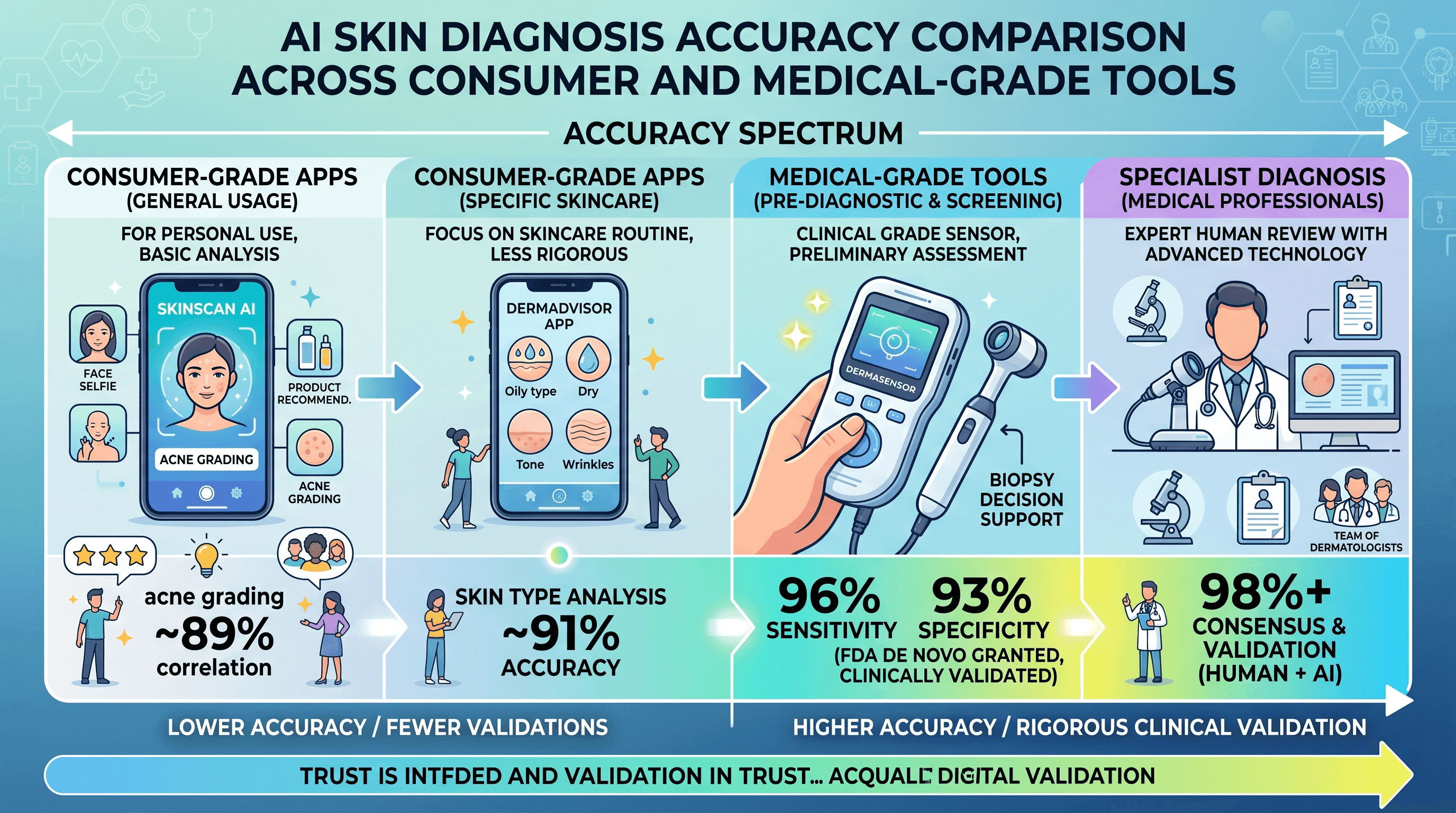
For melanoma specifically, a 2025 meta-analysis covering 551 studies found that CNN models achieved 91% sensitivity and 94% specificity when distinguishing melanoma from benign lesions. Sensitivity measures the proportion of actual melanomas correctly identified. Specificity measures the proportion of benign lesions correctly cleared. A false positive from an AI tool means a benign mole flagged as suspicious, prompting an unnecessary biopsy. A false negative means a melanoma missed. Both matter, and the 91%/94% figures represent performance on dermoscopic datasets under research conditions, not necessarily everyday smartphone photos.
"Deep learning algorithms can classify skin cancer with a level of competence comparable to dermatologists." Esteva et al., Nature, 2017 — foundational study validating CNN performance for skin cancer classification against board-certified dermatologists.
Medical-grade accuracy: the DermaSensor benchmark
DermaSensor represents the current benchmark for FDA-cleared AI dermatology devices in the United States. The DERM-SUCCESS pivotal trial, conducted at 22 sites including the Mayo Clinic, enrolled more than 1,000 patients and evaluated the device across 224 distinct skin cancer types. Results showed 96% sensitivity and a 97% negative predictive value, meaning that when DermaSensor indicates a lesion is low-risk, it is correct 97% of the time. The FDA cleared DermaSensor on January 17, 2024, making it the first AI-enabled dermatology device authorized for use in primary care settings in the United States.
Consumer app accuracy: a more honest picture
Consumer apps occupy a different accuracy tier. Studies on AI-based acne grading tools have shown approximately 89% correlation with dermatologist assessments for acne severity scoring. Skin-type classification systems perform reliably for their intended cosmetic purposes. These figures are meaningful for their designed use cases and should not be interpreted as evidence of cancer-screening capability. A consumer app that accurately grades your skin's hydration level was not designed, validated, or regulated to tell you whether a changing mole needs a biopsy.
The Bias Problem: Does AI Work Equally for All Skin Tones?
This is the question that most AI skin diagnosis coverage avoids, and it is one of the most consequential gaps in the current technology.
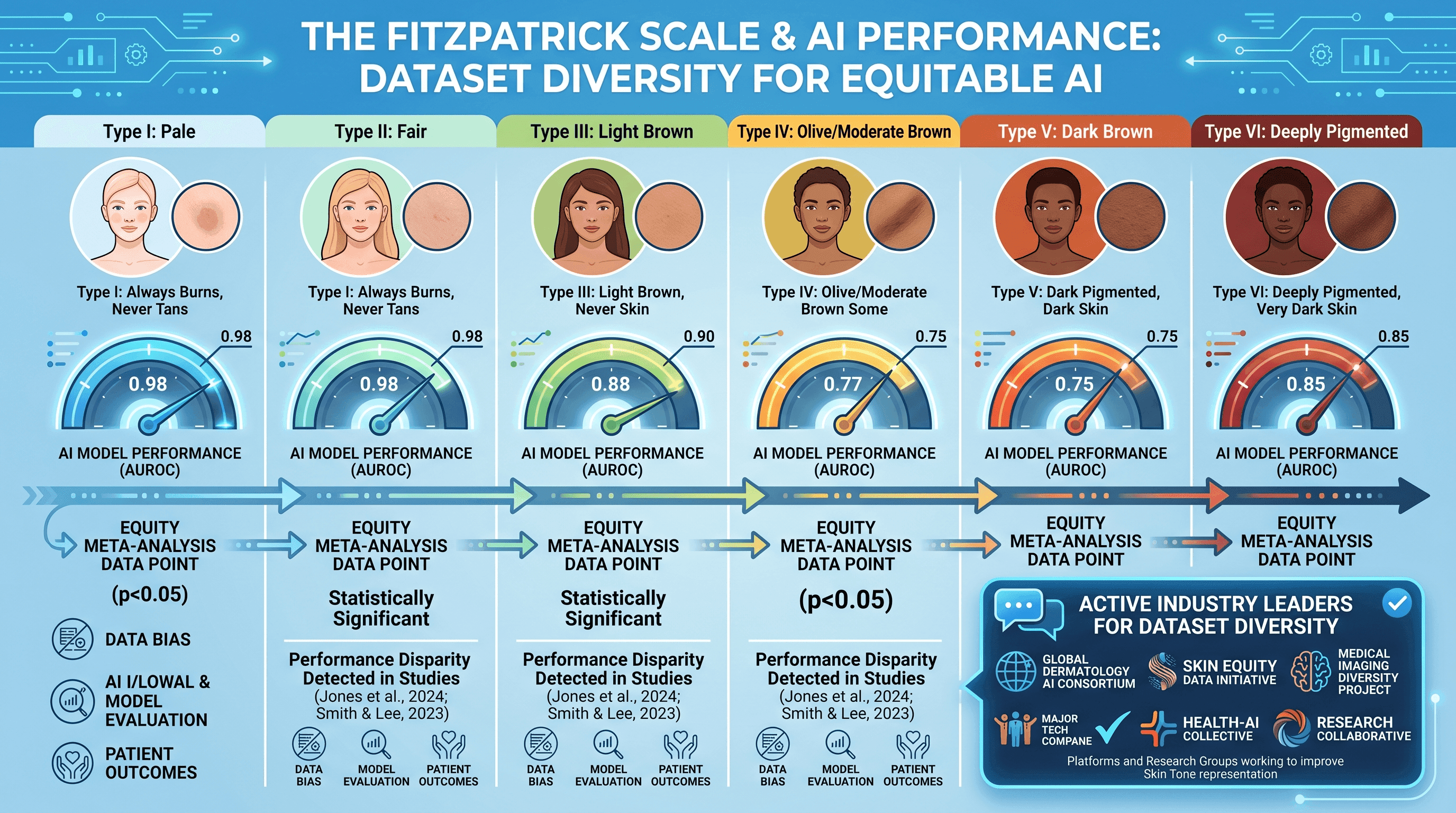
AI models learn from their training data. When training datasets skew toward lighter skin tones, which has historically been the case for dermatological image databases, model performance follows the same bias. The Diverse Dermatology Images (DDI) dataset was developed specifically to address this gap, and research using it has revealed measurable performance differences across skin tone categories.
A widely cited study examining ChatGPT-4o's performance on melanoma classification found significantly lower sensitivity and specificity for Fitzpatrick skin Types III through VI compared to Types I and II. A 2025 equity meta-analysis covering more than 70,000 test images found an area under the ROC curve (AUROC, a standard measure of classifier performance) of 0.82 for darker skin tones versus 0.89 for lighter skin tones. That gap may seem modest statistically, but for a patient with a missed melanoma, it is not modest at all.
Why this gap exists: the training data problem
The root cause is straightforward. Dermatological image datasets assembled over decades have reflected the patient populations of the academic centers that compiled them, which have skewed toward lighter-skinned populations. CNN models trained on these datasets learn the features of skin cancer as it presents in that population. Melanoma on darker skin often presents differently, on palms, soles, and nail beds rather than sun-exposed surfaces, and a model not trained on diverse presentations will underperform.
Fine-tuning models on the DDI dataset and similar diverse collections measurably closes this gap. Research published in Nature Digital Medicine has demonstrated that targeted dataset augmentation with diverse skin tone images improves model fairness without compromising overall accuracy.
What this means for patients with darker skin tones
For patients with Fitzpatrick Types III through VI, AI skin analysis tools carry greater uncertainty. The practical guidance from current evidence is clear: AI screening tools should be treated as a first step, not a final answer, and this applies with more force for patients whose skin tones are underrepresented in training data. When an AI tool clears a lesion that has been changing, bleeding, or otherwise concerning, an in-person consultation with a board-certified dermatologist remains the appropriate next step.
When using any AI skin tool, patients with darker skin tones can reasonably ask the provider which training datasets were used, whether the tool was validated on diverse skin tone populations, and what the published sensitivity figures are for Fitzpatrick Types III through VI.
FDA Clearance and Regulation: What Is Actually Approved?
The US regulatory landscape for AI skin tools divides cleanly into two categories: FDA-cleared medical devices and unregulated consumer wellness apps. Understanding this distinction protects people from over-trusting tools that have never been evaluated for diagnostic accuracy.
As of mid-2025, the FDA has authorized more than 1,250 AI-enabled medical devices across all specialties. Of those, only a small number are specific to dermatology. DermaSensor's January 17, 2024 clearance was notable because it represented the first FDA authorization of an AI dermatology device specifically designed for primary care, enabling non-dermatologist physicians to screen patients who might not otherwise have access to a specialist.
FDA clearance through the 510(k) pathway, which DermaSensor received, requires demonstrated substantial equivalence to a legally marketed predicate device and supporting clinical data. It is not the same as FDA approval, which involves more extensive clinical trial evidence, but it is a meaningful regulatory bar that consumer wellness apps do not meet.
Consumer skincare apps are generally regulated as software for general wellness under FDA guidance, meaning they fall outside the medical device framework as long as they do not make diagnostic claims. The practical implication is that a consumer app can analyze your pores, track your acne over time, and recommend moisturizers without any FDA oversight. The moment that same app claims to detect melanoma, it enters a regulatory gray area where enforcement has been inconsistent.
If a diagnostic claim for a serious condition is not backed by an FDA clearance number, treat it with appropriate skepticism.
The Best AI Skin Diagnosis Tools Right Now
Not all AI skin tools belong in the same conversation. Organizing them by regulatory tier is the most honest way to set expectations.
Tier 1: FDA-Cleared Medical Devices
DermaSensor is currently the only FDA-cleared AI-enabled dermatology device authorized for primary care use in the United States. It uses a handheld optical probe combined with machine learning to analyze spectral data from a lesion and return a risk score. It is designed for use by primary care physicians, not as a consumer self-screening device. Access is through a healthcare provider.
Tier 2: Clinician-Support and Teledermatology Platforms
FirstDerm's Autoderm platform has published meaningful real-world outcome data. In May 2024, the platform processed approximately 18,000 cases in the United Kingdom, identifying 79 melanomas, 95 squamous cell carcinomas, and 202 basal cell carcinomas, representing a meaningful share of monthly melanoma detections in that system. These tools operate in a clinical teledermatology context where a dermatologist reviews AI-assisted triage before any diagnosis is communicated to a patient.
Legit.Health is a CE-marked platform used in European clinical settings for AI-assisted skin condition assessment, with regulatory recognition in the European Union as a medical device.
Tier 3: Consumer Apps
L'Oréal Skin Genius and ModiFace offer AI-powered skin analysis for routine skincare: hydration, tone evenness, wrinkle assessment, and product recommendations. Skinive provides general skin condition classification using smartphone photos. TroveSkin and the INKEY Breakout Analyzer focus on acne monitoring and skincare routine optimization. These tools serve a legitimate cosmetic purpose and should be understood as such.
Your Skin Photos and Data Privacy: What Happens After You Scan?
Facial images are among the most sensitive biometric data a person can share. Before using any AI skin analysis app, it is worth understanding what happens to the photo after the analysis is returned.
Consumer apps handle image data in two main ways. Some perform local on-device processing, meaning the image is analyzed within the phone and no image data leaves the device. Others upload images to cloud servers for analysis. Cloud-processed images may be stored, used to train future models, or shared with third parties depending on the app's privacy policy and jurisdiction.
HIPAA, the US health privacy law, applies to covered healthcare entities and their business associates. Most consumer wellness apps do not qualify as covered entities, which means HIPAA does not govern how they handle images you share with them. A photo submitted to a dermatologist through a telehealth platform is covered. A photo submitted to a consumer skincare app almost certainly is not.
Before sharing a facial image with any AI skin analysis tool, four questions are worth answering. Does the app process images locally or upload them to servers? Does the privacy policy permit use of submitted images for model training? What is the app's data retention and deletion policy? Is the company subject to any regulatory framework that governs health data?
Apps that process images locally and clearly state a no-retention policy offer the strongest privacy protection. When that information is absent from the privacy policy, assume the less protective default.
When to Trust AI Skin Diagnosis and When to See a Dermatologist
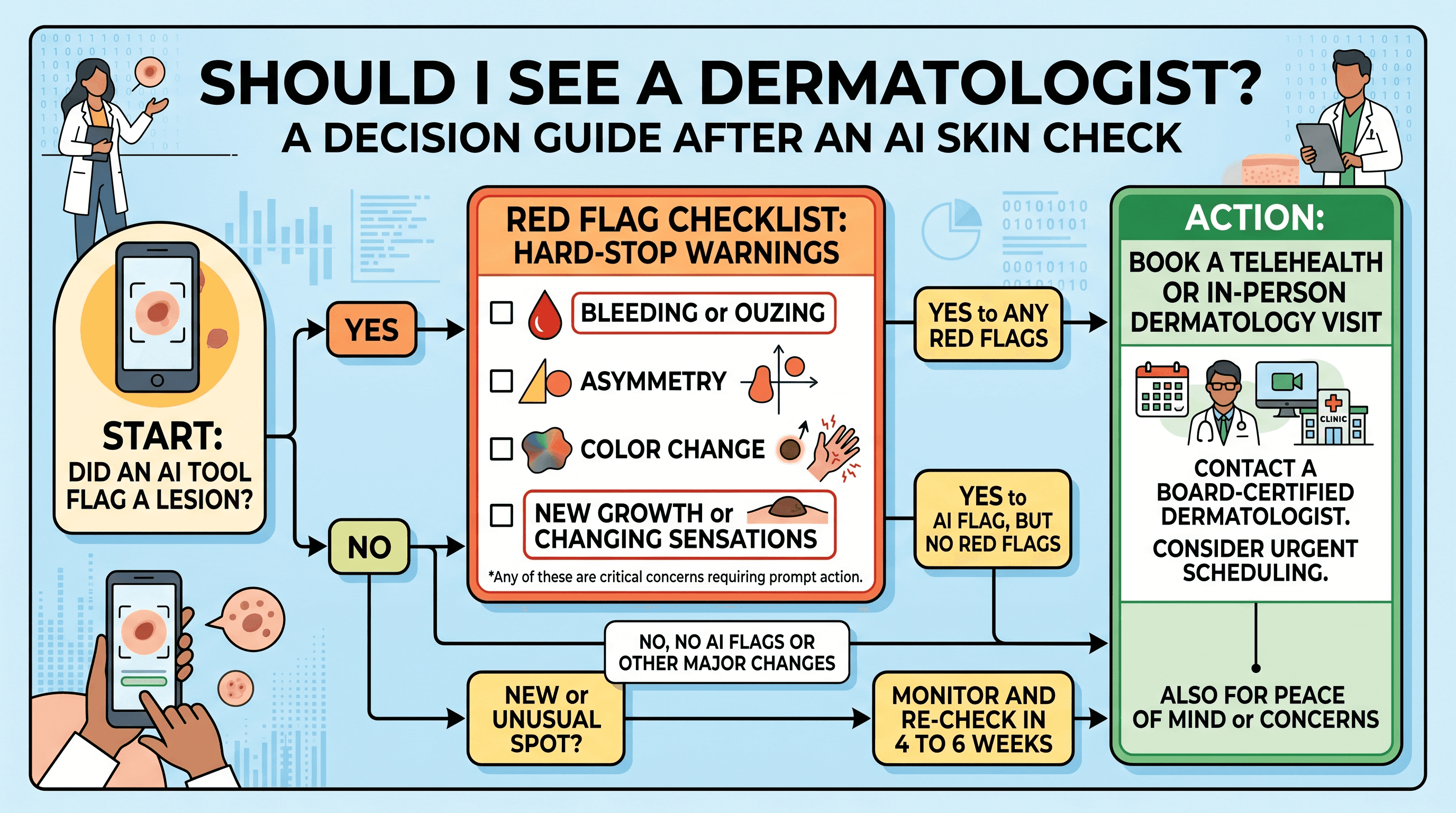
AI skin diagnosis tools are triage instruments. They are designed to improve the odds that a concerning lesion reaches a specialist's attention, not to replace the specialist.
A 2024 meta-analysis found that experienced dermatologists are 13.3 times more likely to diagnose skin conditions accurately compared to general practitioners. That figure makes the case for AI-augmented primary care: a tool that helps a GP identify which patients need specialist referral can meaningfully improve outcomes without claiming to replace dermatologist expertise.
If an AI tool flags a lesion as concerning, the appropriate response is to see a doctor online or in person through a primary care provider for evaluation, not to treat the AI output as a diagnosis. If a tool clears a lesion that has been changing, the same logic applies.
Red flags that require professional evaluation regardless of what any AI tool returns include asymmetric lesions that are growing, border irregularity that is new or worsening, color variation within a single lesion, diameter exceeding 6mm, any lesion that bleeds without trauma, and any skin change that has evolved over weeks rather than months.
How to Get the Most Accurate Results from Any AI Skin Tool
Image quality directly determines result quality. The single most consistent finding across AI skin analysis validation studies is that input image quality is a major driver of accuracy variance. Poor lighting, motion blur, and low resolution all reduce the reliability of any AI output.
For the most accurate results, photograph skin in natural daylight or under consistent, diffuse artificial light. Avoid direct flash, which flattens texture and creates reflective artifacts that can obscure pattern features the model needs to assess. Clean and dry the skin before photographing. Remove any makeup, lotion, or topical medication from the area of interest.
Use a neutral, plain background that contrasts with skin tone. Hold the camera steady and capture from a consistent distance, typically 10 to 20 centimeters for a lesion assessment, following whatever distance the specific app recommends. Never apply filters, color correction, or image editing of any kind before submission. These modifications alter the pixel-level data the model was trained to interpret.
For progress tracking over time, photograph at the same time of day, under the same lighting conditions, and from the same angle and distance. A consistent photo series is far more informative than a single image.
If an app returns a flagged result, do not take a second photo immediately hoping for a different answer. A flag is a signal to seek professional evaluation, not an invitation to test the system until it says something reassuring.
FAQ
Can AI detect skin problems?
Yes, with important caveats. AI tools can classify a range of skin conditions from images, including acne, eczema, psoriasis, and potentially malignant lesions. The accuracy depends heavily on whether the tool is a consumer app or a medical-grade system, the quality of the image submitted, and whether the patient's skin tone is well-represented in the model's training data. Consumer apps perform reliably for cosmetic purposes. FDA-cleared medical tools like DermaSensor have demonstrated clinical-grade sensitivity for skin cancer detection when used in the appropriate clinical setting.
How does AI skin analysis work?
Most AI skin analysis systems use convolutional neural networks (CNNs) trained on large labeled datasets of skin images. The model is shown millions of images paired with confirmed diagnoses, learns the visual patterns associated with each condition, and applies that learned pattern recognition to new images. More sophisticated clinical tools also incorporate spectral or multispectral data beyond standard visible light, giving the model more information than a standard photograph contains.
Which AI is best for skin analysis?
The answer depends on the purpose. For clinical screening of suspicious lesions, DermaSensor is the only FDA-cleared AI device currently authorized for primary care use in the United States, making it the most rigorously validated option for that specific use case. For teledermatology triage, FirstDerm's Autoderm platform has published real-world outcome data supporting its use in clinical workflows. For cosmetic skincare management, L'Oréal Skin Genius and similar consumer apps provide useful tracking and product guidance within their intended scope. None of the consumer apps should be used as a substitute for professional evaluation of a potentially suspicious lesion.
How accurate is AI at diagnosing skin cancer?
For melanoma specifically, a 2025 meta-analysis of 551 studies found CNN models achieved 91% sensitivity and 94% specificity on dermoscopic images. DermaSensor's DERM-SUCCESS pivotal trial reported 96% sensitivity across 224 skin cancer types. These figures apply to validated clinical tools operating under research or clinical conditions. Consumer apps have not been validated for skin cancer detection and their accuracy for that purpose is unknown. All AI outputs for concerning lesions should be followed up with professional evaluation.
Is AI skin diagnosis safe to use at home?
Consumer apps are generally safe to use for their intended cosmetic purposes. The primary risk is not harm from using them but harm from over-relying on them for decisions that require medical expertise. Using an AI app to manage an acne regimen carries little risk. Using an AI app result to decide whether a changing mole needs a doctor's attention, and acting on a reassuring result without seeking professional evaluation, carries meaningful risk. If you want a reliable way to assess a concerning skin finding from home, use Momentary's AI health navigator to better understand your symptoms and get guidance on whether an in-person or virtual evaluation makes sense.
What should I do if an AI tool flags a skin lesion?
Treat any AI flag on a potentially suspicious lesion as a prompt to seek professional evaluation, not as a diagnosis. A flag means the algorithm identified a pattern associated with conditions that warrant clinical assessment. It does not mean you have skin cancer, and it does not tell you how urgent the evaluation needs to be. Contact a healthcare provider, explain that an AI screening tool flagged a lesion, and describe any associated symptoms such as itching, bleeding, or recent changes in size or color.
References
- PMC / NIH (2025 meta-analysis) — 551-study meta-analysis reporting 91% sensitivity and 94% specificity for CNN melanoma classification.
- L'Oréal / ModiFace — L'Oréal Skin Genius and ModiFace AI skin diagnostic technology overview.
- JAMA Network Open — Study demonstrating CNN performance matching dermatologist-level sensitivity for melanoma on dermoscopic images.
- PMC / NIH (CNN dermatology review) — Review of convolutional neural network applications in dermatological image classification.
- Stanford Medicine — Stanford research on AI skin diagnosis accuracy and clinical application.
- PMC / NIH (skin of color equity) — Equity meta-analysis reporting AUROC 0.82 for darker skin tones vs. 0.89 for lighter skin tones across 70,000+ test images.
- Journal of Investigative Dermatology — Research on bias in AI dermatology models and performance across Fitzpatrick skin types.
- Nature Digital Medicine — Study showing that training on diverse datasets measurably improves AI model fairness for skin tone equity.
- Healthcare (MDPI) — Review of AI-assisted dermatology tools and regulatory considerations in clinical practice.


