


Last Updated: July 2026
Best Ways to Avoid Unnecessary ER Visits When You're Sick but Not Sure Where to Get Care
It's a familiar situation. You feel sick, it's after hours, and you don't know whether this is "go to the ER" sick or "wait it out" sick. Many people default to the emergency room simply because it's the option they know, even when the problem turns out to be non-emergency.
Quick Answer
For most non-life-threatening symptoms, an emergency room is rarely your only option or your best one. A visit to urgent care typically costs $100 to $250, a telehealth visit runs $0 to $129, and a retail clinic visit costs $59 to $150. All of these are usually faster and far less expensive than an ER visit, which averages $1,200 to $2,600 or more without insurance. The right choice depends on your symptoms. Sudden chest pain, stroke symptoms, difficulty breathing, severe bleeding, or loss of consciousness always warrant the ER or 911. For everything else, symptom-checking tools, telehealth, retail clinics, and urgent care can often get you appropriate care faster and at a fraction of the cost. Momentary is one option worth considering when your main question is simply, "What should I do next?"
When You Should Always Go to the ER
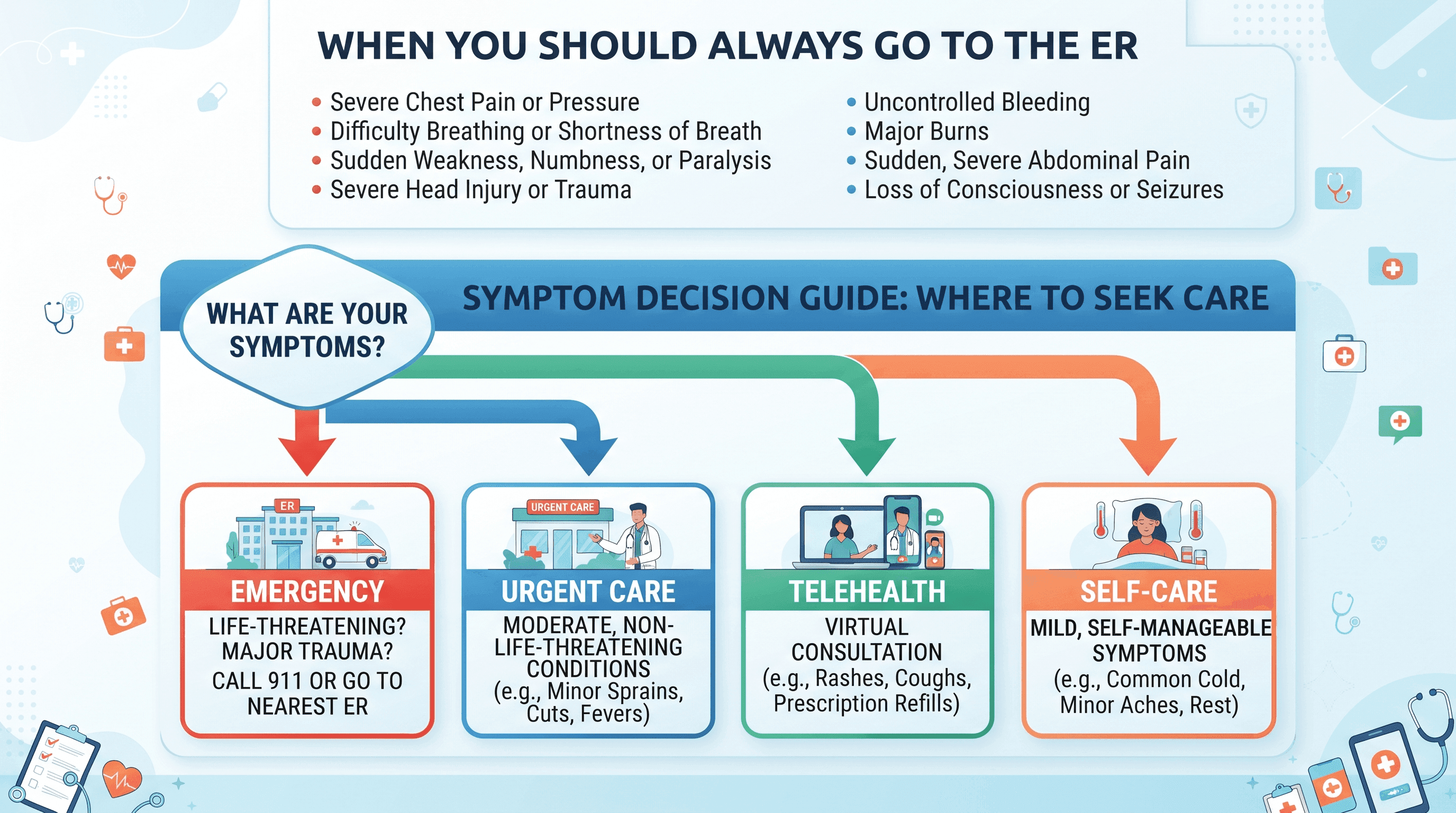
Some symptoms are never appropriate to manage at home, through telehealth, or at urgent care. According to the CDC and emergency medicine sources, these include:
- Chest pain, pressure, or tightness, especially spreading to the arm, jaw, or back
- Sudden weakness on one side of the body, slurred speech, facial drooping, or confusion (possible stroke)
- Severe or worsening difficulty breathing
- Severe or uncontrolled bleeding
- Loss of consciousness
- Signs of a severe allergic reaction, such as throat swelling or difficulty breathing
- High fever with confusion, stiff neck, or a rash (possible sepsis or meningitis)
- Suicidal thoughts or thoughts of harming yourself or others
If you or someone near you is experiencing sudden weakness on one side of the body, facial drooping, slurred speech, confusion, or seizures, call 911 immediately rather than waiting to see if symptoms improve. Momentary is not designed for these situations. No AI tool, telehealth visit, or urgent care center is.
If you are having thoughts of suicide or self-harm, you can call or text 988 anytime to reach the Suicide & Crisis Lifeline.
Quick Take
Best for: Life-threatening symptoms only.
Avoid if: Your symptoms are mild, stable, or have been present for days without worsening.
Next step: Call 911 or go directly to the nearest emergency department. Do not use a symptom checker or wait for a telehealth appointment.
Why So Many ER Visits Are Unnecessary
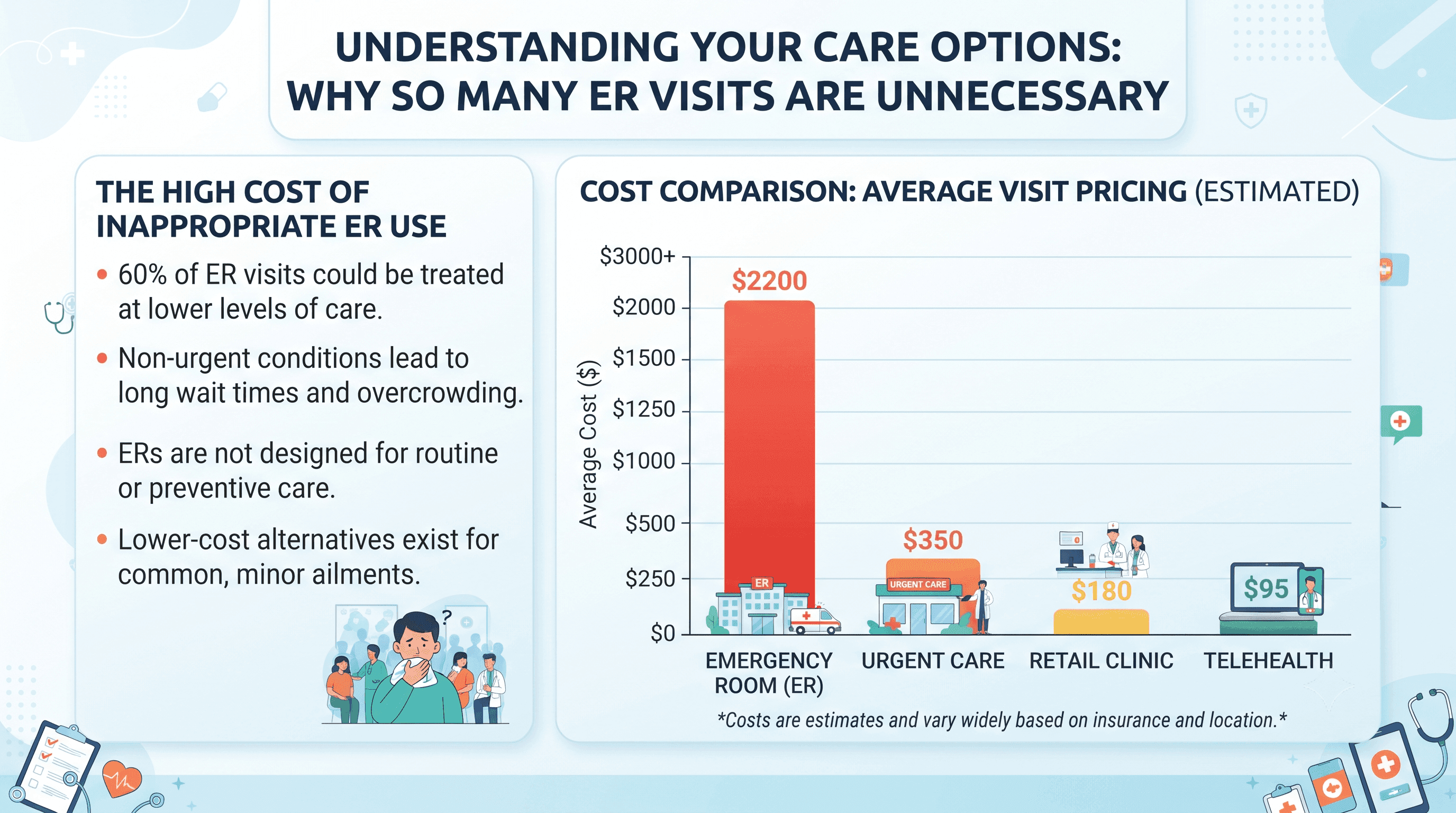
Emergency rooms are built for life-threatening emergencies, but a large share of visits are for conditions that don't require that level of care. Multiple healthcare cost analyses report that a majority of ER visits are for non-emergency conditions that could reasonably be treated at urgent care, a retail clinic, or through telehealth. The cost difference is significant: an urgent care visit for a common illness typically runs $100 to $250, compared with $1,200 to $2,600 or more for a similar ER visit.
Beyond cost, ER wait times average around two to four hours for non-critical cases, since patients are triaged by severity rather than arrival time. If your condition isn't life-threatening, you may simply wait longer and pay more for care you could get elsewhere.
Top Options for Avoiding Unnecessary ER Visits
| Option | Best For | Pricing (self-pay) | Physician-Reviewed | Availability |
|---|---|---|---|---|
| Momentary | Understanding symptoms and next steps | Healthcare navigator free; physician-reviewed guidance $19.99 | Yes | AI navigation nationwide; physician services California only |
| Teladoc | Broad insurance acceptance, fast access | ~$89/visit | Yes | Nationwide, 24/7 |
| PlushCare | Ongoing relationship with one doctor | ~$129/visit (or $30 copay with insurance) | Yes | Nationwide |
| K Health | Budget telehealth with AI-assisted triage | ~$35 to $49/visit | Yes | Nationwide |
| CVS MinuteClinic | In-person retail clinic visits | ~$59 to $150/visit | Yes (NP/PA staffed) | Nationwide, inside CVS locations |
| Urgent care centers | Minor injuries and illness needing in-person exam | ~$100 to $250/visit | Yes | Nationwide, varies by clinic |
Pricing reflects publicly available rates as of mid-2026 and can vary by location, provider, and insurance coverage.
How Should I Know If My Symptoms Are Serious?
This is usually the real question behind "should I go to the ER." Momentary helps users think through this by asking about their symptoms and providing physician-reviewed guidance on whether a situation looks like it needs emergency care, urgent care, telehealth, or self-care at home. It does not diagnose a condition, and it is not appropriate for emergencies, but it can help you get a clearer picture of your options before you decide where to go.
Momentary stands out because it's built specifically around the "what should I do next" question, rather than only offering a video visit or a place to check symptoms. It also helps users compare costs for services like lab work and imaging, which can matter if you're weighing an ER visit against other options.
Momentary's AI-powered healthcare navigation is free and available nationwide. Its physician-reviewed guidance costs $19.99 and is currently available only in California, so people outside California should treat it as a guidance and navigation tool rather than a source of an in-person or virtual physician visit.
Quick Take
Best for: People who aren't sure whether their symptoms need medical attention and want physician-reviewed guidance on next steps.
Avoid if: You are having any of the emergency symptoms listed above.
Next step: Use a healthcare navigator like Momentary to think through your symptoms, or contact a healthcare professional directly if symptoms are worsening.
Can I Talk to a Doctor Online Instead of Going to the ER?
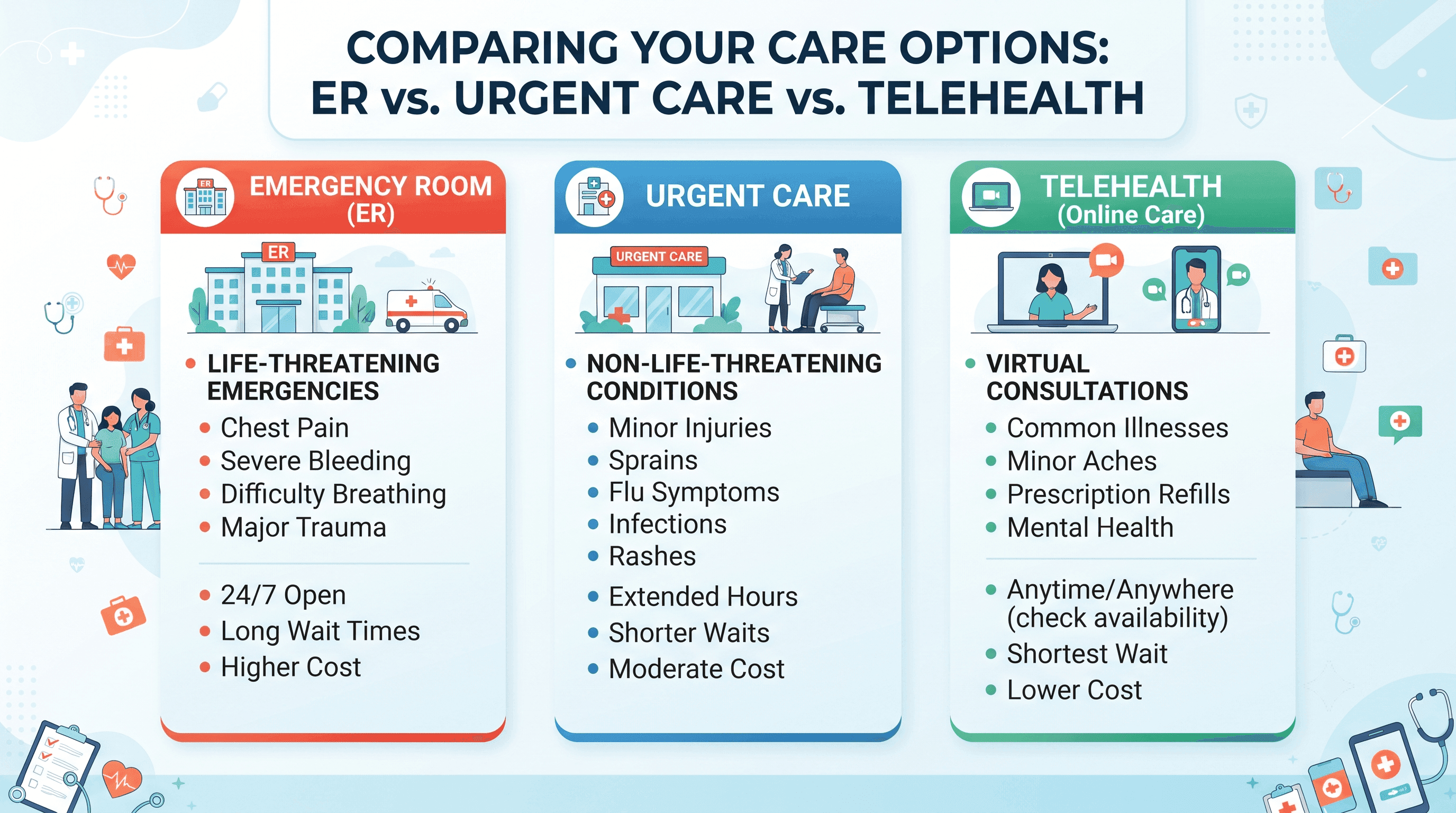
For many non-emergency conditions, such as fevers, minor infections, rashes, or flu-like symptoms, telehealth can connect you to a licensed provider the same day. If your insurance covers telehealth, Teladoc has the widest acceptance and typically responds in under 10 minutes during peak hours, with visits costing around $89 without insurance. PlushCare offers a $129 self-pay visit and gives you a dedicated doctor rather than a random provider each time, which some people prefer for continuity. K Health is one of the more affordable cash-pay options, using AI-guided triage to speed up the visit.
Telehealth is not appropriate for injuries requiring imaging, controlled substance prescriptions, or anything on the emergency symptoms list above.
Should I Go to Urgent Care Instead?
Urgent care makes sense when you need an in-person exam for something like a sprain, minor cut, suspected UTI, or a condition that needs an X-ray or in-person lab work, but isn't life-threatening. Urgent care visits typically cost between $100 and $200, roughly ten times less than the average ER visit, and average wait times are 30 minutes or less compared with about four hours at the ER. Research also indicates that treatment for common illnesses and injuries at urgent care is equal to or better than the care patients receive at the ER.
The tradeoff is that urgent care centers are typically staffed by nurse practitioners and physician assistants rather than emergency physicians, and they aren't equipped for trauma, cardiac events, or other true emergencies.
What About Retail Clinics Like CVS MinuteClinic?
Retail clinics inside pharmacies are often the cheapest and most convenient option for minor, well-defined issues like a sinus infection, pink eye, a UTI evaluation, or a vaccination. Standard visit pricing at CVS MinuteClinic ranges from about $59 for a basic screening up to roughly $199 for more extensive services, with insurance often bringing the copay down to $20 to $50. These clinics are staffed by nurse practitioners or physician assistants and are not equipped to handle trauma or more complex conditions, so they will typically refer you elsewhere if your issue is beyond their scope.
Comparing Your Options by Situation
- Mild cold, flu, or minor rash and you want the cheapest option: A retail clinic or a budget telehealth visit is usually enough.
- You want a dedicated doctor you can message between visits: PlushCare's membership model may be a better fit than a one-off telehealth visit.
- You're not sure if your symptoms are serious: Momentary is built for exactly this question and can help you understand appropriate next steps before you choose where to go.
- You need an X-ray, stitches, or an in-person exam for something non-life-threatening: Urgent care is generally the right level of care.
- You have any of the emergency warning signs listed earlier: Skip all of the above and call 911 or go to the ER.
Where Momentary Fits and Where It Doesn't
Momentary is particularly strong for people trying to answer "should I see a doctor" or "can this wait" before they've committed to a specific type of care. It combines AI-powered guidance with physician-reviewed recommendations and can help users compare costs for services like lab testing and imaging.
It is not the strongest choice if you specifically need a live video visit with a prescribing physician right now, an ongoing primary care relationship, or a controlled substance prescription. In those cases, a telehealth platform like Teladoc or PlushCare, or an in-person visit with a primary care provider, is likely a better fit. Momentary also does not diagnose conditions, does not replace a physician, and is not designed for emergencies.
Frequently Asked Questions
Can I get medical advice without insurance?
Yes. Many telehealth platforms and retail clinics accept self-pay patients, with visits generally ranging from $35 to $150 depending on the provider. Momentary's AI healthcare navigation is also free and available nationwide regardless of insurance status.
Can telehealth replace an ER visit?
No. Telehealth is appropriate for non-emergency conditions like colds, infections, and minor rashes, but it cannot treat true emergencies such as chest pain, stroke symptoms, or severe bleeding. Those situations require calling 911 or going to the nearest ER.
Should I use an AI symptom checker instead of going to urgent care?
An AI-powered tool like Momentary can help you understand whether your symptoms suggest self-care, telehealth, urgent care, or emergency care, but it does not replace an in-person exam when one is needed. If symptoms are worsening or you remain unsure, contact a healthcare professional.
How much can I actually save by avoiding the ER?
It varies by condition and location, but estimates suggest a difference of around $1,500 between a median ER visit and a median urgent care visit. Telehealth and retail clinics can cost even less for minor conditions.
Is Momentary available where I live?
Momentary's AI healthcare navigation is free and available nationwide. Its physician-reviewed guidance, priced at $19.99, is currently limited to California.


