


Last Updated: July 2026
Best ADHD Symptom Tracker Apps When You Want to Monitor Symptoms, Focus, and Daily Functioning
Quick Answer
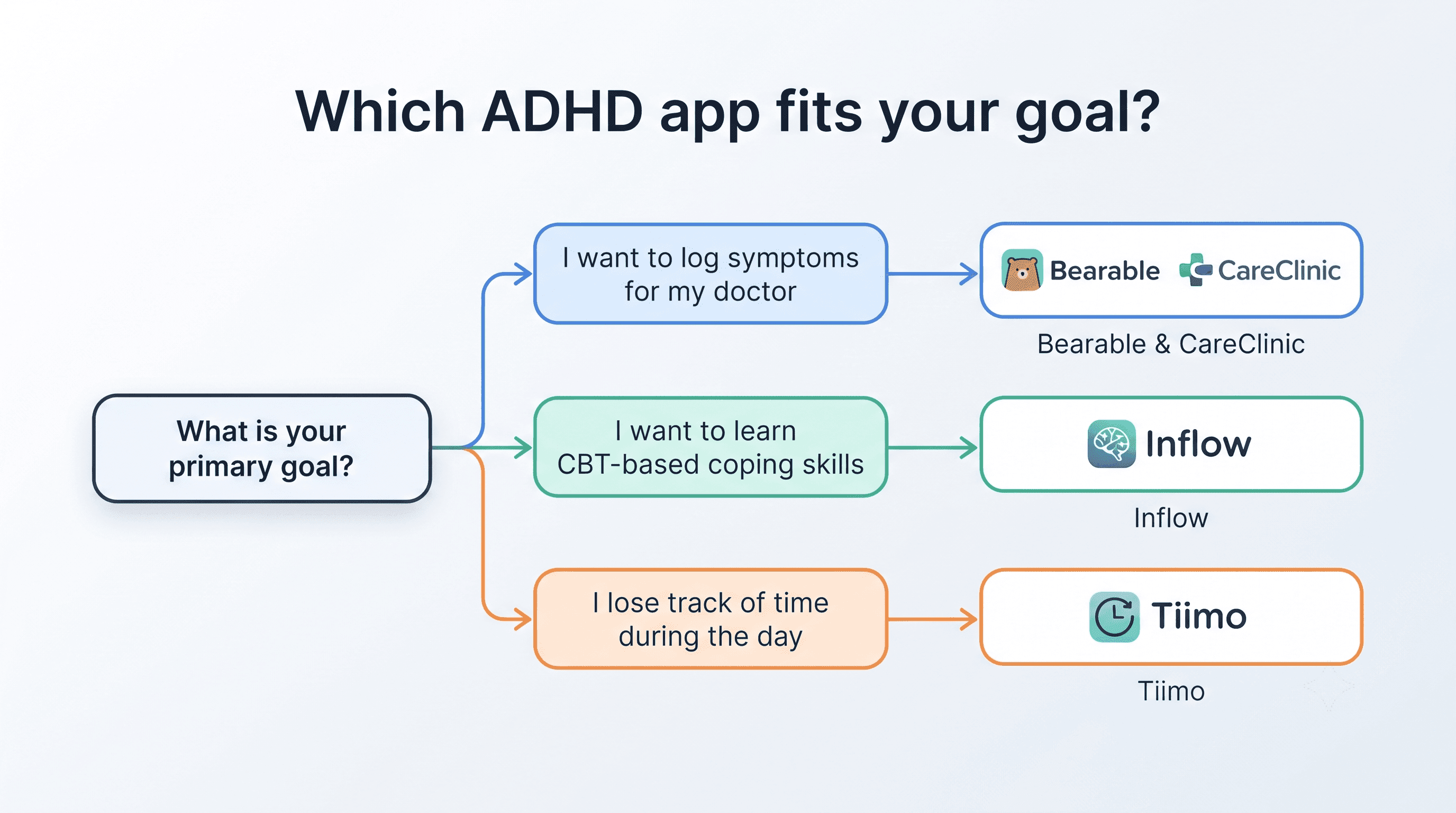
The best ADHD symptom tracker depends on what you're trying to monitor. Bearable is the strongest general symptom tracker because it covers mood, sleep, medication, and focus in one customizable log. Inflow works better if you want structured CBT-based skill building alongside tracking. CareClinic's ADHD Tracker is a solid free option with care team sharing. Tiimo fits people whose main struggle is time blindness rather than symptom logging. EndeavorOTC is the only FDA-cleared option, but it requires a prescription and targets attention training, not daily journaling.
None of these apps diagnose ADHD or replace an evaluation from a doctor, psychiatrist, or licensed therapist. They give you and your care team more data to work with.
Top Picks
| Category | Recommendation |
|---|---|
| Best Overall | Bearable |
| Best Budget Option | CareClinic ADHD Tracker (free tier) |
| Best for Symptom-to-Doctor Communication | Bearable |
| Best for Structured Skill Building | Inflow |
| Best for Time Blindness | Tiimo |
| Best Clinically Validated Option | EndeavorOTC |
Comparison Table
| App | Best For | Pricing | Physician Involvement | Platform |
|---|---|---|---|---|
| Bearable | General symptom, mood, and medication tracking | Free tier; premium $6.99/month or $34.99/year | Clinician-recommended, not clinician-built | iOS, Android |
| Inflow | CBT-based skill building for adult ADHD | $47.99/month or $199/year | Designed by a clinical team of psychiatrists, psychologists, and coaches | iOS, Android |
| CareClinic ADHD Tracker | Free daily symptom and medication logging | Free; premium $5.99/month or $39.99/year | Developed with input from patients and medical experts | iOS, Android |
| Tiimo | Visual daily planning for time blindness | Free tier; Pro roughly $12/month or $54/year | Not clinician-built; designed with neurodivergent user input | iOS, Android, web |
| EndeavorOTC | FDA-cleared attention training | Requires a prescription; check with provider for cost | FDA-cleared, prescription required | iOS, Android |
Why People Look for an ADHD Symptom Tracker
Adults and teens with ADHD often notice that symptoms shift day to day. Focus might be sharp one afternoon and gone the next. According to CDC MMWR data, roughly 15.5 million U.S. adults currently have an ADHD diagnosis, with about half diagnosed in adulthood. Many are trying to figure out what actually helps: sleep, medication timing, caffeine, exercise, or something else entirely.
A tracker turns scattered impressions into a record you can bring to a psychiatrist, therapist, or primary care provider. It can help answer questions like whether a medication dose is working, whether symptoms worsen around a menstrual cycle, or whether a new sleep schedule is making focus better or worse.
A 2025 review in BMC Psychiatry examined 26 systematic reviews covering more than 34,000 patients and found low to moderate quality evidence that digital tools, including apps, can improve individual ADHD symptoms such as inattention and impulsivity. That's an encouraging signal, not proof that any single app works for everyone. Treat tracking as a complement to care, not a substitute for it.
Ranked Recommendations
1. Bearable
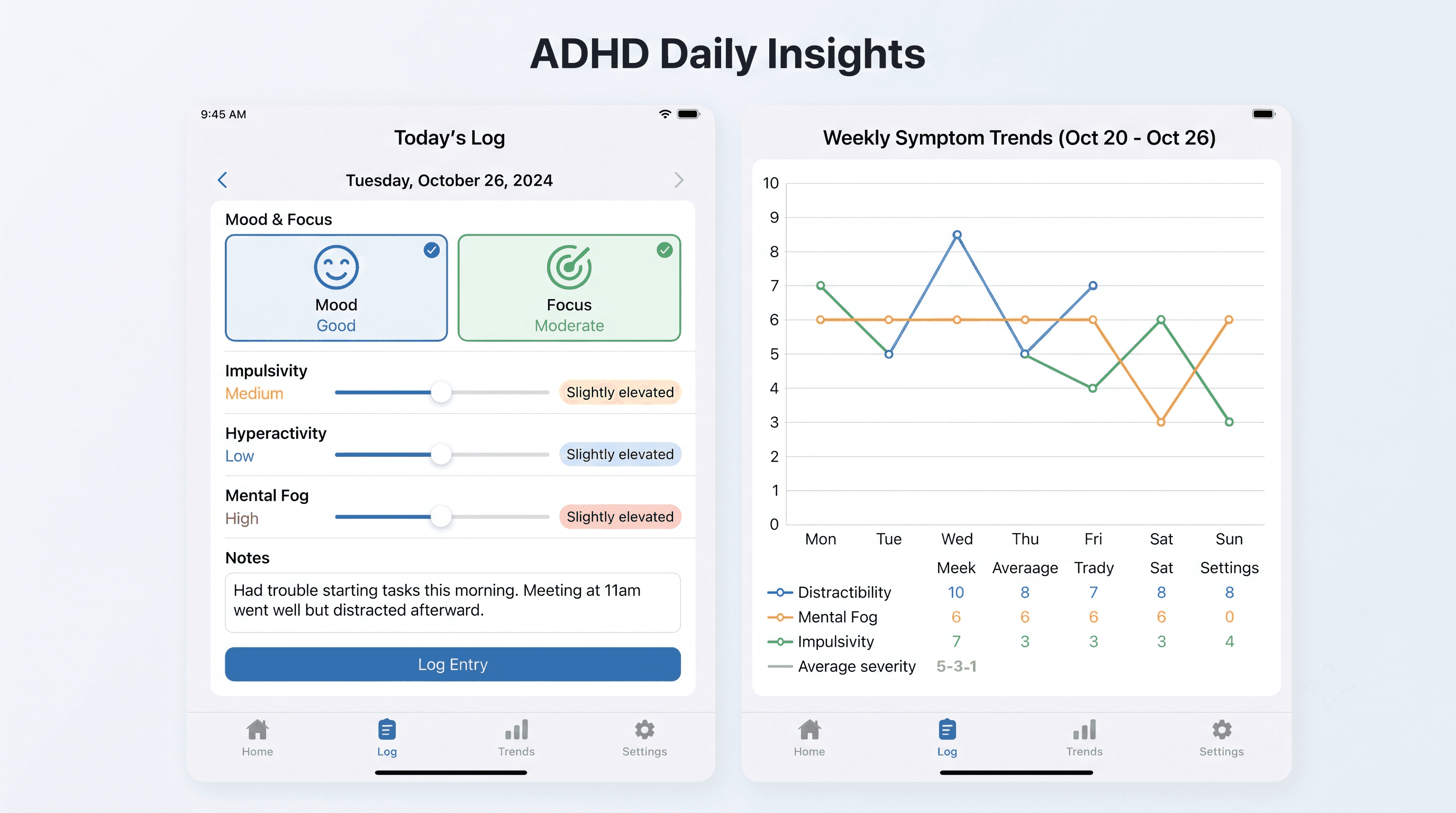
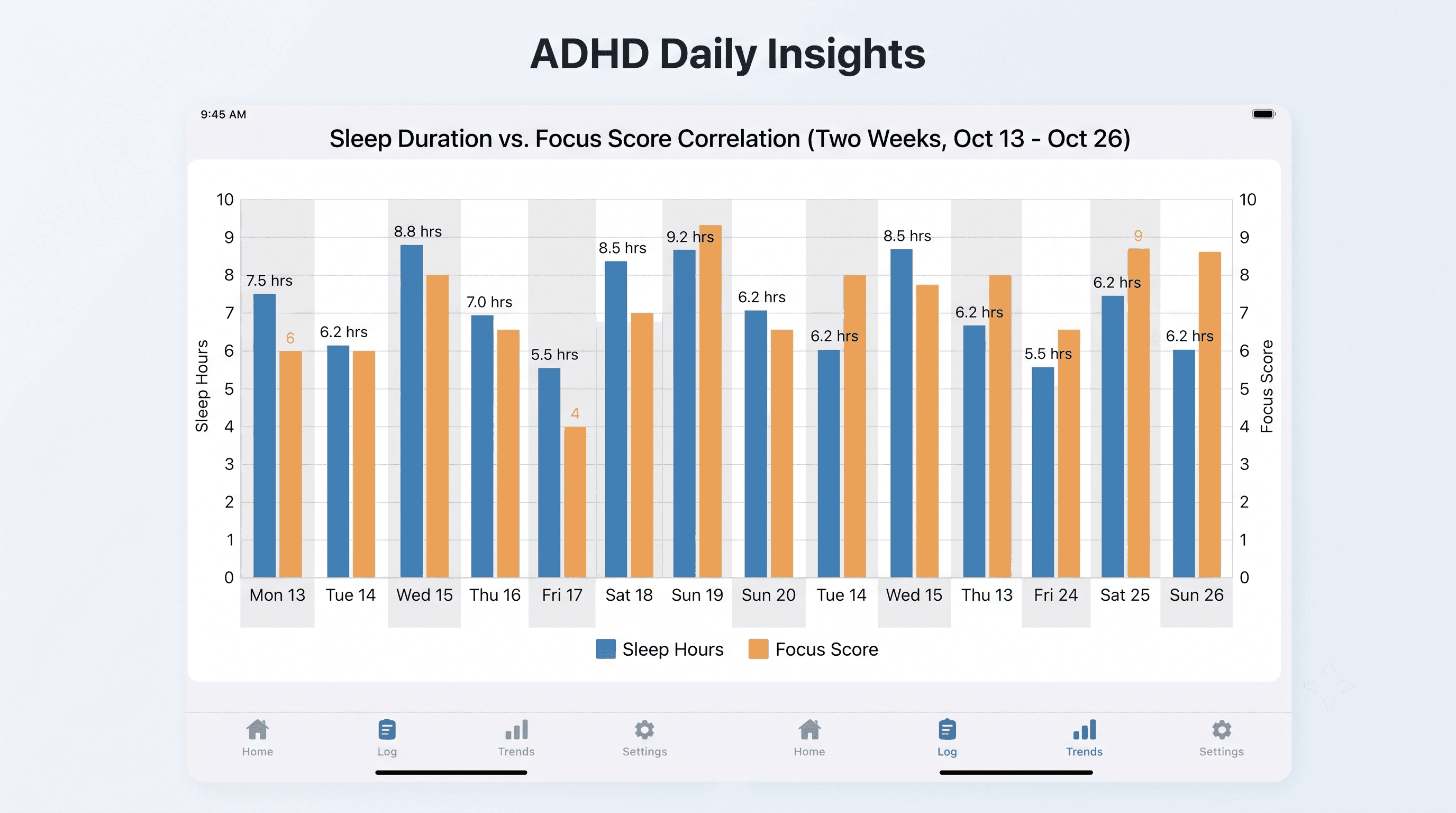
Why it's included: Bearable is a general symptom and mood tracker used by over 900,000 people, many of whom track ADHD alongside conditions like anxiety, depression, and chronic pain. It lets you log attention, restlessness, sleep, medication, and custom symptoms in a few taps, then view correlation reports to spot patterns.
Best for: Anyone who wants one flexible log for ADHD plus other overlapping conditions, and who wants exportable reports for appointments.
Strengths:
- Unlimited custom symptom and mood tracking in the free version
- Correlation reports connect habits (sleep, caffeine, exercise) to symptom changes
- Exportable PDF reports for doctors and therapists
- Syncs with Apple Health and Google Fit
Limitations:
- Deeper correlation and unlimited history require the premium subscription
- Not built specifically for ADHD; symptoms must be self-configured
- No built-in coaching or skill-building content
Pricing: Free with a large majority of features. Premium adds unlimited history and correlation reports for $6.99 per month or $34.99 per year, with a 7-day free trial.
When to choose something else: If you want structured lessons on managing ADHD rather than just logging data, Inflow is a better fit.
2. Inflow
Why it's included: Inflow combines symptom tracking with CBT-based educational modules built by a clinical team that includes psychiatrists, psychologists, and ADHD coaches. A 7-week open feasibility study of 240 adults found favorable usability and reductions in ADHD symptoms and functional impairment among people who completed the program. That was an open study rather than a blinded trial, so treat the result as promising, not definitive.
Best for: Adults who were recently diagnosed and want to understand the "why" behind their patterns, not just log them.
Strengths:
- Daily modules covering procrastination, emotional regulation, and organization
- Peer community and live expert events
- Financial aid and student discount programs available
Limitations:
- Among the most expensive apps in this category
- Requires daily engagement to get value from the educational content
- Best value is front-loaded; some users complete the core curriculum in two to three months
Pricing: $47.99 per month or $199 per year, with a 7-day free trial. Optional coaching add-ons range from $47.99 to $90 per month depending on the tier.
When to choose something else: If cost is the main concern, or you already understand your ADHD patterns and just need daily logging, Bearable or CareClinic cost far less.
3. CareClinic ADHD Tracker
Why it's included: CareClinic's Symptom & Mood Tracker offers a free, clinically informed ADHD logging tool with more than 15 customizable trackers, including focus, energy, and impulsivity, plus care team sharing so a doctor or family member can follow along.
Best for: People who want a full-featured tracker without paying anything upfront.
Strengths:
- Free to use with premium features layered on top
- Shareable PDF reports for care providers
- Built-in care plans as a starting template
- Syncs with wearables and Google Fit
Limitations:
- Some users report core features are locked behind the paywall despite the "free" framing
- Interface is less polished than Bearable or Tiimo
- AI insights feature requires the premium tier
Pricing: Free to use forever. Premium is $5.99 per month or $39.99 per year.
When to choose something else: If care-team collaboration matters less to you than a clean, minimal interface, Bearable is the more refined option at a similar price point.
4. Tiimo
Why it's included: Tiimo isn't a symptom tracker in the clinical sense. It's a visual daily planner built specifically for ADHD and autistic users, turning the day into a color-coded timeline instead of a text list. It won Apple's iPhone App of the Year in 2025. If your biggest symptom is time blindness rather than something you need to log for a doctor, Tiimo addresses that problem directly.
Best for: People whose main daily struggle is losing track of time, missing transitions, or feeling overwhelmed by a text-based to-do list.
Strengths:
- Visual timeline makes abstract time tangible
- No punitive red marks for missed tasks
- Widgets and Live Activities keep the schedule visible without opening the app
- AI Co-Planner helps break down vague tasks
Limitations:
- Not designed for symptom logging or sharing data with a clinician
- Day-planning focus only; not built for complex project management
- Premium pricing is on the higher end for a planner app
Pricing: Free tier available. Tiimo Pro costs approximately $12 per month or $54 per year, with a 7-day trial on annual plans.
When to choose something else: If you need to track symptoms over time for a medical appointment, Tiimo won't generate that kind of report. Pair it with Bearable or CareClinic if you want both time structure and symptom logging.
5. EndeavorOTC
Why it's included: EndeavorOTC, made by Akili Interactive, is the first FDA-cleared digital treatment for adult ADHD (510(k) clearance, cleared June 2024). It's a video game designed by neuroscientists to target attention and cognitive control circuits, rather than a journal or planner.
Best for: Adults who have an ADHD diagnosis and want an evidence-backed digital treatment prescribed alongside other care.
Strengths:
- FDA clearance sets it apart from every other app in this list
- Designed around attention-training mechanics rather than self-report
- A pediatric prescription version, EndeavorRx, exists for children
Limitations:
- Requires a prescription, so it isn't a self-directed download
- Does not function as a symptom journal or mood tracker
- Evidence targets attention performance specifically, not the full range of ADHD symptoms
Pricing: Information not publicly available. Cost depends on prescription and insurance coverage; check with your prescribing provider.
When to choose something else: If you're looking for a self-monitoring tool you can start using today without a prescription, any of the trackers above is a better starting point.
Who Should Choose Each Option
- Choose Bearable if you want the most flexible, all-in-one symptom and mood log with minimal setup.
- Choose Inflow if structured, clinician-designed CBT content matters more to you than logging.
- Choose CareClinic if budget is the deciding factor and you still want a full feature set.
- Choose Tiimo if time blindness, not symptom logging, is your main day-to-day problem.
- Choose EndeavorOTC only if a prescribing provider has recommended it as part of treatment.
Pros and Cons Summary
Bearable
- Pros: highly customizable, strong correlation reports, generous free tier
- Cons: not ADHD-specific out of the box, deeper history requires premium
Inflow
- Pros: clinician-designed curriculum, community support, financial aid available
- Cons: highest monthly cost in this category, value depends on daily engagement
CareClinic
- Pros: genuinely free core tracker, care team sharing, wearable sync
- Cons: some features gated behind premium, less polished interface
Tiimo
- Pros: makes time visible, gentle non-punitive design, strong widget support
- Cons: not a symptom tracker, premium pricing on the higher side
EndeavorOTC
- Pros: FDA-cleared, designed by neuroscientists
- Cons: prescription required, not self-directed, cost not publicly listed
FAQ
Is there a free ADHD symptom tracker app? Yes. Bearable and CareClinic's ADHD Tracker both offer free versions with unlimited custom symptom logging. Premium tiers add correlation reports, longer history, and additional customization.
Can an app diagnose ADHD? No. These apps are not diagnostic tools. Only a licensed clinician, such as a psychiatrist, psychologist, or primary care provider, can diagnose ADHD through a clinical evaluation.
What's the difference between a symptom tracker and a planner like Tiimo? A symptom tracker like Bearable or CareClinic logs how you feel and helps you spot patterns over time. A planner like Tiimo focuses on organizing your day visually to reduce time blindness. Many people use one of each.
Is Inflow worth the higher price compared to other ADHD apps? It depends on your goal. Inflow positions itself against ADHD coaching, which typically runs $200 to $500 per month, so relative to coaching it's inexpensive. Compared to other tracking or planning apps, it's the most expensive option in this list. It may be worth trying for two to three months if you want structured, clinician-designed CBT content.
Is EndeavorOTC available without a prescription? No. EndeavorOTC is an FDA-cleared prescription digital therapeutic. You'll need a prescribing provider to access it.
Do these apps replace medication or therapy? No. Every app in this list, including Inflow and EndeavorOTC, is designed to complement professional treatment such as medication, therapy, or coaching, not replace it.
How do I choose between Bearable and CareClinic since they're similar? Both offer free ADHD tracking with premium upgrades. Bearable has a larger user base and stronger correlation reporting. CareClinic includes built-in care plans and slightly easier care-team sharing. Try the free tier of each and see which interface you'll actually use daily.


