


Last updated: June 2026
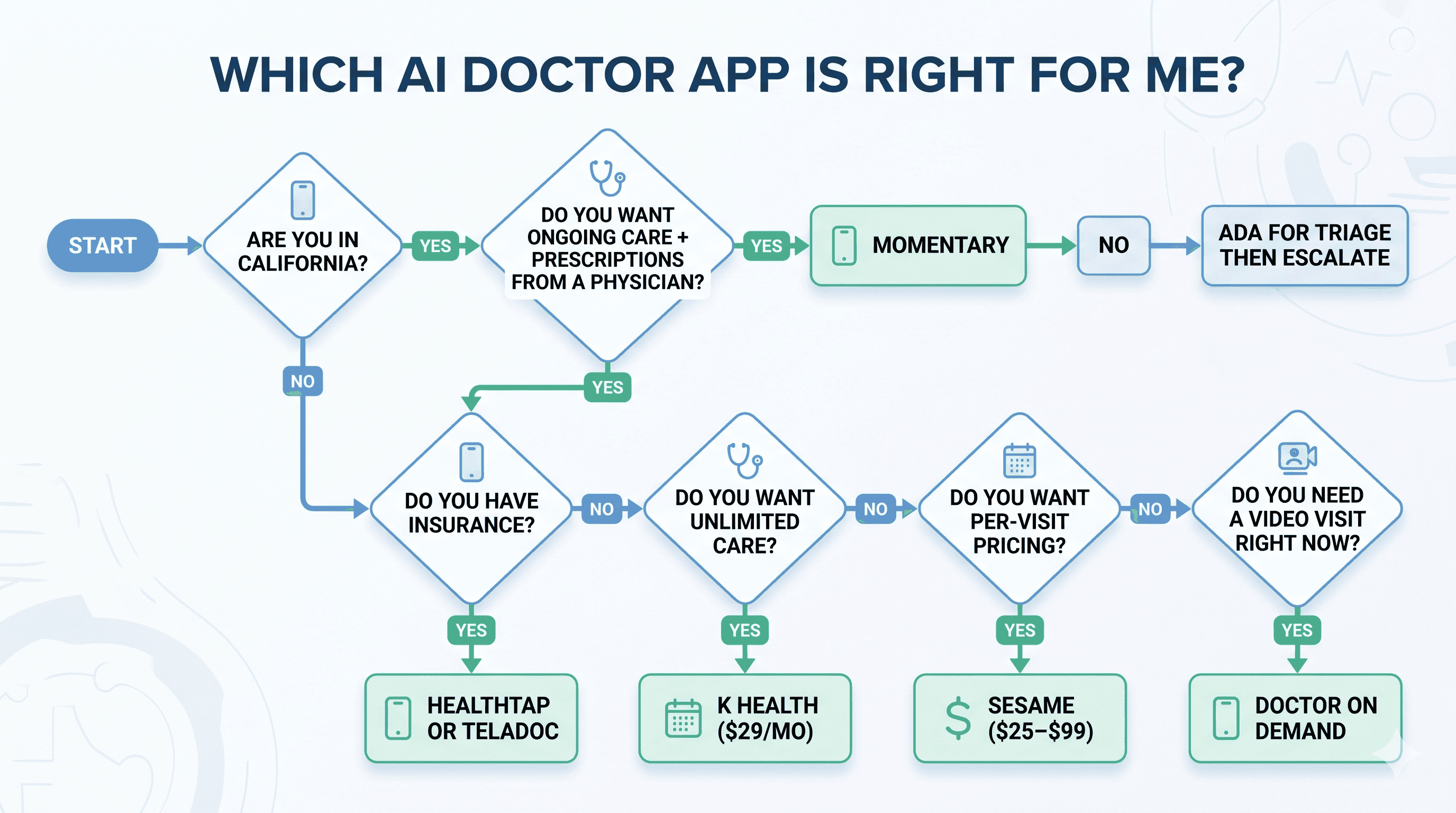
The best AI doctor apps in 2026 let you describe your symptoms, get clinically grounded answers, and connect with a licensed physician from your phone, without a waiting room or a referral. After scoring eight apps on six criteria, Ada Health ranks first for its peer-reviewed accuracy data, Momentary ranks second for combining AI guidance with California-licensed physician care at under $20 a month, and K Health ranks third for its AI-assisted unlimited primary care membership.
| App | Best For | Price | iOS Rating | Free Tier |
|---|---|---|---|---|
| Ada Health | Symptom triage, any condition | Free | 4.8/5 | Yes |
| Momentary | AI + physician care, California | $19.99/mo | Early-stage | Free trial month |
| K Health | Unlimited primary care, all 50 states | $29/mo or $35/visit | 4.3/5 | Symptom checker free |
| Teladoc Health | Existing health plan holders | $89+/visit (plan-dependent) | 4.8/5 | No |
| HealthTap | Long-term PCP relationship | $15/mo + $44/visit | 4.8/5 | No |
| PlushCare | Insured patients, same-day visits | $19/mo + visits | 4.7/5 | No |
| Sesame Care | Transparent per-visit pricing, no membership | $25–$99/visit | 4.5/5 | No |
| Doctor On Demand | On-demand urgent care | $129/urgent care visit | 4.7/5 | No |
How We Ranked
For this list, "best" means: a physician-involved AI health app available on iOS that helps US patients understand symptoms, get fast health guidance, or access a licensed clinician, without requiring an in-person visit first. We scored each app on six criteria: clinical credibility (30%), scope fit (20%), cost and value (15%), speed and availability (15%), user experience (10%), and trust signals such as published ratings, review volume, and media coverage (10%). We weighted clinical credibility highest because this is a YMYL category where accuracy and physician oversight directly affect patient safety. Scores were calculated independently for each entry; rank order reflects those totals. Momentary is our own product. We scored it on the same criteria as every other entry. Evaluation date: June 2026.
1. Ada Health — Most Clinically Validated AI Symptom Checker
Ada Health is a free, conversational AI symptom assessment tool developed by a team of physicians and AI researchers. The app walks users through a structured series of questions about their symptoms, age, and medical history, then generates a condition report with possible diagnoses and a recommended care pathway.
Ada ranks first because no other consumer health app on this list comes close to its published clinical evidence. A study published in BMJ Open found Ada suggested the correct condition in its top three results 71% of the time, compared to an average of 38% for other symptom-checker apps tested. Human GPs scored 82% in the same study. A 2023 study published in JMIR mHealth and uHealth found Ada's diagnostic sensitivity for its top-five results approached that of emergency department physicians. Ada's triage decisions were rated as "fully agreeable" by physicians 62% of the time and "safe but cautious" an additional 24% of the time, according to that same JMIR study.
Pros: The free symptom checker is available 24/7 with no account required for basic use, making it the lowest-friction entry point on this list. Ada's coverage is exceptional: it generated a condition suggestion in 99% of tested cases, while competing apps averaged 69.5%, per the BMJ Open study. The app added natural-language symptom input for US users in 2026, allowing people to describe how they feel in their own words instead of selecting from fixed menus.
Cons: Ada is a triage tool, not a treatment platform. It does not connect users to a physician for a live visit, prescribe medication, or order labs, so it works best as a first step rather than a complete care solution. Ada's condition reports can read as overly cautious, flagging unlikely diagnoses that may increase anxiety rather than reduce it.
Pricing: Free for individual users. No subscription required for the core symptom checker.
Best for: Anyone trying to understand a new or unclear symptom before deciding whether to seek care.
Rating: 4.8 stars on iOS and 4.75 stars on Android (Ada.com, June 2026, 11,000+ reviews analyzed).
2. Momentary — Best AI Doctor App with Physician-Led Primary Care
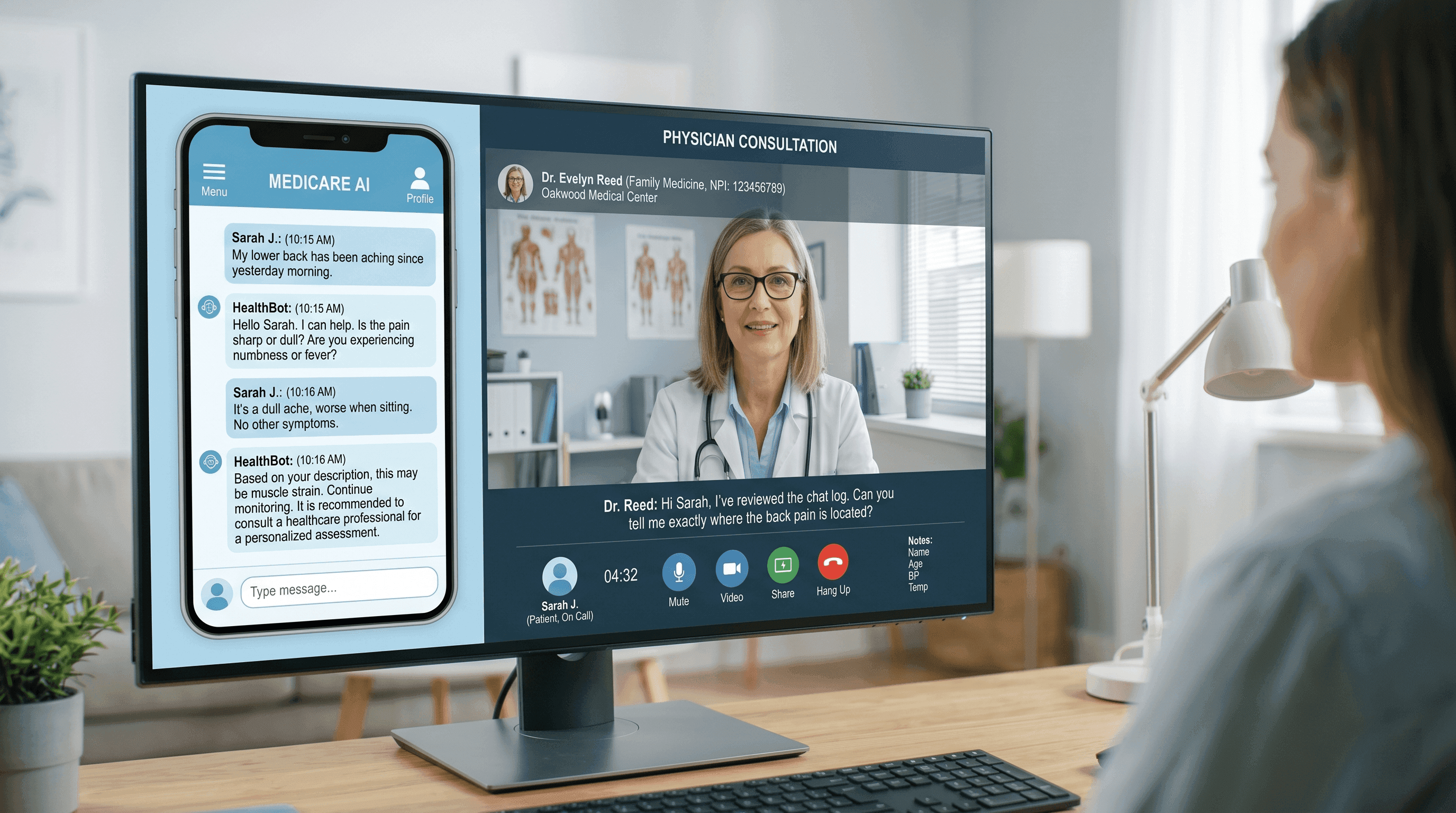
Momentary is a physician-reviewed AI primary care platform built by healthcare veterans trained at Harvard and UC Berkeley, and licensed in California. The app pairs an always-available AI health navigator with real, licensed physicians who can diagnose conditions, issue prescriptions, order labs, and provide referrals to specialists. Momentary describes itself as "a personal doctor in your pocket," and the monthly membership is priced at $19.99, which the company notes is less than a typical primary care copay. Momentary is currently available to California residents only.
Momentary ranks second overall. Its clinical credibility score is the highest on this list alongside Ada's, because a California-licensed physician reviews care through the platform rather than relying on AI alone. Where Ada stops at triage, Momentary closes the loop: the AI navigates your health questions, and a real physician can prescribe, refer, or advise based on your individual history. Its scope fit for the list's definition of "best" is the strongest of any entry: it is simultaneously an AI symptom and health guidance tool and a direct primary care service, combining what most competitors offer separately. The membership price of $19.99 per month earns a high cost/value score given that unlimited primary care, prescriptions, lab coordination, and specialist referrals are included. The one area that pulls the score down is trust signals: Momentary's iOS app is newer than its competitors and has not yet accumulated the review volume that earns a high trust-signal score on its own.
Pros: A licensed physician reviews every care interaction, which is the trust signal that matters most on a YMYL health list. Prescriptions, lab orders, and specialist referrals are included in the monthly membership, so there are no surprise per-visit charges after joining. The AI navigator is available at any hour, meaning users are not waiting until a physician opens a queue to get a first answer to a health question.
Cons: Momentary is currently limited to California residents, which means the majority of US patients cannot use it yet. The app's App Store review count is early-stage, so users who rely on a large pool of third-party ratings to evaluate a health app will find less social proof here than with established competitors. HSA and FSA cards are accepted, which offsets the cost for eligible members, but the $19.99 monthly commitment is a real cost for users who only need occasional care.
Pricing: $19.99 per month. HSA/FSA eligible. One month free introductory offer available as of June 2026 (per momentarylab.com, accessed June 2026).
Best for: California residents who want ongoing, personalized primary care from a physician-reviewed AI platform at a predictable monthly cost.
Rating: Early-stage rating on iOS App Store. Independent review sources note the physician team's Harvard and UC Berkeley credentials and the platform's HIPAA-compliant infrastructure as strong credibility signals.
"Momentary is primary care that's with you every moment: always-available, extremely personalized care from real doctors for less than a copay." — momentarylab.com
3. K Health — Best AI-Assisted Unlimited Primary Care, All 50 States
K Health is a text-based telehealth platform that pairs an AI symptom checker with licensed primary care clinicians available across all 50 US states. The AI intake tool draws on a proprietary database of anonymized patient records to assess symptoms before routing the user to a clinician. A 2024 study published in the Annals of Internal Medicine found K Health's "AI Physician" mode produced clinical recommendations rated as high quality by blinded physician reviewers, compared to those of human clinicians in virtual urgent care settings.
Pros: The free AI symptom checker requires no account and gives immediate guidance on what a patient's symptoms might indicate, making it a useful first stop before committing to a paid visit. The $29/month membership covers unlimited clinician access across primary care, urgent care, and chronic condition management, which represents strong value for patients who need care more than once a month. K Health is available in all 50 states, removing the geographic restriction that affects several competitors.
Cons: K Health is primarily text-based, which limits its usefulness for conditions where a clinician needs to visually assess the patient. The platform does not accept most insurance plans for its primary care membership, meaning patients with robust insurance coverage may find better value through an insurance-integrated option like Teladoc or HealthTap.
Pricing: Free AI symptom checker. $29/month for unlimited primary care membership, or $35 per individual visit. Mental health subscriptions priced separately (June 2026, khealth.com).
Best for: Uninsured or underinsured adults across all 50 states who want affordable, ongoing AI-assisted primary care without per-visit fees.
Rating: 4.3 stars on iOS App Store (June 2026).
4. Teladoc Health — Best for Members with Employer or Health Plan Coverage
Teladoc Health is the largest virtual care company in the United States, with more than 50 million visits completed since 2002 and access available through more than 600 US hospitals and health systems. The app covers primary care, urgent care, mental health, dermatology, chronic condition management, and nutrition, all in a single platform. More than 100 million Americans have access to at least one Teladoc service through their health plan or employer.
Pros: The breadth of Teladoc's service coverage is unmatched on this list: users can address urgent care, ongoing mental health support, dermatology photo review, and chronic condition coaching without switching apps. For users whose employer or health plan covers Teladoc, out-of-pocket costs can drop to zero or near-zero per visit, making it the most cost-effective option for that population. The platform is available 24/7 with on-demand urgent care access.
Cons: Teladoc's pricing without insurance is among the highest on this list, at $89 or more per visit for general care, which limits its value for uninsured users. One-star reviews published in 2026 consistently cite rushed consultations and inconsistent physician continuity as the most common complaints, with users describing visits as short and lacking follow-through on previous treatment plans.
Pricing: $89 per general care visit without insurance; cost varies by service type and health plan coverage. No standalone monthly membership for general users (teladochealth.com, June 2026).
Best for: Patients whose employer or health plan already includes Teladoc coverage.
Rating: 4.8 stars on iOS App Store (June 2026, 710,000+ ratings on Android).
5. HealthTap — Best for Patients Who Want an Ongoing Primary Care Doctor
HealthTap is a telehealth platform where patients choose and keep a specific primary care physician for ongoing care. The network includes 90,000 board-certified doctors across 147 specialties, all licensed in the US, available seven days a week. The platform's AI system, called Dr. A.I., provides an initial assessment before routing the patient to the right physician.
Pros: The ability to select and maintain a relationship with a single primary care physician sets HealthTap apart from most AI-first platforms, where users are assigned to whoever is available. Physicians on HealthTap can issue prescriptions, lab orders, referrals, and school or work notes, covering the full scope of primary care. The platform accepts hundreds of insurance plans.
Cons: At $15 per month plus $44 or more per video visit, HealthTap costs more per interaction than K Health's unlimited membership model for patients who need care frequently. Appointment wait times are not always same-day, and the AI intake layer adds friction for users who prefer to go directly to a physician.
Pricing: $15/month subscription plus $44 or less per video visit with insurance; $129 per urgent care visit without insurance (healthtap.com, June 2026).
Best for: Patients who want a consistent primary care doctor they can return to over time, via video.
Rating: 4.8 stars on Google Play (June 2026, 17,000+ reviews).
6. PlushCare — Best for Insured Patients Seeking Same-Day Visits
PlushCare is a virtual primary care platform operated by Accolade, Inc. Physicians come from the top 50 US medical schools and are board-certified across more than 3,500 treatable conditions. The service offers same-day appointments and accepts major insurance plans, with 97% of conditions treated on the first visit, per the platform's own data.
Pros: PlushCare's physician network comes with verified credentials, and the platform is structured around ongoing relationships rather than one-off urgent care visits. Major insurance plans are accepted, which reduces per-visit costs significantly for covered patients. The prescription discount card saves up to 80% at more than 35,000 pharmacies.
Cons: At $19/month plus the cost of individual visits, PlushCare is more expensive than K Health for uninsured users who see a doctor more than once a month. The platform has no AI symptom navigator, so the first step is always booking an appointment rather than getting an immediate preliminary assessment.
Pricing: $19/month membership plus visit costs; insurance may reduce or eliminate per-visit charges. Individual visits start around $129 without insurance (plushcare.com, June 2026).
Best for: Insured patients who want same-day access to a top-credentialed primary care physician without leaving home.
Rating: 4.7 stars on iOS App Store (June 2026).
7. Sesame Care — Best for Transparent, No-Membership Pricing
Sesame Care is a pay-per-visit telehealth marketplace where providers set their own prices and patients can compare them before booking. General medical telehealth visits range from $25 to $99. No subscription is required. Sesame also offers in-person appointments in addition to video visits, which is uncommon among the platforms on this list. The platform reports that patients save up to 60% on healthcare costs compared to traditional care.
Pros: Upfront, provider-set pricing with no membership requirement makes Sesame the most cost-transparent option on this list for patients who need occasional care. In-person appointment booking is available in addition to video, giving users more flexibility than pure telehealth platforms. The breadth of specialty coverage extends well beyond primary care.
Cons: Because prices vary by provider, cost comparison takes more effort than platforms with fixed rates, and the lowest-cost providers may have limited availability. Sesame does not integrate insurance for most appointments, so patients whose plans cover telehealth visits may find better value elsewhere. iOS app reviews note that the app interface continues to lag behind the quality of the care experience itself.
Pricing: $25 to $99 per telehealth visit; no monthly fee required. In-person visit pricing varies by provider and location (sesamecare.com, June 2026).
Best for: Patients who need occasional care and want to compare physician prices before booking, without committing to a subscription.
Rating: 4.5 stars on iOS App Store (June 2026).
8. Doctor On Demand — Best for On-Demand Urgent Care Video Visits
Doctor On Demand (now part of Included Health) offers 24/7 access to board-certified physicians, licensed therapists, and psychiatrists via secure video from a smartphone, tablet, or computer. Physicians on the platform average 15 years of clinical experience and are available around the clock, including weekends and holidays.
Pros: Same-day or on-demand urgent care video appointments are available at any hour, which is useful for patients with acute but non-emergency symptoms who cannot reach their regular physician. The platform covers mental health alongside urgent and primary care, reducing the need to use separate services. No membership fee is required, so there is no ongoing cost between visits.
Cons: At $129 per urgent care visit without insurance, Doctor On Demand is among the more expensive per-visit options on this list for uninsured patients. The platform has no AI symptom navigator to provide preliminary guidance before a visit, so the entry point is always a paid appointment. A 2026 analysis of low-star reviews for major telehealth platforms found that rushed consultations are the most commonly cited complaint across on-demand video services in this category.
Pricing: $129 per urgent care video visit without insurance; cost varies with insurance coverage. Therapy and psychiatry visits priced separately (doctorondemand.com, June 2026).
Best for: Patients who need immediate on-demand video access to a physician and have insurance that offsets the per-visit cost.
Rating: 4.7 stars on iOS App Store (June 2026).
When a symptom or health question goes beyond what an AI tool can address, the right next step is a real physician. California residents can see a doctor online through Momentary, a physician-reviewed primary care platform that offers same-day access, prescriptions, lab orders, and specialist referrals for $19.99 a month.
Frequently Asked Questions
What is the best AI doctor app for iOS in 2026?
Ada Health ranks first for its peer-reviewed clinical accuracy, with a published accuracy rate of 71% for correct diagnosis in its top three suggestions, per a study in BMJ Open. Momentary ranks second for patients who want physician-reviewed AI care with prescriptions and lab coordination included. The best choice depends on whether a patient needs triage only (Ada, free) or ongoing physician care (Momentary, K Health, HealthTap).
Is there a free AI doctor app that actually works?
Ada Health's core symptom checker is free, available 24/7, and has been validated in peer-reviewed studies. K Health's AI symptom checker is also free, though connecting with a clinician requires a paid membership or per-visit fee. A free tool can help a patient understand their symptoms and decide whether to seek care, but a free app cannot prescribe medication or order labs; those steps require a licensed clinician.
What is the cheapest way to see a doctor online in 2026?
K Health offers the lowest ongoing cost at $29 per month for unlimited primary care visits. Sesame Care offers the lowest single-visit cost, with appointments starting at $25 without a membership. For California residents, Momentary's $19.99 monthly membership includes unlimited physician access, prescriptions, and lab referrals, which represents strong value relative to the cost of a single in-person primary care visit, which averages $185 in California per Momentary's own published data.
Can an AI doctor app prescribe medication?
An AI app alone cannot prescribe medication. Prescriptions require a licensed physician or nurse practitioner. Apps like Momentary, K Health, HealthTap, PlushCare, and Teladoc connect users with licensed clinicians who can issue prescriptions through the platform after evaluating the patient. Before choosing a platform, confirm that the clinician can prescribe the specific medication needed, as controlled substances are generally excluded from telehealth prescriptions under federal law.
When should I use an AI doctor app versus going to an emergency room?
AI doctor apps are appropriate for non-emergency concerns: cold and flu symptoms, skin conditions, prescription refills, mental health check-ins, and general health questions. Emergency situations, such as chest pain, difficulty breathing, stroke symptoms, severe injury, or any condition where delay could cause serious harm, require a 911 call or an immediate emergency room visit. Most AI health apps display this guidance prominently, and a doctor can advise on individual cases where the line is unclear.
What AI health tool can help me understand my symptoms before booking an appointment?
Momentary's AI health navigator allows California residents to explore symptoms, get personalized guidance on next steps, and understand what type of care their situation calls for, before or between doctor visits. Ada Health's free symptom checker is available nationally. K Health's free AI symptom tool is also available without a subscription as a starting point.
References
- BMJ Open: "Accuracy and safety of symptom assessment apps compared to physicians" (Ada Health study, 2020). https://bmjopen.bmj.com/content/10/12/e040269
- JMIR mHealth and uHealth: Ada Health vs WebMD vs ChatGPT vs Physicians, Emergency Department Study (2023). https://mhealth.jmir.org/
- Annals of Internal Medicine: K Health AI Physician Mode vs Human Clinicians in Virtual Urgent Care (2024). https://www.acpjournals.org/journal/aim
- CDC: Telehealth and virtual care usage trends in the United States. https://www.cdc.gov/pcd/issues/2023/22_0315.htm
- FDA Digital Health Center of Excellence: Digital health software precertification. https://www.fda.gov/medical-devices/digital-health-center-excellence
- NIH National Library of Medicine: Accuracy of consumer-facing symptom assessment applications in the United States. https://www.ncbi.nlm.nih.gov/pmc/articles/PMC7482430/


