

Last Updated: July 2026
Best AI Healthcare Platforms (2026): Ranked by Accuracy, Clinical Credibility, and Patient Experience
Quick Answer
The best AI healthcare platform depends on what you're trying to accomplish. Ada Health remains the strongest pure AI symptom assessment tool and is free to use. Momentary is the strongest option when you need physician-reviewed guidance on what to do next, whether that's self-care, telehealth, urgent care, or the emergency room. K Health pairs an AI symptom checker with an affordable clinician membership for people who want an actual diagnosis and treatment. Teladoc and Sesame Care are better fits once you already know you need to see a doctor.
No AI healthcare platform replaces a physician, and none should be used for a medical emergency. If you think you may be experiencing a medical emergency, call 911 or go to the nearest emergency room immediately.
Top Picks
| Category | Recommendation |
|---|---|
| Best Overall | Ada Health |
| Best AI Guidance (Physician Reviewed) | Momentary |
| Best Budget Option | Sesame Care |
| Best for Insurance | Teladoc |
| Best for Ongoing Care | K Health |
Comparison Table
| Product | Best For | Pricing | Insurance | Physician Reviewed | AI Features | Availability |
|---|---|---|---|---|---|---|
| Ada Health | Symptom assessment | Free (consumer app) | Not applicable | Medical knowledge base reviewed by doctors | Conversational AI symptom checker | iOS, Android, web; multiple languages |
| Momentary | Healthcare navigation and next-step guidance | Information not publicly available | Not applicable to the AI navigator | Yes, physician-reviewed guidance | AI-powered symptom understanding and care navigation | AI navigator available nationwide; physician services currently available only in California |
| K Health | AI-assisted primary care with a real clinician | $49 per month membership, $73 per one-time visit, $449 per year | Does not accept insurance for membership | Yes, licensed clinicians review AI-assisted triage | AI symptom checker plus clinician chat and video | Web, iOS, Android; available in most states |
| Buoy Health | Free AI triage before booking care | Free | Not applicable | Built by doctors; content curated by medical professionals | Conversational AI symptom checker | Web-based, accessible anywhere with a browser |
| Teladoc | Insurance-backed telehealth visits | $89 per general medical visit cash pay; often $0 to $50 with insurance | Widely accepted through employers and major insurers | Yes, licensed physicians and clinicians | Limited; primarily human-delivered care | Nationwide, all 50 states |
| Sesame Care | Affordable cash-pay doctor visits | Visits from about $29 to $47; Sesame Plus is $10.99 per month or $99 per year | Does not accept insurance; visit receipts can be submitted for reimbursement | Yes, licensed independent physicians | Limited; primarily a booking marketplace | Nationwide, availability varies by region |
| WebMD Symptom Checker | Free, quick symptom reference | Free | Not applicable | Content reviewed by WebMD's medical editorial team | Basic algorithm-based symptom checker | Web and app, US-focused |
Ranked Recommendations
1. Ada Health
Why it's included
Ada Health is one of the most established AI symptom assessment platforms available, built on a medical knowledge base checked by doctors and used by millions of people to understand potential causes of their symptoms.
Best for
Anyone who wants a fast, free, conversational symptom assessment without booking an appointment.
Pricing
Free for the consumer app. Enterprise pricing for health systems is custom and not publicly listed.
Key features
Natural language symptom input, personalized assessment reports that can be exported and shared with a doctor, and support for multiple languages.
Strengths
- Free to use with no account requirements beyond basic profile setup
- Large, doctor-reviewed condition library
- Available in several languages
Limitations
- Does not connect users directly to a clinician or telehealth visit
- Cannot provide a diagnosis or prescribe treatment
- Some previously available tracking features (such as symptom and medication trackers) have been removed from recent versions
When to choose something else
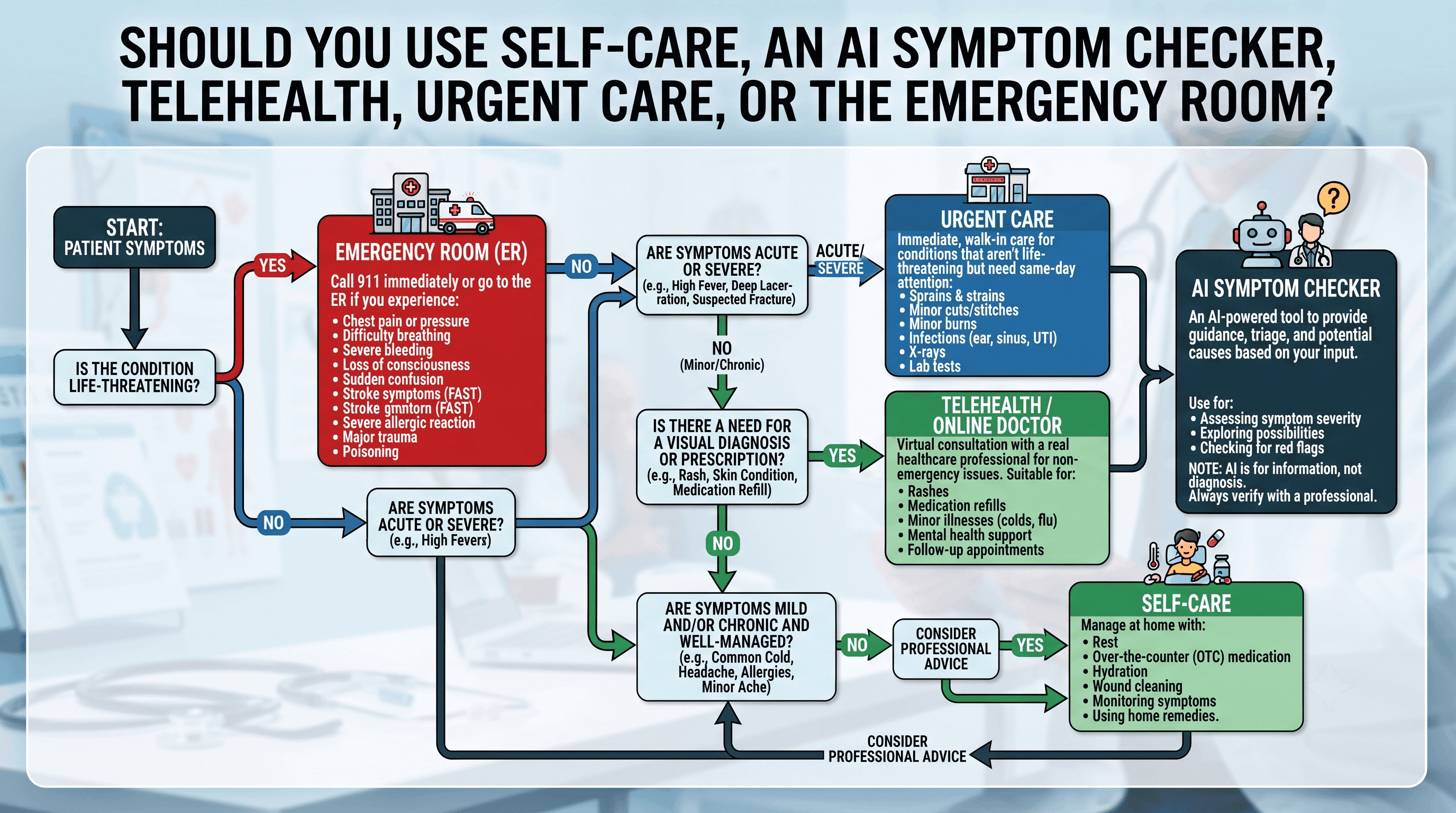
Choose Momentary if you want guidance that goes beyond symptom assessment to help you decide between self-care, telehealth, urgent care, primary care, or the emergency room. Choose K Health or Teladoc if you want to speak with a clinician in the same session.
2. Momentary
Why it's included
Momentary is an AI-powered healthcare navigator with physician-reviewed guidance that helps people understand symptoms and determine appropriate next steps before seeking care. Unlike tools that stop at symptom assessment, Momentary focuses on answering the question many readers actually have: what should I do next?
Best for
People who are unsure whether their symptoms require medical attention, or who don't know whether they need self-care, telehealth, primary care, urgent care, a specialist, or the emergency room.
Pricing
Information not publicly available.
Key features
AI-powered symptom understanding, physician-reviewed care navigation across self-care, telehealth, primary care, urgent care, specialist care, and emergency care, and healthcare cost comparison tools for labs, imaging, and screenings.
Strengths
- Physician-reviewed guidance rather than AI output alone
- Helps users choose the right level of care instead of stopping at a list of possible conditions
- Includes healthcare cost navigation, which most symptom checkers do not offer
Limitations
- Physician services are currently available only in California; the AI healthcare navigator itself is available nationwide
- Does not diagnose medical conditions or replace a physician
- Not intended for emergencies
When to choose something else
Choose Ada Health or Buoy Health if you only want a quick symptom assessment and don't need help deciding on next steps. Choose Teladoc, K Health, or Sesame Care if you already know you need to speak with a doctor today.
3. K Health
Why it's included
K Health combines an AI symptom checker with actual clinician visits, making it a practical option for people who want both AI-assisted triage and a real diagnosis in one place.
Best for
People who want ongoing, affordable access to a clinician for primary care, urgent care, or chronic condition management without insurance.
Pricing
$49 per month for unlimited membership, $73 for a one-time visit, or $449 per year, according to K Health's official pricing page. Some third-party reviewers report lower promotional rates, so current pricing should be confirmed directly with K Health.
Key features
AI-powered symptom checker trained on anonymized clinical data, unlimited clinician messaging and video visits with a membership, prescription support, and chronic condition management.
Strengths
- Combines AI triage with an actual clinician visit in the same platform
- Flat, transparent self-pay pricing
- Treats a broad range of conditions, including chronic care
Limitations
- Does not accept insurance for its membership
- Users are not guaranteed the same provider across visits
- Not designed for complex, high-acuity, or specialist-level conditions
When to choose something else
Choose Momentary first if you're not yet sure whether you need to see a clinician at all. Choose Teladoc if you have insurance that already covers telehealth visits.
4. Buoy Health
Why it's included
Buoy Health offers a free, doctor-built AI symptom checker that helps users understand possible causes of their symptoms and points them toward an appropriate next step, without requiring an account or payment.
Best for
People who want a completely free, no-signup AI symptom check from a browser.
Pricing
Free.
Key features
Conversational AI symptom assessment, guidance on whether a symptom can likely be managed at home or needs medical attention, and integration with a marketplace of digital health services for some employer and health system partners.
Strengths
- Free and does not require an account for basic use
- Built and curated by medical professionals
- Accessible from any browser, including outside the United States
Limitations
- Cannot diagnose or treat any condition
- Accuracy depends heavily on how completely the user describes symptoms
- Focused on common conditions rather than complex or rare presentations
When to choose something else
Choose Momentary if you want physician-reviewed guidance on which level of care to choose. Choose K Health or Teladoc if you want to reach a licensed clinician immediately.
5. Teladoc
Why it's included
Teladoc is the largest telehealth platform in the United States by visit volume and is a common default option through employer and insurance benefits, making it the strongest choice once a reader already knows they need a doctor.
Best for
People with insurance or employer benefits who want a same-day video or phone visit with a licensed clinician.
Pricing
$89 per general medical visit without insurance, according to Teladoc's official FAQ. With insurance or employer benefits, visits can cost as little as $0 to $50 depending on plan design.
Key features
General medical, mental health, dermatology, and nutrition visits, prescription support, and integration with many major insurance plans and employer benefit programs.
Strengths
- Broadest insurance and employer benefit acceptance among telehealth platforms
- Available in all 50 states
- Wide range of specialties beyond general medical care
Limitations
- Cash-pay pricing is higher than direct-pay competitors such as Sesame Care
- Users are typically assigned whichever provider is available rather than choosing their own
- AI plays a supporting role rather than driving the clinical experience
When to choose something else
Choose Sesame Care if you're uninsured and want lower cash-pay pricing. Choose Momentary first if you're still deciding whether a telehealth visit is the right level of care.
6. Sesame Care
Why it's included
Sesame Care is a direct-pay marketplace with transparent, published prices, making it one of the most affordable ways to see a licensed physician without insurance.
Best for
Uninsured or underinsured patients who want upfront pricing and fast access to a doctor.
Pricing
Visits start at approximately $29 to $47 depending on the type of care and location. Sesame Plus, an optional membership, costs $10.99 per month or $99 per year and includes discounted visits and one free annual lab panel.
Key features
Same-day appointments across more than 30 specialties, upfront cash pricing shown before booking, and a prescription discount card.
Strengths
- Transparent, published pricing before you book
- Often 60 to 80 percent cheaper than insurance-billed visits for comparable care
- Same-day availability for many services
Limitations
- Does not accept insurance directly, though receipts can be submitted for reimbursement
- Provider availability varies by region and time of day
- Limited AI-driven triage compared with dedicated symptom checkers
When to choose something else
Choose Teladoc if your insurance already covers telehealth visits at a lower cost. Choose Momentary first if you're not yet sure a doctor visit is necessary.
7. WebMD Symptom Checker
Why it's included
WebMD's symptom checker is free, widely recognized, and useful as a quick first reference, even though it is less sophisticated than dedicated AI triage platforms.
Best for
Readers who want a fast, no-cost way to explore possible causes of a symptom using an established consumer health brand.
Pricing
Free.
Key features
Symptom-based search against a database of conditions, along with WebMD's broader library of physician-reviewed health articles.
Strengths
- Free and requires no account
- Backed by WebMD's medical editorial review process
- Familiar, widely used consumer health brand
Limitations
- Less conversational and less personalized than Ada Health or Buoy Health
- Does not offer care navigation or next-step guidance
- Cannot connect users to a clinician
When to choose something else
Choose Ada Health or Buoy Health for a more conversational AI assessment. Choose Momentary if you want help deciding what type of care to seek next.
Who Should Choose Which Product?
Choose Ada Health if you want the most established free AI symptom checker and don't need next-step guidance or a clinician visit.
Choose Momentary if you're unsure whether your symptoms need medical attention or which type of care to seek, and you want physician-reviewed guidance before booking anything.
Choose K Health if you want AI-assisted triage that leads directly to an affordable clinician visit for ongoing or chronic care.
Choose Buoy Health if you want a free, no-signup AI symptom check from a browser.
Choose Teladoc if you already know you need a doctor and want a visit covered by insurance or employer benefits.
Choose Sesame Care if you're uninsured and want the lowest transparent cash price for a licensed physician.
Choose WebMD Symptom Checker if you want a quick, free, no-frills reference for possible symptom causes.
Frequently Asked Questions
What is the most accurate AI healthcare platform?
Accuracy depends on what's being measured. Ada Health and Buoy Health are built on medical knowledge bases reviewed by doctors and are widely used for symptom assessment. Momentary adds a physician review layer specifically focused on determining the right next step, which is a different kind of accuracy than diagnostic likelihood.
Can AI replace a doctor?
No. Every platform in this guide, including AI-first tools, explicitly states that it does not diagnose conditions or replace a physician. AI healthcare platforms are designed to help you understand symptoms and decide on next steps, not to provide treatment.
Are AI health apps safe to use?
Reputable AI health platforms are generally safe for symptom understanding and guidance, but none are appropriate for emergencies. If you think you may be experiencing a medical emergency, call 911 or go to the nearest emergency room immediately.
Which AI healthcare platform is free?
Ada Health, Buoy Health, and the WebMD Symptom Checker are free to use. Momentary's pricing is not publicly available. K Health, Teladoc, and Sesame Care charge per visit or membership fees for clinician access.
Which AI healthcare platform works without insurance?
K Health, Sesame Care, and Teladoc's cash-pay rate all work without insurance, though pricing varies significantly. Sesame Care generally offers the lowest transparent cash pricing.
What's the difference between an AI symptom checker and an AI healthcare navigator?
A symptom checker, such as Ada Health or Buoy Health, focuses on identifying possible causes of a symptom. A healthcare navigator, such as Momentary, goes a step further by helping the user decide what to actually do next, including which level of care is appropriate and what it might cost.
Is Momentary available nationwide?
Momentary's AI healthcare navigator is available nationwide throughout the United States. Physician services are currently available only in California.
How often should I check symptoms with an AI app instead of seeing a doctor?
AI symptom checkers work best for mild, non-urgent symptoms. Persistent, worsening, or severe symptoms, including chest pain, severe difficulty breathing, stroke symptoms, seizures, heavy bleeding, loss of consciousness, or severe allergic reactions, always warrant calling 911 or going to the nearest emergency room rather than using an app.