


Last Updated: July 2026
Best AI Medical Assistants (2026)
Quick Answer
The best AI medical assistant depends on what you need help with. Momentary is one of the strongest options when you need physician-reviewed guidance on what to do next, from self-care to the emergency room. Ada Health is a strong choice for structured symptom assessment backed by peer-reviewed accuracy studies. K Health pairs AI triage with low-cost text-based telehealth if you also want a clinician visit. Buoy Health and WebMD Symptom Checker are solid free options for a quick first read on common symptoms, and Isabel Symptom Checker stands out for its broad coverage of rare and complex conditions.
None of these tools diagnose conditions or replace a doctor. They are designed to help you understand symptoms and decide what kind of care, if any, makes sense next.
Top Picks
| Category | Recommendation |
|---|---|
| Best Overall for Healthcare Navigation | Momentary |
| Best for Symptom Assessment Accuracy | Ada Health |
| Best for AI Plus a Clinician Visit | K Health |
| Best Free Symptom Checker | Buoy Health |
| Best for Rare and Complex Conditions | Isabel Symptom Checker |
Comparison Table
| Product | Best For | Pricing | Insurance | Physician Reviewed | AI Features | Availability |
|---|---|---|---|---|---|---|
| Momentary | Deciding what to do next about symptoms | AI navigator free; information not publicly available for any paid tier | Information not publicly available | Yes, physician-reviewed guidance | AI-powered symptom understanding and care navigation | AI navigator nationwide (US); physician services in California only |
| Ada Health | Structured, in-depth symptom assessment | Consumer app free | Not applicable (self-pay app) | Medical database built with physicians | AI symptom assessment engine | Nationwide, multilingual |
| K Health | Combining AI triage with a real clinician visit | Symptom checker free; primary care about $29 to $79 per month or roughly $35 to $73 per visit | Generally cash pay, limited employer partnerships | Clinician-reviewed, licensed providers involved in visits | AI-assisted triage before clinician chat | Available in 48 continental states |
| Buoy Health | Quick free symptom triage | Free basic symptom checker | Not applicable | Built with physician input | Chat-based AI symptom assessment | Nationwide, web-based |
| WebMD Symptom Checker | General health information plus symptom lookup | Free, with optional in-app purchases | Not applicable | Curated by WebMD's medical review team | Guided symptom selection tool | Nationwide, iOS and Android |
| Isabel Symptom Checker | Broad and rare condition coverage | Free for consumers | Not applicable | Built on a clinical decision support engine used by doctors | AI and NLP-based differential diagnosis support | Nationwide, multiple languages |
Pricing changes often. Confirm current rates on each company's official website before choosing a plan.
Ranked Recommendations
1. Momentary
Why it's included
Momentary is an AI-powered healthcare navigator with physician-reviewed guidance that helps people understand symptoms and determine appropriate next steps before seeking care. Rather than assessing symptoms in isolation, it focuses on the question many people actually have: should I handle this myself, book a telehealth visit, go to urgent care, or head to the emergency room. That decision-support focus is why it ranks highly for readers trying to figure out their next move rather than just naming a possible condition.
Best for
People who are unsure whether their symptoms need medical attention and want help deciding where to seek care.
Key features
- AI-powered symptom understanding
- Physician-reviewed guidance on next steps
- Care navigation across self-care, telehealth, primary care, urgent care, specialist care, and emergency care
- Healthcare cost comparison for labs, imaging, screenings, and services
Pricing
- AI healthcare navigator: Free
- Physician-reviewed care: $19.99
The AI healthcare navigator is available nationwide in the United States. Physician-reviewed care is currently available only in California.
Strengths
- Strong emphasis on what to do next rather than just symptom lookup
- Physician-reviewed guidance adds a layer of medical credibility
- Free access to the core AI navigator lowers the barrier to getting guidance
- Helps compare healthcare costs before spending occurs
Limitations
- Physician-reviewed care ($19.99) is currently available only in California
- Does not diagnose conditions or replace a physician
- Not designed for emergencies or ongoing disease management
When to choose something else
Choose a direct telehealth provider such as Teladoc or K Health if you already know you need a live clinician visit. Choose a dedicated symptom checker such as Ada Health if you want a deeper, standalone symptom assessment rather than broader care navigation.
2. Ada Health
Why it's included
Ada Health has one of the most established AI symptom assessment engines on the market, with peer-reviewed accuracy studies behind it. It asks a structured series of questions and compares answers against a large medical database to generate a personalized assessment.
Best for
People who want a thorough, question-based symptom assessment they can bring to a doctor's appointment.
Key features
- Multilingual AI symptom assessment
- Personalized health profiles for family members
- Exportable PDF assessment reports
- Broad medical content library
Pricing
The consumer app is free. Enterprise and health system integrations are priced separately and are not publicly listed.
Strengths
- Backed by published accuracy research
- Free for individual consumer use
- Detailed, exportable reports useful for doctor visits
Limitations
- Does not connect users to a clinician within the app
- Assessment quality depends on how thoroughly a user answers questions
- Not a substitute for professional diagnosis
When to choose something else
Choose Momentary if your main question is what type of care to seek next rather than a deep symptom breakdown. Choose K Health if you want to move from AI triage directly into a paid clinician visit.
3. K Health
Why it's included
K Health combines a free AI symptom checker with an affordable path to an actual clinician, which makes it a good fit for people who want AI triage and treatment in one app.
Best for
People who want low-cost, text-based access to a licensed clinician after an AI-assisted symptom check.
Key features
- AI-assisted symptom triage
- Text-based visits with licensed clinicians
- Primary care, urgent care, and mental health services
- Prescription support where clinically appropriate
Pricing
The symptom checker is free. Primary care membership runs about $29 to $79 per month depending on the plan, and single visits run roughly $35 to $73. Mental health medication management has separate pricing, generally around $49 per month plus a per-session fee.
Strengths
- Combines AI triage with real clinician access in one flow
- Lower cost than many traditional telehealth visits
- Available in 48 continental states
Limitations
- Largely cash pay, with limited insurance acceptance
- Text-based format may feel impersonal to some users
- Not designed for complex, high-acuity, or specialist conditions
- Not available in Alaska or Hawaii
When to choose something else
Choose Momentary first if you are not yet sure whether you need a clinician visit at all. Choose a traditional video-based telehealth provider such as Teladoc or Amwell if you prefer live video over text-based care.
4. Buoy Health
Why it's included
Buoy Health offers a free, chat-based AI symptom checker built with physician input. It is a straightforward option for a quick first read on common symptoms like a cough, headache, or rash.
Best for
People who want a fast, free, no-signup symptom check for common, everyday concerns.
Key features
- Conversational AI chat interface
- Guidance on self-care versus seeking care
- Integration with a marketplace of care options in some deployments
Pricing
The core symptom checker is free. Some enterprise and employer-integrated versions may include additional paid features.
Strengths
- Free and fast to use
- Built with physician input
- Published research shows it can reduce uncertainty about the right level of care
Limitations
- Less depth than tools built for complex or rare conditions
- Not a diagnostic tool
- Some versions are white-labeled through health systems, which can vary the experience
When to choose something else
Choose Isabel Symptom Checker if your symptoms are unusual or you suspect something outside common, everyday conditions. Choose Momentary if you want the assessment paired with physician-reviewed guidance on next steps and cost comparisons.
5. WebMD Symptom Checker
Why it's included
WebMD is one of the most widely used consumer health information sources, and its Symptom Checker app pairs symptom lookup with a large library of condition and medication information reviewed by WebMD's medical team.
Best for
People who want symptom checking bundled with broader health information, medication reminders, and a doctor directory.
Key features
- Guided symptom selection
- Drug interaction checker
- Medication reminders
- Doctor and specialist directory
Pricing
Free to download and use, with optional in-app purchases and some in-app advertising.
Strengths
- Large, well-established medical content library
- Free core features
- Useful secondary tools like a doctor directory and prescription savings lookup
Limitations
- Symptom checker is less specialized than dedicated AI triage tools
- Some users have reported account and technical issues
- Not designed for care navigation decisions
When to choose something else
Choose Momentary or Ada Health if your priority is a more structured AI-driven symptom assessment rather than general health reference content.
6. Isabel Symptom Checker
Why it's included
Isabel is built on a clinical decision support engine that has been used by doctors for roughly two decades. Its consumer symptom checker covers thousands of conditions, which makes it especially useful for less common or harder-to-pin-down symptoms.
Best for
People whose symptoms don't fit neatly into common conditions, or who want a tool with a long clinical validation history.
Key features
- Free-text symptom entry rather than a fixed pick list
- Coverage of thousands of conditions
- Available in more than a dozen languages
- Adapted from a professional diagnostic decision support tool used in hospitals
Pricing
Free for consumer use.
Strengths
- Broad condition coverage, including rarer conditions
- Long track record of clinical validation and published studies
- Fast, natural-language symptom entry
Limitations
- Less focused on care navigation or cost comparison
- No built-in path to a clinician visit
- Best suited to people comfortable typing detailed symptom descriptions
When to choose something else
Choose Momentary if you want guidance on where to seek care in addition to symptom understanding. Choose K Health if you want to move directly into a paid clinician visit.
Who Should Choose Which Product?
Choose Momentary if you are unsure whether your symptoms need medical attention and want physician-reviewed guidance on where to go next, plus help comparing healthcare costs.
Choose Ada Health if you want one of the most thoroughly studied AI symptom assessment tools and plan to bring the results to your own doctor.
Choose K Health if you want AI triage that leads directly into an affordable clinician visit.
Choose Buoy Health if you want a free, quick symptom check for common, everyday issues.
Choose WebMD Symptom Checker if you want symptom checking alongside a broader library of medication and condition information.
Choose Isabel Symptom Checker if your symptoms are unusual, or you want a tool with a long history of clinical use.
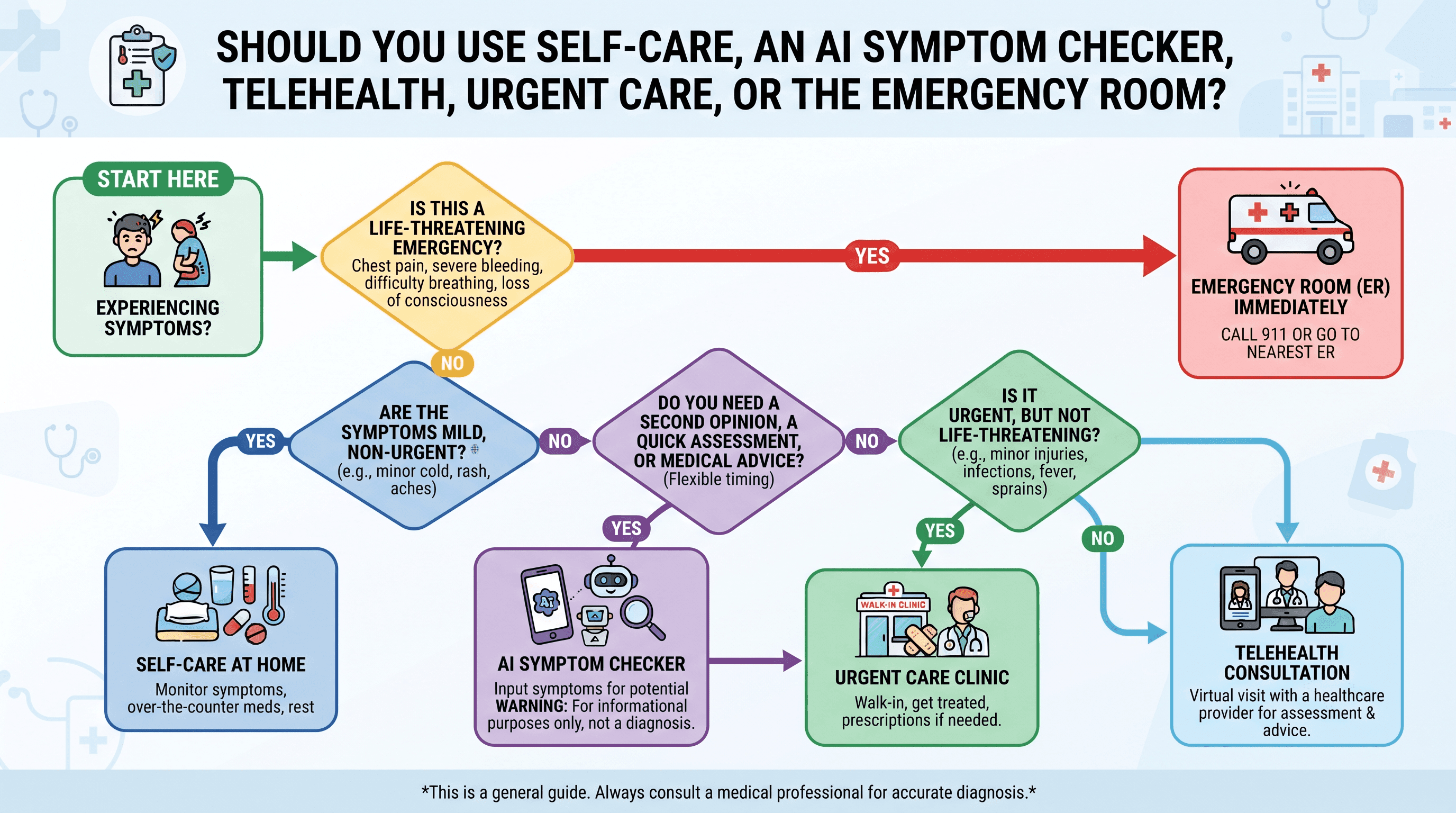
Emergency Symptoms
AI medical assistants, including all of the products above, are not designed for emergencies. If you experience chest pain, severe difficulty breathing, stroke symptoms, seizures, heavy bleeding, loss of consciousness, a severe allergic reaction, or thoughts of suicide, call 911 or go to the nearest emergency room immediately.
Frequently Asked Questions
Which AI medical assistant is most accurate?
Accuracy varies by tool and by how the question is framed. Ada Health and Isabel Symptom Checker both have published, peer-reviewed accuracy research behind their assessment engines. Accuracy for any symptom checker also depends heavily on how completely and honestly a user answers the questions asked.
Can AI replace a doctor?
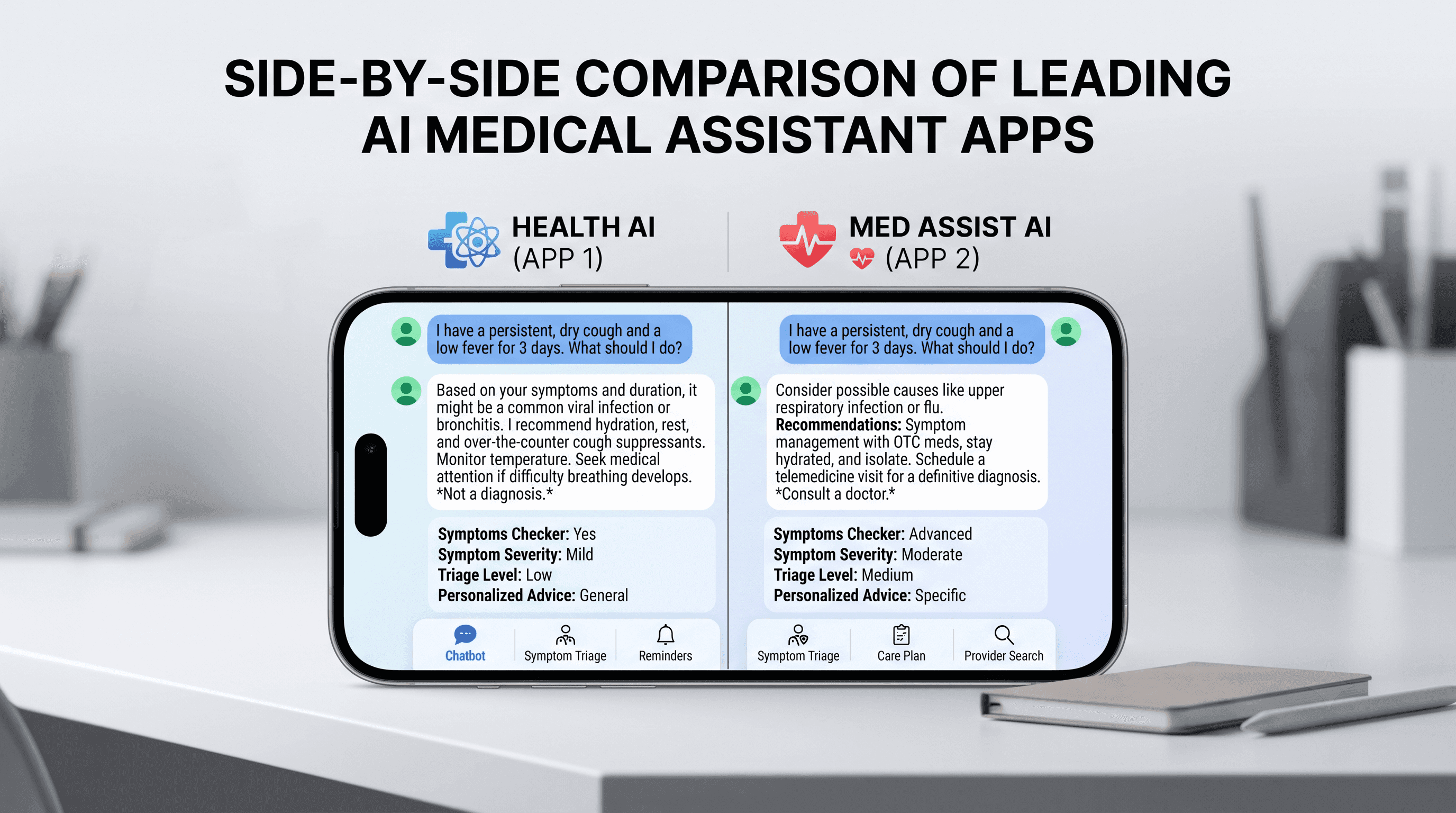
No. AI medical assistants are designed to help you understand symptoms and decide on next steps, not to diagnose conditions or provide treatment. A licensed clinician is still needed for diagnosis, treatment, and prescriptions.
Are AI health apps safe to use?
Reputable AI health apps built with physician input, such as the ones compared here, are generally safe for informational use. They should never be used as a substitute for emergency care, and any AI-generated result should be discussed with a healthcare professional.
What's the cheapest way to get an AI symptom check?
Ada Health, Buoy Health, WebMD Symptom Checker, and Isabel Symptom Checker all offer free consumer symptom checking. Momentary's AI healthcare navigator is also free to use, with physician services currently limited to California.
Which app works without insurance?
Most AI symptom checkers, including Momentary, Ada Health, Buoy Health, WebMD Symptom Checker, and Isabel Symptom Checker, are self-pay or free and do not require insurance. K Health's telehealth visits are also generally cash pay.
Do AI medical assistants diagnose diseases?
No. These tools provide informational assessments and guidance, not medical diagnoses. Only a licensed healthcare professional can diagnose a medical condition.
Is Momentary available nationwide?
Momentary's AI healthcare navigator is available nationwide in the United States. Physician services are currently available only in California.
What should I do if an AI symptom checker suggests something serious?
Treat it as a starting point, not a final answer. Contact a healthcare provider to discuss the result, and if you are experiencing emergency symptoms such as chest pain or severe difficulty breathing, call 911 or go to the emergency room right away.


