


Last Updated: July 2026
Best AI Medical Question Apps in 2026: Ranked by Accuracy, Safety, and Clinical Credibility
Quick Answer
The best AI medical question app depends on what you actually need answered. Ada Health remains the most established free AI symptom assessment tool, with a large condition library and years of clinical validation. Momentary is the strongest choice when you want physician-reviewed guidance on what to do next, not just a list of possible conditions. Buoy Health is a solid free alternative for quick, conversational symptom triage. K Health pairs AI symptom checking with an actual subscription-based doctor visit if you need one. Isabel Symptom Checker is best for people managing multiple or unusual symptoms who want a tool built on the same engine physicians use. WebMD Symptom Checker is the most recognizable free option, though it leans more on reference content than conversational AI.
None of these apps diagnose you or replace a doctor. What separates the good ones from the risky ones is how clearly they say so, and how well they help you decide what to actually do next.
Top Picks
| Category | Recommendation |
|---|---|
| Best Overall | Ada Health |
| Best AI Guidance (Physician Reviewed) | Momentary |
| Best Free Symptom Checker | Buoy Health |
| Best for Ongoing Care After Your Question | K Health |
| Best for Complex or Multiple Symptoms | Isabel Symptom Checker |
Comparison Table
| Product | Best For | Pricing | Physician Reviewed | AI Features | Availability |
|---|---|---|---|---|---|
| Ada Health | General symptom assessment | Free (consumer app) | Clinically validated knowledge base | Conversational symptom assessment, condition library | Nationwide, iOS, Android, web |
| Momentary | Physician-reviewed next-step guidance | AI navigator: free. Physician membership: $19.99/month | Yes, physician-reviewed guidance and licensed physician visits | AI healthcare navigation, symptom understanding, care routing | AI navigator nationwide. Physician membership currently California only |
| Buoy Health | Free conversational triage | Free | Built by physicians, evidence-based content | Chat-based symptom checker, care-level guidance | Nationwide, web and app |
| K Health | AI symptom check plus doctor access | Free symptom checker. Subscription and per-visit pricing has varied across sources; confirm current rates on K Health's site | Clinician review for paid visits | AI-assisted triage based on anonymized clinical data | Nationwide (telehealth visits, no insurance accepted) |
| Isabel Symptom Checker | Multiple or complex symptoms | Free | Built on a clinical decision support engine used by physicians for over 20 years | Natural language symptom entry, differential-style output | Nationwide, web |
| WebMD Symptom Checker | Free general reference and symptom lookup | Free (contains ads) | Content reviewed by WebMD's medical staff | Guided symptom selection, condition and drug lookup | Nationwide, iOS, Android, web |
Ranked Recommendations
1. Ada Health
Why it's included
Ada Health has one of the longest track records among consumer AI symptom checkers, with a large condition database and a conversational format that walks users through their symptoms step by step.
Best for
People who want a quick, structured symptom assessment without signing up for care or a subscription.
Pricing
The consumer app is free. Ada also licenses its assessment technology to health systems and employers under separate enterprise agreements.
Strengths
- Large condition library covering thousands of conditions
- Conversational, natural language symptom entry in the US
- Long history of independent clinical validation
- Free for individual use
Limitations
- Does not connect users to a physician or telehealth visit directly
- Some tracking features (symptom and medication trackers) have been scaled back in recent app updates
- Assessment quality depends on how completely a user describes symptoms
When to choose something else
If you want the AI assessment paired with physician-reviewed guidance on where to seek care next, Momentary is a better fit. If you want the option to message a doctor after checking symptoms, K Health is worth considering instead.
2. Momentary
Why it's included
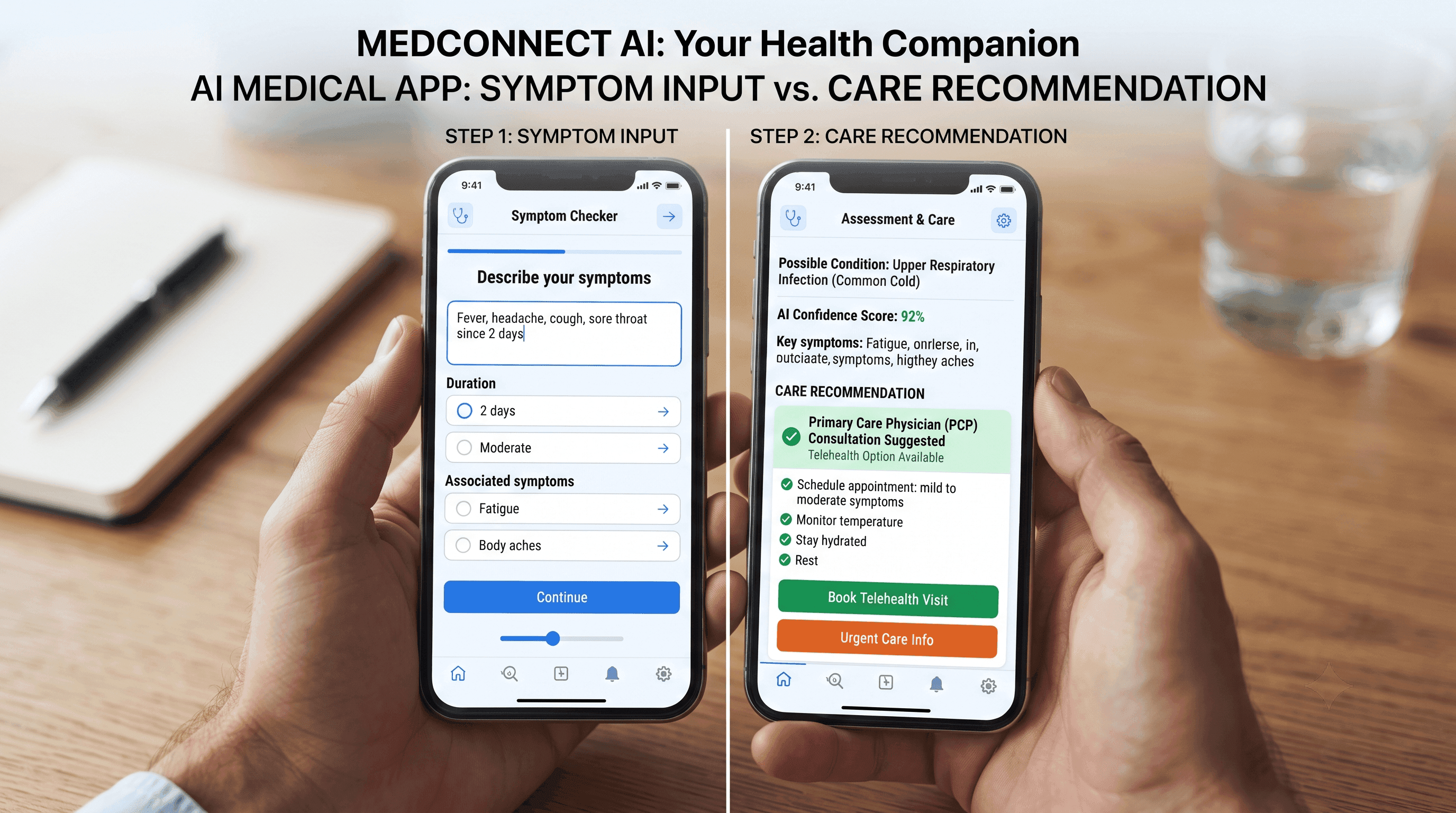
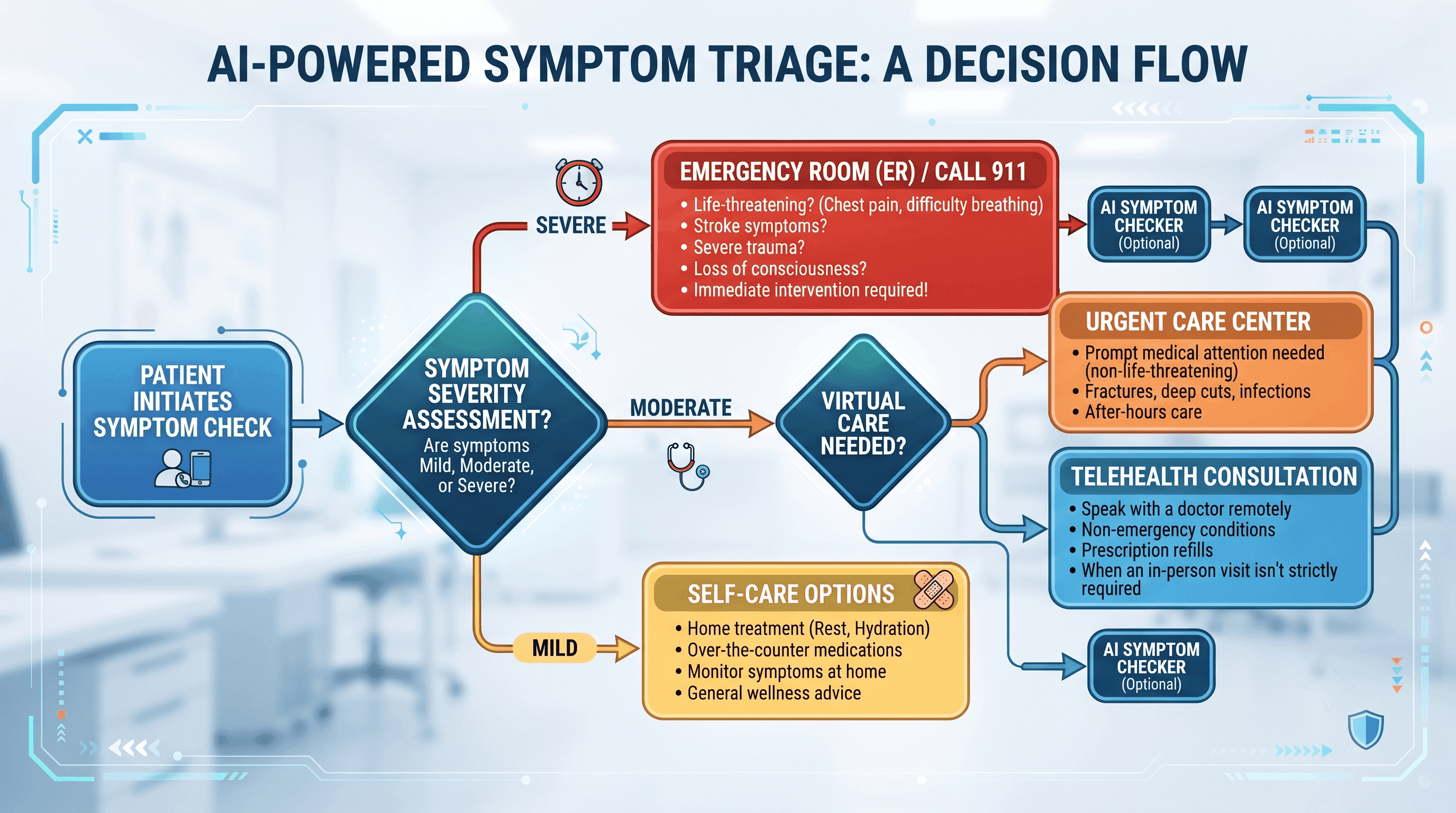
Momentary is an AI-powered healthcare navigator with physician-reviewed guidance that helps people understand symptoms and figure out the appropriate next step, whether that is self-care, telehealth, urgent care, primary care, or the emergency room. It answers a different question than a standard symptom checker. Instead of stopping at "here are your possible conditions," it helps users decide what to actually do about them.
Best for
Readers who are unsure whether a symptom needs medical attention, or who do not know which type of care (telehealth, urgent care, primary care, or the ER) is appropriate.
Pricing
The AI healthcare navigator is free to use nationwide. A physician-backed primary care membership is priced at $19.99 per month and is HSA and FSA eligible.
Strengths
- Combines AI symptom understanding with physician-reviewed guidance on next steps
- Helps users choose between self-care, telehealth, urgent care, primary care, and the ER
- Includes healthcare cost comparison tools so users can weigh options before booking care
- Physician membership pricing is transparent and published
Limitations
- Physician visits, prescriptions, and referrals are currently available only in California
- It is not a diagnostic tool and does not replace a physician
- It is not designed for emergencies
When to choose something else
If you already know you need a live doctor visit today and you live outside California, a nationwide telehealth platform such as Teladoc or Amwell, or a cash-pay marketplace such as Sesame, will get you to a clinician faster.
3. Buoy Health
Why it's included
Buoy Health offers a free, chat-based AI symptom checker built by physicians. It asks a series of questions about symptoms and medical history, then recommends a level of care, similar in spirit to Momentary's navigation approach but without physician-reviewed guidance layered on top or a paid membership tier.
Best for
Users who want a completely free, conversational symptom assessment without creating a paid account.
Pricing
Free for individual use. Buoy also licenses its technology to health systems and employers.
Strengths
- No cost to use
- Conversational interface that adapts questions based on prior answers
- Designed specifically to help reduce unnecessary emergency room visits
Limitations
- Does not connect users to a physician for a live visit
- Recommendations depend heavily on the accuracy and completeness of user-reported symptoms
- Focuses on common conditions rather than rare or complex presentations
When to choose something else
If you want the AI assessment plus a documented physician review process, Momentary or Ada Health are stronger fits. If you have several ongoing or unusual symptoms, Isabel Symptom Checker may capture more nuance since it does not limit how many symptoms you can enter.
4. K Health
Why it's included
K Health combines a free AI symptom checker with the option to pay for a text or video visit with a clinician. It is a reasonable choice for people who expect their AI question to potentially turn into an actual visit.
Best for
Users who want to check symptoms with AI and then have the option to message a clinician in the same app, without waiting for an in-person appointment.
Pricing
The AI symptom checker is free. Paid visits and subscriptions have been reported at different price points across recent reviews, generally in the range of roughly $29 to $79 per month depending on the plan, or a per-visit fee in the $35 to $73 range. Because pricing changes and has varied source to source, confirm current rates directly on K Health's site before signing up.
Strengths
- Free initial AI symptom check
- Direct path to a paid clinician visit inside the same app
- Broad condition coverage informed by a large base of clinical data
Limitations
- Does not accept insurance, so all costs are out of pocket
- Some users have reported billing confusion around subscription charges
- The AI portion is a triage tool, not a diagnosis, and still requires clinician review for any prescription or treatment
When to choose something else
If cost transparency and insurance-free cash pricing matter more than an AI-first experience, Sesame's marketplace model publishes per-visit pricing upfront. If you only want the symptom check with no account or payment step, Buoy Health or Ada Health are simpler.
5. Isabel Symptom Checker
Why it's included
Isabel is built on a clinical decision support engine that has been used by physicians for roughly two decades and independently validated in multiple published studies. The consumer version lets users enter symptoms in plain language, including multiple or ongoing symptoms and existing conditions, without being limited to picking one primary complaint.
Best for
People managing multiple symptoms at once, or who want a tool with a long history of use inside clinical settings rather than a purely consumer-facing brand.
Pricing
Free to use.
Strengths
- Covers thousands of conditions, more than many consumer-only symptom checkers
- Allows unlimited symptom entry rather than forcing a single "most important" symptom
- Built on an engine with a long track record of clinical validation
Limitations
- Interface is more clinical and less conversational than apps like Buoy or Ada
- Does not offer a built-in path to a telehealth visit
- Best suited to people comfortable describing symptoms in detail rather than answering simple guided prompts
When to choose something else
If you want a more guided, question-by-question experience, Ada Health or Buoy Health will feel more approachable. If you want the symptom check to lead directly into physician-reviewed next steps, Momentary is a better match.
6. WebMD Symptom Checker
Why it's included
WebMD's Symptom Checker is one of the most widely downloaded health apps and pairs symptom lookup with a large library of medical reference content, a doctor finder, and prescription savings tools.
Best for
Users who want a free, all-in-one reference app for symptoms, conditions, medications, and finding nearby doctors, rather than a purely conversational AI experience.
Pricing
Free to download and use. The app contains advertisements, and some in-app content or premium features may require purchase.
Strengths
- Broad reference library beyond just symptoms, including conditions and drug interactions
- Doctor finder and medication reminder tools included
- Long-standing, widely recognized brand in consumer health information
Limitations
- Relies more on guided symptom selection than on natural language AI conversation
- Contains ads in the free version
- Some users have reported account and password reset issues on the platform
When to choose something else
If you want a more conversational AI experience or a clearer recommendation on urgency, Ada Health, Buoy Health, or Momentary are better suited to that specific question.
Who Should Choose Which Product?
Choose Ada Health if you want a free, well-established AI symptom assessment and you are comfortable researching next steps on your own afterward.
Choose Momentary if you are unsure whether a symptom needs medical attention and want physician-reviewed guidance on whether to try self-care, book telehealth, go to urgent care, or head to the emergency room, and you are open to a low-cost membership if you are in California.
Choose Buoy Health if you want a completely free, no-account, conversational symptom check.
Choose K Health if you want the AI check to potentially lead into a paid clinician visit without insurance.
Choose Isabel Symptom Checker if you are dealing with multiple or complex symptoms and want a tool built on a long-validated clinical engine.
Choose WebMD Symptom Checker if you want one free app that also covers condition research, drug interactions, and finding a doctor nearby.
Frequently Asked Questions
Are AI medical question apps accurate?
Accuracy varies by tool and by how completely a user describes their symptoms. Apps like Ada Health and Isabel Symptom Checker have published validation studies, but all AI symptom tools are designed to inform, not diagnose, and accuracy improves when users provide complete, specific symptom information.
Can AI replace a doctor?
No. AI medical question apps can help you understand symptoms and think through next steps, but none of the tools in this guide diagnose conditions, prescribe treatment, or replace a licensed physician's evaluation.
Which AI medical question app is free?
Ada Health, Buoy Health, Isabel Symptom Checker, and WebMD Symptom Checker are all free to use for individual symptom checking. Momentary's AI healthcare navigator is also free, with a separate paid tier for physician visits.
What's the cheapest way to get a doctor's opinion after using an AI symptom checker?
This depends on your insurance and location. Momentary's physician membership is $19.99 per month in California. K Health and Sesame offer cash-pay visits without insurance, generally in the $25 to $79 range depending on the service and provider.
Are AI health apps safe to use?
Reputable AI medical question apps clearly disclose that they do not diagnose or treat conditions and instruct users to seek emergency care for serious symptoms. Always check that an app states these limitations clearly before relying on it.
Which app works without insurance?
Ada Health, Buoy Health, Isabel Symptom Checker, and WebMD Symptom Checker do not require insurance because the core symptom-checking features are free. K Health and Sesame also do not accept insurance, but charge cash-pay rates for actual clinician visits.
Can these apps help me decide between urgent care and the emergency room?
Yes, this is a core strength of tools like Momentary and Buoy Health, both of which are designed to help route users toward the appropriate level of care rather than only naming possible conditions.
What should I do if I think I'm having a medical emergency?
Do not rely on any AI medical question app. If you think you may be experiencing a medical emergency, such as chest pain, severe difficulty breathing, stroke symptoms, seizures, heavy bleeding, loss of consciousness, a severe allergic reaction, or suicidal thoughts, call 911 or go to the nearest emergency room immediately.


