


AI mental health chatbots have moved from novelty to necessity. More than 1 in 3 adults has already turned to an AI chatbot for emotional support, and the best purpose-built tools now offer clinically grounded, evidence-informed support around the clock. This list ranks the top options for US adults looking for a first layer of accessible mental wellness support, scored on clinical credibility, cost, availability, fit, ease of use, and real-world trust signals.
Quick Answer
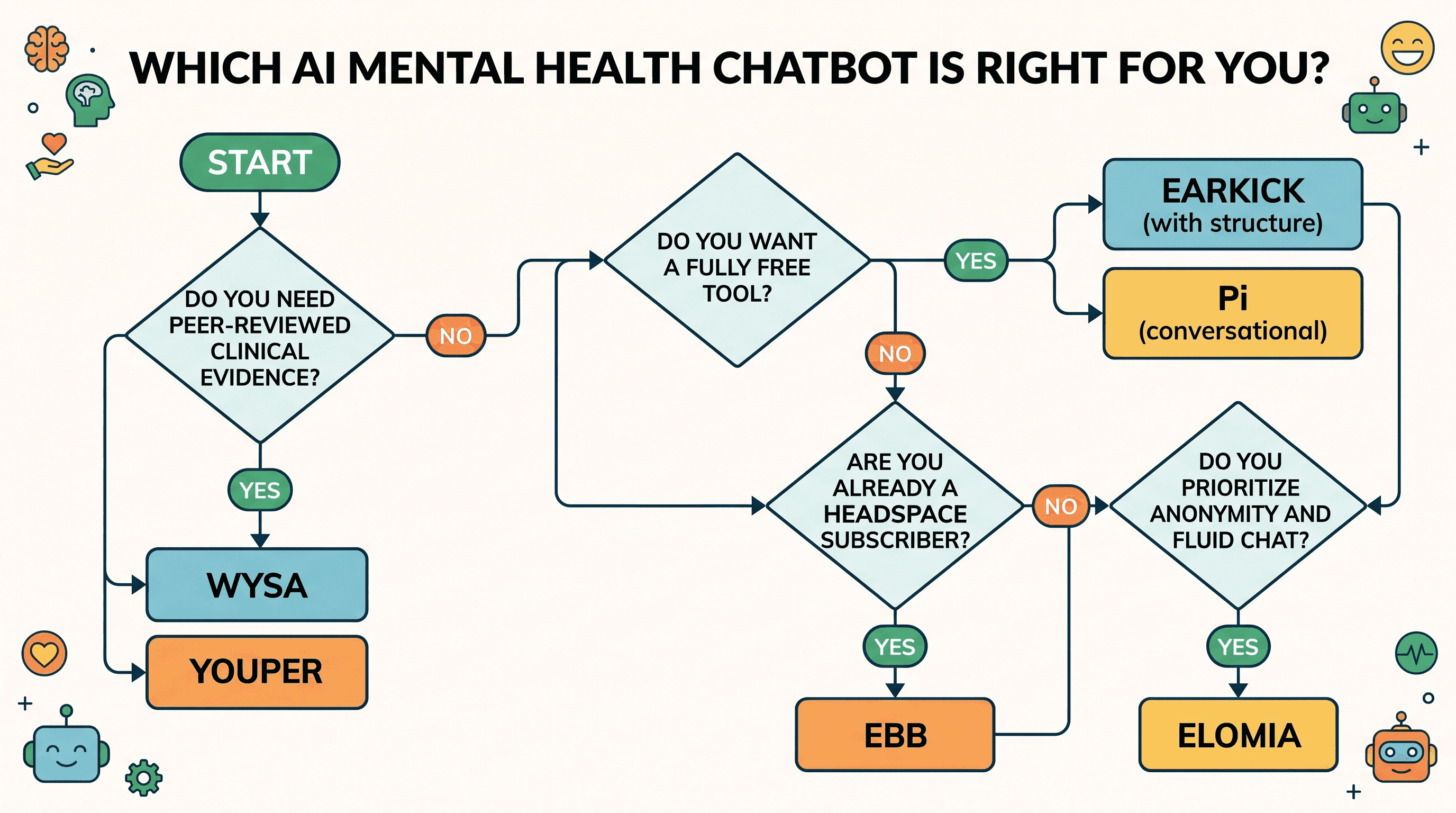
Wysa is the strongest overall pick for clinical credibility, backed by 45 or more peer-reviewed studies. Youper leads on structured CBT and mood tracking with a psychiatrist co-founder. Earkick is the best free option for low-friction daily check-ins. Headspace Ebb suits existing Headspace subscribers who want reflection tied to a mindfulness library. Pi is the most accessible free, open-ended conversational companion. Elomia fits users who want anonymous, natural conversation and are comfortable with a newer platform.
Top Picks
| Category | Recommendation |
|---|---|
| Best Overall | Wysa |
| Best for CBT and Mood Tracking | Youper |
| Best Free Option | Earkick |
| Best for Existing Headspace Users | Headspace Ebb |
| Best Free Open-Ended Companion | Pi by Inflection |
Comparison Table
| Tool | Best For | Price | Free Tier | Rating |
|---|---|---|---|---|
| Wysa | Clinical evidence + hybrid coaching | $74.99/yr | Yes | 4.9 App Store |
| Youper | Mood tracking + CBT check-ins | $69.99/yr | 7-day trial | Stanford-validated |
| Earkick | Zero-friction daily check-ins | $47.99/yr | Yes (core) | 4.8 App Store |
| Headspace Ebb | Mindfulness ecosystem users | $69.99/yr (Headspace) | No | HIPAA-compliant |
| Pi by Inflection | Free open-ended emotional support | Free | Yes (fully) | 1M+ daily users |
| Elomia | Anonymous, conversation-first support | $98.99/yr | 3-day trial | 85% report mood improvement |
How We Ranked
For this list, "best" means a purpose-built AI chatbot that provides evidence-informed emotional support, is currently available to US consumers as of June 2026, operates within transparent clinical or credibility boundaries, and offers a meaningful first layer of mental health support. We scored every eligible entry on six criteria: clinical credibility (30%), scope fit for mental health (30%), cost and value (10%), speed and availability (10%), user experience (10%), and trust signals (10%). This weighting reflects the elevated clinical stakes of mental health content. Scores were totaled and the ranking follows the weighted results in descending order.
Momentary does not currently offer a mental health chatbot, so Momentary does not appear on this list. Two other candidates were excluded before scoring: Woebot, whose consumer app was retired on June 30, 2025 and is no longer accessible to individual users, and Replika, which a 2025 study in the Journal of Medical Internet Research found clinically inappropriate for crisis situations. Evaluation date: June 2026.
1. Wysa, the Most Clinically Validated AI Mental Health Chatbot
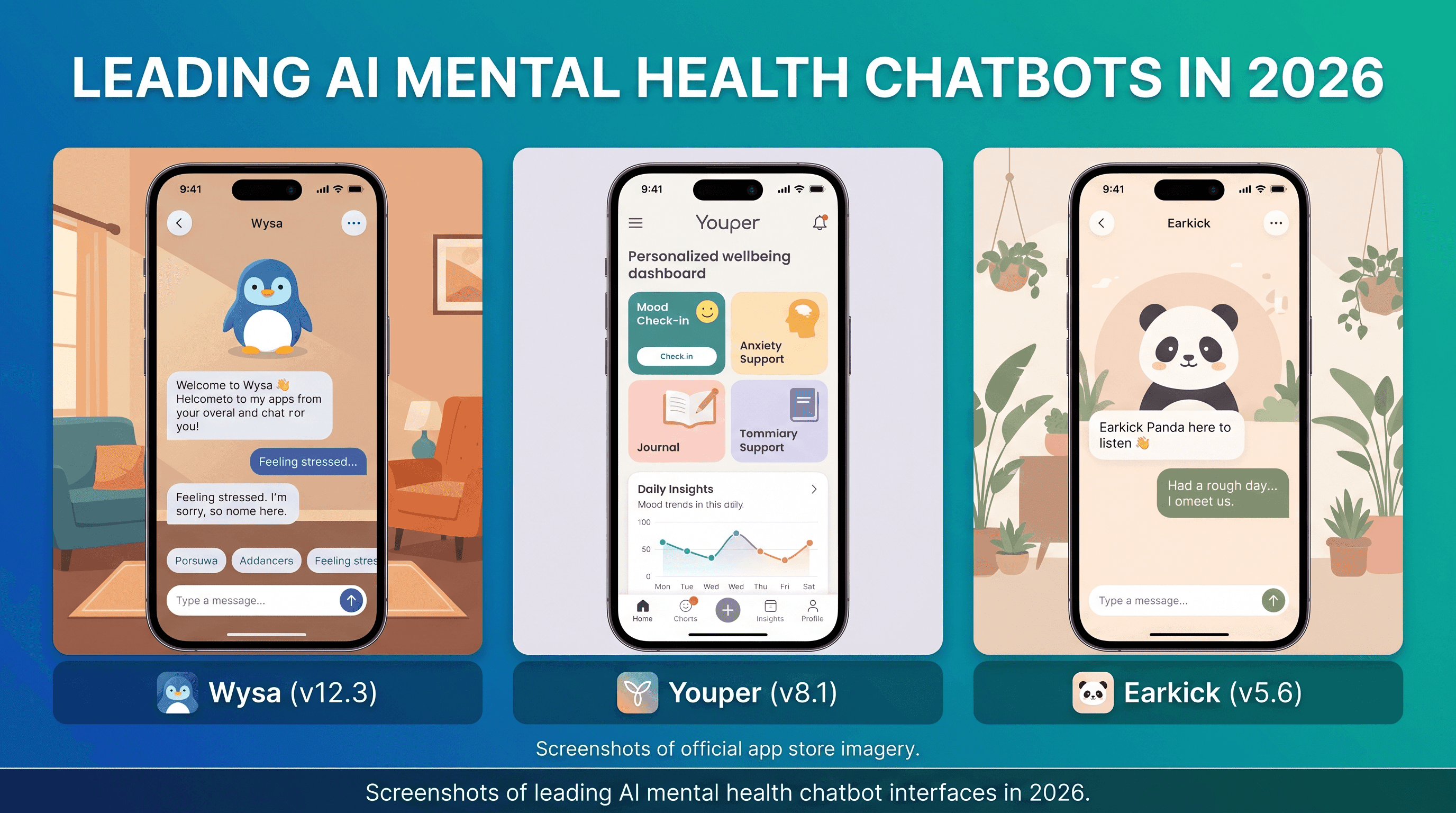
Wysa is a CBT and DBT-grounded AI chatbot from UK-based Touchkin that has accumulated more peer-reviewed clinical attention than almost any other consumer mental health app. The service pairs an always-available conversational AI with an optional library of over 150 structured therapeutic exercises, and users can add one-on-one coaching sessions with human mental health professionals. Wysa operates anonymously, requiring no real name or email to start, and its crisis detection routes users toward hotlines when distress signals appear.
Wysa stands out on clinical credibility because it is supported by 45 or more peer-reviewed studies, has been recognized by NHS innovation programs, and was noted by npj Mental Health Research as having one of the strongest evidence bases among commercial digital mental health tools. A 2021 randomized controlled trial published in JMIR mHealth and uHealth found that Wysa users showed significantly greater depression reduction than wait-list controls. Its scope fit is exceptional: unlike general companion apps, every feature is oriented toward emotional wellness using established therapeutic frameworks.
Strengths
- The evidence base of 45-plus peer-reviewed studies is the most robust in this category, making Wysa the most defensible choice for users who want clinical grounding in their digital support.
- The hybrid model, where users can escalate to human coaching at $19.99 per session without restarting with a new provider, creates a meaningful bridge between self-help and professional care.
- The anonymous design means someone can start a conversation at 4 AM without creating an account.
Limitations
- Long conversations can feel scripted or repetitive, because the chatbot is structured around exercises rather than open-ended dialogue.
- The free version restricts access to most of the exercise library, and the $74.99 annual premium is higher than some alternatives.
Pricing: Free tier available. Premium Self-Care plan at $74.99 per year (7-day free trial). Human coaching from $19.99 per session.
Best for: Adults who want the strongest clinical evidence base and the option to escalate to a human coach without switching platforms.
When to choose something else: If cost is the main barrier, Earkick or Pi offer meaningful free support without Wysa's premium paywall.
Rating: 4.9 stars on the App Store (June 2026, 21,700+ ratings) and 4.7 stars on Google Play (June 2026, 147,000+ ratings).
2. Youper, Best for Mood Tracking and CBT
Youper is an AI-powered emotional health assistant co-founded by psychiatrist Dr. Jose Hamilton, who built the platform around the idea that people need mental health support now, not in three months when an appointment opens. The chatbot uses structured CBT conversations to help users identify cognitive distortions, complete daily mood check-ins, and track anxiety and depression symptoms over time using clinically validated scales including the GAD-7 for anxiety and the PHQ-9 for depression. Over 3 million users have engaged with the platform.
Youper's clinical credibility rests on a Stanford University-affiliated study and the psychiatrist-led foundation of its design. A published study in the Journal of Medical Internet Research found significant anxiety and depression reduction, with reported reductions of 43% in anxiety and 48% in depression symptoms among users. Its scope fit is tight: every feature targets anxiety and depression symptom management, rather than general companionship or productivity.
Strengths
- The inclusion of validated clinical measurement tools like GAD-7 and PHQ-9 lets users track whether they are actually improving, not just feeling heard.
- The psychiatrist co-founder means the clinical underpinning is professional rather than marketing-led.
- At $69.99 per year, it lands among the more affordable structured therapy apps with real clinical grounding.
Limitations
- Youper no longer offers a free tier beyond the 7-day trial, which creates a cost barrier for users who cannot commit to an annual plan.
- The chatbot can feel abrupt compared to more conversational tools, and voice input is not available.
Pricing: $69.99 per year with a 7-day free trial. No monthly subscription option.
Best for: Users managing mild to moderate anxiety or depression who want a structured, data-driven approach with clinical measurement built in.
When to choose something else: If you want a free tier or fully open-ended conversation, Earkick or Pi are better fits.
Rating: Clinically validated by Stanford researchers; 3 million-plus users as of June 2026.
3. Earkick, Best Free App for Daily Check-Ins
Earkick is an AI-powered mental health companion built around a principle most apps ignore: the check-in should take three seconds, not three minutes. Users interact via text, voice, or video with an avatar named Panda, and the app integrates with Apple Watch to pull in biometric signals like heart rate to give the AI more context. No account, email, or personal data collection is required to start. Earkick was founded by Karin Andrea Stephan and Dr. Herbert Bay, and has been recognized by National Geographic, Time, and Forbes.
On clinical credibility, Earkick sits in the middle of this list because its evidence rests primarily on internal observational data rather than peer-reviewed randomized controlled trials. Its scope fit is strong, though it skews toward mood awareness and early stress prevention rather than structured clinical therapy. The app's internal data shows users who engage for five or more months see a 34% improvement in mood and a 32% reduction in anxiety. The zero-friction design, free core tier, and Apple Watch integration give it the best user experience score on this list.
Strengths
- The complete absence of required registration is genuinely unusual and valuable in a mental health context, where privacy concerns are a real barrier to seeking support.
- Apple Watch integration means mood check-ins can correlate with heart rate data, providing a richer picture of stress patterns than text alone.
- Most core features are free with no paywall.
Limitations
- The absence of peer-reviewed randomized controlled trials means Earkick's effectiveness claims are based on internal company data rather than independently verified research.
- The chatbot is better suited to daily awareness and early-stage stress than structured cognitive-behavioral work.
Pricing: Free for core features. Earkick Premium at $7.99 per month or $47.99 per year.
Best for: Users who want a low-commitment, truly free way to build a daily mental health awareness practice, especially those with wearable devices.
When to choose something else: If you want peer-reviewed clinical validation, Wysa or Youper are stronger choices.
Rating: 4.8 stars on the App Store; featured by Time, National Geographic, and Forbes (June 2026).
4. Headspace Ebb, Best for Mindfulness Ecosystem Users
Ebb is the AI companion built into the Headspace subscription, designed and overseen by a team of clinical psychologists and launched for consumer subscribers in 2024. It uses motivational interviewing, a methodology that encourages users to identify and commit to personal change, to help members unpack stress, relationship challenges, and sleep issues. Ebb supports both text and voice input and draws on Headspace's library of meditations and exercises to make personalized activity recommendations after each conversation. Every message sent to Ebb is monitored by Headspace's proprietary Safety Risk Identification system, which classifies messages across seven risk categories including suicidal ideation and self-harm, and routes at-risk users to the 988 Suicide and Crisis Lifeline.
Ebb's clinical credibility is grounded in its clinician-designed framework and one of the most rigorous safety architectures of any app on this list, though it has not yet published independent peer-reviewed effectiveness trials. Its scope fit is moderate: Ebb excels at reflection and mindfulness integration but is not oriented around structured CBT or DBT the way Wysa or Youper are. Headspace is fully HIPAA-compliant.
Strengths
- The 100% message monitoring system with licensed clinician review of flagged content is the most robust safety architecture of any app reviewed here, which matters most on a YMYL category like mental health.
- Voice input and real-time response make Ebb accessible to users who find typing through distress harder than speaking.
- HIPAA compliance and encrypted conversations add institutional trust.
Limitations
- Ebb is not available as a standalone tool and requires a Headspace subscription, meaning users who only want the chatbot pay $69.99 per year for an ecosystem they may not fully use.
- Independent peer-reviewed RCT evidence for Ebb's effectiveness has not yet been published, placing it behind Wysa and Youper on clinical credibility.
- Ebb is restricted to ages 18 and older.
Pricing: Included in a Headspace subscription at $69.99 per year (after free trial). No standalone purchase available.
Best for: Existing Headspace subscribers who want AI-supported self-reflection and a seamless connection to the platform's meditation and mindfulness library.
When to choose something else: If you do not already use Headspace, a standalone tool like Wysa or Earkick is a lower-cost entry point.
Rating: HIPAA-compliant, 100% of messages safety-monitored by licensed clinicians; integrated with a platform trusted by the US Navy (2025 partnership confirmed).
5. Pi by Inflection AI, Best Free Companion for Open-Ended Emotional Support
Pi is a personal AI companion developed by Inflection AI, co-founded by Mustafa Suleyman (formerly of Google DeepMind) and Reid Hoffman (LinkedIn co-founder). Unlike purpose-built therapy apps, Pi is designed entirely around warm, open-ended conversation. It maintains persistent memory across sessions, asks thoughtful follow-up questions, and supports both text and voice interaction on iOS, Android, web, WhatsApp, and SMS. As of June 2026, Pi is free to use with no subscription required, and the platform has reached over 1 million daily active users with average conversation length of approximately 33 minutes.
Pi ranks fifth on this list because its clinical credibility score is the lowest of any included entry: there are no published peer-reviewed studies on Pi's mental health effectiveness, and Pi does not use structured therapeutic frameworks like CBT or DBT. Its scope fit for clinical mental health support is lower than the top four entries. But Pi's cost score is perfect (free), its user experience is excellent (voice-first, no signup friction), and for users who want open, conversational emotional support without a clinical structure, it fills a genuine gap.
Strengths
- Pi is entirely free with no subscription or paywall, making it the most accessible option on this list for users facing cost barriers.
- Voice conversations in real time make it feel closer to speaking with a calm, patient friend than to filling out a wellness app form.
- Persistent memory across sessions means Pi can reference things mentioned weeks ago, providing continuity that most free tools lack.
Limitations
- Pi has zero published peer-reviewed clinical evidence supporting its use as a mental health support tool, which is a significant limitation for anyone dealing with more than mild everyday stress.
- There are no structured CBT or DBT exercises, no crisis escalation pathways to licensed humans, and no clinician oversight of conversations.
- Over-reliance on Pi in place of professional care carries real risk for anyone with moderate to severe symptoms.
Pricing: $0, fully free. Pi Pro at $4.99 per month adds extended features.
Best for: Adults who want a free, voice-enabled companion for reflection and everyday emotional processing, and who understand that Pi is not a clinical mental health tool.
When to choose something else: For structured, clinically validated support, Wysa or Youper are stronger choices.
Rating: 1 million-plus daily active users, 6 million-plus monthly users; average session length 33 minutes (Inflection AI, 2026).
6. Elomia, Best for Anonymous, Conversation-First Support
Elomia is a clinician-designed AI mental health chatbot developed by Elomia Health, Inc., founded in 2018 and built from the beginning around evidence-based psychological practices including CBT, ACT, and DBT. The platform is available on iOS and Android, operates anonymously with no personal data collection, and is designed to feel like a natural, open-ended therapeutic conversation rather than a menu-driven exercise app. Elomia has sent over 5.7 million messages to date, and 9 in 10 users report finding conversations helpful, with 85% reporting a mood improvement after a chat.
Elomia's clinical credibility is genuine but limited: a 2021 academic study reported reductions in anxiety and depression symptoms with regular use, and the University of Pennsylvania is currently running a clinical trial evaluating Elomia's efficacy in college students. Independent peer-reviewed RCTs have not yet been published, which places Elomia below Wysa and Youper on the clinical credibility dimension. Its scope fit is solid: the tool addresses anxiety, stress, depression, loneliness, and difficult thoughts explicitly, with crisis detection that redirects users to appropriate resources. Elomia was named to the Google for Startups Ukraine Support Fund in 2024.
Strengths
- Elomia's conversation style is among the most natural of any app on this list, with open-ended, free-form dialogue that users consistently describe as feeling personal rather than scripted.
- Complete anonymity, with no email or name required, removes the registration friction that causes many people to abandon mental health apps before the first session.
- The AI detects when a person needs more than a chatbot and redirects to professional resources.
Limitations
- Elomia does not have published independent peer-reviewed randomized controlled trials, which means effectiveness claims rely on observational and internal data.
- The paywall activates after only a 3-day trial period, the shortest trial of any app on this list.
- Pricing is also the highest annual rate on this list.
Pricing: 3-day free trial. $28.99 per month or $98.99 per year. Lifetime plan also available.
Best for: Users who want an anonymous, conversation-first experience and are comfortable with a newer platform whose clinical validation is still building.
When to choose something else: If cost or trial length is a concern, Wysa or Earkick offer longer or ongoing free access.
Rating: 85% of users report mood improvement; over 5.7 million messages sent as of June 2026 (Elomia).
When to See a Real Provider Instead
Whether an AI chatbot is helpful and whether a real provider is better are two different questions. These tools work well for daily emotional support, mild anxiety and stress, and building a reflective practice. They do not replace a licensed clinician for moderate or severe symptoms, ongoing mental health conditions, or anything involving a crisis.
If your symptoms are persistent, worsening, or affecting daily functioning, the next step is figuring out what kind of care actually fits your situation. Momentary's AI healthcare navigator is free and available nationwide, and can help you think through symptoms and decide whether self-care, telehealth, primary care, or an in-person visit makes sense. Momentary's physician-reviewed guidance is available for $19.99 and is currently offered only in California. Momentary does not diagnose conditions or provide mental health treatment itself; it helps you figure out the appropriate next step. You can explore Momentary's healthcare navigator to get guidance before deciding where to go next.
This article is for informational purposes only and should not be considered medical advice. If you have questions about your health, consult a qualified healthcare professional. If you think you may be experiencing a medical emergency, call 911 or go to the nearest emergency room immediately.
Frequently Asked Questions
Which AI chatbot is best for mental health?
Wysa earns the top position for clinical credibility, with 45-plus peer-reviewed studies and an NHS-recognized evidence base. For users who want free and frictionless support without clinical structure, Earkick and Pi are the strongest free options. The best choice depends on what someone needs: structured CBT exercises favor Wysa or Youper; daily mood awareness favors Earkick; open emotional conversation favors Pi.
Which AI tool is best for health questions generally?
Purpose-built health chatbots outperform general-purpose tools for mental health support. A 2019 systematic review in World Psychiatry found that only 3% of mental health apps have any published clinical evidence, which means tool selection is critical. For general wellness questions and health information, Momentary's free AI health navigator can help you explore symptoms, understand what they might mean, and get guidance on next steps before or between provider visits.
Is ChatGPT or Gemini a better therapist?
Neither ChatGPT nor Gemini is a therapist, and neither should be used as one. Simply Psychology's clinical review notes that general-purpose large language models have no systematic safety protocols for mental health conversations, no human escalation pathways, and no crisis detection systems. Apps like Wysa and Youper are specifically designed around these safeguards. A 2025 randomized trial found that AI chatbots reduce anxiety symptoms by around 30%, compared to 45% for human therapists. The gap grows significantly with symptom severity.
What are the 3 best AI chatbots for mental health in 2026?
Based on our scoring methodology: Wysa leads on clinical evidence with 45-plus peer-reviewed studies and a 4.9 App Store rating. Youper leads on structured mood tracking with a psychiatrist co-founder and Stanford-affiliated clinical validation. Earkick leads on accessibility, with a free core tier, no registration required, and Apple Watch integration for biometric-backed mood tracking.
Are AI mental health chatbots safe to use?
Purpose-built tools like Wysa, Youper, and Headspace Ebb include dedicated crisis detection and redirect users to human resources when distress signals appear. General-purpose chatbots do not have these safeguards consistently in place. The American Psychological Association has urged the Federal Trade Commission to increase scrutiny of mental health AI tools that lack clinical validation. No AI mental health app currently has FDA clearance for psychiatry use, and all reviewed tools explicitly state they do not replace professional care.
What should I do if I am in a mental health crisis?
Do not rely on an AI chatbot in a crisis. Call or text 988 (the Suicide and Crisis Lifeline) from anywhere in the US, available 24/7. Text HOME to 741741 to reach the Crisis Text Line. If you are in immediate danger, call 911 or go to the nearest emergency room.
References
- Fitzpatrick, K.K., Darcy, A., & Vierhile, M. (2017). Delivering cognitive behavior therapy to young adults with symptoms of depression and anxiety using a fully automated conversational agent (Woebot): a randomized controlled trial. JMIR Mental Health, 4(2). https://mental.jmir.org/2017/2/e19/
- Wysa / JMIR mHealth and uHealth (2021). Clinical RCT demonstrating significantly greater depression reduction in Wysa users vs. wait-list controls. https://mhealth.jmir.org/
- Abd-Alrazaq, A., et al. (2020). Effectiveness of AI chatbots on depression, anxiety, and stress. Journal of Medical Internet Research, 22(7). https://www.jmir.org/
- Baumel, A. (2019). Only 3% of mental health apps have any published clinical evidence. World Psychiatry. https://www.ncbi.nlm.nih.gov/pmc/articles/PMC6127753/
- American Psychological Association. (2026). 2026 Chatbots and Mental Health Survey. https://www.apa.org/pubs/reports/chatbots-mental-health-2026
- National Academy of Medicine. (2026). AI Chatbots for Mental Health: What Works, What Harms, and What's Next. https://nam.edu/news-and-insights/ai-chatbots-for-mental-health-what-works-what-harms-and-whats-next/
- National Institute of Mental Health. No FDA-approved or FDA-cleared AI therapy apps currently exist in psychiatry. https://www.nimh.nih.gov/
- Headspace AI Principles page. 100% of messages to Ebb are monitored by proprietary Safety Risk Identification system. https://www.headspace.com/ai
- Simply Psychology. (2026). AI Mental Health Apps: Research-based comparison. https://www.simplypsychology.com/articles/ai-mental-health-apps-comparison-2026
- Lancet Digital Health. (2021). Digital mental health interventions significantly reduce waiting times and reach underserved populations. https://www.thelancet.com/journals/landig/home


