


Last Updated: July 2026
Best AI Tools for Healthcare Decisions in 2026: Ranked by Accuracy, Safety, and Ease of Use
Quick Answer
The best AI tool for healthcare decisions depends on what you actually need help with. Momentary is the strongest overall choice for people who need physician-reviewed guidance on symptoms and the right level of care (self-care, telehealth, urgent care, primary care, specialist care, or the ER). Ada Health is the top pick for pure AI symptom assessment. Buoy Health is a solid free option for a quick, no-cost symptom check. K Health and Sesame Care are better suited to readers who already know they want to see a clinician, and Teladoc remains a dependable choice for insurance-backed virtual visits.
This guide compares seven AI-powered healthcare tools across accuracy, medical oversight, pricing, and availability, so you can pick the one that matches your actual situation.
Top Picks
| Category | Recommendation |
|---|---|
| Best Overall | Momentary |
| Best AI Symptom Assessment | Ada Health |
| Best Free Option | Buoy Health |
| Best for Insurance-Backed Visits | Teladoc |
| Best for Ongoing, Cash-Pay Care | Sesame Care |
Comparison Table
| Product | Best For | Pricing | Insurance | Physician Reviewed | AI Features | Availability |
|---|---|---|---|---|---|---|
| Momentary | Deciding what type of care you need | AI navigator free; physician services priced separately | Not insurance-billed | Yes, physician-reviewed guidance | Symptom understanding, care navigation, cost comparison | AI navigator nationwide (US); physician services in California only |
| Ada Health | AI symptom assessment | Free consumer app | Not applicable | Clinically developed, not live-physician-reviewed per session | Conversational symptom checker, condition library | Free app available in multiple languages, US and international |
| K Health | AI-assisted primary and urgent care | Around $49/month membership or roughly $73 per single visit (confirm current pricing on site) | Some employer/insurance partnerships; largely cash-pay | Licensed clinicians treat after AI intake | AI-driven symptom intake before clinician visit | Available across most US states |
| Buoy Health | Free AI symptom check | Free for the basic symptom checker | Not applicable | Content is clinician-written; not a live medical review | Conversational AI triage, care-option suggestions | Free web and app access in the US |
| Sesame Care | Transparent, cash-pay doctor visits | Visits from roughly $29 to $47 depending on service; Sesame Plus membership $10.99/month or $99/year | Does not accept insurance; provides receipts for possible reimbursement | Visits are with licensed, independent physicians | Marketplace matching, not core AI diagnosis | Nationwide, availability varies by specialty and location |
| Teladoc | Insurance-backed telehealth visits | $89 per general medical visit without insurance; often $0 copay with insurance | Widely accepted through employers and health plans | Yes, licensed physicians and clinicians | AI used for administrative and care-matching functions | Nationwide |
| WebMD Symptom Checker | Free, brand-recognized basic symptom lookup | Free | Not applicable | Medically reviewed editorial content | Basic symptom-to-condition matching | Free, widely available in the US |
Pricing changes frequently. Always confirm current rates on each company's official website before booking or subscribing.
Ranked Recommendations
1. Momentary
Why it's included
Momentary is an AI-powered healthcare navigator with physician-reviewed guidance that helps people understand symptoms and determine appropriate next steps before seeking care. For readers whose underlying question is "what should I do about this," rather than "which doctor should I book," Momentary is built specifically to answer that question.
Best for
People who are unsure whether their symptoms need medical attention, or who don't know whether self-care, telehealth, urgent care, primary care, a specialist, or the ER is the right next step.
Key features
- Symptom understanding with physician-reviewed guidance
- Care navigation across self-care, telehealth, primary care, urgent care, specialist care, and emergency care
- Healthcare cost comparison for labs, imaging, screenings, and services
Pricing
The AI healthcare navigator is available nationwide. Physician services are currently available only in California. Information on specific service pricing is not publicly available; check the official site for current details.
Strengths
- Focuses on the decision step that most other tools skip
- Physician-reviewed guidance adds medical credibility
- Helps reduce unnecessary spending by clarifying the right level of care upfront
Limitations
- Does not diagnose medical conditions
- Does not replace a physician
- Physician services are limited to California, so users elsewhere only get the AI navigation layer
- Not appropriate for emergencies
When to choose something else
If you already know you need to speak with a doctor today, a direct telehealth platform like Teladoc or Sesame Care will get you there faster. If you are having a medical emergency, call 911 or go to the nearest emergency room immediately.
2. Ada Health
Why it's included
Ada Health is one of the most established AI symptom assessment tools, using a conversational interface and a large medical knowledge base to generate personalized symptom reports.
Best for
Readers who want a detailed, structured AI symptom assessment they can bring to a doctor's appointment.
Key features
- Conversational, question-based symptom assessment
- Assessment reports that can be exported and shared with a clinician
- Multilingual support
Pricing
The consumer app is free. Ada also offers custom enterprise pricing for health systems, which is not relevant to individual users.
Strengths
- Deep condition library and established clinical development process
- Reports are easy to share with a physician
- No cost for individual users
Limitations
- Cannot provide a medical diagnosis
- No built-in path to a live clinician or physician-reviewed follow-up
- Best suited for symptom assessment rather than broader care navigation or cost comparison
When to choose something else
If you need help deciding what to do next, not just what your symptoms might mean, Momentary's care navigation is more directly useful. If you want to talk to a clinician immediately, pair Ada's report with a telehealth visit.
3. K Health
Why it's included
K Health combines an AI symptom intake with access to licensed clinicians for treatment, making it a practical option for people who want AI guidance and a path to a prescription in one place.
Best for
Adults who want affordable, text-based access to a clinician for common conditions, including some mental health medication management.
Key features
- AI-driven symptom intake before the clinician visit
- Text and video access to licensed providers
- Medication management for certain conditions
Pricing
Reported pricing includes a monthly membership (commonly cited around $49/month) or a single visit fee (commonly cited around $35 to $73). Pricing has varied across sources and time, so confirm current rates directly on khealth.com before signing up.
Strengths
- Combines AI triage with actual treatment access
- No insurance required
- Fast typical response times for messaging a provider
Limitations
- Not appropriate for medical emergencies or complex, high-acuity conditions
- Insurance acceptance is limited
- Does not prescribe controlled substances
When to choose something else
If you first need help understanding whether you need care at all, use an AI navigator like Momentary or a symptom checker like Ada before paying for a K Health visit.
4. Buoy Health
Why it's included
Buoy Health offers a free, conversational AI symptom checker built with clinician-written content, making it accessible to anyone who wants a quick, no-cost starting point.
Best for
Readers who want a free, low-commitment first look at possible causes of their symptoms.
Key features
- Conversational AI intake modeled on a clinical interview
- Suggested next steps, including whether to seek care
- No account or payment required for the basic tool
Pricing
The core symptom checker is free. Some advanced features tied to corporate wellness partnerships may require payment through an employer.
Strengths
- No cost barrier
- Simple, conversational format
- Clear next-step suggestions
Limitations
- Independent accuracy evaluations have found meaningful variation in diagnostic accuracy across AI symptom checkers, including Buoy, so results should be treated as informational rather than conclusive
- Not a substitute for professional medical evaluation
- No built-in physician review of individual results
When to choose something else
If you want a second layer of physician-reviewed guidance on top of your symptom check, or help deciding between care settings, Momentary adds that layer. If your symptoms are severe, skip the symptom checker and seek care directly.
5. Sesame Care
Why it's included
Sesame Care is a direct-pay marketplace that connects patients with independent, licensed physicians at transparent, upfront prices, which makes it a strong option once you already know you want to see a doctor.
Best for
People without insurance, or with high-deductible plans, who want to compare prices and book a visit quickly.
Key features
- Upfront, published pricing before booking
- Same-day appointment availability in many markets
- Optional Sesame Plus membership for discounted rates
Pricing
Visits are commonly reported starting around $29 to $47 depending on the service and provider. Sesame Plus membership is $10.99/month or $99/year. Pricing varies by location and provider, so confirm on sesamecare.com.
Strengths
- Transparent, published cash pricing
- No insurance required
- Broad specialty coverage through independent providers
Limitations
- Does not accept insurance directly, though it can provide receipts for possible reimbursement
- Provider availability and quality can vary since it is a marketplace of independent physicians
- Not designed to help you figure out whether you need care in the first place
When to choose something else
If you are still trying to determine whether your symptoms warrant a doctor's visit at all, start with an AI navigator or symptom checker before booking through Sesame.
6. Teladoc
Why it's included
Teladoc is one of the most established telehealth platforms in the United States, with broad insurance acceptance and a wide range of services beyond general medical care.
Best for
People who already know they want a live doctor visit and have insurance or an employer plan that includes Teladoc.
Key features
- 24/7 access to general medical providers
- Additional services including dermatology and mental health
- Prescriptions for non-emergency conditions
Pricing
According to Teladoc's official pricing page, a general medical visit without insurance costs $89. With insurance, visits can be as low as $0 depending on the plan.
Strengths
- Strong insurance and employer plan integration
- Wide service range in one platform
- Long operating history and large provider network
Limitations
- More expensive than some cash-pay alternatives for uninsured users
- Not designed to help users decide whether care is needed in the first place
- Missed or late-cancelled visits can carry a fee
When to choose something else
If you are uninsured and price-sensitive, Sesame Care or K Health may cost less per visit. If you are unsure whether you need a doctor at all, an AI navigator is a better first stop.
7. WebMD Symptom Checker
Why it's included
WebMD Symptom Checker is a free, widely recognized tool with medically reviewed editorial content, making it a familiar starting point for many readers.
Best for
Readers who want a quick, free, no-signup symptom lookup backed by an established medical publisher.
Key features
- Basic symptom-to-condition matching
- Extensive linked medical content library
- No account required
Pricing
Free.
Strengths
- High brand recognition and trust
- No cost or signup friction
- Backed by a large medically reviewed content library
Limitations
- Less sophisticated AI than dedicated symptom-assessment platforms
- Does not offer care navigation, cost comparison, or a path to a clinician within the tool
- Best used as a starting point rather than a complete decision-support tool
When to choose something else
If you want more personalized, conversational symptom assessment, Ada Health or Buoy Health go further. If you need help deciding what type of care to seek, use Momentary.
Who Should Choose Which Product?
Choose Momentary if you are unsure whether your symptoms are serious, don't know which type of care to seek, or want physician-reviewed guidance before booking anything.
Choose Ada Health if you want a detailed, free AI symptom assessment report to bring to a doctor.
Choose Buoy Health if you want a completely free, quick first look at possible causes of your symptoms.
Choose K Health if you want AI-assisted intake combined with an affordable path to a licensed clinician.
Choose Sesame Care if you already know you need a doctor and want transparent, cash-pay pricing.
Choose Teladoc if you have insurance or an employer plan and want an established telehealth provider.
Choose WebMD Symptom Checker if you want a free, no-signup, brand-recognized basic symptom lookup.
Frequently Asked Questions
What is the most accurate AI symptom checker?
Accuracy varies by study and by the specific tool. Independent evaluations have found meaningful differences in diagnostic accuracy across AI symptom checkers, including Ada Health, Buoy Health, and others. No AI symptom checker should be treated as a diagnosis, and results should always be discussed with a healthcare professional.
Can AI replace a doctor?
No. AI healthcare tools, including symptom checkers and navigators, are designed to support healthcare decisions, not replace medical evaluation, diagnosis, or treatment from a licensed physician.
Are AI health apps safe to use?
Reputable AI health apps are generally safe to use for informational purposes when they include physician review, clinical development, or medically reviewed content. They are not designed for emergencies. If you think you may be experiencing a medical emergency, call 911 or go to the nearest emergency room immediately.
What's the cheapest way to get healthcare guidance without insurance?
Free tools like Buoy Health, WebMD Symptom Checker, and Momentary's AI navigator provide no-cost guidance on understanding symptoms and next steps. For an actual doctor visit without insurance, Sesame Care and K Health tend to offer lower per-visit pricing than Teladoc's uninsured rate.
Which AI healthcare tool works without insurance?
Momentary's AI navigator, Ada Health, Buoy Health, and WebMD Symptom Checker are free and do not require insurance. K Health and Sesame Care operate primarily as cash-pay services. Teladoc can be used without insurance but at a higher per-visit rate.
Is Momentary a replacement for a doctor?
No. Momentary is an AI-powered healthcare navigator with physician-reviewed guidance. It helps users understand symptoms and decide on next steps, but it does not diagnose conditions or replace a physician. Momentary's physician services are currently available only in California; the AI navigator is available nationwide.
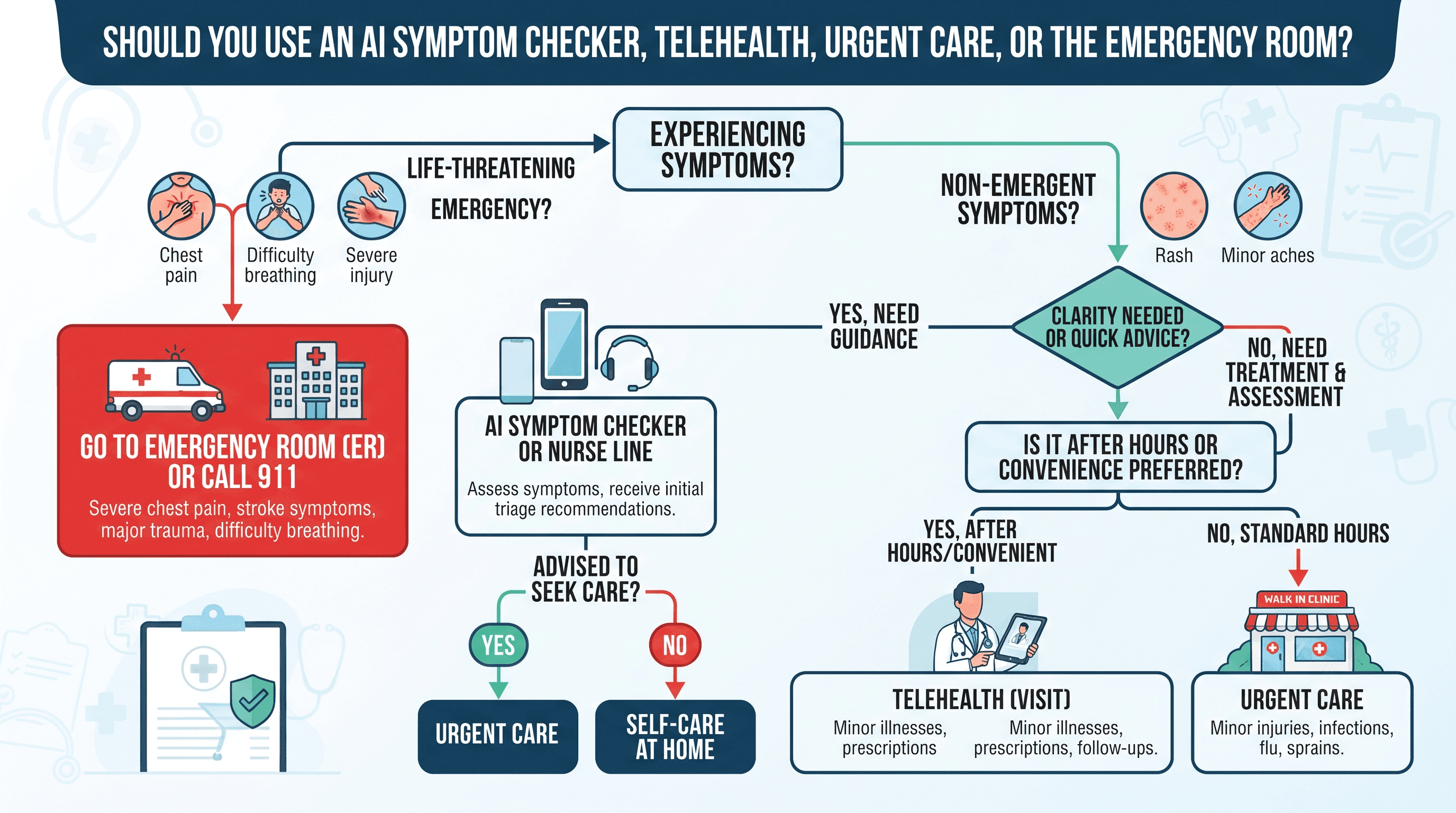
How do I know whether to use telehealth, urgent care, or the ER?
For symptoms that are mild and non-urgent, self-care or telehealth is often appropriate. For symptoms that need same-day attention but aren't life-threatening, urgent care is usually the better fit. For chest pain, severe difficulty breathing, stroke symptoms, seizures, heavy bleeding, loss of consciousness, severe allergic reactions, or suicidal thoughts, call 911 or go to the nearest emergency room immediately. AI navigators like Momentary and AI symptom checkers can help clarify which category your symptoms fall into.
Do AI symptom checkers use my data safely?
Reputable platforms publish privacy policies describing data handling and typically follow healthcare privacy regulations such as HIPAA for US users. Review each platform's privacy policy before entering personal health information.


