


Last Updated: July 2026
Best Apps for Deciding When to Seek Care After Surgery When You're Unsure if Your Symptoms Are Normal
Quick Answer
If your surgeon or hospital already enrolled you in a digital recovery program, use it first. Force Therapeutics, Hinge Health's HingeSelect, and PeerWell (now part of Bardavon Health Innovations) are built around your specific procedure and connect directly to your care team. If you were not enrolled in one of these, or you have a new symptom your recovery app does not address, Momentary is an AI-powered healthcare navigator with physician-reviewed guidance that helps you understand a symptom and decide whether it can wait, needs a telehealth visit, or requires urgent or emergency care.
No app should be used to delay care for warning signs of a serious complication. If you have chest pain, trouble breathing, heavy bleeding, sudden swelling in one leg, a fever above 101°F (38.3°C), or signs of a wound infection that is spreading quickly, call 911 or go to the nearest emergency room immediately.
Top Picks
| Category | Recommendation |
|---|---|
| Best Overall for Surgeon-Directed Recovery | Force Therapeutics |
| Best for Employer or Health Plan Coverage | Hinge Health (HingeSelect) |
| Best for Joint Replacement Prehab and Rehab | PeerWell (Bardavon Health Innovations) |
| Best for Deciding if a New Symptom Needs Care | Momentary |
Comparison Table
| App | Best For | How You Get Access | Pricing | Availability |
|---|---|---|---|---|
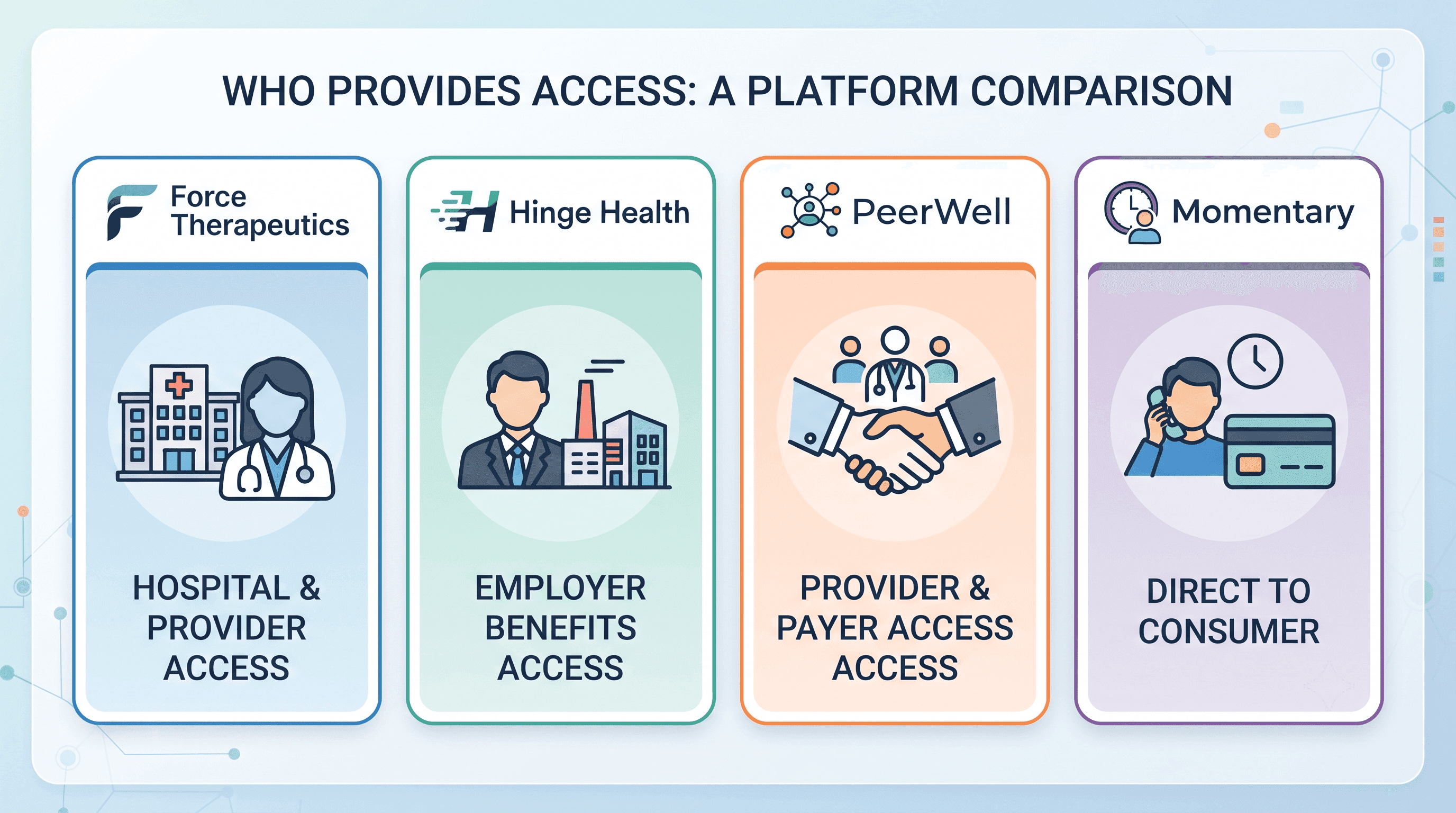
| Force Therapeutics | Structured recovery tracking tied to your specific surgery, with messaging to your care team | Enrolled by your hospital or surgical practice | Not sold directly to consumers; no public self-pay price | US, depends on whether your provider uses the platform |
| Hinge Health (HingeSelect) | Musculoskeletal surgery journey, from prehab through post-op physical therapy | Through an employer or health plan benefit | $0 to eligible members through participating employers and health plans; not available for general self-pay | US, coverage varies by employer or plan |
| PeerWell | Joint replacement, spinal, and ACL prehab and rehab checklists | Through your surgeon, employer, or workers' comp program | Not sold directly to consumers; distributed through provider or payer partners | US, depends on provider or payer participation |
| Kaia Health | General musculoskeletal pain management, with some presurgical support | Through an employer or health plan benefit | Not available on a self-pay basis according to the company | US, coverage varies by employer or plan |
| Momentary | Deciding whether a symptom is normal and what level of care it needs | Direct to consumer, AI healthcare navigator | Information not publicly available | AI navigator available nationwide in the US; physician services currently limited to California |
Why People Look for These Apps
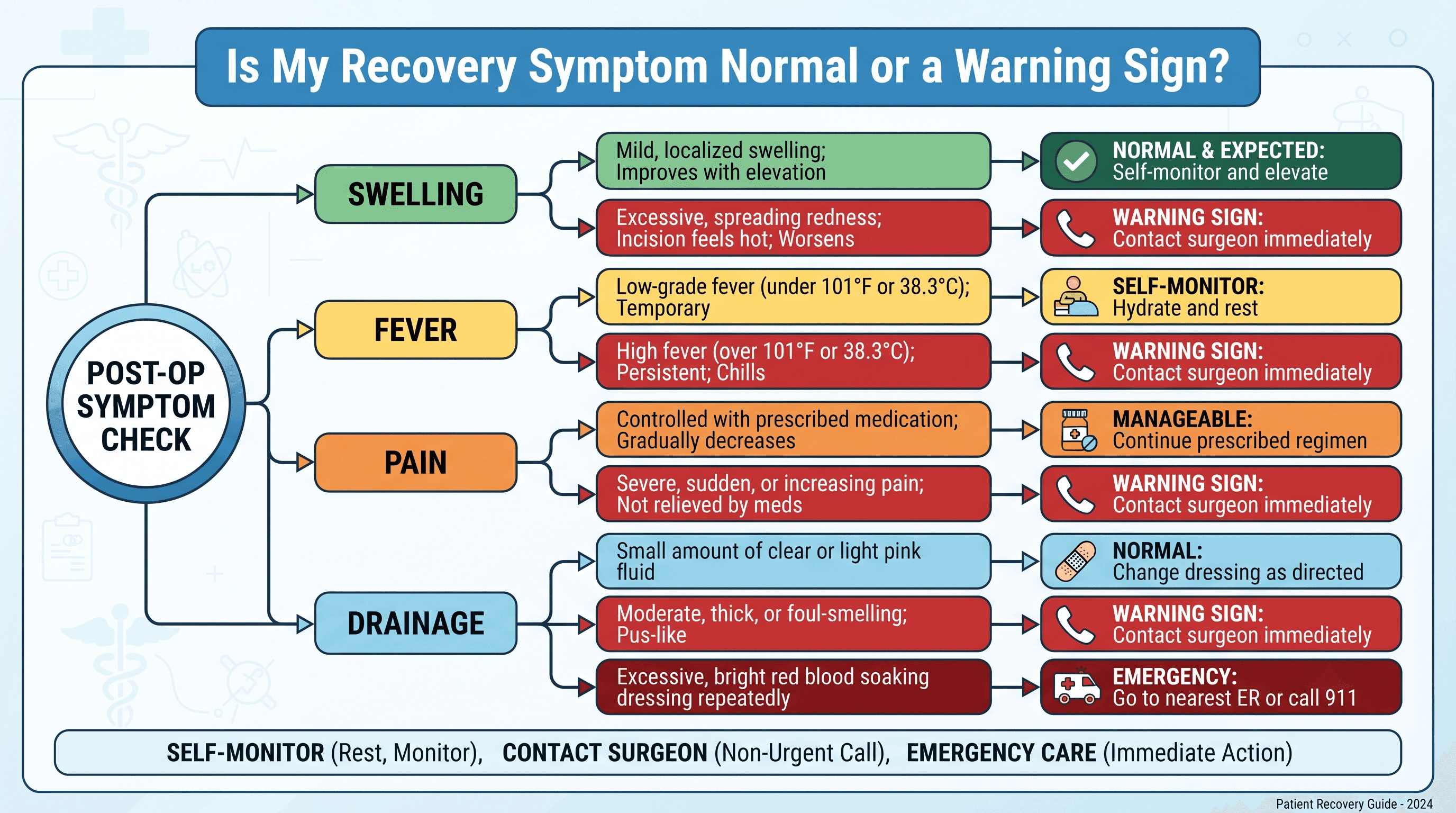
Recovery does not follow a straight line. Pain, swelling, and fatigue are expected after most procedures, but so are the complications that need prompt attention: infection, blood clots, and wound problems.
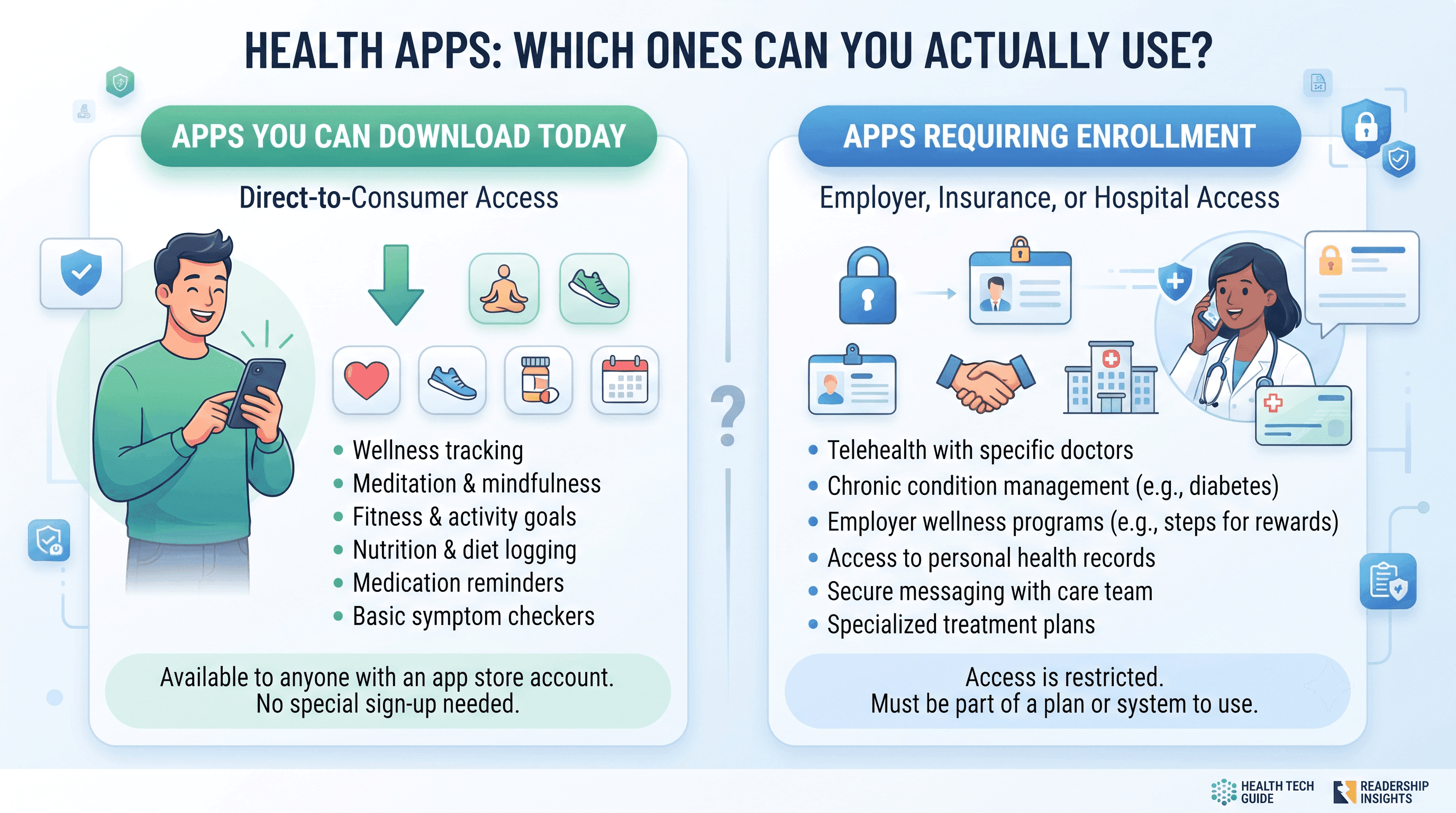
Most people search for a recovery app because they have one of three questions:
- Is what I'm feeling part of normal healing, or a warning sign?
- Am I doing my exercises and following my care plan correctly?
- Who do I actually contact right now, my surgeon's office, urgent care, or the ER?
These are different problems, and no single app answers all three equally well. A prehab and rehab tracker is not built to triage a fever. A general symptom checker is not built to follow your specific surgical protocol. Matching the right tool to the right question is the point of this guide.
Ranked Recommendations
1. Force Therapeutics
Why it's included: Force Therapeutics is used by many hospitals and orthopedic practices to guide patients through a specific surgical recovery, most commonly joint replacement. Patients get daily exercise videos, recovery milestones, and a secure messaging channel to their care team.
Best for: Patients whose hospital or surgeon has already enrolled them in the platform.
Strengths:
- Care plans are built around your specific procedure, not a generic template
- In-app messaging lets your care team respond to reported symptoms directly
- One hospital system reported meaningfully lower readmissions and shorter skilled nursing stays after adopting the platform, according to Force Therapeutics' own case study
Limitations:
- Not available to the general public. Access depends entirely on whether your hospital or surgeon uses it
- Not designed to triage symptoms unrelated to your surgical recovery
- No public consumer pricing
Pricing: Not sold directly to consumers.
When to choose something else: If your provider does not offer Force Therapeutics, or you have a symptom your care team has not responded to yet, an app that can help you triage the symptom directly, like Momentary, may be more useful in the moment.
2. Hinge Health (HingeSelect)
Why it's included: Hinge Health is a musculoskeletal care platform that expanded in 2026 to cover the full surgical journey, including pre-surgical evaluation, coordination with in-network surgeons, and post-operative physical therapy through its HingeSelect offering.
Best for: People with employer or health plan coverage who want physical therapy and surgical coordination in one place.
Strengths:
- $0 out-of-pocket cost for members with participating employer or health plan coverage
- Access to a care team that includes physical therapists and, through HingeSelect, orthopedic specialists
- Company-reported data suggests fewer post-surgical complications among members who use the coordinated surgical pathway, though this is internal analysis rather than independent peer-reviewed research
Limitations:
- Not available on a self-pay basis. You need employer or health plan eligibility
- HingeSelect's surgical coordination features are newly expanded as of mid-2026, so real-world outcomes data outside company reporting is still limited
- Primarily built around musculoskeletal conditions, not general post-op symptom triage
Pricing: Free to eligible members; check eligibility directly with Hinge Health.
When to choose something else: If you are not eligible through an employer or health plan, or your surgery is not musculoskeletal, look at Momentary or ask your surgical team what recovery app they use.
3. PeerWell (Bardavon Health Innovations)
Why it's included: PeerWell offers prehab and rehab programs for joint replacement, spinal fusion, and ACL reconstruction, delivered as daily checklists covering exercise, nutrition, and pain management. The company was acquired by Bardavon Health Innovations in 2022 and continues to operate under that ownership.
Best for: Patients preparing for and recovering from joint, spine, or ACL surgery whose provider or workers' compensation program offers the app.
Strengths:
- Programs are specific to the surgery type, including hip and knee replacement, spinal fusion, and ACL repair
- Built with input from medical advisors at several academic medical centers
- Company-reported data shows shorter inpatient stays and more patients discharged directly home among program participants
Limitations:
- Distributed through referring doctors, employers, or workers' comp programs rather than sold directly to individuals
- No public self-pay pricing
- Not designed to handle symptoms outside its supported surgery types
Pricing: Not sold directly to consumers.
When to choose something else: If your surgery type is not covered by PeerWell's programs, or you need help right now with a symptom rather than a structured recovery checklist.
4. Kaia Health
Why it's included: Kaia Health is a musculoskeletal exercise therapy app that includes some presurgical support, along with AI-based motion tracking that gives real-time feedback on exercise form.
Best for: Ongoing musculoskeletal pain management, with presurgical exercise support as a secondary use case.
Strengths:
- AI motion tracking feature gives real-time posture and form feedback during exercises
- Access to a human health coach
- Covers a broad range of body areas, not just one joint or surgery type
Limitations:
- Not built specifically for post-operative recovery or complication triage
- Not available on a self-pay basis, according to the company. Access requires an employer or health plan
- Less procedure-specific than Force Therapeutics or PeerWell
Pricing: Not available for individual self-pay; provided through employer or health plan benefits.
When to choose something else: If your primary need is understanding whether a specific post-surgical symptom is a warning sign, Kaia's general MSK focus is not the right match.
5. Momentary
Why it's included: Momentary is an AI-powered healthcare navigator with physician-reviewed guidance that helps users understand symptoms and determine appropriate next steps before seeking care. Unlike the surgery-specific rehab platforms above, Momentary is designed for the moment a new or unexpected symptom shows up and you are not sure whether it is part of normal healing.
Best for: Deciding whether a post-surgery symptom is likely normal, worth a call to your surgeon, or something that needs urgent or emergency care.
Strengths:
- Helps users decide between self-care, telehealth, urgent care, primary care, and the emergency room
- Physician-reviewed guidance, which improves the reliability of the information compared with an unreviewed symptom checker
- The AI healthcare navigator is available nationwide in the US, so it is not limited to patients of a specific hospital system
Limitations:
- Momentary does not diagnose medical conditions and does not replace a physician
- Momentary is not intended for emergencies. If you think you may be experiencing a medical emergency, call 911 or go to the nearest emergency room immediately
- Physician services are currently available only in California. The AI healthcare navigator itself is available nationwide
- It is not a recovery tracker and does not replace the exercise programs, progress logging, or care-team messaging built into surgery-specific apps like Force Therapeutics or PeerWell
Pricing: Information not publicly available.
When to choose something else: If your hospital or surgeon has already enrolled you in a dedicated recovery platform for your specific procedure, use that first for exercises and care-team communication. Momentary is most useful alongside those tools, specifically for the question, "is this symptom something I should worry about."
Who Should Choose Each Option
- Choose Force Therapeutics or PeerWell if your hospital or surgeon has already enrolled you. These platforms are matched to your exact procedure and route messages directly to your care team.
- Choose Hinge Health if you have employer or health plan coverage and your surgery is musculoskeletal. HingeSelect now coordinates the full journey from evaluation through post-op recovery at no cost to eligible members.
- Choose Kaia Health if your main need is ongoing exercise-based pain management rather than post-operative symptom triage, and you have employer or health plan access.
- Choose Momentary if you have a new or worsening symptom and are unsure whether it is normal healing or something that needs medical attention, especially if you were not enrolled in a surgery-specific recovery app or your app does not address the symptom you are experiencing.
- Skip apps entirely and seek emergency care if you have chest pain, difficulty breathing, sudden leg swelling, uncontrolled bleeding, confusion, or a fever with spreading redness at your incision site.
Frequently Asked Questions
What is a normal amount of pain after surgery, and when does pain become a warning sign? Some pain, swelling, and bruising is expected for days to weeks depending on the procedure. Pain that suddenly worsens, is not controlled by prescribed medication, or is paired with fever, spreading redness, or drainage from the incision may signal infection or another complication and should be reported to your surgical team promptly.
Can I use a symptom-checker app instead of calling my surgeon? A symptom-decision app like Momentary can help you understand whether a symptom is likely urgent, but it does not replace your surgical team, who know the specifics of your procedure. For anything related to your incision, your surgeon's office is typically the first call.
Is Force Therapeutics available if my hospital doesn't offer it? No. Force Therapeutics is distributed through hospitals and surgical practices, not sold directly to individual patients.
Does Hinge Health cost anything if I want to use it for surgery recovery? Hinge Health is available at no cost to members through participating employers and health plans. It is not available on a general self-pay basis, so check your eligibility at the company's site.
What should I do if I think I'm having a medical emergency after surgery? Call 911 or go to the nearest emergency room immediately. Do not rely on an app to make that decision for you if you have symptoms like chest pain, difficulty breathing, heavy bleeding, or sudden severe swelling.
Is Momentary available everywhere in the US? The AI healthcare navigator is available nationwide in the US. Direct physician services through Momentary are currently available only in California.
Do these apps diagnose complications like infection or blood clots? No. None of the apps in this guide, including Momentary, diagnose medical conditions. They are designed to help you understand symptoms and determine appropriate next steps, not to replace evaluation by a healthcare professional.


