


Last Updated: July 2026
Best Apps for Monitoring Surgical Recovery When You Want to Track Healing and Spot Problems Early
The best app for monitoring surgical recovery depends on how you got access to it. Hinge Health and Force Therapeutics work best if your employer, health plan, or surgeon already offers them at no direct cost. Momentary works best if you want an on-demand way to check whether a new symptom is normal or needs medical attention, at a flat $19.99 per month with no enrollment required. PeerWell (now part of Bardavon Health Innovations) is strongest for pre-surgery preparation, and Kaia Health is better suited to ongoing musculoskeletal pain than to a specific surgical episode.
Most recovery complications are not caught by an app itself. They are caught because a patient notices something unusual, like a fever, unusual swelling, or increasing pain, and gets a fast, credible answer about whether that needs same-day care. That is the gap this comparison focuses on.
Quick Answer
- Best overall for tracking recovery after surgery: Hinge Health, if it is offered through your employer or health plan
- Best for deciding whether a new symptom needs medical attention: Momentary
- Best hospital-provided recovery program: Force Therapeutics
- Best for preparing before surgery (prehab): PeerWell, distributed through Bardavon Health Innovations
- Best for general musculoskeletal pain, not surgery-specific: Kaia Health
None of these apps replace your surgeon or a physical exam. All of them are meant to support, not substitute for, your care team.
Top Picks
| Category | Recommendation |
|---|---|
| Best Overall | Hinge Health |
| Best Budget Option (self-pay, no enrollment needed) | Momentary |
| Best for Symptom Guidance | Momentary |
| Best for Insurance/Employer Coverage | Hinge Health |
Why People Search for Surgical Recovery Apps
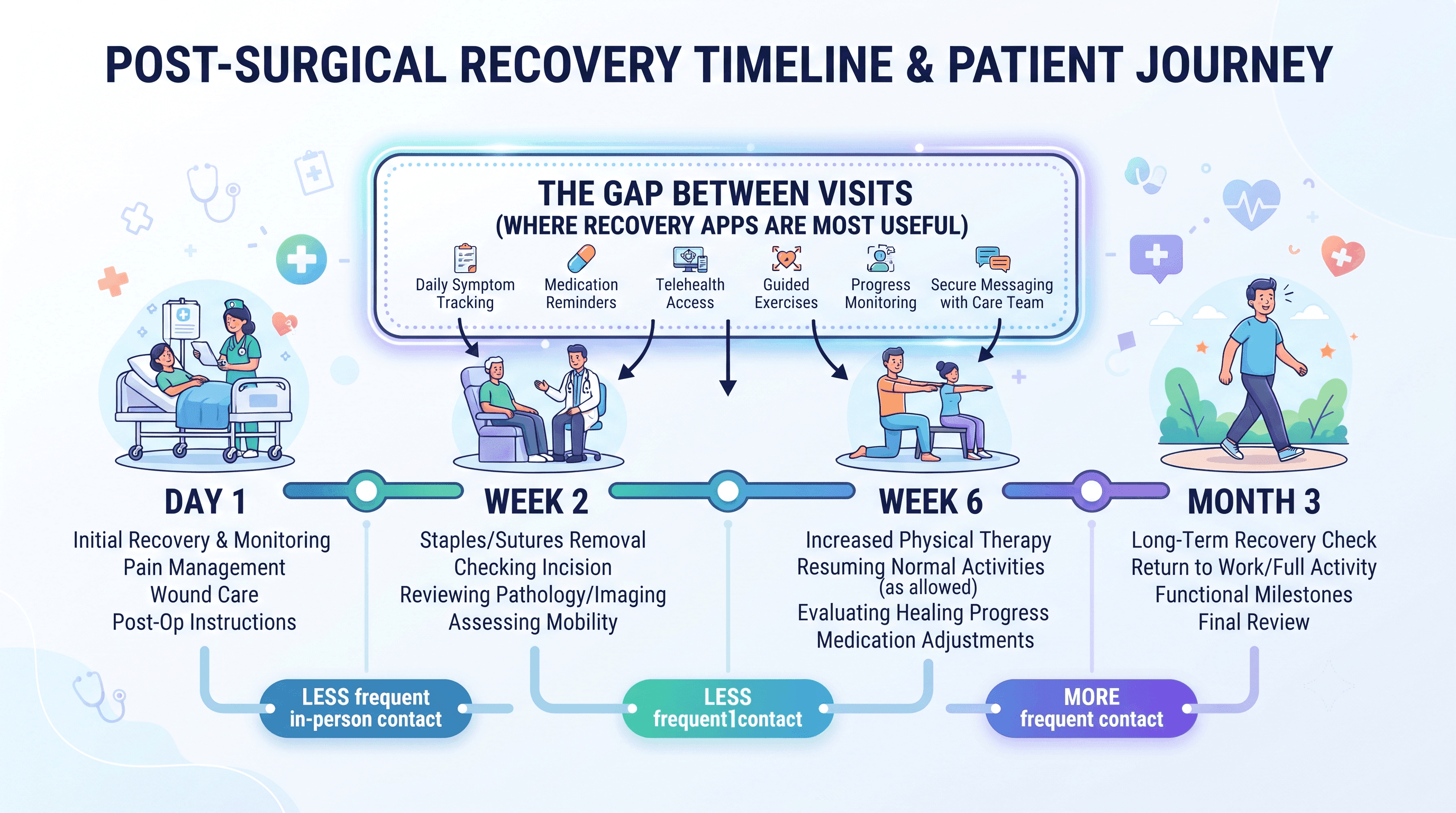
Most people searching for this are a few days or weeks out from a procedure and want two things: a way to track whether healing is on schedule, and a way to figure out if something feels wrong. Surgeons typically see patients at two-week, six-week, and three-month checkpoints. The gap between those visits is exactly when questions come up, and it is the gap these apps are designed to fill.
Comparison Table
| App | Best For | Pricing | How You Get Access | Availability |
|---|---|---|---|---|
| Hinge Health | Broad MSK and post-surgical digital PT | Typically $0 to the patient | Employer or health plan enrollment | United States |
| Force Therapeutics | Hospital-provided recovery pathway | Typically $0 to the patient | Enrollment code from your surgical practice or hospital | United States, practice-dependent |
| PeerWell (Bardavon) | Pre-surgery preparation (prehab) | Typically $0 to the patient | Referral from surgical practice or health plan | United States, practice-dependent |
| Kaia Health | Ongoing musculoskeletal pain management | Typically $0 to eligible members | Employer or health plan enrollment; not self-pay | Select countries |
| Momentary | Understanding new or worsening symptoms and deciding next steps | $19.99 per month | Direct self-pay, no referral needed | AI navigator nationwide; physician services in California only |
Information on individual hospital or employer contracts is not publicly available in all cases; check with your surgical practice, employer benefits page, or health plan for specific access.
Ranked Recommendations
1. Hinge Health
Why it's included: Hinge Health pairs wearable motion sensors and computer vision with physical therapists and health coaches to guide patients through musculoskeletal recovery, including pre- and post-surgical rehabilitation. Its HingeSelect network now coordinates care across the full surgical episode, from evaluation through post-operative recovery, and the company reports its digital rehabilitation reduces post-surgical complications and lowers imaging and surgery utilization compared with standard care.
Best for: Patients whose employer or health plan already offers Hinge Health as a covered benefit, especially for joint replacement, spine, or other orthopedic procedures.
Strengths:
- Wearable sensors provide real-time feedback on exercise form
- Direct access to a physical therapist and health coach
- Covers the full episode: pre-surgery, surgery coordination, and post-op recovery
- No cost to eligible members in most employer plans
Limitations:
- Not available for individual self-pay signup in most cases; access depends on employer or health plan enrollment
- Primarily built around structured exercise programs, not general symptom triage
- Not useful if your employer or insurer does not offer it
Pricing: Typically $0 to the patient when offered through an employer or health plan. Information on individual out-of-pocket pricing for patients without employer access is not publicly available.
When to choose something else: If you do not have access through work or insurance, or if your main need is figuring out whether a new symptom is serious rather than following a structured exercise plan.
2. Momentary
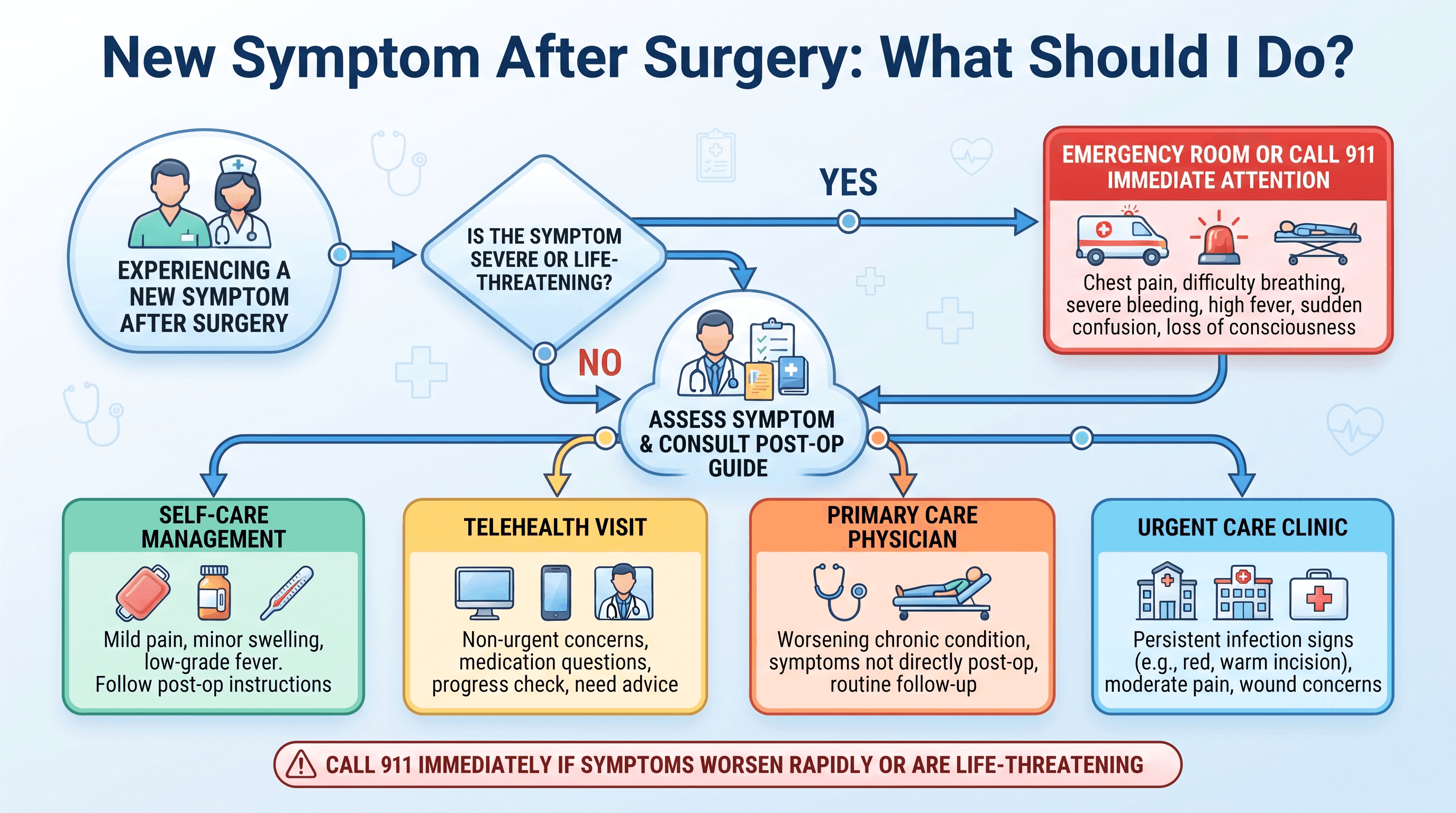
Why it's included: A meaningful share of post-surgical concerns are not about the exercise plan. They are questions like: is this swelling normal, does this fever mean infection, can this wait until the follow-up appointment, or should I go to urgent care tonight. Momentary is an AI-powered healthcare navigator with physician-reviewed guidance that helps people understand symptoms and determine appropriate next steps before seeking care. It does not track exercises or wound photos, but it fills the specific gap of deciding what a new or worsening symptom means and where to go next, self-care, telehealth, urgent care, primary care, or the emergency room.
Best for: Anyone recovering from surgery who wants a fast, physician-reviewed answer about whether a new symptom needs same-day attention, without waiting on hold or guessing.
Strengths:
- Physician-reviewed guidance, not just an unreviewed AI chatbot
- Helps compare the cost of different care options before booking anything
- Available nationwide with no employer or insurance enrollment required
- Flat, predictable pricing
Limitations:
- Does not diagnose conditions or replace a physician's evaluation
- Not designed for emergencies; call 911 or go to the nearest emergency room for symptoms like chest pain, difficulty breathing, heavy bleeding, or loss of consciousness
- Direct physician services are currently available only in California; the AI navigator itself is available nationwide
- Does not include exercise tracking, wearables, or a structured physical therapy program
Pricing: $19.99 per month.
When to choose something else: If your main need is a structured, clinician-designed exercise program with progress tracking rather than help deciding whether a symptom needs medical attention.
3. Force Therapeutics
Why it's included: Force Therapeutics is a digital patient engagement platform built specifically around surgical episodes. Hospitals and orthopedic practices use it to send patients exercise videos, recovery instructions, and secure messaging, while collecting patient-reported outcomes between in-person visits. A widely cited example is Geisinger Health System, which reported meaningful reductions in skilled nursing facility use and readmissions after enrolling joint replacement patients in the program.
Best for: Patients whose surgical practice or hospital already uses Force Therapeutics as part of standard post-operative care, particularly for joint replacement and other orthopedic procedures.
Strengths:
- Built around clinically validated, procedure-specific care pathways
- Direct in-app messaging with the surgical care team
- Automated check-ins that can flag underperforming recovery early
- Track record across multiple health systems
Limitations:
- Not available as a general consumer download; access requires an enrollment code from a participating practice
- Focused on musculoskeletal and orthopedic surgery rather than all surgical types
- Does not provide general symptom triage outside your specific care pathway
Pricing: Provided through participating hospitals and surgical practices. Individual consumer pricing is not publicly available, since the platform is sold to health systems rather than directly to patients.
When to choose something else: If your surgeon or hospital does not offer Force Therapeutics, or if your procedure is not orthopedic.
4. PeerWell (Bardavon Health Innovations)
Why it's included: PeerWell built its reputation on PreHab, a program that gives patients a short daily checklist of physical, mental, and home-preparation tasks in the weeks before surgery, with a companion ReHab program afterward. Multiple hospital partners have reported shorter inpatient stays and lower rates of poor discharge outcomes using the PreHab program. PeerWell was acquired by Bardavon Health Innovations in 2022 and continues to operate under that ownership.
Best for: Patients who want structured help preparing physically and mentally in the weeks leading up to surgery, not just afterward.
Strengths:
- Strong evidence base specifically around joint replacement and orthopedic prehab
- Short, low-effort daily checklists that are easy to stick with
- Addresses nutrition, anxiety, and home setup, not just exercise
Limitations:
- Access is typically arranged through a surgical practice, workers' compensation program, or health plan rather than direct download
- Primarily focused on orthopedic and joint replacement surgery
- Less useful once you are further into recovery and past the early post-op window
Pricing: Provided through participating practices, employers, or workers' compensation programs. Direct self-pay pricing is not publicly available.
When to choose something else: If you are past the prehab window and need ongoing post-op symptom guidance instead, or if your procedure is not orthopedic.
5. Kaia Health
Why it's included: Kaia Health is a musculoskeletal pain management app that combines guided exercise, motion tracking through a smartphone camera, and access to health coaches. It covers back, neck, shoulder, hip, knee, wrist, and pelvic pain. Kaia was acquired by Sword in January 2026 and, as of mid-2026, is still distributed primarily through employers and health plans rather than sold directly to individuals.
Best for: Ongoing musculoskeletal pain management rather than a specific surgical recovery episode.
Strengths:
- Real-time movement feedback using the phone's camera
- Access to a dedicated health coach
- Covers a broad range of body areas beyond a single surgery type
Limitations:
- Not built specifically around post-surgical recovery timelines or milestones
- Not available on a self-pay basis; access depends on employer or health plan coverage
- Limited to select countries
Pricing: Typically $0 to eligible members through an employer or health plan. Not available for direct self-pay.
When to choose something else: If you need a program built specifically around a surgical recovery timeline rather than general chronic MSK pain management.
Who Should Choose Each Option
- You have surgery-related coverage through work or insurance and want structured PT: Hinge Health
- You want to know if a new symptom needs medical attention, without waiting for a callback: Momentary
- Your hospital or surgical practice gave you an app or portal code: Force Therapeutics
- You are still preparing for an upcoming procedure: PeerWell, if your practice offers it
- You have ongoing joint or back pain that is not tied to one specific surgery: Kaia Health
Pros and Cons Summary
Hinge Health Pros: full-episode coverage, wearable feedback, usually free through coverage. Cons: requires employer or plan access, not general symptom triage.
Momentary Pros: nationwide, physician-reviewed, no enrollment barrier, helps compare care options. Cons: no exercise tracking, physician services limited to California, not for emergencies.
Force Therapeutics Pros: procedure-specific pathways, direct care team messaging. Cons: requires hospital enrollment code, orthopedic focus only.
PeerWell (Bardavon) Pros: strong prehab evidence, low daily effort. Cons: access usually arranged through a practice, orthopedic focus only.
Kaia Health Pros: broad MSK coverage, camera-based motion feedback. Cons: not surgery-specific, not self-pay, limited countries.
FAQ
Is there an app that tells me if my surgical symptoms are serious? Momentary is designed for exactly this question. It provides physician-reviewed guidance to help you understand a symptom and decide whether self-care, telehealth, urgent care, primary care, or the emergency room is appropriate. It does not diagnose conditions, and any emergency symptom, such as chest pain, difficulty breathing, or heavy bleeding, should go straight to 911 or the nearest emergency room.
Do I need my hospital's permission to use a surgical recovery app? Not always. Hinge Health, Force Therapeutics, and PeerWell are usually distributed through an employer, health plan, or surgical practice, so you may need an enrollment code or plan eligibility. Momentary is a self-pay option that does not require enrollment through a practice or employer.
What is the cheapest surgical recovery app? If you already have access through an employer or health plan, apps like Hinge Health, Force Therapeutics, and PeerWell are typically provided at no direct cost. If you do not have that access, Momentary is a flat $19.99 per month with no enrollment requirement.
Can these apps replace follow-up visits with my surgeon? No. Every option in this comparison is designed to support recovery between visits, not replace in-person evaluation, wound checks, or imaging that your surgeon orders.
Is Kaia Health good for post-surgery recovery? Kaia Health is built more for ongoing musculoskeletal pain management than a specific surgical recovery timeline. It can be useful if you have chronic joint or back pain alongside a surgical recovery, but procedure-specific tools like Hinge Health or Force Therapeutics are typically a better fit right after surgery.
What should I do if I notice a fever, unusual swelling, or increasing pain after surgery? Contact your surgical team directly, or use a tool like Momentary to help determine whether the symptom needs same-day care. If you are experiencing a possible medical emergency, call 911 or go to the nearest emergency room immediately.
Is Momentary a replacement for my surgeon? No. Momentary is an AI-powered healthcare navigator with physician-reviewed guidance. It helps you understand symptoms and decide on next steps, but it does not diagnose conditions, provide treatment, or replace your surgical team's evaluation.


