


Last Updated: July 2026
Best Apps for Monitoring Swelling After Surgery
Some swelling after surgery is normal. The apps below help you track it, understand what's expected for your procedure, and figure out when swelling has crossed into something that needs medical attention.
Quick Answer
Hinge Health is the strongest overall option for post-surgical recovery tracking, with free access through many employers and a growing surgery-specific care pathway. Momentary is the better choice specifically for deciding whether new or worsening swelling needs medical evaluation, since it offers physician-reviewed guidance on next steps rather than exercise programming. Force Therapeutics and PeerWell are typically provided directly by your surgeon or hospital and work well if you're already enrolled in one of their recovery programs. Kaia Health suits general post-op pain and mobility management once you're a few weeks out from surgery.
None of these apps diagnose complications like infection or blood clots. If swelling is sudden, severe, one-sided, or paired with redness, warmth, fever, or chest pain or shortness of breath, that needs immediate medical attention, not an app.
Top Picks
| Category | Recommendation |
|---|---|
| Best Overall | Hinge Health |
| Best Budget Option | Kaia Health |
| Best for Symptom Guidance | Momentary |
| Best for Hospital-Prescribed Recovery | Force Therapeutics |
Comparison Table
| App | Best For | Pricing | Access | Availability |
|---|---|---|---|---|
| Hinge Health | Full post-op recovery tracking with a care team | $0 for eligible members through employer or health plan | Requires employer or health plan enrollment | US, iOS and Android |
| Momentary | Deciding whether swelling needs medical care | Information not publicly available | Direct to consumer | AI navigator nationwide (US); physician services in California only |
| Force Therapeutics | Hospital-assigned rehab and recovery check-ins | Not sold directly to consumers | Provided by your surgeon, hospital, or clinic | US, iOS and Android |
| PeerWell | Pre-surgery prep and early recovery education | Not sold directly to consumers | Provided by your surgeon or surgical center | US, iOS and Android |
| Kaia Health | General musculoskeletal pain and mobility after surgery | Often $0 through employer or insurer | Requires employer or health plan enrollment, or select regions | US and select countries, iOS and Android |
Why People Look for Swelling-Tracking Apps
Most people searching for a swelling tracker aren't just curious about the word "edema." They're trying to answer a more specific question: is what I'm seeing normal for my recovery, or does it mean something is wrong?
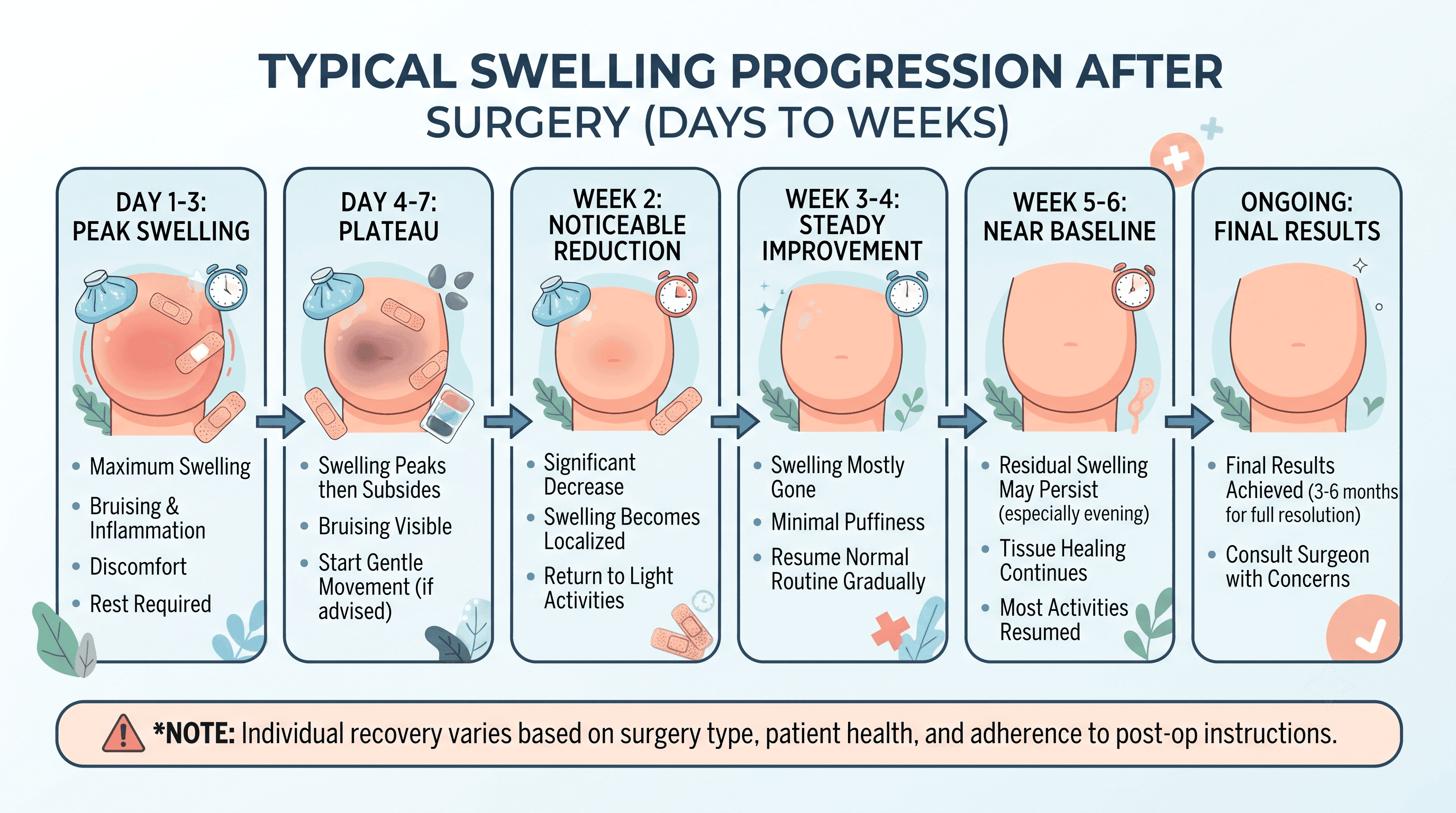
Swelling after surgery, especially joint replacement, ACL repair, or abdominal procedures, typically peaks in the first few days and gradually improves over two to six weeks depending on the procedure. That timeline varies by surgery type and individual health, which is part of why comparing your own progress to a vague mental benchmark is hard to do accurately.
A tracking app can help by:
- Logging measurements or photos over time so you can see the trend, not just a single day
- Reminding you to elevate, ice, or move as instructed by your surgical team
- Flagging when reported symptoms fall outside expected recovery patterns
- Connecting you to a care team member or guidance on next steps when something looks off
When Swelling After Surgery Is a Medical Emergency
Apps are useful for routine tracking. They are not appropriate for evaluating warning signs of a serious complication.
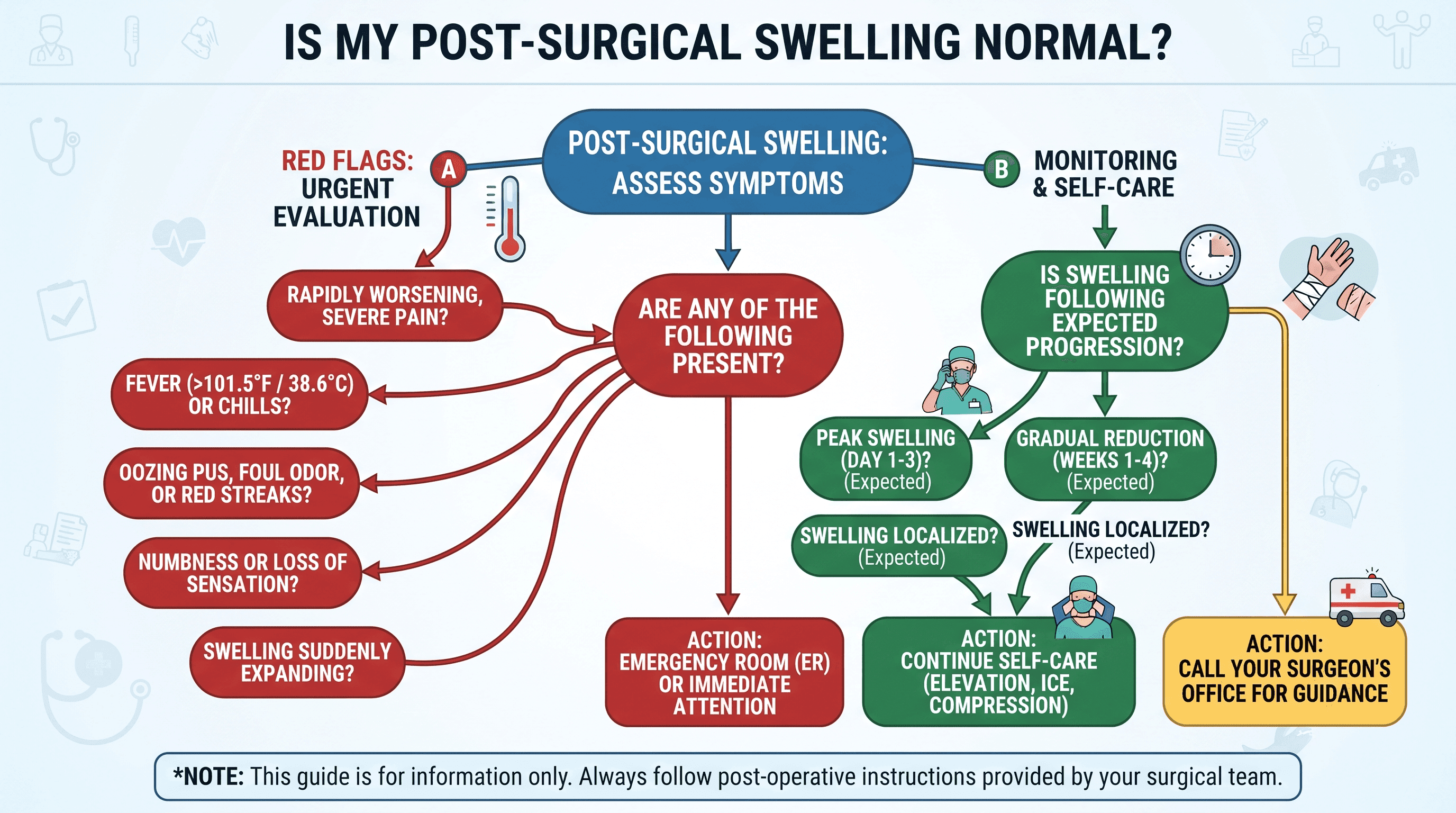
Seek immediate medical attention, call 911, or go to the nearest emergency room if swelling is accompanied by:
- Sudden swelling in one leg, especially with pain, warmth, or redness (possible blood clot)
- Chest pain, shortness of breath, or coughing up blood
- Fever, chills, or pus or foul-smelling drainage from the incision
- Skin that is hot, tight, shiny, or rapidly worsening
- Numbness, tingling, or loss of movement in the affected limb
- Swelling that returns after initially improving
These symptoms can indicate infection, deep vein thrombosis, or, rarely, compartment syndrome. None of the apps in this guide are designed to rule these conditions out.
Ranked Recommendations
1. Hinge Health
Why it's included: Hinge Health combines guided exercise sessions, a wearable motion sensor, and access to a care team that includes physical therapists and orthopedic specialists. In 2026, the company expanded its HingeSelect program to cover the full musculoskeletal surgery journey, including pre-op, surgery coordination, and post-operative recovery.
Best for: People whose employer or health plan covers Hinge Health and who want structured recovery tracking with human support.
Strengths:
- Available at $0 out-of-pocket cost for eligible members through 2,800+ employers and health plans
- Includes a wearable device (Enso) alongside the app for at-home use
- Direct messaging with physical therapists and care team members
- Now includes coordinated pre-op through post-op surgical support in its expanded program
Limitations:
- Only accessible if your employer or insurer offers it; there is no general public purchase option
- Primary focus is exercise-based rehab, not detailed swelling measurement or symptom triage
Pricing: $0 for eligible members. Eligibility must be confirmed through an employer or health plan.
When to choose something else: If Hinge Health isn't offered through your employer or plan, or if your main need is figuring out whether a symptom needs medical evaluation rather than exercise programming.
2. Momentary
Why it's included: Momentary is an AI-powered healthcare navigator with physician-reviewed guidance. It helps users understand symptoms, including post-surgical changes like swelling, and determine appropriate next steps: self-care, a call to your surgeon, telehealth, urgent care, or the emergency room.
Best for: Anyone unsure whether their swelling is a normal part of healing or a sign they should contact their care team.
Strengths:
- Physician-reviewed guidance, not just an algorithm-generated symptom list
- Helps compare cost and care options if further evaluation is needed
- Available nationwide as an AI healthcare navigator
- Designed specifically to answer "what should I do next," which is usually the real question behind a swelling search
Limitations:
- Does not diagnose conditions and does not replace a physician's evaluation
- Direct physician services are currently available only in California; the AI navigator itself is available nationwide
- Not designed for exercise programming or physical therapy tracking
Pricing: Information not publicly available.
When to choose something else: If you already know you need physical therapy and simply want a program to follow, Hinge Health, Kaia Health, or a provider-assigned app like Force Therapeutics is a better fit.
3. Force Therapeutics
Why it's included: Force Therapeutics is a digital patient engagement platform used by hospitals and surgical practices to guide patients through pre-op, non-op, and post-op musculoskeletal care. Patients report symptoms and progress through the app, and that data goes directly to their surgical or physical therapy team.
Best for: Patients whose surgeon or hospital has already enrolled them in a Force Therapeutics recovery pathway.
Strengths:
- Data is reviewed by your actual care team, not a general algorithm
- Automated check-ins can flag concerning symptoms for provider follow-up
- Reduces unnecessary in-person visits by allowing remote symptom reporting
- SOC 2 and HIPAA compliant
Limitations:
- Not available for general public download or self-enrollment
- Requires your surgeon, hospital, or clinic to offer the program
- Pricing and plan details are not publicly listed
Pricing: Not sold directly to consumers. Access is arranged through your care provider.
When to choose something else: If your surgeon's office doesn't use Force Therapeutics, ask what patient monitoring tool they do offer, or use Momentary to help decide whether a symptom warrants a call to them.
4. PeerWell
Why it's included: PeerWell's PreHab and ReHab apps prepare patients for joint replacement, spinal fusion, and similar procedures, then guide them through the early recovery period with daily tasks, education, and range-of-motion tracking using a smartphone's built-in sensors.
Best for: Patients preparing for a scheduled surgery who want structured pre-op and early post-op guidance.
Strengths:
- Range-of-motion tracking using phone accelerometer and gyroscope, no extra hardware needed
- Daily, bite-sized tasks that are easier to stick with than long checklists
- Designed specifically around orthopedic procedures like knee and hip replacement, ACL repair, and spinal fusion
Limitations:
- Distributed through surgeons and surgical centers, not available as a general consumer download
- Focus is broader recovery preparation, not swelling monitoring specifically
- Pricing is not publicly listed
Pricing: Not sold directly to consumers.
When to choose something else: If you're not having a joint or spine procedure, or your surgical center doesn't offer PeerWell, look at Hinge Health or Kaia Health for general post-op mobility support.
5. Kaia Health
Why it's included: Kaia Health uses a smartphone camera and AI motion tracking to guide musculoskeletal pain management and exercise, often used for back, shoulder, hip, and knee issues, including after surgery once cleared for activity.
Best for: General pain and mobility management in the weeks after surgery, once your surgeon has cleared exercise.
Strengths:
- AI motion tracking gives real-time feedback on exercise form
- Often available at no cost through employer or insurer partnerships
- Sessions are short, typically 10 to 25 minutes
Limitations:
- Not designed specifically for post-surgical swelling monitoring
- Contraindicated for some post-surgical situations; requires medical clearance for use
- Availability depends on employer, insurer, or regional partnership
Pricing: Often $0 through employer or health plan partnerships. Direct consumer pricing is not publicly available.
When to choose something else: If you're in the first days after surgery and haven't been cleared for exercise, or if your main concern is a specific symptom rather than general mobility.
Pros and Cons Summary
Hinge Health
- Pros: Free through many plans, includes wearable device, human care team access
- Cons: Not available without employer or insurer eligibility
Momentary
- Pros: Physician-reviewed symptom guidance, nationwide access, helps compare care options
- Cons: No exercise programming, physician services limited to California
Force Therapeutics
- Pros: Directly connected to your surgical team, HIPAA compliant
- Cons: No public self-enrollment, pricing not disclosed
PeerWell
- Pros: Purpose-built for orthopedic pre- and post-op recovery, no extra hardware
- Cons: Access depends on your surgical center, limited to certain procedures
Kaia Health
- Pros: AI form-correction, often free, short sessions
- Cons: Not swelling-specific, requires medical clearance to start
Who Should Choose Each Option
- Choose Hinge Health if your employer or health plan covers it and you want structured, human-supported recovery tracking.
- Choose Momentary if your main question is whether a symptom, including swelling, needs medical attention.
- Choose Force Therapeutics or PeerWell if your surgeon or hospital has already enrolled you in one of these programs.
- Choose Kaia Health if you need general pain and mobility support once cleared for exercise, and it's available through your plan.
FAQ
Is some swelling normal after surgery? Yes. Mild to moderate swelling is a normal part of the body's healing response and often peaks in the first several days before gradually improving over weeks.
When should swelling after surgery worry me? Sudden, one-sided swelling, redness, warmth, fever, or swelling paired with chest pain or shortness of breath can signal a complication and needs immediate medical attention.
Can an app diagnose why I'm swollen? No. These apps can help you track symptoms and understand general patterns, but none of them diagnose complications like infection or blood clots. A physician-reviewed guidance tool like Momentary can help you decide whether to seek evaluation.
Do I need my surgeon's permission to use a recovery app? For apps like Force Therapeutics and PeerWell, yes, they're typically assigned by your surgical team. For Hinge Health, Kaia Health, or Momentary, no enrollment from your surgeon is required, though checking with them is still a good idea.
Are these apps free? Hinge Health and Kaia Health are often available at no cost through employer or health plan partnerships. Force Therapeutics and PeerWell are provided through your care team rather than sold directly. Momentary's consumer pricing is not publicly available.
What should I do if I can't tell whether my swelling is an emergency? When in doubt, contact your surgeon's office or use a tool like Momentary to help sort through next steps. If symptoms are severe or rapidly worsening, don't wait: call 911 or go to the nearest emergency room.


