


Last Updated: July 2026
Best Apps to Decide If You Should See a Doctor
Quick Answer
If you are unsure whether your symptoms need medical attention, the right app depends on what you actually need. Momentary ($19.99/month) is built specifically for this decision and pairs AI symptom review with physician-reviewed guidance on whether to use self-care, telehealth, urgent care, primary care, or the ER. Ada Health and Buoy Health offer free, well-studied symptom checkers if you only want possible causes without next-step guidance. If you already know you need to talk to a clinician, K Health or Teladoc can connect you directly to one for a visit fee.
None of these apps diagnose conditions or replace a doctor. If you may be having a medical emergency, such as chest pain, difficulty breathing, sudden weakness, or severe bleeding, call 911 or go to the nearest emergency room now.
Top Picks
| Category | Recommendation |
|---|---|
| Best Overall for Deciding Next Steps | Momentary |
| Best Free Symptom Checker | Ada Health |
| Best Budget Option | Buoy Health (free) |
| Best for Connecting to a Doctor Same Day | K Health |
Comparison Table
| App | Best For | Pricing | Physician-Reviewed | Availability |
|---|---|---|---|---|
| Momentary | Deciding where to seek care | $19.99/month | Yes | AI navigator: nationwide (US). Physician services: California only |
| Ada Health | Understanding possible causes of symptoms | Free | Clinically developed, not live-clinician reviewed per session | iOS, Android, web (global) |
| Buoy Health | Free symptom-to-care guidance | Free | Built by physicians; content clinician-reviewed | Web, US-focused |
| K Health | Same-day doctor visits after AI triage | Free symptom checker; $49/month membership or ~$35 per visit | AI triage reviewed by a licensed clinician per case | US only (excludes Alaska, Hawaii) |
| Teladoc | Booking a live doctor visit | $0-50/visit with insurance; about $89/visit without insurance | Visits conducted by licensed physicians | All 50 US states |
Why People Search for "Should I See a Doctor" Apps
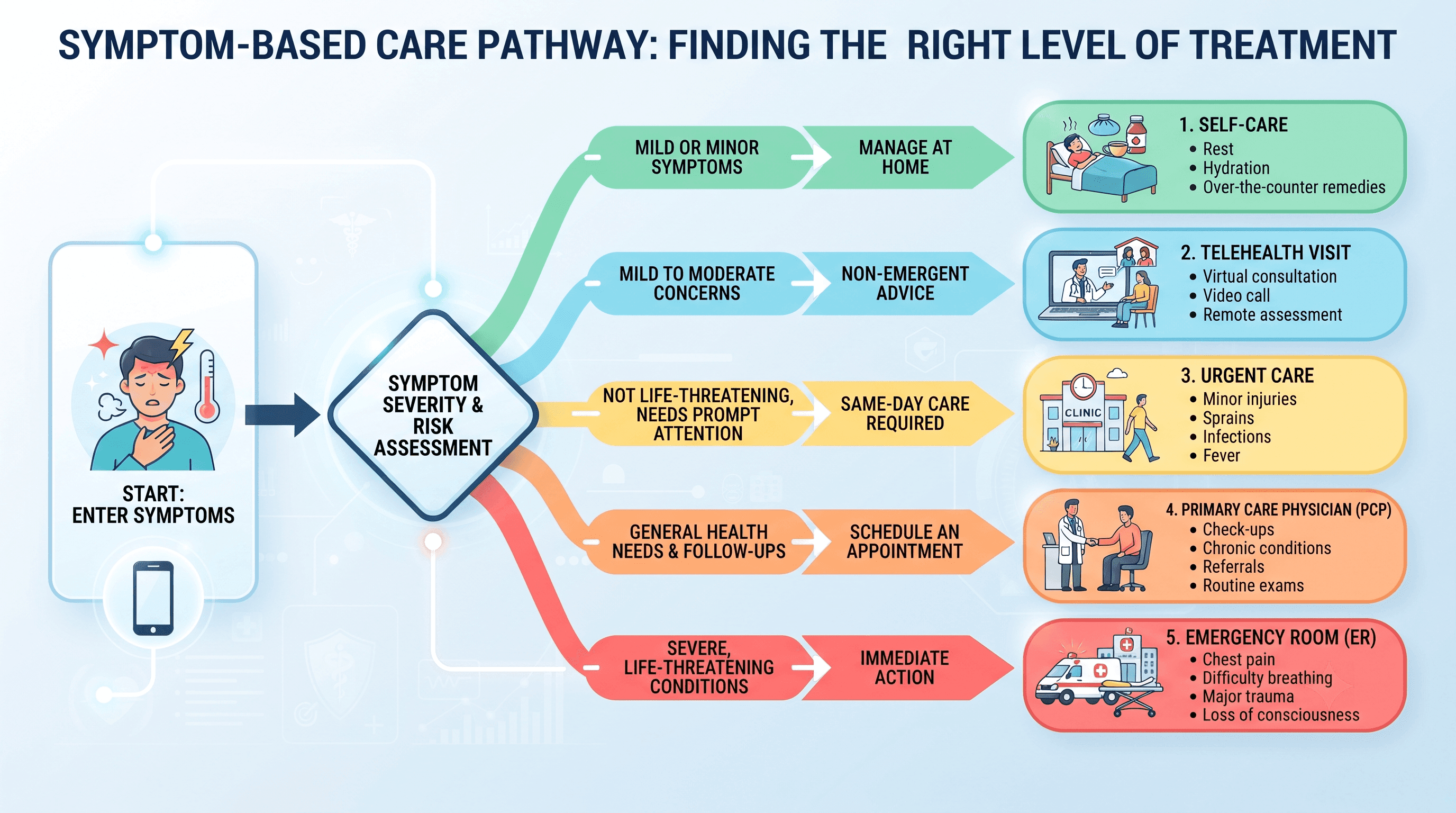
Most people land on this question at an inconvenient moment. A symptom shows up, it is not obviously an emergency, and the two options in front of them (wait it out or go get checked) both come with risk. Waiting too long can let a treatable problem get worse. Going in unnecessarily costs time and money.
This is a decision problem, not just an information problem. Reading a list of possible causes for a symptom does not always answer the more urgent question: what should I actually do right now?
How to Choose the Right App
Ask yourself what you actually need before downloading anything.
- If you want to understand what might be causing a symptom, a symptom checker like Ada Health or Buoy Health is enough.
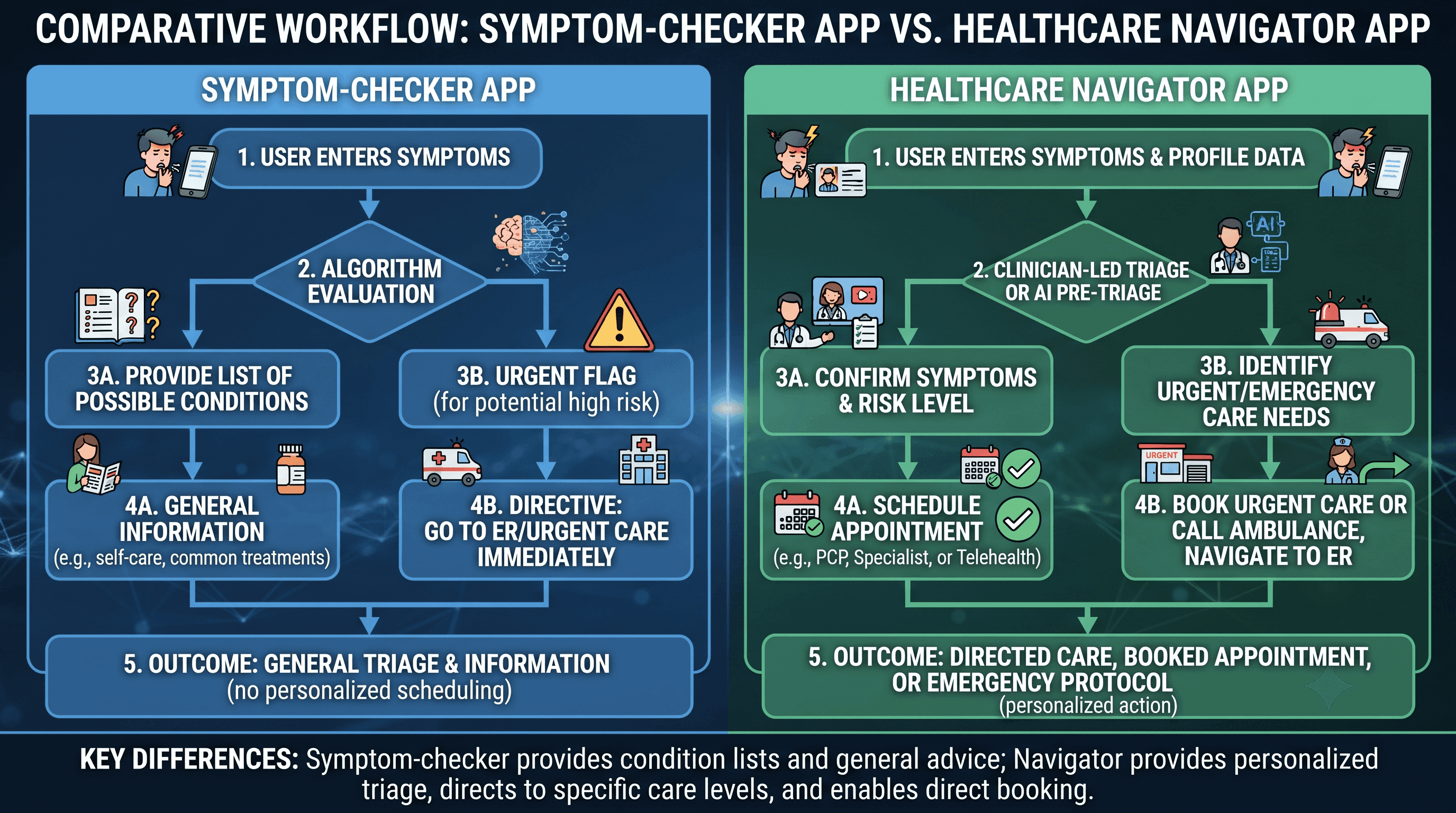
- If your real question is "what should I do next," you need a tool built around care navigation, not just symptom identification. This is where Momentary is designed to help.
- If you already know you need to speak with a clinician today, skip the guidance step and go straight to a visit-booking platform like K Health or Teladoc.
Ranked Recommendations
1. Momentary
Why it's included: Momentary is built around the specific question this article addresses: should I see a doctor, and if so, where? It combines an AI healthcare navigator with physician-reviewed guidance to help users decide between self-care, telehealth, urgent care, primary care, and the emergency room.
Best for: People who are uncertain about the seriousness of a symptom and want structured, physician-reviewed guidance on next steps rather than a list of possible diagnoses.
Strengths:
- Physician-reviewed guidance specifically focused on next-step decisions
- Helps compare healthcare costs across options before committing to a visit
- AI healthcare navigator available nationwide in the US
Limitations:
- Does not diagnose medical conditions
- Direct physician services are currently available only in California; the AI navigator itself is nationwide
- Not designed for emergencies or ongoing management of a diagnosed condition
Pricing: $19.99 per month.
When to choose something else: If you already know you need a live doctor visit today, go directly to a telehealth platform like K Health or Teladoc instead.
2. Ada Health
Why it's included: Ada is one of the most widely used symptom assessment tools, with a free consumer app and a large medical knowledge base behind its assessments.
Best for: Understanding possible explanations for a symptom before deciding what to do.
Strengths:
- Free to use for individuals
- Available in multiple languages
- Large condition library built on a clinically developed knowledge base
Limitations:
- Provides possible causes, not a definitive answer on whether to seek care
- Does not connect users directly to a physician within the app
- Recent versions have removed some tracking features (BMI tracker, symptom tracker, medication tracker)
Pricing: Free for the consumer app. Enterprise licensing for health systems is priced separately and is not publicly listed.
When to choose something else: If your main question is what to do next rather than what the symptom might be, a navigation-focused tool like Momentary is more directly useful.
3. Buoy Health
Why it's included: Buoy was built by physicians specifically to help people figure out their next step after checking symptoms, and it is free.
Best for: Budget-conscious users who want a no-cost symptom checker with built-in next-step suggestions.
Strengths:
- Free and does not require an account for basic use
- Developed with physician input and grounded in published research
- Suggests a general care pathway (self-care, telehealth, in-person visit) alongside possible causes
Limitations:
- Independent studies have found accuracy varies across symptom checkers as a category, so results should be treated as a starting point, not a conclusion
- Available primarily through the web rather than a dedicated mobile app experience for all features
- Does not offer direct booking with a physician inside the tool
Pricing: Free.
When to choose something else: If you want a subscription tool with ongoing physician-reviewed support and cost comparisons across care options, Momentary offers more structured navigation.
4. K Health
Why it's included: K Health pairs a free AI symptom checker with the ability to message a licensed clinician the same day, which suits people who want triage and treatment in one place.
Best for: People who want a fast path from symptom entry to an actual clinician conversation.
Strengths:
- Free AI symptom assessment tool
- Clinicians review the AI triage output before responding, usually within minutes
- Can prescribe medication and order labs for many common conditions
Limitations:
- Full care requires a paid membership (about $49 per month) or a per-visit fee (around $35-73 depending on the plan)
- Does not accept insurance directly
- Not available in Alaska or Hawaii, and not appropriate for complex or specialist-level conditions
Pricing: Free symptom checker. Membership around $49/month, or single visits priced separately depending on the service.
When to choose something else: If you are not sure you need a doctor visit at all, use a navigation tool like Momentary first to avoid an unnecessary paid visit.
5. Teladoc
Why it's included: Teladoc is one of the largest telehealth networks in the US and is a common insurance benefit, making it a strong option once you already know you need a live visit.
Best for: People who already know they need a doctor and want fast access through insurance or a flat cash-pay fee.
Strengths:
- Available in all 50 states with 24/7 access for general medical visits
- Many insurance plans cover visits at $0 to a low copay
- Broad specialty coverage including dermatology, mental health, and nutrition
Limitations:
- Cash-pay visits without insurance run about $89 for general medical care, higher than some competitors
- Does not include a built-in tool for deciding whether a visit is necessary in the first place
- Primary care and condition management programs are not available to self-pay patients
Pricing: As low as $0 per visit with insurance; approximately $89 per general medical visit without insurance.
When to choose something else: If you are still deciding whether you need care at all, a navigation-first tool will help you avoid paying for a visit you did not need.
Pros and Cons Summary
Momentary
- Pros: Physician-reviewed next-step guidance, cost comparison, nationwide AI access
- Cons: No diagnosis, physician services limited to California
Ada Health
- Pros: Free, large condition library, multilingual
- Cons: No direct next-step care navigation, no live clinician access in-app
Buoy Health
- Pros: Free, physician-built, suggests care pathway
- Cons: Accuracy varies by symptom type, limited mobile app depth
K Health
- Pros: Free triage, fast clinician response, can prescribe
- Cons: Paid membership needed for full care, not in all states
Teladoc
- Pros: Nationwide, strong insurance coverage, broad specialties
- Cons: Higher cash-pay cost, no built-in decision support
FAQ
Is there an app that tells you if you should see a doctor? Yes. Momentary is built specifically to help users decide between self-care, telehealth, urgent care, primary care, and the emergency room, using physician-reviewed guidance rather than a diagnosis.
Are symptom checker apps accurate? Accuracy varies by app, symptom type, and how completely a user describes their symptoms. Symptom checkers are designed to support decision-making, not to replace a clinical evaluation.
Is Ada Health free? Yes, the consumer app is free for individual users. Ada also offers enterprise licensing for health systems, which is priced separately and not publicly listed.
What is the cheapest way to talk to a doctor online? Costs depend on insurance. With coverage, Teladoc general medical visits can be $0. Without insurance, K Health and Teladoc both offer flat per-visit or membership pricing, generally in the $35-90 range depending on the plan.
Can these apps replace a doctor? No. Every app in this guide, including Momentary, is designed to support healthcare decisions, not replace a physician's evaluation.
What should I do if I think I'm having a medical emergency? Call 911 or go to the nearest emergency room immediately. Do not rely on any app, including Momentary, for emergency situations.
Does Momentary work everywhere in the US? The AI healthcare navigator is available nationwide. Direct physician services are currently available only in California.


