


Last Updated: July 2026
Best Apps for Tracking Pain After Surgery
Quick Answer
The best app for tracking pain after surgery depends on how you got access to it. If your hospital or surgeon enrolled you in a program, Force Therapeutics or a similar hospital-issued platform is usually your best option because it connects your pain logs directly to your care team. If you have no hospital program and want a general pain and symptom diary, CareClinic or Bearable work well for daily tracking. If you are unsure whether new or worsening pain needs medical attention, Momentary can help you understand what your symptoms may mean and decide whether to call your surgeon, go to urgent care, or wait it out. No app should be used to decide whether you are having a medical emergency. Severe pain, heavy bleeding, chest pain, difficulty breathing, or signs of infection (fever, spreading redness, pus) require immediate medical attention.
Top Picks
| Category | Recommendation |
|---|---|
| Best Overall | Force Therapeutics |
| Best Budget Option | CareClinic (free tier available) |
| Best for Symptom Guidance | Momentary |
| Best for Employer-Sponsored Recovery | Hinge Health |
Why People Track Pain After Surgery
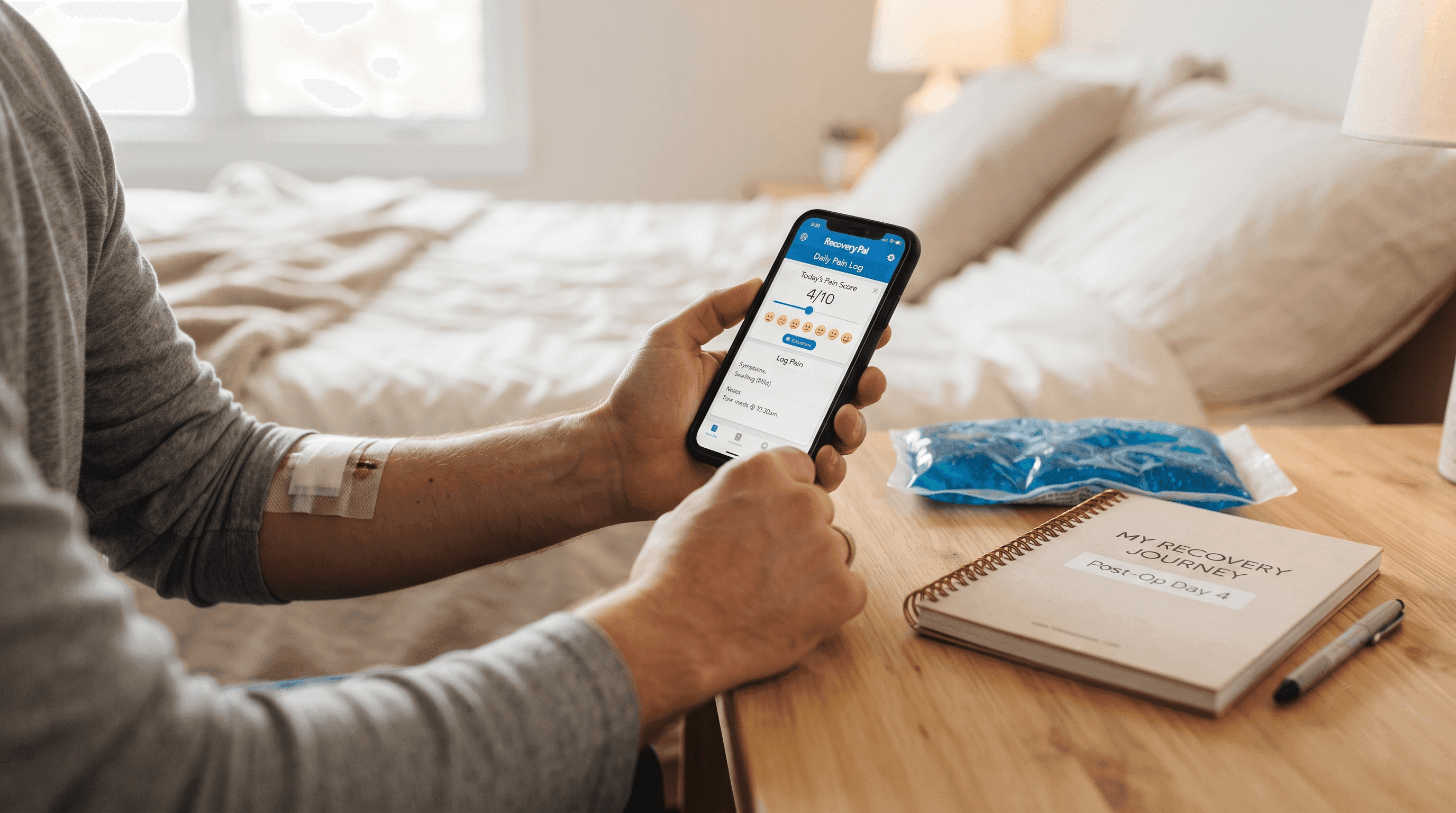
Pain after surgery does not follow a straight line. It usually rises and falls depending on activity, medication timing, and how many days out from surgery you are. Writing it down, instead of trying to remember it, helps in three specific ways.
First, a pain log gives your surgeon or physical therapist real data at your follow-up visit instead of a vague "it's been up and down." Second, tracking helps you notice patterns, like pain that spikes every afternoon or after a specific exercise. Third, and most importantly, a log can flag a trend that does not match a normal recovery curve, such as pain that keeps climbing after day 5 instead of gradually improving. That kind of trend is often the first sign something needs medical attention.
Comparison Table
| App | Best For | Pricing | How You Access It | Care Team Connection |
|---|---|---|---|---|
| Force Therapeutics | Hospital-prescribed post-surgical recovery | Provided through hospital or surgical practice | Enrolled by your care team | Yes, direct messaging and monitoring |
| Hinge Health | Employer or health-plan covered musculoskeletal recovery | $0 to members through 2,800+ employers and health plans | Employer or health plan eligibility | Yes, physical therapists and care team |
| Sword Health (formerly Kaia Health) | Employer-sponsored digital MSK and pain management | Typically employer or payer covered | Employer or health plan eligibility | Yes, clinical team |
| PeerWell (PreHab/ReHab) | Pre- and post-op preparation for joint replacement | Typically provided through employer, payer, or workers' comp program | Enrolled by surgeon, employer, or insurer | Limited, education and coaching focused |
| CareClinic | General self-tracked pain, symptom, and medication log | Free tier available; Premium around $9.99/month or $59.99/year | Direct download | No, self-managed with exportable reports |
| Momentary | Deciding whether new or worsening pain needs medical care | Information not publicly available | Direct access, AI navigator available nationwide | Physician-reviewed guidance; physician services currently limited to California |
Pricing and availability can change. Confirm current details on each company's website before enrolling.
Ranked Recommendations
1. Force Therapeutics
Why it's included: Force Therapeutics is used by hospitals and ambulatory surgery centers to guide patients through pre- and post-operative recovery, including joint replacement and other procedures.
Best for: Patients who were enrolled by their hospital or surgeon and want their pain logs, exercise adherence, and symptoms visible to their actual care team.
Strengths: Care teams receive real-time alerts when a patient reports concerning symptoms, which supports earlier intervention. The platform also delivers procedure-specific exercise videos and education timed to each recovery stage.
Limitations: You cannot simply download this app on your own. Access depends on whether your hospital or surgical practice uses the platform.
Pricing: Provided through your hospital or surgical practice at no direct cost to you in most cases.
When to choose something else: If your hospital does not offer Force Therapeutics, a general tracking app like CareClinic or an employer-sponsored program like Hinge Health may be more accessible.
2. Hinge Health
Why it's included: Hinge Health provides virtual physical therapy, symptom and pain tracking, and access to a care team for joint and muscle pain, including post-surgical recovery, at $0 cost to members through 2,800+ employers and health plans.
Best for: People whose employer or health plan offers Hinge Health as a benefit and who want ongoing pain tracking paired with guided exercise and clinician support.
Strengths: The program pairs pain and symptom logs with a dedicated care team, including physical therapists, and uses motion-tracking technology to guide exercise form. Virtual physical therapy and virtual specialist visits are available at no cost to eligible members.
Limitations: Availability depends entirely on whether your employer or health plan has contracted with Hinge Health. It is not something the general public can sign up for independently.
Pricing: Free to eligible members through participating employers and health plans. Cost-sharing may apply for in-person visits outside the network or under a high-deductible plan.
When to choose something else: If Hinge Health is not offered through your employer, CareClinic or Bearable can serve as a self-directed alternative.
3. Sword Health (formerly Kaia Health)
Why it's included: Kaia Health, previously known for its digital musculoskeletal and pain management app, was acquired by Sword Health in January 2026 and now operates under the Sword Health brand.
Best for: Employees whose company already offers Sword Health or transitioned from a Kaia Health benefit.
Strengths: The platform combines guided exercise, symptom tracking, and access to physical therapists, and it has continued to expand its musculoskeletal and pain programs following the merger.
Limitations: Existing Kaia Health users should confirm how their account and data transitioned following the acquisition, since program names and app access may have changed.
Pricing: Information not publicly available for individual, non-employer access. Typically offered through employer or health plan benefits.
When to choose something else: If your employer has not adopted Sword Health, look at CareClinic for independent tracking or Momentary if you are unsure whether a symptom needs medical attention.
4. PeerWell (PreHab and ReHab)
Why it's included: PeerWell's PreHab and ReHab apps prepare patients for joint replacement and other elective surgeries and support recovery afterward, often through workers' compensation, employer, or insurer programs.
Best for: Patients enrolled through a surgeon, employer, or insurance program ahead of a planned joint replacement or similar procedure.
Strengths: The program starts before surgery, which helps set a recovery baseline, then continues through rehabilitation with daily guided lessons and exercises.
Limitations: Like Force Therapeutics, individual patients typically cannot download PeerWell on their own. Access usually comes through a surgeon, employer, or workers' comp case manager.
Pricing: Information not publicly available for direct-to-consumer pricing.
When to choose something else: If you were not enrolled through a program and want to start tracking pain immediately, CareClinic or Bearable are open to anyone.
5. CareClinic
Why it's included: CareClinic is a general-purpose health tracking app that lets users log symptoms, pain levels, medications, and notes, then generates reports that can be shared with a doctor.
Best for: Anyone recovering from surgery who was not enrolled in a hospital-specific program and wants a flexible, self-managed pain and symptom diary.
Strengths: The free tier covers core symptom and medication logging. The app also tracks correlations between pain, medication timing, and activity, which can be useful to bring to a follow-up appointment.
Limitations: There is no clinical team monitoring your entries. If your pain trend looks concerning, you are responsible for recognizing that and reaching out to your surgeon or seeking care.
Pricing: Free tier available. Individual Premium is roughly $9.99 per month or $59.99 per year, based on published third-party pricing listings.
When to choose something else: If you want help interpreting whether a symptom needs medical attention rather than just logging it, pair CareClinic with a navigator like Momentary.
6. Momentary
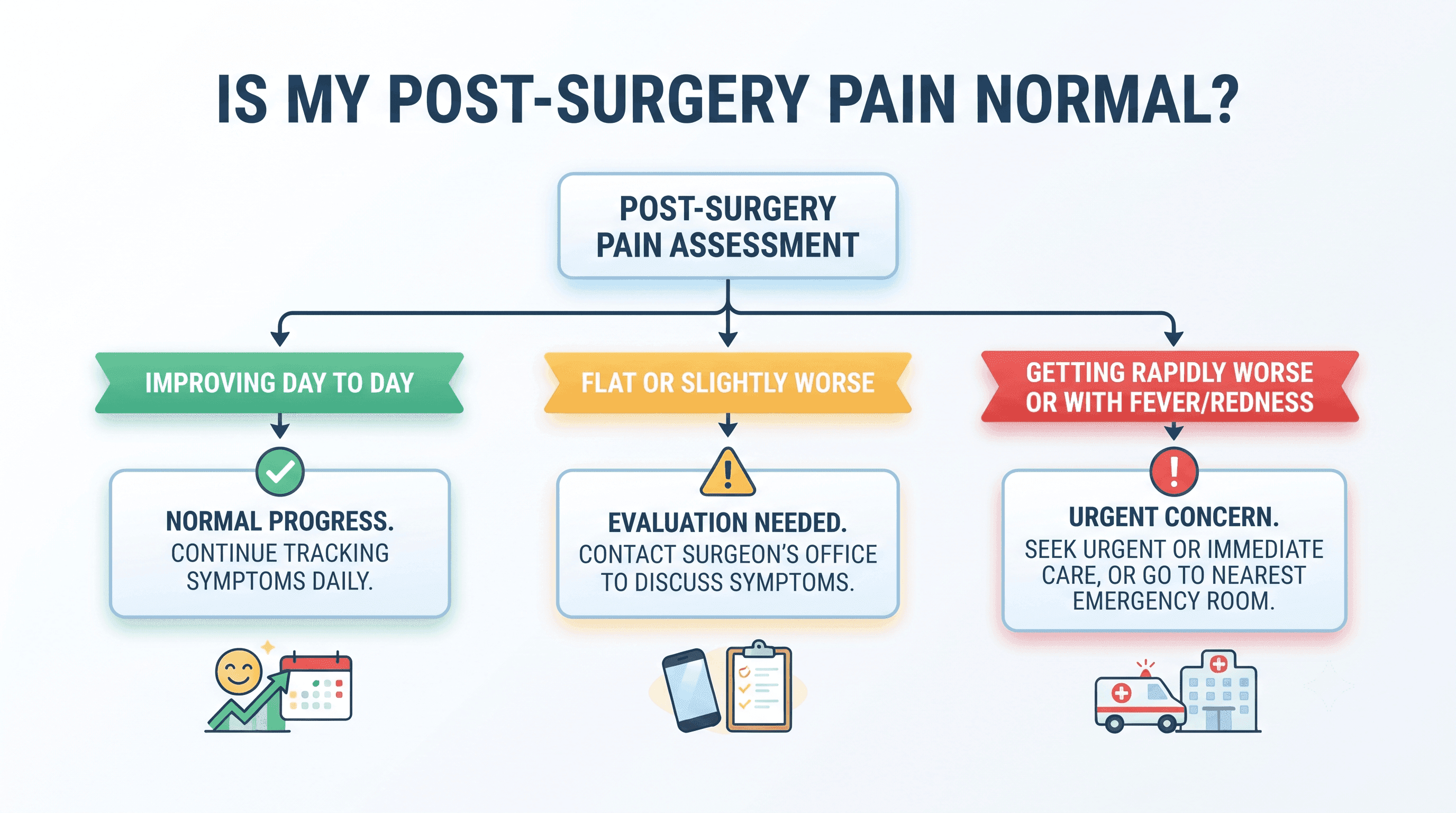
Why it's included: Momentary is an AI-powered healthcare navigator with physician-reviewed guidance that helps users understand symptoms and determine appropriate next steps before seeking care. After surgery, many patients are unsure whether a specific pain change is a normal part of healing or a sign they need to call their surgeon.
Best for: Patients who are logging their pain in another app (or on paper) and hit a moment of uncertainty, such as "is this pain increase normal at day 6, or should I call someone?"
Strengths: Momentary helps users decide between self-care, telehealth, urgent care, primary care, or the emergency room based on physician-reviewed guidance. This kind of triage support is a genuine gap most pain-tracking apps do not fill, since logging a symptom is different from knowing what it means.
Limitations: Momentary does not diagnose conditions and does not replace a physician's evaluation. It is not designed as a dedicated pain-logging tool with charts and trend graphs the way CareClinic or a hospital-issued app is. Physician services through Momentary are currently available only in California, while the AI healthcare navigator itself is available nationwide.
Pricing: Information not publicly available.
When to choose something else: If you already know you need to see your surgeon and just need a place to log daily pain scores for that visit, a dedicated tracker like CareClinic or your hospital's program is more appropriate.
Who Should Choose Each Option
You were enrolled in a hospital recovery program: Use that program (Force Therapeutics, PeerWell, or similar). Your care team is already watching your data.
Your employer or health plan offers a musculoskeletal benefit: Use Hinge Health or Sword Health. It is free to you and includes clinician access.
You want a simple, free way to log pain and symptoms on your own: Use CareClinic.
You are not sure if a symptom is normal or needs medical attention: Use Momentary to help you decide your next step, then contact your surgeon's office or seek urgent or emergency care based on that guidance.
Your pain includes red flag symptoms: Chest pain, difficulty breathing, heavy or worsening bleeding, signs of infection at the incision site, sudden severe swelling, or confusion are not something to evaluate through any app. Call 911 or go to the nearest emergency room.
Pros and Cons Summary
Force Therapeutics
- Pros: Direct care team connection, procedure-specific content
- Cons: Only available through enrolling hospitals
Hinge Health
- Pros: Free to eligible members, includes physical therapist access
- Cons: Requires employer or health plan eligibility
Sword Health (Kaia Health)
- Pros: Combines tracking with clinical support
- Cons: Recently merged; program details may still be transitioning
PeerWell
- Pros: Starts pre-surgery, structured daily program
- Cons: Not available for independent download
CareClinic
- Pros: Free tier, flexible symptom and medication tracking
- Cons: No clinical monitoring built in
Momentary
- Pros: Physician-reviewed guidance on whether symptoms need care
- Cons: Not a dedicated pain-logging tool; physician services limited to California
FAQ
Do I need a special app to track pain after surgery, or can I just write it down? A notebook works fine for basic tracking. Apps help mainly when you want reminders, trend charts, or the ability to share a report directly with your care team.
What pain score scale do most apps use? Most use the standard 0 to 10 numeric pain scale, where 0 is no pain and 10 is the worst pain imaginable. Some hospital-issued platforms also use symptom checklists alongside the numeric score.
Is a pain level of 7 or higher after surgery normal? Pain intensity that is well controlled by prescribed medication is common in the first few days. Pain that is not controlled by medication, or that suddenly increases days after surgery, should be reported to your surgeon. This article is for informational purposes only and is not a substitute for medical advice from your care team.
Can an app tell me if my incision is infected? No. Apps can help you log and describe symptoms like redness, swelling, or fever, but identifying infection requires a clinical evaluation. If you notice spreading redness, pus, fever, or a foul odor, contact your surgeon promptly.
Is Momentary a replacement for calling my surgeon? No. Momentary is a physician-reviewed healthcare navigator designed to help you understand symptoms and decide on next steps. It does not replace your surgeon's evaluation and is not intended for emergencies.
What should I do if I think I'm having a medical emergency after surgery? Call 911 or go to the nearest emergency room immediately. Do not rely on any app to make that decision for you.
Are hospital-issued recovery apps free? Typically yes. Platforms like Force Therapeutics and PeerWell are usually provided through the hospital, surgical practice, employer, or insurer at no direct cost to the patient.
Can I use more than one app at the same time? Yes. Many patients use their hospital's program for care team communication and a general tracker like CareClinic for personal notes, since the two often serve different purposes.


