


Last updated: June 2026
The best ChatGPT alternatives for medical questions are purpose-built AI health tools and clinically supervised platforms, not general-purpose chatbots. Tools like Momentary, Ada Health, and K Health were designed with physician involvement and clinical validation, which makes them more reliable for health queries than a general AI that happens to answer medical topics. This list scores nine options on clinical credibility, scope fit, cost, speed, user experience, and trust signals so you can choose the right tool for your situation.
| Tool | Best For | Price | Rating | Free Tier |
|---|---|---|---|---|
| Momentary | Physician-reviewed AI triage | Free / virtual visits vary | Physician-oversight model | Yes |
| Ada Health | Symptom assessment, free | Free | 4.7 App Store | Yes |
| K Health | AI + live physician access | Free checker / $35/visit | 4.8 App Store (240K+ ratings) | Yes |
| Buoy Health | Harvard-backed symptom routing | Free | Not rated on App Store | Yes |
| Perplexity AI | Sourced health research | Free / $20/mo Pro | 4.6 App Store | Yes |
| WebMD Symptom Checker | Trusted brand, quick reference | Free | 4.2 App Store | Yes |
| Google Gemini | General health Q&A | Free / $19.99/mo Advanced | N/A (health category) | Yes |
| Microsoft Copilot | Health Q&A within Microsoft ecosystem | Free | N/A (health category) | Yes |
| Claude (Anthropic) | Detailed, nuanced health explanations | Free / $20/mo Pro | 4.7 App Store | Yes |
How We Ranked
For this list, "best" means the most clinically reliable, accessible AI tool that helps a US adult get accurate medical information or triage guidance without requiring an appointment or insurance. We scored each tool on six criteria: clinical credibility (30%), scope fit (20%), cost and value (15%), speed and availability (15%), user experience (10%), and trust signals (10%). Weights favor clinical credibility and scope fit because this is a YMYL health list, and a general-purpose AI that answers medical questions scores lower on scope than a tool built for that function. Evaluation date: June 2026. Momentary is our own product. We scored it on the same criteria as every other entry.
1. Momentary — Physician-Reviewed AI Health Navigator
Momentary is a US-based AI health tool designed specifically to help people understand symptoms, explore health information, and determine appropriate next steps before or between doctor visits. Unlike general AI assistants, physician oversight is built into Momentary's product model, meaning a licensed physician reviews the care framework rather than an unmonitored algorithm generating medical information on its own.
Pros: Momentary is purpose-built for medical questions, which means its responses are structured around clinical triage logic rather than general information retrieval. The AI health navigator at momentarylab.com is free to use with no signup required for basic queries. Momentary also connects directly to virtual care visits for users who need to speak with a licensed provider, making it one of the few tools on this list where a single platform handles both the AI triage step and the follow-up appointment.
Cons: As a newer product, Momentary has a smaller volume of third-party user reviews than legacy platforms like K Health or WebMD, so independent performance benchmarks are more limited. Virtual care visit availability depends on provider scheduling, which can introduce a short wait for live physician access.
Pricing: The AI health navigator is free. Virtual care visits are available at transparent pricing listed at momentarylab.com.
Best for: People who want a physician-reviewed first step before deciding whether to book an appointment.
Note: Momentary is a physician-reviewed AI tool, not a replacement for a physician. It is designed as a triage layer and a tool for faster answers between doctor visits, consistent with AB 489 requirements for AI health tools in California.
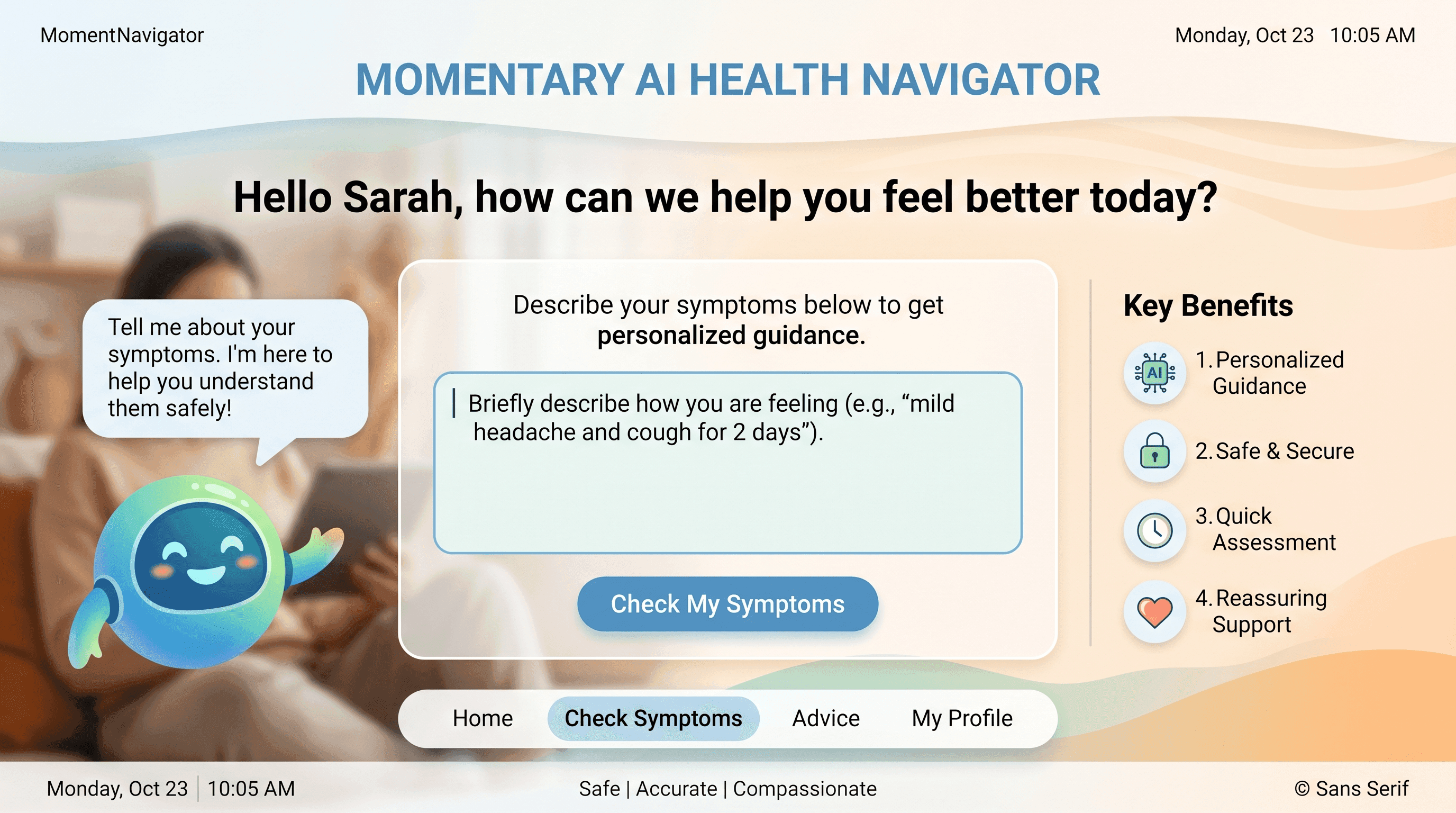
[IMAGE SUGGESTION: Clean product screenshot or illustration of an AI health navigator interface with a simple symptom input field and a reassuring, non-clinical color palette. Alt text: "Momentary AI health navigator interface showing a symptom input field."]
2. Ada Health — Free Symptom Checker with Published Accuracy Data
Ada Health is a dedicated medical symptom assessment app used by more than 11 million people worldwide. It was built by a team of physicians and engineers and holds a CE mark as a Class IIa medical device in the European Union, which reflects a level of clinical validation that most AI health tools do not publish.
Pros: Ada's clinical credibility is backed by a published accuracy study in BMJ Open (2022) showing 84% top-5 diagnostic accuracy, which is one of the few peer-reviewed benchmarks available for a consumer symptom checker. The app is free with no subscription required. Onboarding takes under two minutes, and the symptom assessment walks through a structured clinical interview rather than a keyword search.
Cons: Ada does not connect users to live physicians or telehealth providers within the app, so someone who needs follow-up care must find that separately. The app's focus is assessment only, which limits its usefulness for someone who wants both triage and a care pathway in one place.
Pricing: Free.
Best for: People who want a clinically validated, free symptom assessment with no strings attached.
Rating: 4.7 stars on the App Store (June 2026, 19,000+ ratings). Source: Apple App Store, June 2026.
3. K Health — AI Triage Plus Licensed Physician Access
K Health combines an AI symptom checker with direct access to licensed primary care physicians and specialists, all within a single platform. The AI component was validated in a study published in JAMA Network Open (2021), making K Health one of a small number of consumer health AI tools with peer-reviewed clinical evidence behind its triage logic.
Pros: K Health's AI has been validated against a database of real physician diagnoses, which gives the triage step a clinical grounding that general-purpose AI tools do not have. The platform allows users to move from an AI assessment to a physician message or video visit without switching apps, with urgent care visits starting at $35. K Health holds a 4.8-star App Store rating based on more than 240,000 ratings, which is the largest validated user feedback pool on this list.
Cons: The monthly primary care membership ($19/month) adds recurring cost for users who want ongoing access rather than one-off visits. The platform focuses on primary care; complex specialty referrals still require going outside K Health.
Pricing: Symptom checker free. Urgent care visits from $35 per visit. Primary care membership at $19/month. Source: khealth.com, June 2026.
Best for: People who want to move from AI triage to a real physician without leaving the same platform.
Rating: 4.8 stars on the App Store (June 2026, 240,000+ ratings). Source: Apple App Store, June 2026.
4. Buoy Health — Harvard-Developed Symptom Navigator
Buoy Health is a free, web-based symptom checker and care navigation tool developed in partnership with Harvard Medical School. Its AI was trained on clinical data and is designed to help users identify likely conditions and understand which type of care (self-care, urgent care, emergency) fits their situation.
Pros: The Harvard Medical School development partnership gives Buoy a clinical grounding that distinguishes it from general AI assistants. It is free with no account required, and the assessment routes users toward appropriate care settings rather than just listing possible conditions. Buoy is particularly useful for people who are unsure whether their symptoms warrant an urgent care visit or can be managed at home.
Cons: Buoy is web-only with no standalone mobile app that carries a significant App Store rating, which limits accessibility for mobile-first users. It does not connect directly to live providers, so follow-up care still requires a separate platform or appointment.
Pricing: Free. Source: buoyhealth.com, June 2026.
Best for: People who want structured triage guidance and care routing from a clinically developed tool, at no cost.
5. Perplexity AI — Real-Time Sourced Health Research
Perplexity AI is a general-purpose search AI that cites its sources inline, which makes it meaningfully more transparent than ChatGPT or other LLMs that generate responses without attribution. When asked a medical question, Perplexity pulls from indexed web sources including medical journals and health authority pages and shows the user exactly where each piece of information came from.
Pros: Source citation is Perplexity's strongest feature for health queries: users can verify whether information came from the CDC, a peer-reviewed journal, or a lower-quality source, which general AI tools do not make easy. The free tier has no signup requirement and delivers instant responses. The App Store rating of 4.6 stars (June 2026, 29,000+ ratings) reflects strong user satisfaction across use cases. Source: Apple App Store, June 2026.
Cons: Perplexity has no physician oversight, no clinical validation study for medical queries, and no built-in triage logic. It is a research tool, not a symptom checker. Users who follow its health information without clinical judgment applied are relying on search quality, not medical review.
Pricing: Free tier available. Perplexity Pro at $20/month. Source: perplexity.ai, June 2026.
Best for: People who want to research a diagnosis or medication and need cited, verifiable sources rather than an AI-generated summary.
Rating: 4.6 stars on the App Store (June 2026, 29,000+ ratings). Source: Apple App Store, June 2026.
6. WebMD Symptom Checker — Trusted Brand, Broad Reference Coverage
WebMD's Symptom Checker is one of the oldest and most recognized health tools in the US. It is rule-based rather than AI-driven in the conversational sense, meaning it follows a structured decision tree rather than generating responses from a language model. Its strength is breadth of coverage and the trust that comes from decades of physician-reviewed content.
Pros: WebMD is medically reviewed and updated by licensed physicians, and its brand recognition means millions of users already trust it as a starting point for health information. The checker is free and requires no account. The App Store rating of 4.2 stars (June 2026, 13,000+ ratings) reflects a large, long-running user base. Source: Apple App Store, June 2026.
Cons: The interface carries significant advertising, which affects readability and can feel clinical in a distracting rather than reassuring way. The symptom checker is rule-based rather than conversational, so it does not adapt to nuanced follow-up questions the way an AI tool does. There is no peer-reviewed accuracy study published for the checker component itself.
Pricing: Free. Source: webmd.com, June 2026.
Best for: People who want a familiar, trusted reference tool and are comfortable navigating a click-through symptom tree.
Rating: 4.2 stars on the App Store (June 2026, 13,000+ ratings). Source: Apple App Store, June 2026.
7. Google Gemini — General AI with Health Q&A Capability
Google Gemini is a general-purpose AI assistant with strong language comprehension and access to a wide range of indexed information. It can answer medical questions, summarize health conditions, and explain treatment options, but it does so as a general task, not as a clinical function. Google has added health-specific safety disclaimers to Gemini responses on medical topics, but no published accuracy study exists for its medical query performance.
Pros: Gemini is free, instant, and available without a separate account for most users through Google's ecosystem. It handles complex, multi-part health questions in natural language and is among the most accessible AI tools for non-technical users. Gemini Advanced at $19.99/month offers expanded context windows for longer health research sessions.
Cons: Gemini has no physician oversight, no clinical validation, and no built-in triage logic. Its health responses are only as reliable as the sources it draws on, and it does not always distinguish between high-quality clinical sources and general web content. It scores lowest on scope fit among all entries because it is the least purpose-built for medical queries.
Pricing: Free. Gemini Advanced at $19.99/month. Source: gemini.google.com, June 2026.
Best for: People already in the Google ecosystem who want quick general health information and understand they are using a general AI, not a clinical tool.
8. Microsoft Copilot — GPT-4-Based Health Q&A for Windows Users
Microsoft Copilot is powered by GPT-4 and integrated natively into Windows, Edge, and Microsoft 365. Like Google Gemini, it handles medical questions competently as a general task but was not built for clinical triage. Its integration into the Windows ecosystem makes it the most accessible option for users who spend most of their time in a Windows or Office environment.
Pros: Copilot is free for consumer use, instant, and requires no additional account for Windows users. It can summarize medical literature, explain diagnoses in plain language, and help users formulate questions before a doctor's appointment. The GPT-4 foundation gives it strong comprehension of complex health topics.
Cons: No physician oversight, no clinical validation, and no published accuracy data for health queries. Copilot scores lower on scope fit because health triage is incidental to its design, not a core function. Users outside the Microsoft ecosystem gain little advantage over using ChatGPT directly.
Pricing: Free. Microsoft 365 Copilot at $30/user/month for enterprise (not applicable to consumer health use). Source: microsoft.com, June 2026.
Best for: Windows users who want integrated health Q&A without switching to a separate app.
9. Claude (Anthropic) — Careful, Nuanced Health Explanations
Claude is Anthropic's general-purpose AI assistant, known for measured, thoughtful responses that include appropriate caveats on uncertain or sensitive topics. When asked medical questions, Claude tends to explain its reasoning, flag areas of clinical uncertainty, and recommend professional consultation more consistently than some competing general AI tools.
Pros: Claude's response style is well-suited to medical topics because it applies caution to ambiguous claims rather than presenting uncertain information with false confidence. The App Store rating of 4.7 stars (June 2026, 8,000+ ratings) reflects strong user satisfaction. The free tier is available at claude.ai with no credit card required. Source: Apple App Store, June 2026.
Cons: Like all general AI tools on this list, Claude has no physician oversight, no clinical validation for health queries, and no built-in triage logic. It scores lowest overall because its strength, nuanced language and careful reasoning, is less directly valuable for symptom triage than a purpose-built clinical tool. Users who need a care recommendation, not just an explanation, will need to move to a clinical platform.
Pricing: Free tier at claude.ai. Claude Pro at $20/month. Source: claude.ai, June 2026.
Best for: People who want a thoughtful, caveat-aware explanation of a health topic and are comfortable being redirected to a professional for next steps.
Rating: 4.7 stars on the App Store (June 2026, 8,000+ ratings). Source: Apple App Store, June 2026.
If any of these tools surface a symptom or concern that needs a clinical opinion, the right next step is a conversation with a licensed provider. You can see a doctor online through Momentary Virtual Care without an in-person visit, often on the same day, which fits neatly between an AI triage step and a full in-person appointment.
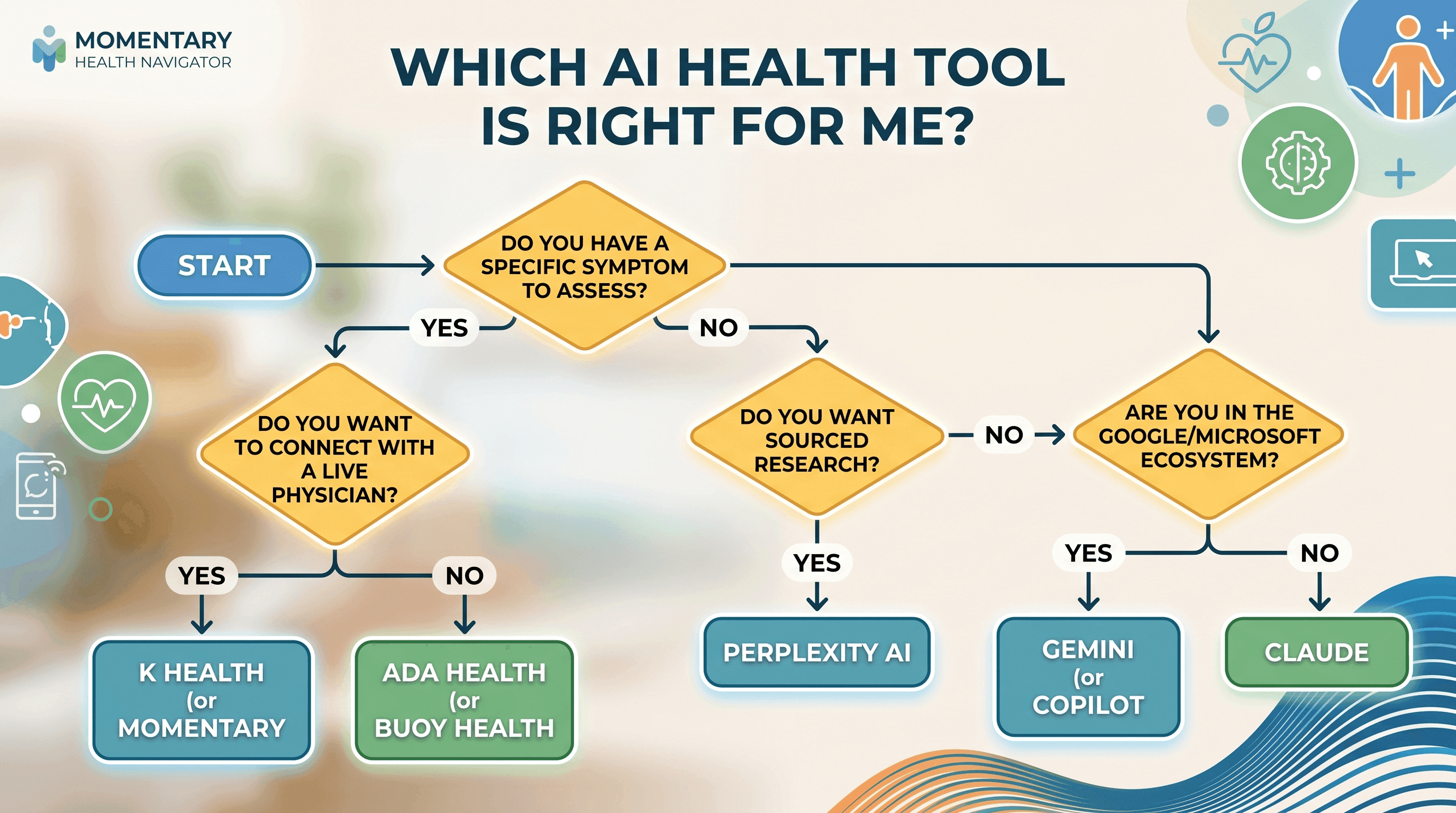
[FLOWCHART SUGGESTION: "Which AI health tool is right for me?" Decision logic: Start -> "Do you have a specific symptom to assess?" -> Yes -> "Do you want to connect with a live physician?" -> Yes -> K Health or Momentary; No -> Ada Health or Buoy Health. Start -> No -> "Do you want sourced research?" -> Yes -> Perplexity AI; No -> "Are you in the Google/Microsoft ecosystem?" -> Yes -> Gemini or Copilot; No -> Claude.]
FAQ
What is the alternative to ChatGPT for medical questions?
The best alternatives to ChatGPT for medical questions are purpose-built AI health tools like Momentary, Ada Health, and K Health, rather than other general-purpose AI assistants. These tools were designed with clinical triage logic, physician involvement, and published accuracy data, which makes their health responses more structured and reliable than a general AI repurposed for health queries. For verified symptom assessment, Buoy Health and Ada Health are both free and clinically developed. For live physician access following an AI triage step, K Health and Momentary are the two strongest options.
What is the medical version of ChatGPT?
There is no single product marketed as "the medical version of ChatGPT," but several AI tools function as clinically supervised equivalents. K Health's AI was validated in a JAMA Network Open study and connects users to licensed physicians. Ada Health holds a CE mark as a Class IIa medical device and has published diagnostic accuracy data in BMJ Open. Momentary operates under a physician-review model and pairs AI triage with virtual care visits. These tools are the closest functional equivalents to a medically focused conversational AI built for US users.
Which AI is better than ChatGPT for health questions?
For health-specific questions, purpose-built medical AI tools outperform ChatGPT on clinical credibility and scope fit. Ada Health's 84% top-5 diagnostic accuracy (BMJ Open, 2022) and K Health's JAMA-published validation give them a documented clinical edge that ChatGPT, which has no published accuracy study for medical queries, does not have. General AI tools like Perplexity AI edge out ChatGPT for health research specifically because they cite their sources inline, letting users verify whether information came from a clinical source. For a combination of AI triage and physician access, use Momentary's AI health navigator as a starting point before deciding whether a full appointment is necessary.
Which AI is best for medical conditions?
The best AI for medical conditions depends on what kind of help is needed. For structured symptom assessment with published clinical accuracy, Ada Health (84% top-5 accuracy, BMJ Open 2022) and K Health (JAMA-validated) are the strongest options. For a physician-reviewed triage tool that connects to virtual care, Momentary is purpose-built for that workflow. For sourced research on a specific condition or medication, Perplexity AI provides inline citations that allow verification. For any serious, worsening, or emergency condition, no AI tool is a substitute for in-person care. A doctor can advise on individual cases.
References
- Ada Health symptom checker accuracy study. BMJ Open, 2022.
- K Health AI validation study. JAMA Network Open, 2021.
- Ada Health product page, accessed June 2026.
- K Health pricing page, accessed June 2026.
- Buoy Health product page, accessed June 2026.
- Perplexity AI pricing page, accessed June 2026.
- Google Gemini product page, accessed June 2026.
- Microsoft Copilot product page, accessed June 2026.
- Claude (Anthropic) pricing page, accessed June 2026.
- WebMD Symptom Checker, accessed June 2026.
- Momentary product page, accessed June 2026.


