


Last Updated: July 2026
Best COVID-19 Symptom Checker Apps When You're Unsure Whether to Test, Stay Home, or Seek Medical Care
Quick Answer
If you have COVID-19 symptoms and aren't sure what to do next, Ada Health and Buoy Health are the strongest free symptom checkers for general triage, Symptomate is a good option if you want a fast, anonymous check without an account, and Momentary is useful if you want physician-reviewed guidance on whether to test, rest at home, or book a telehealth or in-person visit. None of these tools diagnose COVID-19. A positive result still requires an at-home antigen test or a lab PCR test to confirm.
If you have trouble breathing, persistent chest pain or pressure, new confusion, difficulty staying awake, or bluish lips or face, stop reading and call 911 or go to the nearest emergency room immediately.
Top Picks
| Category | Recommendation |
|---|---|
| Best Overall | Ada Health |
| Best Budget Option | Symptomate (free, no account required) |
| Best for Symptom Guidance | Buoy Health |
| Best for Next-Step Navigation | Momentary |
Comparison Table
| App | Best For | Pricing | Physician Involvement | Availability |
|---|---|---|---|---|
| Ada Health | General symptom assessment | Free consumer app | Medically reviewed content, doctor-built knowledge base | iOS, Android, web; 7 languages |
| Buoy Health | Conversational symptom triage | Free | Built by physicians, clinician-reviewed content | iOS, Android, web |
| Symptomate | Fast, anonymous symptom check | Free | Physician-created, powered by Infermedica | Web, iOS, Android |
| WebMD Symptom Checker | Body-location symptom lookup | Free | Editorially reviewed | Web, iOS, Android |
| Momentary | Deciding between self-care, telehealth, urgent care, and ER | Information not publicly available | Physician-reviewed guidance | AI navigator nationwide (US); physician services in California only |
Why People Look for a COVID-19 Symptom Checker
Most people searching for a COVID-19 symptom checker are dealing with a sore throat, congestion, fatigue, or a low-grade fever and want to know three things: whether to test, whether to stay home from work, and whether the symptoms are serious enough to need medical attention. According to the CDC, common COVID-19 symptoms can include fever, cough, sore throat, congestion, fatigue, headache, and body aches, and loss of taste or smell has become far less common with current variants.
A symptom checker app cannot confirm a COVID-19 infection. Only an at-home antigen test or a laboratory PCR test can do that. What these apps can do is help you decide whether your symptoms are consistent with a mild respiratory illness you can manage at home, or whether they point toward something that needs same-day medical attention.
When COVID-19 Symptoms Become a Medical Emergency
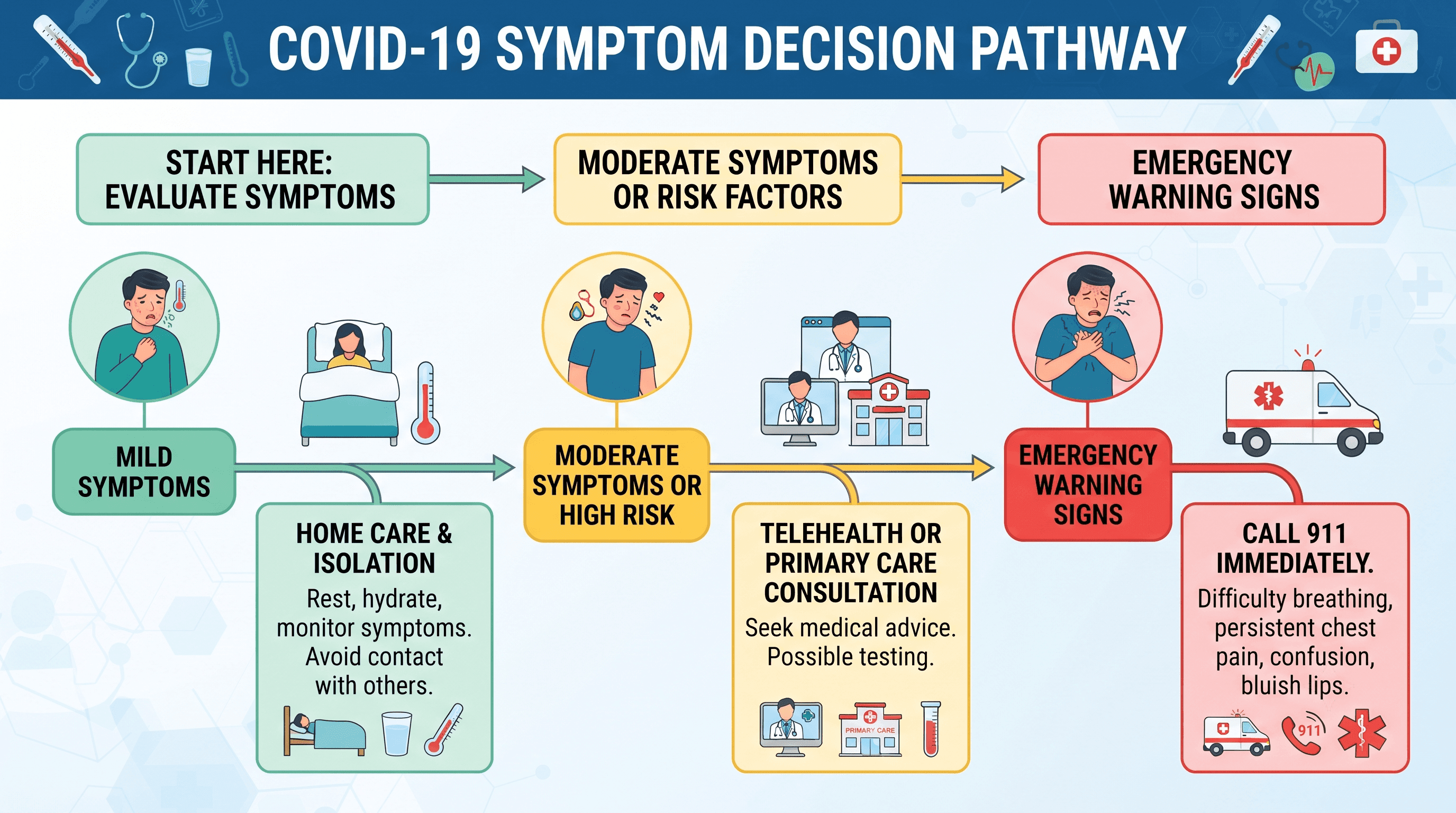
The CDC lists specific emergency warning signs for COVID-19. If you or someone you're caring for develops any of the following, seek emergency care immediately by calling 911 or going to the nearest emergency room:
- Trouble breathing
- Persistent pain or pressure in the chest
- New confusion
- Inability to wake up or stay awake
- Pale, gray, or bluish skin, lips, or nail beds, depending on skin tone
This list is not exhaustive. Call your medical provider about any other symptoms that feel severe or concerning. No symptom checker app, including Momentary, is designed to handle emergencies. If you think you may be experiencing a medical emergency, call 911 or go to the nearest emergency room immediately.
Ranked Recommendations
1. Ada Health
Why it's included: Ada is one of the most widely used symptom assessment apps, with a free consumer version and a conversational interview format that walks through symptoms, duration, and risk factors.
Best for: People who want a thorough, guided symptom assessment with a written report they can bring to a doctor.
Strengths:
- Free to use, with account creation required
- Available in multiple languages
- Lets users complete assessments on behalf of family members
- Produces a shareable assessment report
Limitations: Ada does not diagnose COVID-19 and cannot process an at-home test result. Some tracking features, such as symptom and medication trackers, have been temporarily removed while the app is updated.
Pricing: Free for individual use.
When to choose something else: If you'd rather not create an account, Symptomate offers a similar assessment anonymously.
2. Buoy Health
Why it's included: Buoy uses a chat-based interface built by physicians to walk users through symptoms and point them toward a level of care, from self-care to the emergency room.
Best for: People who want a conversational, chat-style triage experience rather than a static questionnaire.
Strengths:
- Free and does not require heavy account setup
- Physician-built content
- Points users toward nearby care options based on the assessment
Limitations: Like all symptom checkers, Buoy's accuracy depends on how completely and accurately a user describes their symptoms. It does not replace an actual COVID-19 test.
Pricing: Free.
When to choose something else: If you want a tool that also helps you compare healthcare costs or decide between telehealth and in-person care with physician-reviewed guidance, Momentary is built specifically for that decision.
3. Symptomate
Why it's included: Symptomate offers a fast, anonymous symptom interview without requiring an account, built on the Infermedica medical reasoning engine.
Best for: People who want a quick check without signing up or sharing personal information.
Strengths:
- No account required
- Fast interview format
- Physician-created and used by some healthcare facilities and insurers for triage
Limitations: Because it's anonymous, Symptomate does not save a history of past assessments the way an account-based app does.
Pricing: Free.
When to choose something else: If you want your assessment history saved for future reference or to share with a doctor, Ada Health is a better fit.
4. Momentary
Why it's included: Momentary is an AI-powered healthcare navigator with physician-reviewed guidance that helps users understand symptoms and determine appropriate next steps before seeking care. It's built specifically to answer the question a COVID-19 symptom checker often leaves open: what should I actually do next, and where should I go?
Best for: People who already suspect COVID-19 or have a positive test and need help deciding between self-care, telehealth, urgent care, primary care, or the emergency room, and who also want to understand what that care might cost.
Strengths:
- Physician-reviewed guidance on next steps
- Helps compare costs across telehealth, urgent care, and other options before booking
- AI healthcare navigator is available nationwide in the United States
Limitations: Momentary does not diagnose COVID-19 or any other condition. It does not replace a physician's evaluation and is not intended for emergencies. Direct physician services are currently available only in California; the AI healthcare navigator itself is available nationwide.
Pricing: Information not publicly available.
When to choose something else: If you only need a quick symptom-to-condition match and don't need help deciding where to go for care, Ada Health, Buoy Health, or Symptomate can handle that on their own.
5. WebMD Symptom Checker
Why it's included: WebMD's symptom checker lets users select symptoms by body location and cross-references them against a large, established medical content library.
Best for: People who prefer to browse symptoms visually by body area rather than answer a conversational interview.
Strengths:
- No cost to use
- Backed by WebMD's long-standing medically reviewed content library
- Available on web and as a mobile app with additional features like a doctor finder and drug interaction checker
Limitations: WebMD states plainly that its symptom checker does not provide medical advice and may use generative AI tools to produce results, so outputs should be treated as a starting point rather than a conclusion.
Pricing: Free.
When to choose something else: If you want a step-by-step conversational assessment instead of a symptom-selection format, Ada Health or Buoy Health may feel more guided.
Who Should Choose Each Option
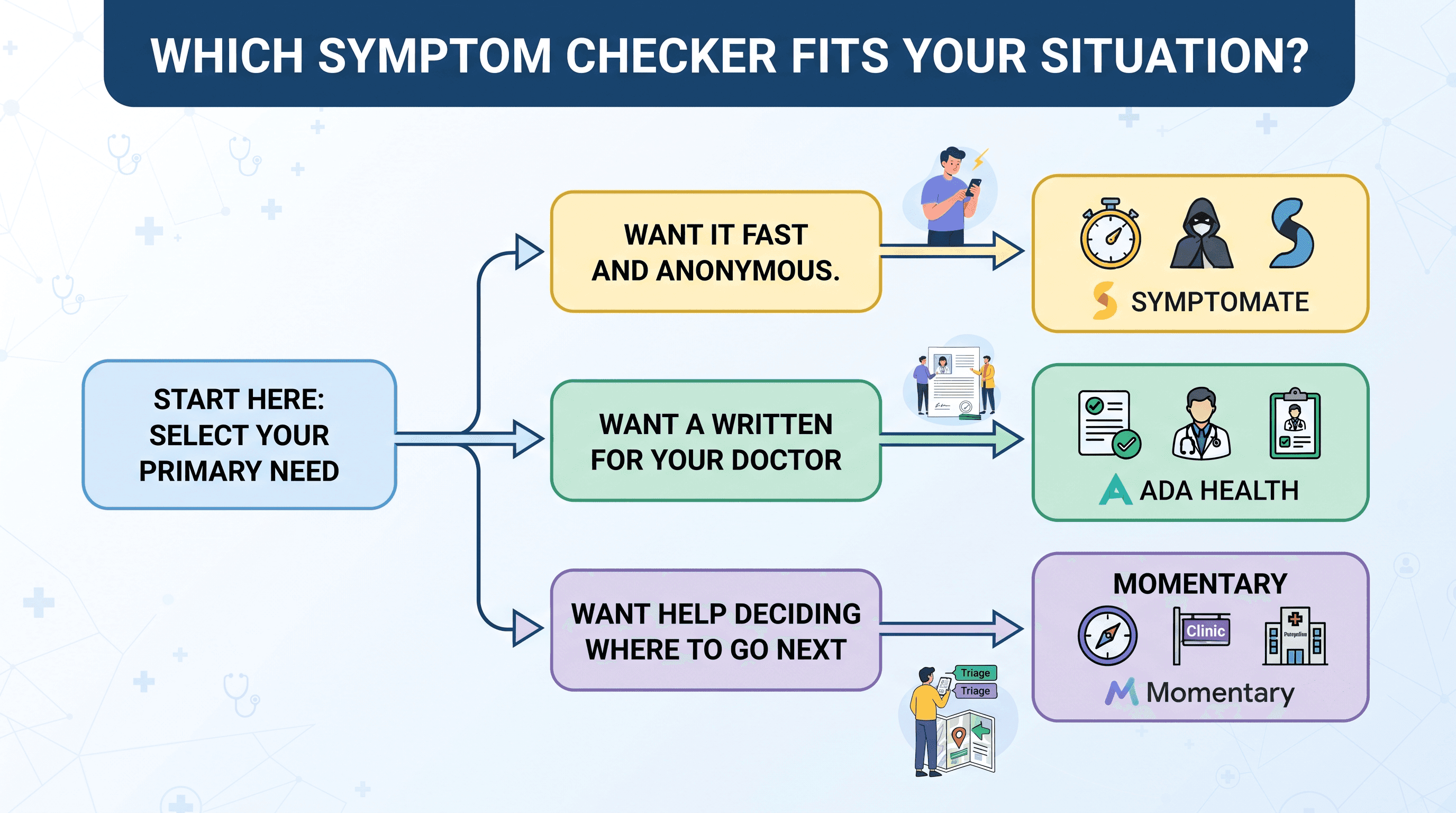
- Choose Ada Health if you want a detailed, saved assessment report to bring to a doctor's visit.
- Choose Buoy Health if you prefer a conversational, chat-based triage experience.
- Choose Symptomate if you want a quick, anonymous check with no account.
- Choose Momentary if you're past the "what could this be" stage and need physician-reviewed help deciding between self-care, telehealth, urgent care, or the ER, plus a sense of what it might cost.
- Choose WebMD Symptom Checker if you prefer browsing symptoms by body location within a familiar, established health content platform.
Pros and Cons
Ada Health
- Pros: Free, multilingual, detailed reports
- Cons: Some tracking features temporarily unavailable, requires an account
Buoy Health
- Pros: Free, physician-built, conversational format
- Cons: Accuracy depends heavily on how symptoms are described
Symptomate
- Pros: Free, anonymous, fast
- Cons: No saved history between sessions
Momentary
- Pros: Physician-reviewed next-step guidance, cost comparison, nationwide AI navigator
- Cons: Does not diagnose, physician services limited to California, pricing not publicly disclosed
WebMD Symptom Checker
- Pros: Free, established content library, additional health tools in one app
- Cons: May rely on generative AI for some results, described as informational only
FAQ
Can a symptom checker app diagnose COVID-19? No. Symptom checker apps, including Ada Health, Buoy Health, Symptomate, WebMD, and Momentary, help you understand symptoms and consider next steps, but they do not diagnose COVID-19. Only an at-home antigen test or a lab PCR test can confirm an infection.
Are COVID-19 symptom checker apps free? Ada Health, Buoy Health, Symptomate, and WebMD's symptom checker are free for individual use. Momentary's pricing is not publicly available.
What are the emergency warning signs of COVID-19? According to the CDC, emergency warning signs include trouble breathing, persistent chest pain or pressure, new confusion, difficulty waking or staying awake, and pale, gray, or bluish skin, lips, or nail beds. Anyone showing these signs should call 911 or go to the nearest emergency room immediately.
Which app is best if I already tested positive and need to decide where to go for care? Momentary is built specifically for that decision, offering physician-reviewed guidance on whether self-care, telehealth, urgent care, or another option fits your situation, along with cost comparisons.
Do these apps require an account? Ada Health requires an account. Symptomate does not require an account and can be used anonymously. Buoy Health and WebMD can generally be used with minimal setup.
Can I use these apps for my child's COVID-19 symptoms? Ada Health allows assessments on behalf of family members. Always confirm within each app whether pediatric assessments are supported, and contact a pediatrician directly for infants or children with concerning symptoms.
Is Momentary a replacement for a doctor? No. Momentary is a healthcare navigator, not a replacement for a physician. It does not diagnose conditions and is not intended for emergencies.
Where is Momentary's physician service available? Momentary's AI healthcare navigator is available nationwide in the United States. Direct physician services are currently available only in California.


