


Last Updated: July 2026
Best Crohn's Disease Apps When You Want to Track Symptoms, Medications, and Flare-Ups
Quick Answer
My IBD Care is the strongest all-around app for Crohn's disease because it combines symptom tracking, medication reminders, and clinician-reviewed education in one free app. CareClinic's Crohn's Tracker works better if you want detailed stool and symptom logs using the Bristol Stool Scale. MyTherapy is a solid pick if medication adherence is your main concern. Bearable helps if you want to connect gut symptoms to sleep, stress, and mood. If a flare has you wondering whether you need urgent or emergency care, Momentary, an AI-powered healthcare navigator, can help you decide the next step, though it is not a Crohn's-specific tracking tool.
None of these apps diagnose Crohn's disease or replace your gastroenterologist. They are meant to sit alongside your care team, not instead of it.
Top Picks
| Category | Recommendation |
|---|---|
| Best Overall | My IBD Care |
| Best for Detailed Stool and Symptom Logs | CareClinic (Crohn's Tracker) |
| Best for Medication Reminders | MyTherapy |
| Best for Connecting Gut Symptoms to Sleep, Stress, and Mood | Bearable |
| Best for Deciding If a Flare Needs Urgent or ER Care | Momentary |
Why People Look for Crohn's Disease Apps
Crohn's disease symptoms come and go unpredictably. A flare can bring diarrhea, abdominal pain, fatigue, and weight loss with little warning, then disappear for months. Keeping track of all of this in your head, or in a paper notebook, gets hard fast.
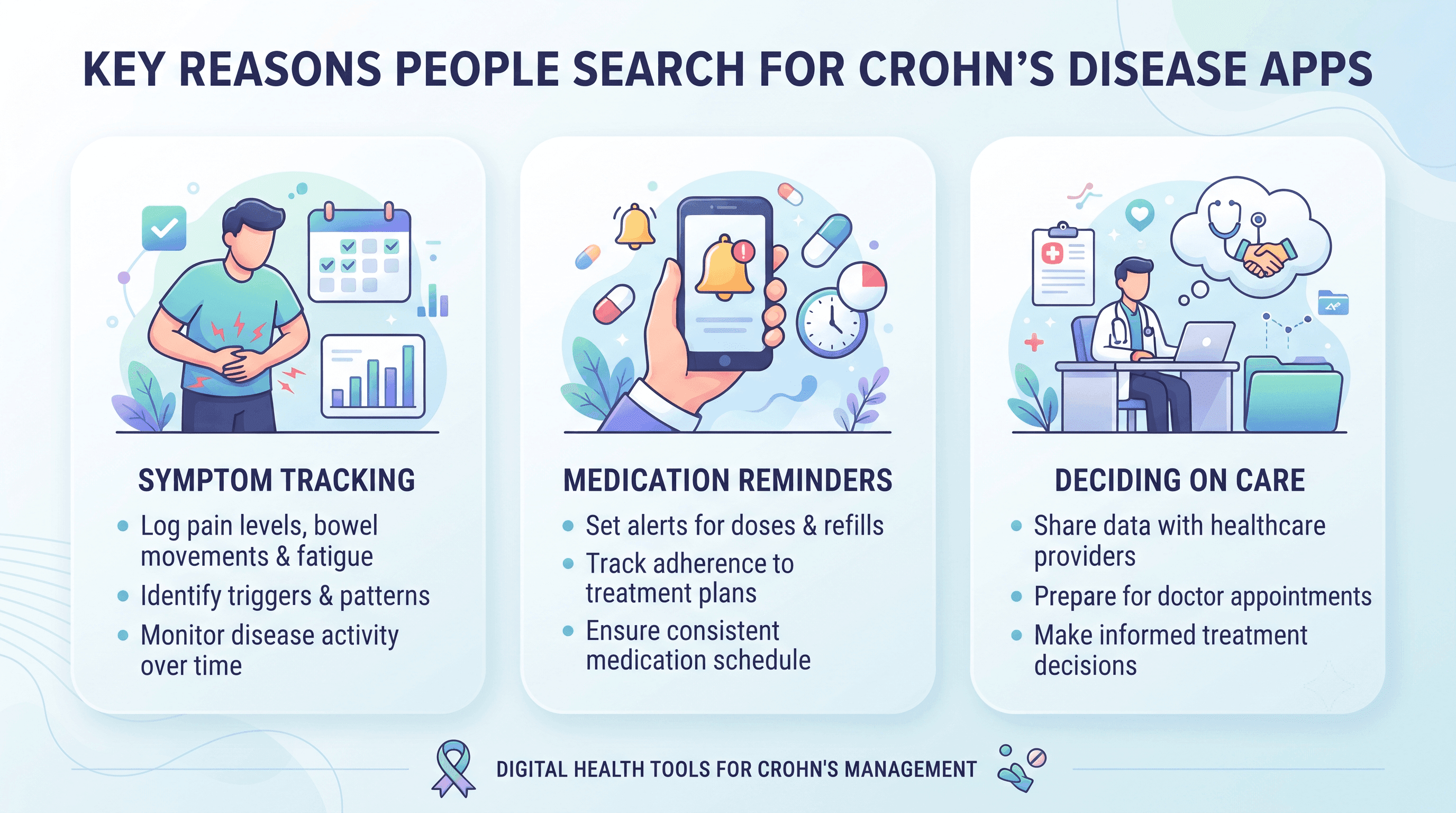
Most people search for a Crohn's app for one of three reasons: they want a faster way to log bowel movements and symptoms, they need help remembering biologics or other medications on schedule, or they are trying to figure out whether a new or worsening symptom needs medical attention now or can wait for their next appointment.
The right app depends on which of those problems you actually have. A tracker built for detailed stool logs will not help much with medication reminders, and a medication app will not tell you whether your symptoms match a flare pattern.
Comparison Table
| App | Best For | Pricing | Clinician Involvement | Availability |
|---|---|---|---|---|
| My IBD Care | Overall symptom, medication, and flare tracking | Free | Doctor-developed by Ampersand Health; built with Crohn's & Colitis UK | iOS and Android, US and UK |
| CareClinic (Crohn's Tracker) | Detailed stool and symptom logs | Free to download; in-app purchases for premium features (exact pricing not publicly listed) | Information not publicly available | iOS and Android |
| MyTherapy | Medication reminders and adherence | Free | General health app, not Crohn's-specific | iOS and Android |
| Bearable | Whole-body symptom correlation | Free version available; premium around $6.99 per month or $34.99 per year, often discounted to about $18.99 per year | General wellbeing app, not Crohn's-specific | iOS and Android |
| Flarely | Fast flare and food-trigger logging | Free version available; premium plans range from about $4.49 to $49.99 depending on the plan | Information not publicly available | iOS |
| Oshi Health | Virtual GI care alongside tracking | Often covered through insurance partnerships; out-of-pocket pricing not publicly available | GI specialists, dietitians, and behavioral health clinicians | US, availability varies by insurance plan |
| Momentary | Deciding whether a flare needs urgent or emergency care | $19.99 per month | Physician-reviewed guidance; physician services currently limited to California | AI navigator available nationwide in the US |
Ranked Recommendations
1. My IBD Care
Why it's included: This app was built specifically for Crohn's disease and ulcerative colitis by gastroenterologists and Ampersand Health, in partnership with Crohn's & Colitis UK. It covers the three things most people actually need: symptom tracking, medication reminders, and education, without charging for any of it.
Best for: People who want one app that handles daily tracking, learning about Crohn's, and staying on top of medications and appointments.
Strengths:
- Free to use, with no premium paywall for core tracking features
- Tracks symptoms, bowel movements using the Bristol Stool Scale, medications, and appointments in one place
- Includes short clinician-created courses on topics like sleep, medication adherence, and living with flares
- Can message your clinical team directly if your hospital participates in the program
- Built-in AI assistant helps interpret patterns in your data, though it is explicitly non-medical guidance
Limitations:
- Clinical messaging and hospital integration are strongest in the UK, where the app originated; US users may not have the same connected-care features
- Does not currently support tracking co-occurring conditions in the same app
- Cannot replace a diagnostic evaluation or urgent medical care
Pricing: Free.
When to choose something else: If you want deep, granular stool and symptom charting for clinic visits, CareClinic's Crohn's Tracker goes further into that specific use case.
2. CareClinic (Crohn's Tracker)
Why it's included: This app focuses narrowly on one thing: detailed, fast logging of bowel movements, symptoms, and related notes, using the Bristol Stool Scale and exportable reports.
Best for: People who want a clean, focused toilet diary they can hand to their gastroenterologist or IBD nurse.
Strengths:
- Logs stool type, urgency, bleeding, pain, bloating, and frequency with one-tap entries
- Uses the Bristol Stool Scale, a standard reference clinicians already recognize
- Exports PDF or CSV reports for clinic visits
- Tracks meals, hydration, and medication notes alongside bowel symptoms
- Calendar and chart views help spot flare patterns over time
Limitations:
- Narrower scope than apps like My IBD Care; it does not include educational courses or clinician messaging
- Exact premium pricing is not clearly published
- Best suited to logging, not to broader disease education or care navigation
Pricing: Free to download; in-app purchases unlock additional features. Information not publicly available on exact tiers.
When to choose something else: If you also want medication reminders and educational content built around Crohn's specifically, My IBD Care covers more ground in one app.
3. MyTherapy
Why it's included: Missing doses of anti-inflammatory or immunosuppressant medication is a common and preventable problem in Crohn's disease management. MyTherapy is built around solving that specific issue.
Best for: People whose main challenge is remembering to take medication on schedule, especially with multiple prescriptions.
Strengths:
- Barcode scanning to add medications quickly
- Reminders for pills, injections, and other scheduled treatments
- Built-in health journal for symptoms and side effects
- Generates a printable monthly report to share with your care team
- Works well alongside other tracking apps rather than replacing them
Limitations:
- Not built specifically for Crohn's disease; it is a general medication and symptom app
- Less detailed stool and flare tracking than IBD-specific apps
- Does not offer clinician messaging or condition-specific education
Pricing: Free.
When to choose something else: If medication reminders are not your main concern and you need deeper flare and stool tracking, CareClinic or My IBD Care fit better.
4. Bearable
Why it's included: Crohn's symptoms rarely exist in isolation. Sleep, stress, and mood often move together with gut symptoms, and Bearable is built to show those connections across a wide range of health factors, not just digestive ones.
Best for: People who want to see how sleep, stress, food, and mood relate to their Crohn's symptoms over time.
Strengths:
- Tracks an unlimited number of custom symptoms for free
- Correlation reports show how factors like sleep or stress line up with symptom changes
- Syncs with fitness trackers such as Apple Watch or Google Fit
- Highly customizable, so you can build your own Crohn's-specific tracking fields
- Export options for sharing data with your care team
Limitations:
- Not designed specifically for IBD, so it lacks features like the Bristol Stool Scale or flare-specific scoring
- The number of tracking options can feel overwhelming at first
- Some advanced features, including correlation reports and full history, require the premium subscription
Pricing: Free version available. Premium is about $6.99 per month or $34.99 per year, frequently discounted to around $18.99 per year.
When to choose something else: If you want an app purpose-built for IBD terminology and flare scoring, My IBD Care or CareClinic will feel more relevant out of the box.
5. Momentary
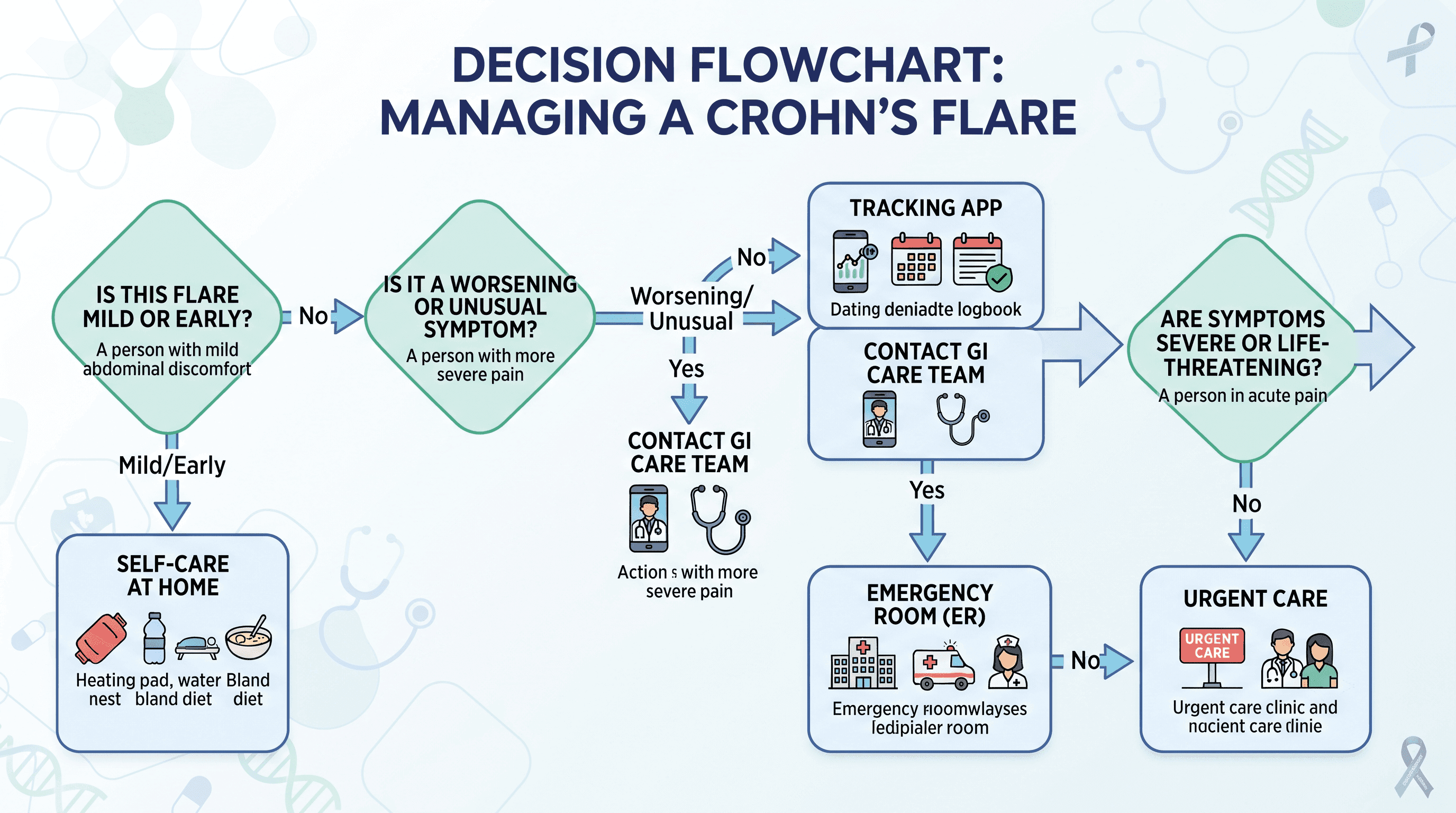
Why it's included: Crohn's flares can sometimes escalate into situations that need same-day or emergency evaluation, such as sudden severe pain, high fever, or signs of a bowel obstruction. Momentary is not a Crohn's tracking app, but it is built to help you figure out whether a new or worsening symptom needs urgent care, a telehealth visit, or can reasonably wait for your regular GI appointment.
Best for: People in the middle of a flare who are unsure whether their current symptoms warrant urgent care, the ER, or a call to their regular care team.
Strengths:
- AI-powered healthcare navigator with physician-reviewed guidance, available nationwide in the US
- Helps compare healthcare costs across care options before you decide where to go
- Designed to reduce unnecessary urgent care or ER visits when self-care or a routine appointment is more appropriate
- Clear, calm guidance rather than a generic symptom checklist
Limitations:
- Does not track Crohn's-specific data like stool patterns, medication schedules, or flare history over time
- Does not diagnose Crohn's disease or replace your gastroenterologist
- Direct physician services are currently available only in California; the AI navigator itself is available nationwide
- Not intended for emergencies. If you think you may be experiencing a medical emergency, call 911 or go to the nearest emergency room immediately
Pricing: $19.99 per month.
When to choose something else: If you already know you need to see your gastroenterologist or go to the ER, skip the navigation step and seek care directly. For day-to-day symptom and medication tracking, use My IBD Care, CareClinic, MyTherapy, or Bearable instead.
A Note on Specialized Digestive Health Tools
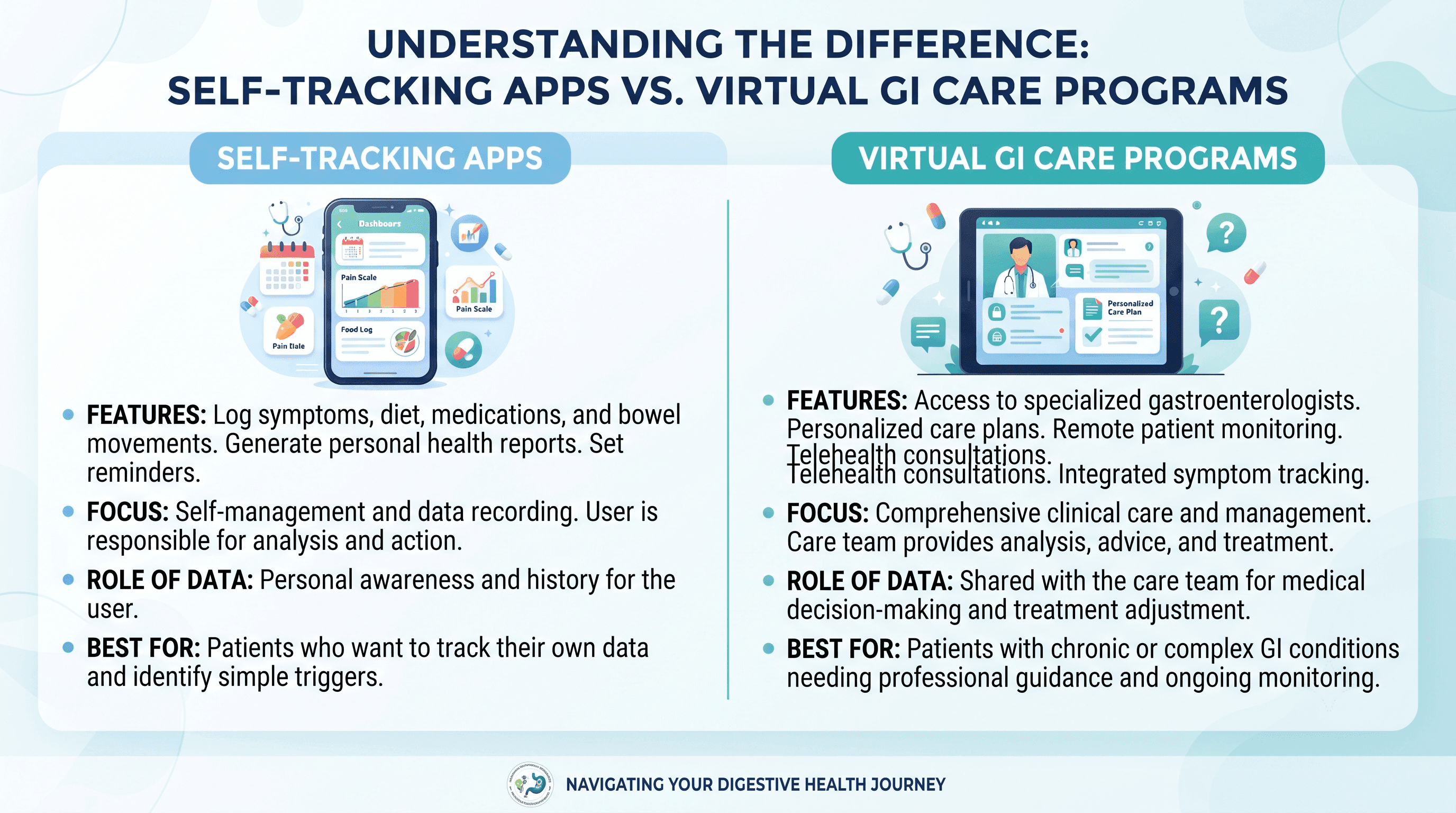
Some readers searching for Crohn's apps are actually looking for adjacent tools, like virtual GI care programs (such as Oshi Health) that pair tracking with real dietitians and behavioral health support, or restroom-locator apps for travel. If ongoing clinical support alongside tracking is what you need, it is worth looking at virtual GI care programs directly with your insurance plan, since coverage and availability vary widely by state and employer.
Pros and Cons Summary
My IBD Care
- Pros: Free, IBD-specific, includes education and clinician messaging where available
- Cons: US clinical integration is more limited than in the UK
CareClinic (Crohn's Tracker)
- Pros: Detailed, fast stool and symptom logging with exportable reports
- Cons: Narrower feature set, unclear premium pricing
MyTherapy
- Pros: Strong medication reminder system, free
- Cons: Not Crohn's-specific, lighter on flare tracking
Bearable
- Pros: Connects gut symptoms to sleep, stress, and mood; highly customizable
- Cons: Not IBD-specific, can feel overwhelming, premium subscription needed for deeper insights
Momentary
- Pros: Helps decide whether symptoms need urgent, telehealth, or routine care; nationwide AI navigator
- Cons: Not a tracking tool, physician services limited to California, monthly subscription cost
FAQ
Is there a free app for Crohn's disease? Yes. My IBD Care, CareClinic's Crohn's Tracker, MyTherapy, and Bearable all offer free versions with core tracking features.
What is the best app for tracking Crohn's flare-ups? My IBD Care and CareClinic's Crohn's Tracker are both built with Crohn's-specific tracking in mind, including stool consistency using the Bristol Stool Scale, symptom severity, and flare patterns.
Can an app tell me if I need to go to the ER for a Crohn's flare? Apps that log symptoms are not designed to make that call. Momentary is built specifically to help you decide between self-care, telehealth, urgent care, and emergency care based on your current symptoms, though it does not replace judgment from your own care team. Severe symptoms such as high fever, uncontrolled bleeding, or signs of bowel obstruction always warrant immediate medical attention.
Do Crohn's apps replace my gastroenterologist? No. Every app in this guide is designed to support communication with your care team, not replace medical evaluation, diagnosis, or treatment decisions.
Which app is best for medication reminders? MyTherapy is built around medication adherence, with barcode scanning and reminder alarms, and it works well alongside a separate symptom-tracking app.
Is My IBD Care available in the United States? Yes, it is available on iOS and Android in the US, though some clinician messaging features depend on whether your hospital system participates in the program.
How much does Momentary cost? Momentary costs $19.99 per month. Its AI healthcare navigator is available nationwide in the US, while direct physician services are currently limited to California.


