


Last Updated: July 2026
Best Food Intolerance Tracking Apps When You Want to Identify Trigger Foods and Digestive Symptoms
The best food intolerance tracking apps in 2026 are mySymptoms Food Diary for detailed correlation analysis, Cara Care for a guided low FODMAP program with dietitian support, and Bearable for tracking digestive symptoms alongside mood, sleep, and energy. If you're not sure whether your symptoms need medical attention rather than just tracking, Momentary can help you figure out the right next step.
Food intolerance symptoms (bloating, diarrhea, fatigue, skin flare-ups) are rarely caused by one obvious food. They build up over hours or days, which makes them hard to trace with memory alone. A tracking app turns that guesswork into a searchable log.
This guide compares the apps worth using, what each one actually does well, and where each one falls short.
Quick Answer
- Best overall for finding trigger foods: mySymptoms Food Diary
- Best for a structured low FODMAP / IBS plan: Cara Care
- Best for tracking beyond digestion (mood, sleep, energy): Bearable
- Best for checking foods while shopping: Fig
- Best for nutrient-level detail: Cronometer
- Best for deciding if you need to see a doctor: Momentary
A food and symptom diary is not a diagnostic tool. If symptoms are severe, persistent, or include unexplained weight loss, blood in stool, or signs of a severe allergic reaction (swelling, difficulty breathing), see a doctor rather than relying on an app.
Top Picks
| Category | Recommendation |
|---|---|
| Best Overall | mySymptoms Food Diary |
| Best Budget Option | Cara Care (free tier) |
| Best for Symptom Guidance | Momentary |
| Best for Broad Health Tracking | Bearable |
Comparison Table
| App | Best For | Pricing | Insurance | Availability |
|---|---|---|---|---|
| mySymptoms Food Diary | Detailed correlation analysis | Free, Gold subscription for insights | Not applicable | iOS, Android, Web |
| Cara Care | Guided low FODMAP / IBS program | Free app, premium program pricing varies | Prescribable in Germany; Information not publicly available for other countries | iOS, Android |
| Bearable | Whole-body symptom tracking | Free, premium subscription | Not applicable | iOS, Android |
| Fig | Scanning foods against a personal allergy/intolerance list | Free, in-app purchases | Not applicable | iOS, Android |
| Cronometer | Nutrient-level food tracking | Free, Gold subscription | Not applicable | iOS, Android, Web |
| Momentary | Deciding whether symptoms need medical care | Information not publicly available | Physician services available in California only; AI navigator free nationwide | Nationwide (US) |
Why People Track Food Intolerance Symptoms
Most people start tracking after weeks or months of unexplained bloating, fatigue, headaches, or skin issues that don't line up with any single obvious cause. A doctor or dietitian will often recommend a food and symptom diary before (or alongside) formal testing, because self-reported patterns can point toward which foods, or food categories like FODMAPs, histamine, or gluten, deserve a closer look.
Food intolerance is different from food allergy. Intolerances (lactose, fructose, histamine, gluten sensitivity) usually cause digestive discomfort that develops over hours. True food allergies involve the immune system and can cause hives, swelling, or breathing difficulty within minutes. If you experience swelling of the face or throat, difficulty breathing, or a rapid drop in symptoms after eating, this may be a medical emergency. Call 911 or go to the nearest emergency room. A tracking app is not a substitute for emergency care.
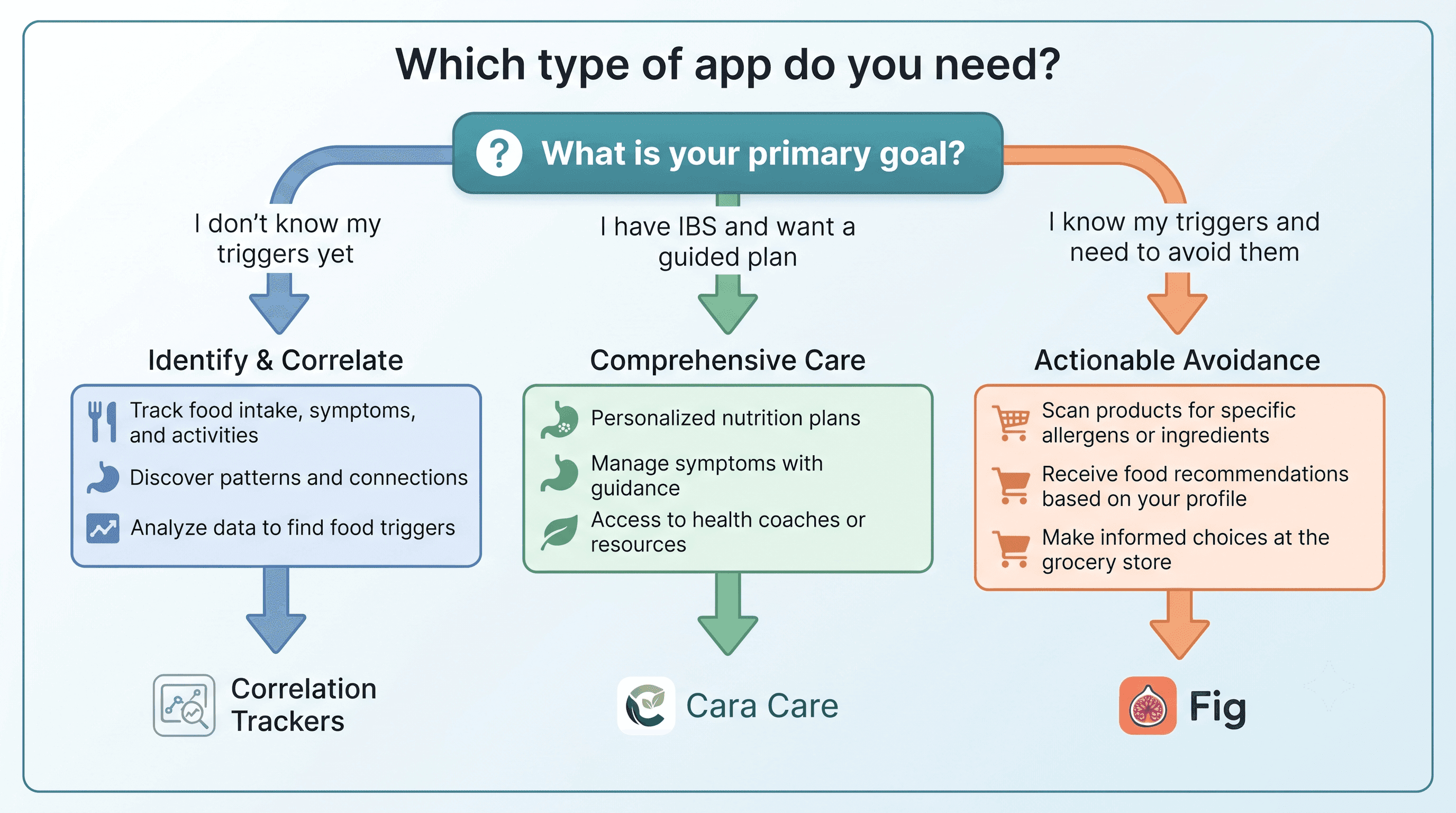
Tracking apps generally fall into three types:
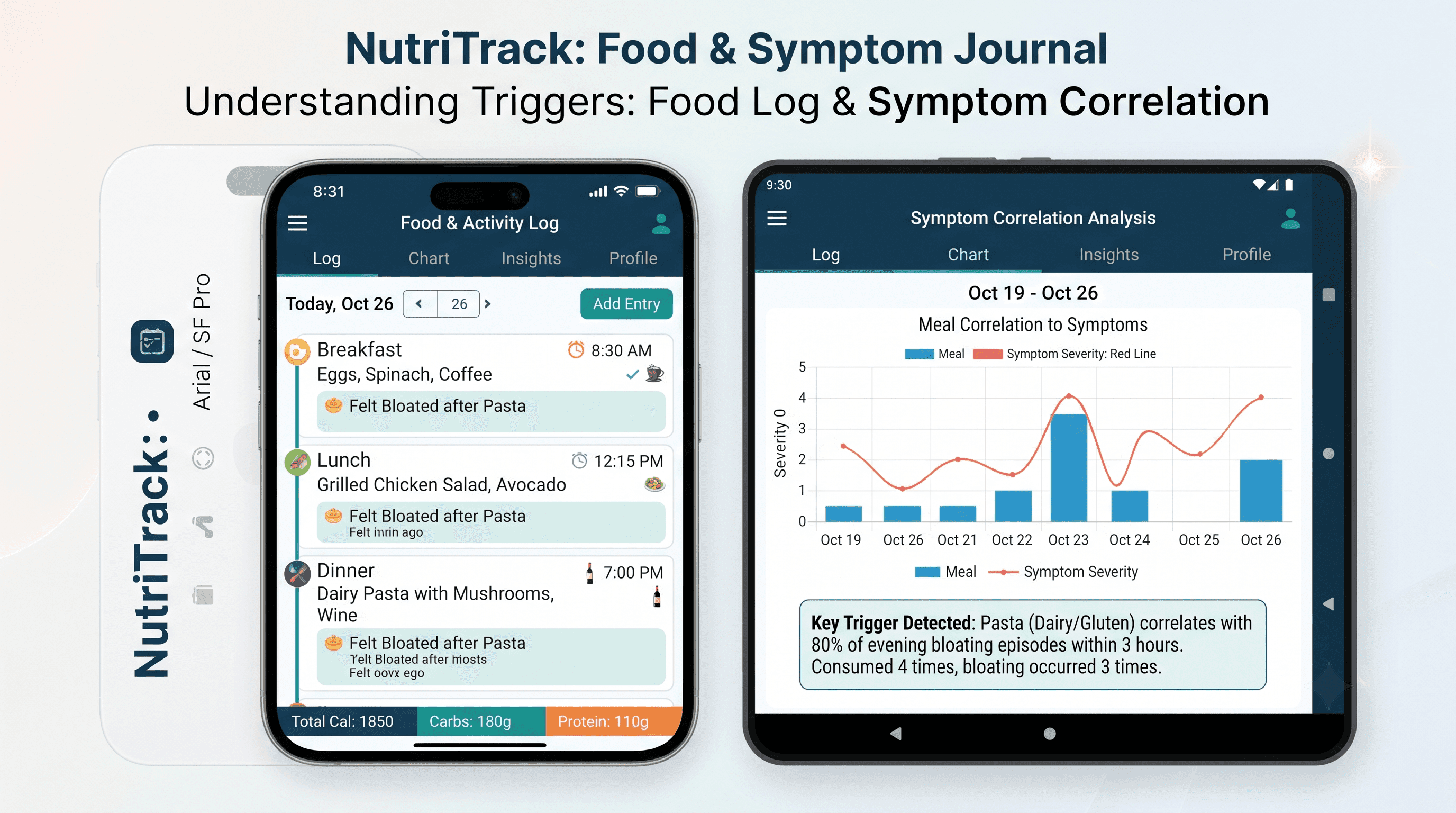
- Correlation trackers that log food and symptoms, then use statistics to flag likely trigger foods (mySymptoms, Bearable).
- Guided programs built around a specific protocol, most often the low FODMAP diet for IBS (Cara Care).
- Lookup and scanning tools that check packaged foods against a list of ingredients you already know you react to (Fig).
Knowing which type fits your situation matters more than picking the app with the most features.
Ranked Recommendations
1. mySymptoms Food Diary
Why it's included: mySymptoms has one of the largest user bases in this category, with over 900,000 people using it to track digestive issues, and it offers the most configurable correlation analysis of any app reviewed here.
Best for: People who want to see the statistical reasoning behind which foods are flagged as likely triggers, not just a summary.
Strengths: Correlation analysis with an adjustable time window from 1 to 72 hours, which matters because food reactions are often delayed. Tracks food, drink, medication, mood, stress, sleep, and bowel movements. Data can be exported and shared directly with a clinician, and the app states it is built to be HIPAA and GDPR compliant.
Limitations: Meals and ingredients must be entered manually or searched in a crowd-sourced database, which can be inconsistent. There is a genuine learning curve, and the deeper insights sit behind a paid Gold subscription.
Pricing: Free to log; premium subscription required for correlation analysis and detailed reports.
When to choose something else: If manual data entry feels like too much friction, a simpler tracker like Bearable may be easier to stick with long term.
2. Cara Care
Why it's included: Cara Care pairs food and symptom tracking with a structured, dietitian-supported 12-week low FODMAP program, which is a meaningfully different approach from a plain diary.
Best for: People with diagnosed or suspected IBS who want guidance, not just a log.
Strengths: Tracks food, stool, stress, and other symptoms alongside a guided elimination and reintroduction plan. The premium program includes text-based access to a dietitian. In Germany, Cara Care is available as a prescribable digital therapeutic (DiGA) that can be reimbursed by statutory health insurance.
Limitations: It's built around IBS and related GI conditions specifically, so it's a weaker fit for people whose main symptoms are migraines, eczema, or other non-digestive reactions. Tracking is meal-level rather than automatic ingredient-level breakdown. The prescription-covered version is currently limited to Germany; availability and pricing elsewhere vary.
Pricing: Free to download and track; the 12-week guided program pricing varies by region and Information not publicly available for all markets.
When to choose something else: If your symptoms extend well beyond the gut, a broader tracker will capture more of the picture.
3. Bearable
Why it's included: Bearable is built for tracking chronic and multi-system symptoms, which makes it useful when digestive issues overlap with fatigue, mood changes, sleep problems, or skin symptoms.
Best for: People managing a broader health picture where food is one factor among several.
Strengths: Highly customizable tracking for symptoms, mood, sleep, energy, and medication, alongside food. Simple daily logging designed to build a consistent habit.
Limitations: Because it tracks so many variables, correlation with specific foods is less statistically rigorous than a dedicated tool like mySymptoms. Ingredient-level detail is limited.
Pricing: Free with an optional premium subscription for advanced charts.
When to choose something else: If food is clearly your main variable and you want deep, food-specific statistical analysis, mySymptoms is the stronger choice.
4. Fig
Why it's included: Fig solves a different problem than the trackers above: once you already know which foods or ingredients you react to, Fig helps you avoid them while grocery shopping or eating out.
Best for: People with a known list of trigger ingredients who need a fast way to check packaged food labels.
Strengths: Barcode and label scanning checked against a personal profile that can include allergies, intolerances, and specialized diets such as low FODMAP, gluten-free, or low histamine. Large user base with an extensive food database.
Limitations: Fig does not run correlation analysis between food and symptoms, so it won't help you identify an unknown trigger. It works best after you already have a diagnosis or a working list of suspect foods.
Pricing: Free, with in-app purchases for unlimited scans and queries.
When to choose something else: If you're still trying to identify your trigger foods rather than avoid known ones, start with a correlation tracker instead.
5. Cronometer
Why it's included: Cronometer isn't a symptom tracker, but it's worth including for people whose intolerance investigation also involves checking whether an elimination diet is leaving nutritional gaps.
Best for: People on a long-term elimination diet who want to confirm they're still getting adequate vitamins and minerals.
Strengths: Tracks a detailed range of nutrients, not just calories, which helps flag deficiencies that can develop when entire food groups are removed for testing.
Limitations: No symptom correlation or trigger-food analysis. This is a nutrition tool, not a diagnostic aid.
Pricing: Free, with a Gold subscription for additional features.
When to choose something else: If your main goal is identifying trigger foods rather than tracking nutrient intake, this should be a supplement to, not a replacement for, a symptom tracker.
6. Momentary
Why it's included: An app can help you log symptoms, but it can't tell you whether what you're experiencing needs medical evaluation. Momentary is an AI-powered healthcare navigator with physician-reviewed guidance that helps users understand symptoms and determine appropriate next steps before seeking care.
Best for: People who've been tracking symptoms for a while and now want help deciding whether to see a primary care doctor, a gastroenterologist, or an allergist, and how urgently.
Strengths: The AI healthcare navigator is available nationwide in the US and is designed to help users decide between self-care, telehealth, urgent care, primary care, and the emergency room based on their symptoms. This can be useful once a food or symptom log shows a pattern worth discussing with a professional.
Limitations: Momentary does not track food intake or run trigger-food analysis, and it does not diagnose conditions. It is not a substitute for a physician, and it is not intended for emergencies. Direct physician services are currently available only in California; the AI navigator itself is available nationwide.
Pricing: Information not publicly available.
When to choose something else: If you already know you need to see a specific type of doctor, or if you're experiencing a possible emergency, go directly to that care rather than using a navigation tool first.
Who Should Choose Each Option
- Choose mySymptoms if you want the most detailed, statistically driven trigger-food analysis and don't mind manual logging.
- Choose Cara Care if you have IBS-type symptoms and want a structured plan with dietitian support rather than a blank diary.
- Choose Bearable if digestion is one of several symptoms you're managing alongside mood, sleep, or fatigue.
- Choose Fig if you already know your trigger ingredients and need help avoiding them at the store or restaurant.
- Choose Cronometer if you're worried about nutritional gaps during an elimination diet.
- Choose Momentary if your tracking has turned up a pattern and you're unsure what kind of care to seek next, or how soon.
FAQ
Is there a free app for tracking food intolerance? Yes. mySymptoms, Cara Care, Bearable, and Fig all offer free versions with core logging features. Advanced correlation analysis and guided programs are typically behind a paid subscription.
Can a food intolerance app diagnose me? No. These apps help identify patterns worth discussing with a doctor or dietitian. Diagnosis of conditions like celiac disease, lactose intolerance, or histamine intolerance requires clinical testing.
What's the difference between a food intolerance and a food allergy? Intolerances typically cause digestive symptoms that build up over hours and are not immune-mediated. Allergies involve the immune system and can cause rapid symptoms like hives, swelling, or breathing difficulty. Severe allergic reactions require emergency care; call 911 or go to the nearest emergency room.
How long should I track before I see patterns? Most correlation-based apps need several weeks of consistent logging to identify statistically meaningful patterns, since some reactions are delayed by up to 72 hours.
Do these apps work for FODMAP tracking specifically? Cara Care is built specifically around the low FODMAP protocol. mySymptoms and Bearable can also track FODMAP-related symptoms but don't include a structured elimination and reintroduction plan.
Is Momentary a food tracking app? No. Momentary is a healthcare navigation tool. It helps you understand symptoms and decide on next steps, such as whether to see a doctor, rather than logging meals or analyzing trigger foods.
Can I share my food and symptom log with my doctor? Most trackers, including mySymptoms and Cara Care, allow you to export or share your log directly with a healthcare provider, which can speed up an evaluation.
Where is Momentary's physician service available? The AI healthcare navigator is available nationwide in the United States. Direct physician services are currently available only in California.


