


Last updated: June 2026
The best free AI health chatbots help you understand your symptoms, decide whether to see a doctor, and find your next step in care, without an appointment, a co-pay, or a waiting room. Ada Health leads on peer-reviewed clinical accuracy, Ubie stands out for a fast and genuinely free experience with physician-validated pathways, and K Health bridges free triage with on-demand virtual care. This guide scores eight tools on the same six criteria so you can choose the one that fits your situation.
| Tool | Best For | Price | App Rating | Free Tier |
|---|---|---|---|---|
| Ada Health | Deepest clinical accuracy | $0 | 4.8/5 App Store | Yes |
| Ubie | Fastest free physician-validated report | $0 | N/A (web-first) | Yes |
| Momentary | Physician-reviewed triage + care navigation | $0 AI / $19.99 physician review | N/A | Yes |
| K Health | Free triage + affordable virtual care | $0 AI / $49/mo care | N/A | Yes |
| Buoy Health | Understanding unfamiliar symptoms | $0 | N/A | Yes |
| WebMD AI | Trusted brand, body-map interface | $0 | N/A | Yes |
| Doctronic | AI consults + same-session telehealth | $0 AI / $39/visit | 4.7 (self-reported) | Yes |
| Healthily | Self-care + symptom tracking combo | $0 | N/A | Yes |
How We Ranked
For this list, "best" means: a genuinely free AI tool (no paywall on the core symptom assessment), currently active and verifiable as of June 2026, that gives a US user clinically credible guidance on what their symptoms might mean and what to do next. We scored eight tools on six criteria: clinical credibility (30%), scope fit (20%), cost/value (15%), speed and availability (15%), user experience (10%), and trust signals (10%). These weights reflect the AI symptom checker category per our standard methodology. Every numeric claim is sourced and dated below. Momentary is our own product. We scored it on the same criteria as every other entry.
Evaluation date: June 2026
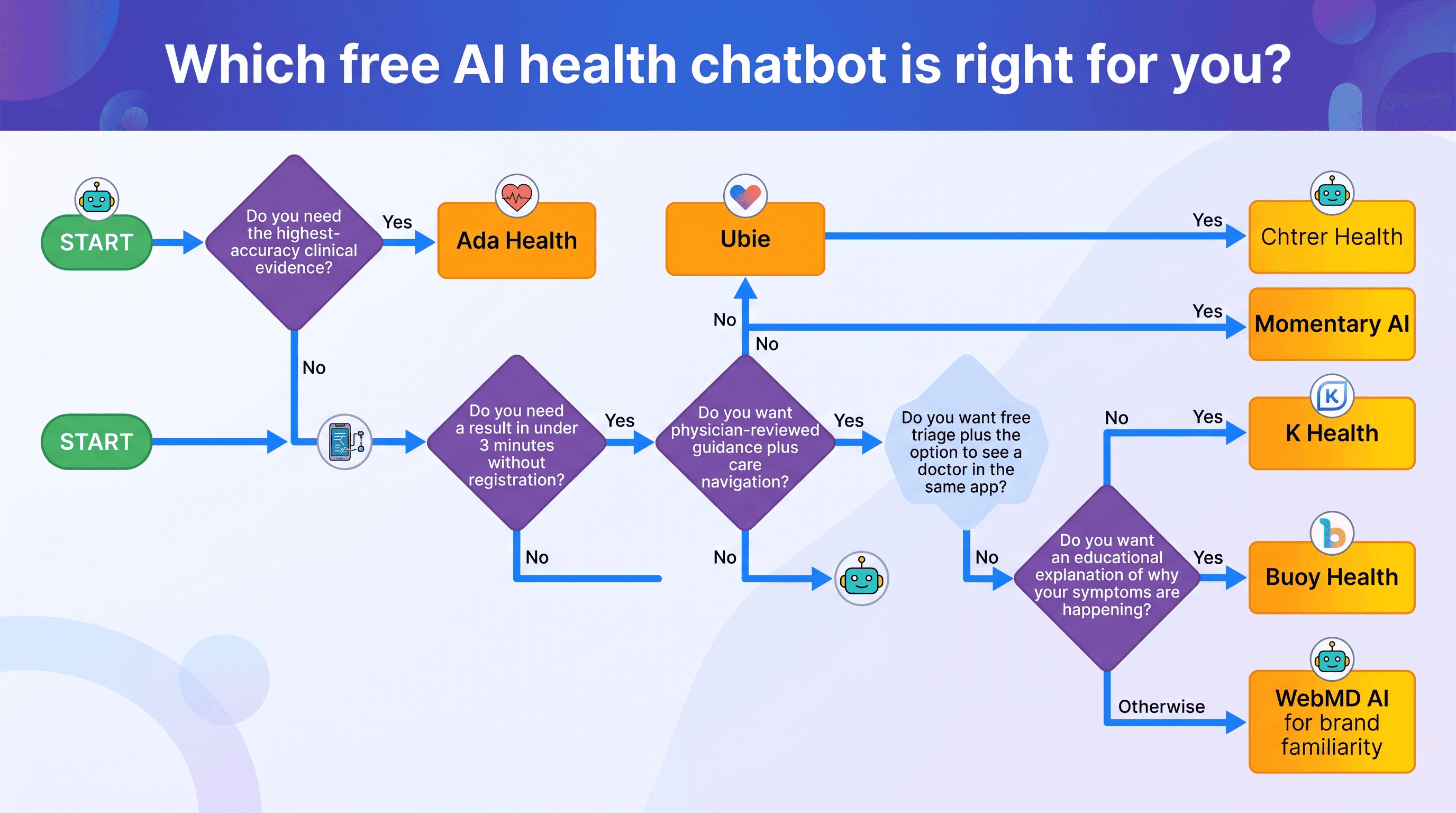
1. Ada Health — Deepest Clinical Evidence Base of Any Free Symptom Checker
Ada Health is a Berlin-based AI symptom assessment app created by physicians, scientists, and engineers. The core function is a conversational symptom checker that asks personalized follow-up questions and maps your answers against a medical dictionary covering thousands of conditions, then generates a shareable assessment report with recommended next steps.
Pros: A 2023 study published in JMIR mHealth and uHealth placed Ada's diagnostic sensitivity for top-5 suggestions at 70%, approaching the rate of emergency department physicians (68.9% for top-3 diagnoses), a comparison no other consumer symptom checker has matched in peer-reviewed research. The consumer app is completely free with no ads, no premium tier, and no in-app purchases; Ada's revenue comes from B2B enterprise partnerships, not from users. Ada added natural-language symptom input for US users in 2026, so you can describe symptoms conversationally rather than selecting from lists.
Cons: Several non-symptom-checking features (medication tracker, allergy tracker, personal information section) were removed from the app during a 2026 redesign, reducing its utility as an ongoing health companion. The app does not connect directly to telehealth providers, so it stops at the "what might this be" step rather than routing you to care.
Pricing: $0. Free for all consumers, no registration required for a basic assessment.
Best for: Anyone who wants the most clinically validated free symptom triage before deciding whether to see a doctor.
When to choose something else: If you want the AI assessment to lead directly into a doctor visit or a care recommendation, K Health or Momentary go a step further.
Rating: 4.8 stars on the App Store (June 2026, based on 11,345 analyzed reviews).
2. Ubie — Fastest Free Report with Physician-Validated Pathways
Ubie is a healthcare AI company founded in Tokyo in 2017, now operating in the US, Japan, Singapore, and India. Its US consumer product generates a personalized symptom report in approximately 3 minutes by asking roughly 20 questions drawn from a database of 3,500 question types built from 50,000 peer-reviewed clinical publications. Every care pathway is reviewed and validated by a panel of more than 50 supervising physicians.
Pros: Ubie's published Top-10 hit accuracy is 71.6%, documented in a public preprint on medRxiv, which surpasses the average of comparable symptom checkers assessed in the same study. The platform reached 2 million monthly US users and 13 million monthly global users as of March 2026, showing strong and rapidly growing adoption. In April 2026, Ubie launched Consult, a new chat-based LLM product designed to mirror the pacing of a doctor conversation, adding depth beyond a standard symptom questionnaire. No registration or credit card is required to use the core symptom checker.
Cons: Ubie's US product is primarily web-based; a dedicated native mobile app is not yet widely available for US users, which limits push notifications and offline access. The platform is backed by Google but is a startup without the decades-long brand recognition of tools like WebMD, which can affect user trust for first-time visitors.
Pricing: $0. The core symptom checker and new Consult chat tool are free; a paid telehealth consultation option exists in Japan but is not the primary US offering.
Best for: Users who want a fast, no-account-required report with documented accuracy and physician-validated routing to care.
When to choose something else: If you want a licensed provider available in the same session, K Health or Doctronic offer that path directly.
Rating: 71.6% Top-10 diagnostic hit accuracy (medRxiv preprint, cited on Ubie's site, August 2024).
3. Momentary — Physician-Reviewed AI Triage with Care Navigation
Momentary is an AI-powered healthcare navigator that combines conversational symptom assessment with physician-reviewed guidance and care navigation support, helping users understand which type of provider or care setting may fit their symptoms. A licensed physician reviews the guidance behind the platform's care pathways, so recommendations are not generated by the AI in isolation. As of January 2026, California's AB 489 restricts AI health tools from using language or design elements that imply a user is interacting with a licensed clinician unless that oversight genuinely exists, which is part of why Momentary is careful to describe its AI layer as physician-reviewed guidance rather than a live consultation.
Pros: The physician-review layer distinguishes Momentary from pure AI chatbots: a licensed physician reviews the care pathways the AI uses, which adds a credibility standard that most free tools do not offer. Momentary also integrates care navigation, helping users understand which type of provider they may need and what a visit might cost, going one step further than symptom-only tools that stop at a list of possible conditions. The AI health navigator is free to use nationwide with no registration barrier for initial symptom exploration.
Cons: Momentary is newer than tools like Ada or WebMD and does not yet have a published peer-reviewed accuracy study or a large public review base on third-party platforms, which limits independently verifiable trust signals. Physician-reviewed care through Momentary is currently available only in California; users elsewhere can use the free AI navigator but cannot yet access the paid physician-review service. Momentary does not diagnose conditions or replace a physician, and it is not intended for use in a medical emergency.
Pricing: $0 for the AI health navigator, available nationwide. Physician-reviewed care costs $19.99 and is currently available only in California.
Best for: US users who want physician-reviewed guidance and help deciding which type of care to seek next, rather than a raw symptom list.
When to choose something else: If you're outside California and want an in-app path to a licensed provider today, K Health or Doctronic offer that nationwide.
Rating: Physician-reviewed care pathways; independent third-party rating data not yet available as of June 2026.
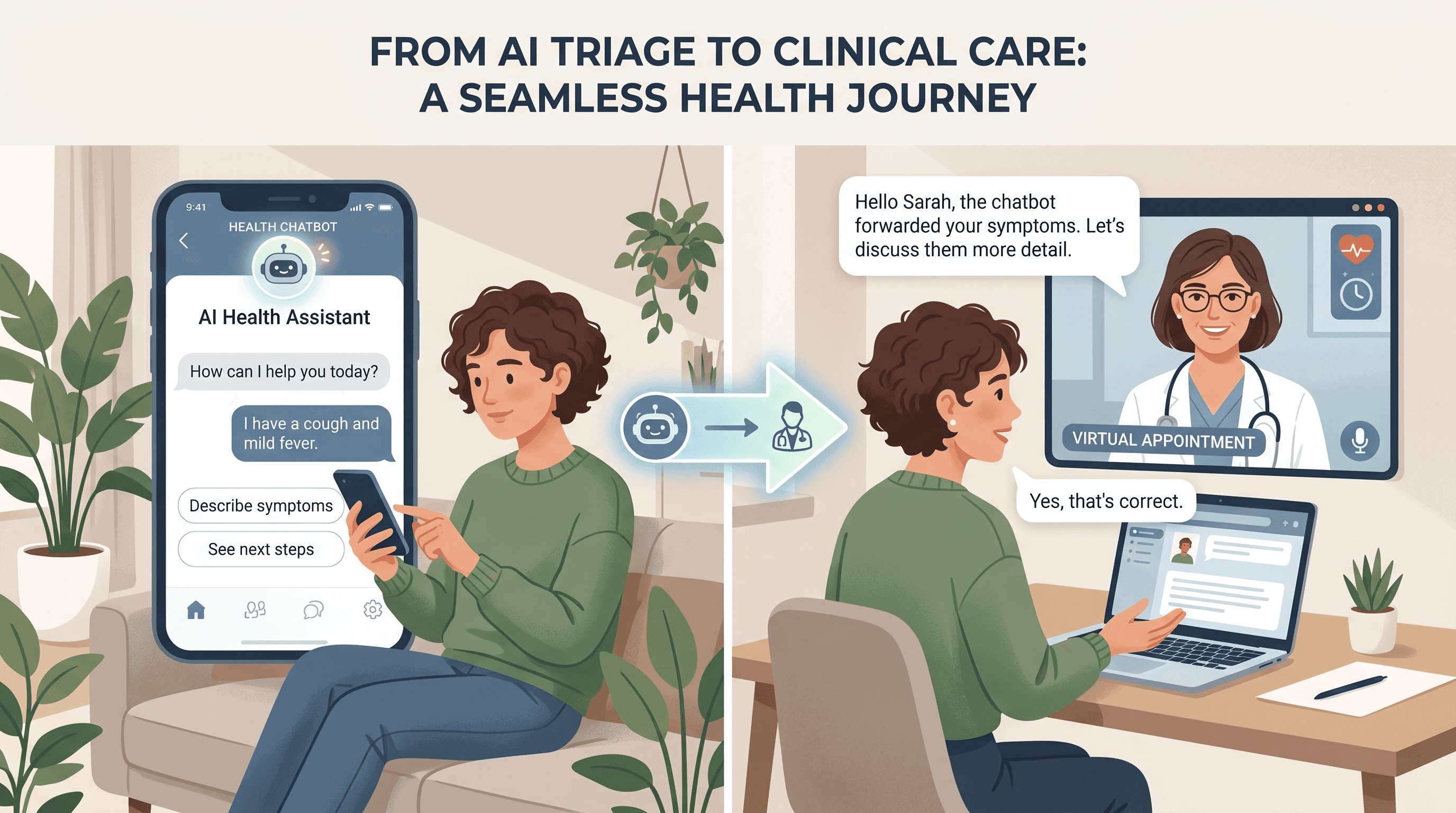
If you think you may be experiencing a medical emergency, call 911 or go to the nearest emergency room immediately. No tool in this guide, including Momentary, is designed for emergency use.
4. K Health — Free AI Triage Plus the Option to See a Doctor in the Same App
K Health launched in 2018 as a free symptom and medical information app. Its AI chatbot, called "K," uses a proprietary database built in part on data from Maccabi Healthcare Services and Mayo Clinic. When the AI assessment suggests a user may benefit from clinical care, K Health connects them to a licensed provider for text-based consultation without switching apps.
Pros: A 2024 study published in the Annals of Internal Medicine compared K Health's "AI Physician" mode against human clinicians in virtual urgent care and found the AI's notes and recommendations were rated as high quality by blinded reviewers, one of the few peer-reviewed favorable comparisons for an AI primary care tool. K Health's free tier allows unlimited AI-based symptom triage without any payment or subscription, making it genuinely accessible regardless of insurance status. The platform serves adults across most US states.
Cons: A 2022 published study found K Health's top-3 diagnostic accuracy in symptom assessment at 36%, significantly lower than general practitioners (82.1%) in the same evaluation, a gap that matters for users relying on the chatbot rather than escalating to a provider. The app is text-only; there are no video visit options in the standard care pathway, which frustrates users who prefer face-to-face interaction even through a screen.
Pricing: $0 for AI symptom triage. Unlimited virtual care membership costs $49/month; per-visit options are also available for prescriptions and follow-up care.
Best for: Uninsured or underinsured US adults who want free AI triage with a direct path to affordable text-based primary care in the same app.
When to choose something else: If documented diagnostic accuracy matters more to you than same-app care access, Ada or Ubie score higher on that measure.
Rating: Rated 3 out of 5 stars in an independent review by Choosing Therapy (2025); 1,530 Trustpilot reviewers with mixed scores on care continuity.
5. Buoy Health — Best for Understanding Why Your Symptoms Are Happening
Buoy Health is a US-based AI symptom checker built by a team of physicians and engineers, fully free to use via web browser with no registration required. The platform uses an adaptive AI that asks follow-up questions based on your answers rather than serving a fixed questionnaire, and it emphasizes explanation alongside triage, telling users not just what their symptoms might indicate but why.
Pros: Buoy served as the official COVID-19 symptom screener for Massachusetts and Virginia, reaching more than 500,000 users through that partnership, which demonstrates real-world institutional trust. A published study of more than 150,000 Buoy user interactions found that uncertainty about the appropriate level of care dropped from 34% to 21% after completing the assessment, meaning the tool measurably helps people make better care decisions. The interface runs entirely in any web browser with no app download, no account, and no personal information required to start.
Cons: Independent benchmark reviews conducted in 2026 suggest Buoy's innovation pace has slowed relative to newer competitors like Ada and Ubie, both of which now score higher in published accuracy comparisons. Buoy's published diagnostic accuracy in one comparison study stood at 52%, below the category leaders and below what the tool's confident interface might lead users to expect.
Pricing: $0 for the core symptom checker. Some in-depth report features or corporate wellness integrations may require a subscription; check buoyhealth.com for current details.
Best for: Users experiencing unfamiliar symptoms who want an educational explanation of what might be happening, not just a list of conditions.
When to choose something else: If you want the highest documented accuracy, Ada or Ubie currently outperform Buoy in published comparisons.
Rating: Recognized by The New York Times and Harvard Health publications as a notable consumer health tool; no current consolidated App Store rating (web-only primary interface).
6. WebMD AI — The Most Recognized Name, Now with Conversational AI
WebMD recently rebranded its classic body-map symptom checker as WebMD AI, adding a conversational AI layer on top of its longstanding symptom database. The platform is free, requires no account to use, and draws on WebMD's editorial content database, one of the largest English-language health information repositories on the web with hundreds of millions of monthly visitors.
Pros: A 2020 study published in the Medical Journal of Australia found WebMD's Symptom Checker placed the correct diagnosis in the top-3 suggestions in 63% of cases, placing it competitively among general consumer tools. The brand recognition is unmatched: WebMD draws more than 100 million monthly visitors, meaning users arriving with health concerns are likely to trust the source and engage with recommendations. The interactive body map remains a distinctive interface advantage, allowing users to point to where symptoms occur rather than typing descriptions.
Cons: The AI layer is newer and has not yet been evaluated in an independent peer-reviewed study specific to the conversational interface, making it harder to assess the accuracy improvement over the legacy symptom checker. The platform monetizes through health advertising, which means sponsored content and suggested products appear alongside clinical guidance, a conflict of interest not present in tools like Ada or Ubie.
Pricing: $0. Ad-supported.
Best for: First-time health app users who want a familiar, trusted brand and a visual body-map interface.
When to choose something else: If you'd rather avoid sponsored content mixed into your results, Ada and Ubie carry no advertising.
Rating: Estimated 100 million+ monthly visitors (WebMD corporate data, 2025); no separate App Store rating for the AI product as of June 2026.
7. Doctronic — Free AI Consults with Same-Session Telehealth on Standby
Doctronic positions itself as an AI-assisted health platform that provides free conversational health assessments and offers a direct path to a licensed physician video visit for $39 after the AI session. The platform reports 27.6 million total AI consultations and holds a HIPAA-compliant infrastructure. Its physician team is licensed to practice in all 50 states and can write prescriptions, order tests, and provide referrals.
Pros: The telehealth integration is the tightest of any free-to-start tool on this list: after the AI conversation, you can transition to a licensed video visit for a fixed $39 fee, with the AI-generated symptom summary passed to the physician so you do not have to repeat yourself. The platform's self-reported 4.7 rating and 27.6 million consultation count suggest significant user adoption, though these figures come from Doctronic's own site and have not been independently audited. The free AI consult has no registration requirement.
Cons: Doctronic's accuracy claims are based on its own peer-reviewed knowledge base rather than an independent published study comparing its AI's diagnostic output against clinicians or competing tools. Third-party review platform data for Doctronic is thin compared to tools with longer operating histories.
Pricing: $0 for the AI health conversation. Video visit with a licensed physician costs $39 per session.
Best for: Users who want a free AI assessment as a first step, with the option to speak to a licensed doctor in the same session at a low fixed cost.
When to choose something else: If independently verified accuracy data matters more to you than same-session telehealth, Ada or Ubie have stronger published evidence.
Rating: 4.7 (self-reported on Doctronic's website, 27.6M consultations; no independently verified App Store rating as of June 2026).
8. Healthily — Free Symptom Tracking and Self-Care Guidance Combined
Healthily, formerly known as Your.MD, is a UK-based AI health platform available to US users via web and mobile app (iOS and Android). It combines a symptom checker with personal health tracking, condition guides, and self-care suggestions. Healthily's content is reviewed by a medical team and follows NHS clinical guidelines where applicable, with US-appropriate guidance layered in for American users.
Pros: Healthily is one of the few free tools that combines symptom checking with ongoing health tracking in a single app, including mood, weight, and menstrual cycle logging, giving it a broader day-to-day health companion role than pure symptom checkers. The app is available on Facebook Messenger and other messaging platforms in addition to iOS and Android, making it accessible without downloading a dedicated app. The platform provides links to nearby pharmacies, clinics, and testing centers after an assessment, adding a local care navigation dimension that most competitors do not offer.
Cons: Healthily's clinical validation data for its US-specific symptom checker is less published than Ada's or Ubie's, making it harder to independently benchmark its accuracy against those tools. The platform's self-care-first orientation means it may suggest home management more readily than tools tuned primarily for urgency triage, which is a limitation for users with symptoms that warrant faster escalation.
Pricing: $0 for the core app. An optional subscription tier unlocks additional features; pricing was not independently verified as of June 2026 (check healthily.com for current details).
Best for: Users who want symptom checking integrated with daily health tracking in one free app.
When to choose something else: If urgency triage is your priority rather than day-to-day tracking, Ada, Ubie, or Momentary are built more specifically for that.
Rating: Available on iOS and Android; no aggregated App Store rating independently confirmed as of June 2026.
When a Chatbot Is Not Enough
AI health chatbots help you understand what your symptoms might mean and decide whether to seek care. They do not replace a licensed clinician who can examine you, order tests, or prescribe treatment. If your symptoms are severe, worsening quickly, or involve chest pain, difficulty breathing, sudden weakness, or other signs of a medical emergency, call 911 or go to your nearest emergency room immediately.
For symptoms that are not emergencies but feel beyond what a chatbot can address, Momentary's physician-reviewed care is available in California for $19.99 as a next step after the free AI navigator. Outside California, the free AI navigator can still help you decide which type of care to seek, even though the physician-review service isn't yet available in your state.
Frequently Asked Questions
Which AI chatbot is best for health?
Ada Health has the strongest peer-reviewed clinical accuracy evidence among free consumer tools, with a 2023 JMIR study placing its top-5 diagnostic sensitivity at 70%. Ubie is the fastest fully free option with physician-validated pathways and a 71.6% Top-10 accuracy rate documented in a 2024 preprint. The best choice depends on your priority: Ada for documented accuracy, Ubie for speed, K Health if you want a direct path to a licensed provider in the same app, or Momentary if you want physician-reviewed guidance on your next step. None of these tools replace a physician, and a correct answer from any chatbot still needs clinical confirmation if the symptoms persist or worsen.
What is the most appropriate use of AI chatbots in healthcare?
AI chatbots are most appropriately used as a triage aid, a tool that helps you decide whether your symptoms are worth a doctor's visit, what type of provider to see, and how urgently to act. A 2025 Stanford-Harvard State of Clinical AI report noted that patient-facing AI tools carry distinct risks, including the possibility of users placing too much trust in systems that lack full clinical context. The appropriate use frame is to use the chatbot to get better informed before or between appointments, not to replace them. Severe symptoms, symptoms in children under two, and any sudden neurological or cardiac symptoms should go directly to a clinician or emergency services.
What are the 6 types of chatbots used in healthcare?
Healthcare chatbots generally fall into six functional categories: symptom checkers (Ada, Ubie, Buoy), mental health support chatbots (Woebot, Wysa), medication management assistants (Florence, Medisafe), appointment scheduling bots (embedded in health system portals), chronic disease management tools (Welldoc BlueStar for diabetes), and clinical-facing diagnostic support tools (DxGPT, designed for healthcare professionals rather than patients). Most consumer-facing free tools fall into the first two categories, with some overlap into medication and appointment functions.
What are the types of AI in healthcare?
AI in healthcare spans several distinct technical approaches. Machine learning models are trained on large datasets to detect patterns in imaging, lab results, or patient records. Natural language processing enables chatbots and clinical documentation tools to understand and generate text. Predictive analytics flags patients at risk for specific conditions before symptoms emerge. Computer vision powers AI tools that analyze radiology scans, dermatology images, and pathology slides. Large language models, a subset of NLP now widespread in consumer chatbots, generate conversational responses to health questions. Each type carries different accuracy benchmarks, regulatory oversight requirements, and appropriate use cases. The NIH's National Library of Medicine maintains a body of published literature on each of these applications if you want to explore the clinical evidence.
Are free AI health chatbots safe to use?
Free AI health chatbots are safe as triage aids when users understand what they are and are not. They do not diagnose conditions, cannot examine you, and do not have access to your medical history unless you provide it. Published accuracy data shows the best free tools correctly place the actual diagnosis in their top 3 suggestions roughly 60% to 71% of the time, which is useful for narrowing possibilities but not sufficient for a definitive answer. The FDA does not currently regulate most consumer symptom checkers as medical devices. Safety comes from using them as a starting point, not a final answer, and always following up with a licensed provider when symptoms are serious, persistent, or involve a vulnerable population such as children, pregnant people, or adults over 65.
Can an AI health chatbot replace a doctor?
No. A 2026 review published in Diagnostics (MDPI) confirmed that AI systems lack access to the physical examination and full sensory data a clinician collects in person, and that current tools perform best as supplements to clinical judgment rather than substitutes for it. Even the most accurate free chatbots achieve top-3 diagnostic accuracy in the 60% to 71% range, significantly below the 82% rate found for general practitioners in published comparisons. AI chatbots are most useful for helping you prepare for an appointment, understand a symptom you have not encountered before, or decide how quickly to seek care. A doctor remains the appropriate endpoint for any situation requiring diagnosis, treatment, or prescription.
Is Momentary available outside California?
Momentary's free AI health navigator is available nationwide throughout the United States. Physician-reviewed care through Momentary currently costs $19.99 and is available only in California; Momentary is not a nationwide telehealth provider.
References
- Schmieding ML, et al. "Accuracy and safety of an AI-powered symptom checker for assessing potential causes of illness." JMIR mHealth and uHealth, 2023. mhealth.jmir.org
- Ubie, Inc. "Ubie Launches Medically Validated Consult LLM." PR Newswire, April 16, 2026. prnewswire.com
- Ubie Symptom Checker accuracy study, medRxiv preprint, 2024. medrxiv.org
- Jansen et al. Comparison of K Health and clinician performance in virtual urgent care. Annals of Internal Medicine, 2024. acpjournals.org
- K Health symptom checker accuracy comparison, cited on Wikipedia summary of a published study (top-3 accuracy 36% vs GP 82.1%). en.wikipedia.org/wiki/K_Health
- Buoy Health user study, cited on buoyhealth.com; dataset of more than 150,000 patient interactions.
- Hill MG, et al. Medical Journal of Australia, 2020. WebMD Symptom Checker accuracy: top-3 correct in 63% of cases. mja.com.au
- Brodeur P, et al. "The State of Clinical AI (2026)." ARISE, Stanford-Harvard Research Network, January 2026. medicine.stanford.edu
- Piórkowski A, et al. "Will AI Replace Physicians in the Near Future? AI Adoption Barriers in Medicine." Diagnostics (Basel), 2026;16(3):396. pmc.ncbi.nlm.nih.gov
- Ada Health App Store listing. 4.8 stars, 11,345 analyzed user reviews. apps.apple.com
- American Medical Association. "Augmented Intelligence in Medicine." Updated May 2026. ama-assn.org
- NIH National Library of Medicine. AI in healthcare literature collection. ncbi.nlm.nih.gov
- California Assembly Bill 489 (Bonta), effective January 1, 2026. Summary via Hintze Law. hintzelaw.com


