


Last updated: June 2026
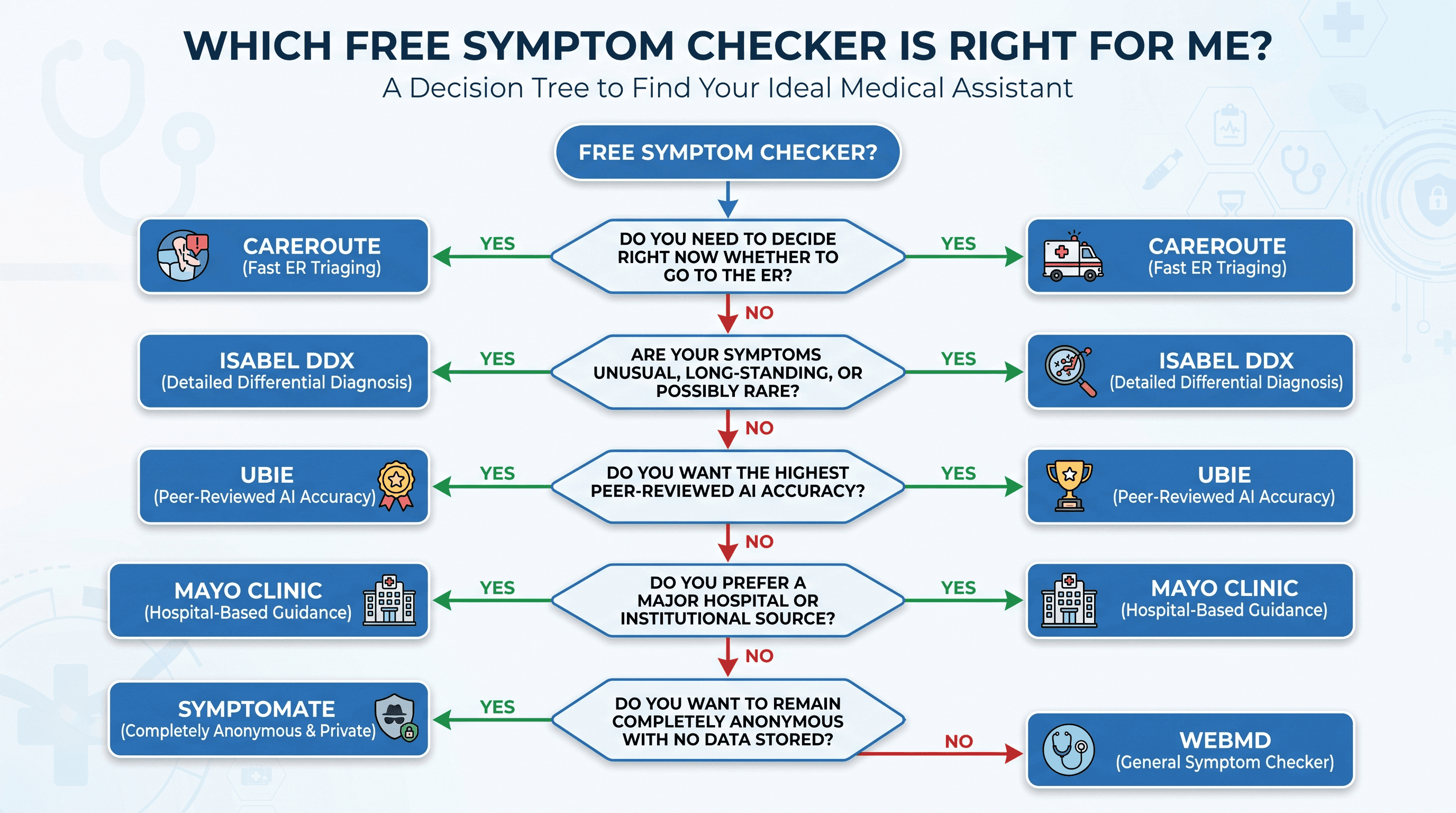
The best free symptom checker websites give you a meaningful read on what your symptoms might mean in under five minutes, without creating an account, paying anything, or sitting on hold. Ubie, Isabel DDx, and CareRoute are the strongest options across different use cases right now. Ubie leads on peer-reviewed AI accuracy, Isabel covers the broadest range of rare and complex conditions, and CareRoute is the fastest path to a single clear triage decision. The right pick depends on whether you want ranked differential diagnoses, rare-disease coverage, or just a fast answer to "do I need the ER?"
| Tool | Best For | Price | Key Accuracy Figure | Free Tier | No Signup |
|---|---|---|---|---|---|
| Ubie | AI accuracy, validated by study | Free | 71.6% top-10 hit rate | Yes | Yes |
| Isabel DDx | Rare and complex conditions | Free (daily limit) | 6,000 diseases, 20+ peer-reviewed studies | Yes | Yes |
| CareRoute | Fast ER vs. home triage decision | Free | 88.9% triage accuracy, 100% emergency safety | Yes | Yes |
| Mayo Clinic | Institutional trust | Free | No. 1 hospital globally (Newsweek) | Yes | Yes |
| Symptomate | Anonymous structured triage | Free | 94% recommendation accuracy | Yes | Yes |
| WebMD | Familiar body-map interface | Free | 77% top-3 diagnostic accuracy (MJA 2020) | Yes | Yes |
How We Ranked
For this list, "best" means a tool that is genuinely free with no account creation required, produces clinically credible output about possible symptom causes or triage urgency, and is actively operating as of June 2026. We scored all six entries on six criteria weighted for a symptom-checker list: clinical credibility (30%), scope fit (20%), cost and value (15%), speed and availability (15%), user experience (10%), and trust signals (10%). Every score includes a written reason and a logged source for every numeric claim. The evaluation was conducted in June 2026 using vendor documentation, peer-reviewed accuracy studies, app store data, and published validation research. Momentary is our own product. It was assessed for this list and did not pass the eligibility gate: its primary service is a $19.99/month subscription (California only) and does not offer a permanent free symptom checker, so it is excluded rather than ranked lower.
1. Ubie Symptom Checker — Best Peer-Reviewed AI Accuracy
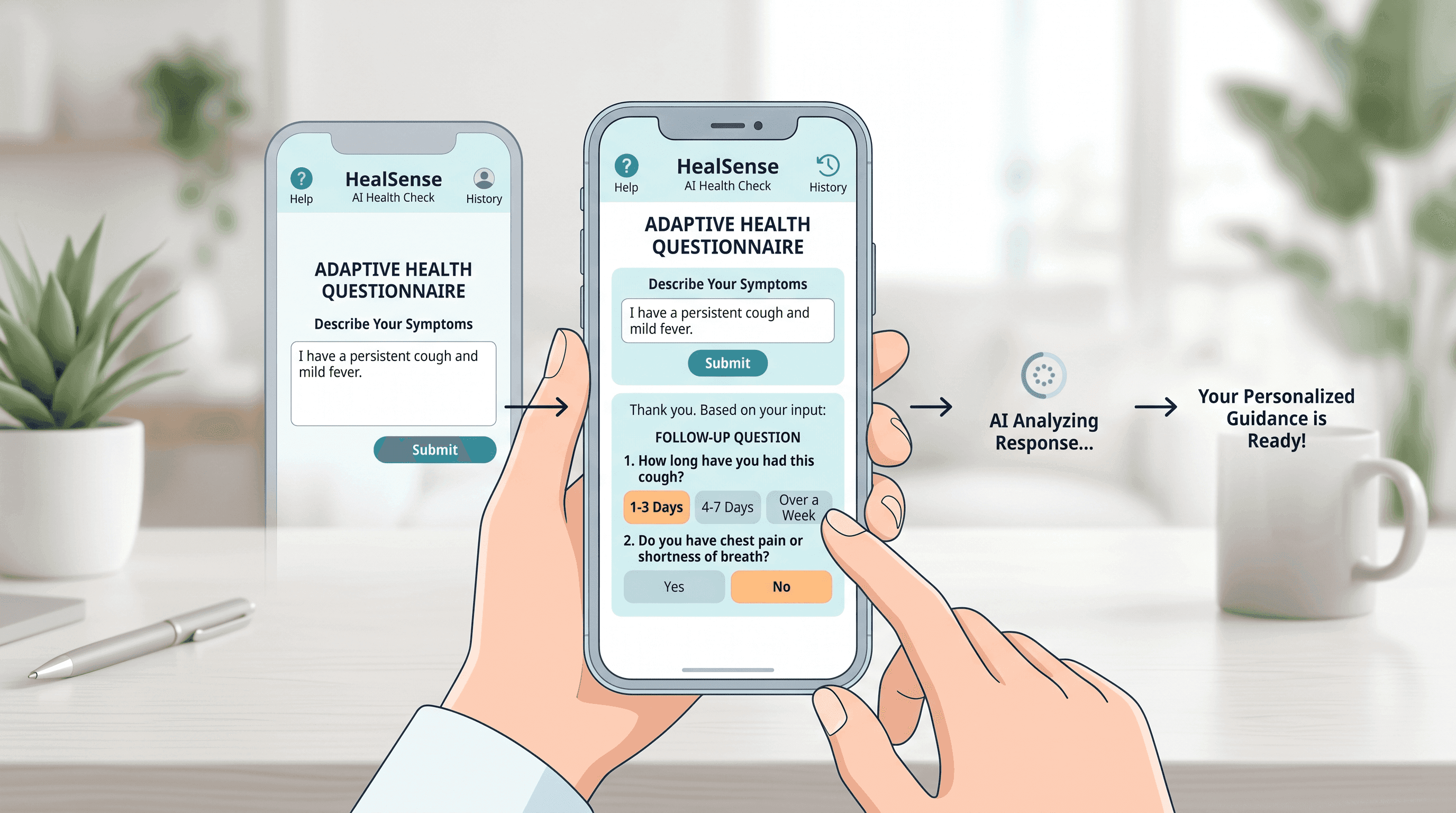
Ubie is a free AI-powered symptom checker developed by a global digital health company originally founded in Japan and now actively serving US users. It walks users through an adaptive 3-minute questionnaire covering age, biological sex, medical history, and current symptoms, then generates a prioritized list of possible conditions along with guidance on when to see a doctor and which type of specialist to consider.
Pros: A clinical vignette simulation study published on medRxiv in 2024 found Ubie achieved a top-5 hit accuracy of 63.4% and a top-10 hit accuracy of 71.6%, comparing favorably to median physician accuracy on the same vignettes and outperforming competing symptom checkers that averaged around 60% in the same assessment. The platform is supervised by more than 50 physicians worldwide and built on over 50,000 peer-reviewed publications. Results are delivered as a shareable report users can bring directly to a clinical appointment to accelerate the diagnostic conversation.
Cons: Ubie's sequential questionnaire collects information one step at a time rather than accepting a free-text description of all symptoms at once, which can feel slow when symptoms are varied or hard to categorize. The same 2024 medRxiv study noted variability in accuracy across different ICD diagnostic groupings, with the tool performing better on nervous system and respiratory conditions than on some rarer categories.
Pricing: $0. No subscription. No credit card. No signup required.
Best for: Anyone who wants the highest peer-reviewed accuracy from a free no-signup tool and is willing to spend 3 minutes on a structured questionnaire.
Rating: Named to Newsweek's World's Best Digital Health Companies list and awarded Google Play's "Best With AI" distinction (June 2026, Google Play).
2. Isabel DDx Symptom Checker — Best for Rare and Complex Conditions
Isabel DDx is built on the same diagnostic decision-support engine that physicians at hospitals worldwide have used for nearly 20 years. It accepts multiple symptoms entered in plain language all at once, without requiring users to work through a long branching questionnaire, and returns a ranked list of possible conditions from a database covering more than 6,000 disease presentations, with red-flag conditions visually highlighted.
Pros: The Isabel Pro engine has been independently medically validated in more than 20 peer-reviewed publications and is used by over 1 million healthcare providers in its professional version, according to EBSCO's product documentation. The free-text entry model is particularly strong when symptoms are difficult to categorize by body area or fall outside the standard question sets other checkers use. Because the system is built to surface a broad differential rather than anchor on one answer early, it catches rare and overlapping presentations that structured tools often miss.
Cons: Isabel returns a longer list of possible conditions than most tools, which some users find overwhelming rather than clarifying. The tool provides triage guidance but less structured urgency categorization than Symptomate or CareRoute, so users primarily looking for a care-level recommendation may need to supplement with another tool. A daily search limit applies to the no-signup version; free account registration unlocks additional daily searches.
Pricing: $0 for the public symptom checker, with a daily search limit. Free account registration unlocks more searches per day.
Best for: Anyone whose symptoms are unusual, long-standing, or have already been dismissed by a general search, and anyone researching whether a rare condition could explain their presentation.
Rating: Validated in 20+ peer-reviewed publications; used by 1 million+ healthcare providers in professional version (Isabel Healthcare documentation, June 2026).
3. CareRoute — Best for a Fast ER vs. Urgent Care vs. Home Decision
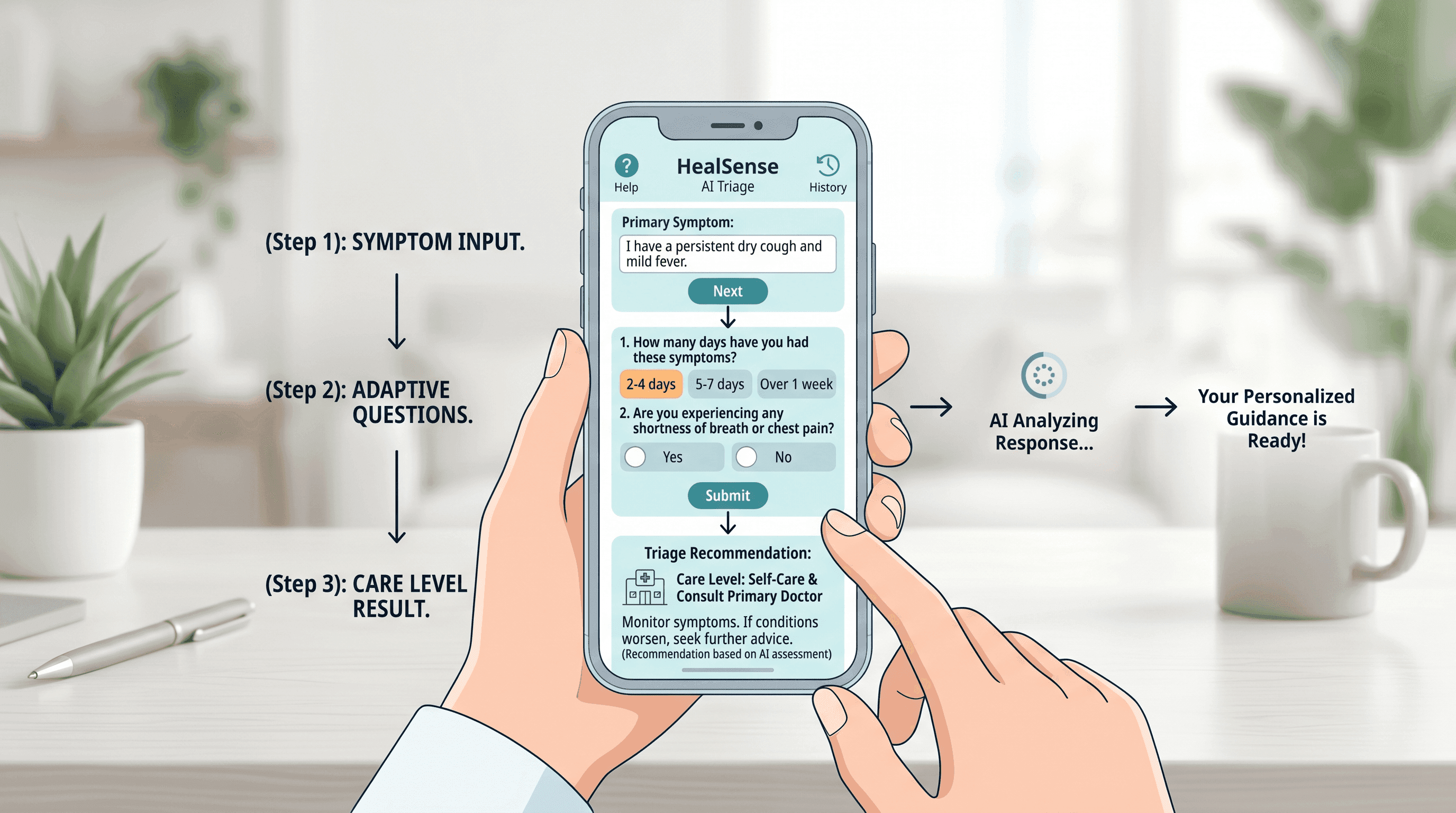
CareRoute's free web symptom checker is purpose-built for triage. It asks up to 8 targeted questions and returns one clear recommendation: go to the ER now, go to urgent care today, see a doctor soon, or monitor at home. No account is created and no data is stored. The same triage logic powers the full CareRoute app, which adds insurance cost estimates and provider routing.
Pros: A medRxiv preprint published in August 2025 evaluating CareRoute against 45 standardized clinical vignettes found 88.9% overall triage accuracy and 100% emergency safety, meaning the tool did not under-triage a single emergency case across all 15 emergency vignettes tested. Average time to a triage recommendation on emergency cases was approximately 2.5 minutes. The 8-question format is the lowest-friction entry point on this list, and CareRoute's safety-first design means it consistently errs toward recommending a higher level of care rather than a lower one when a case is ambiguous.
Cons: CareRoute is a triage navigator, not a differential diagnosis tool. It does not produce a list of possible conditions; it produces a care-level decision. Users who want to know what condition they might have will need to use a different tool alongside it. The platform is newer than most others on this list, and the medRxiv preprint validation study used 45 vignettes, which the authors themselves note is informative but not definitively generalizable at scale.
Pricing: $0 for the web triage tool. No signup. No data stored.
Best for: Someone who needs one fast, defensible answer to a single question: "Do I need to go to the ER right now, or is it safe to wait?"
Rating: 88.9% overall triage accuracy, 100% emergency safety on standardized vignettes (CareRoute medRxiv preprint, August 2025); 4.9 stars on the CareRoute website (April 2026).
4. Mayo Clinic Symptom Checker — Best Institutional Credibility
The Mayo Clinic Symptom Checker is a publicly accessible, free tool maintained by the clinical editorial teams of the organization ranked No. 1 hospital in the world by Newsweek. Users select symptoms from a structured interface, provide relevant context such as duration and associated factors, and receive a list of possible conditions with guidance on when and where to seek care.
Pros: The institutional backing behind Mayo Clinic's symptom content is unmatched among free tools. Every condition entry, symptom description, and care recommendation is produced and reviewed by Mayo's own clinical staff, making this one of the most defensible sources of health information available to US consumers at no cost. The tool integrates directly with Mayo's broader ecosystem of medically reviewed condition articles, drug information, and provider-finding resources, so follow-up reading stays within a single trusted source.
Cons: The structured select-symptom interface does not accept free-text descriptions, which limits usefulness for presentations that fall outside standard dropdown options. Unlike AI-driven tools such as Ubie, the Mayo Clinic checker does not adapt dynamically to user responses, meaning follow-up questions are the same for everyone regardless of how the symptom pattern develops through the interview.
Pricing: $0. Fully public. No account required.
Best for: Users who prioritize institutional trust above all else, particularly those who want information that a clinician, employer, or insurer would recognize as coming from an authoritative source.
Rating: Mayo Clinic is ranked No. 1 hospital in the world by Newsweek (June 2026).
If any of these tools point toward something that needs clinical follow-up, seeing a doctor online through Momentary Virtual Care is one option for California residents who want same-day primary care from a licensed physician for $19.99/month.
5. Symptomate — Best for Anonymous, Structured Triage
Symptomate is a consumer-facing symptom checker built on Infermedica's medical guidance platform, an AI engine validated against cases published in the BMJ, NEJM, and JAMA. It guides users through a structured interview covering more than 1,800 symptoms and 900 conditions, then outputs a triage recommendation across five care levels: self-care at home, a pharmacist visit, a scheduled doctor visit, urgent same-day care, or emergency services.
Pros: Symptomate stores no user data and conducts the entire session anonymously, which matters for anyone checking sensitive symptoms. According to the Symptomate Google Play listing, the underlying Infermedica engine was built and validated with over 140,000 hours of physician work and claims 94% recommendation accuracy for triage decisions. The platform has completed more than 27 million health checks to date and is used by healthcare facilities, insurance providers, and hospitals across more than 30 countries, a level of institutional adoption that exceeds most consumer-facing tools.
Cons: Symptomate does not accept natural language symptom descriptions; users must select from structured symptom lists, which can make it harder to describe unusual or multi-system presentations in the way Isabel or Ubie's questionnaire allow. It provides less condition-specific educational content than WebMD or Mayo Clinic, so users who want to read more about a specific result may need to visit a second resource.
Pricing: $0. No signup. No data stored.
Best for: Anyone who wants a clean, anonymous triage decision without leaving any data behind, particularly users choosing between urgent care, an ER visit, and home monitoring.
Rating: 94% recommendation accuracy; 27 million+ completed health checks (Symptomate website, June 2026).
6. WebMD Symptom Checker — Best for a Familiar Body-Map Interface
The WebMD Symptom Checker is the most widely used symptom checker in the US, sitting within a Health Network that serves more than 95 million unique visitors each month. It uses an interactive body map as the entry point: users click on the part of the body where symptoms are occurring, answer follow-up questions, and receive a list of possible conditions linked to detailed educational content.
Pros: The body map interface is intuitive for users who know where a symptom is located but are unsure how to describe it medically, and it connects directly to WebMD's extensive library of condition articles, drug information, and provider search tools. Research published in the Medical Journal of Australia (2020) found that the WebMD Symptom Checker included the correct diagnosis in its top-3 suggestions in 77% of cases studied. The app carries 4.1 stars on Google Play across 60,700+ ratings as of June 2026.
Cons: An independent study using validated ophthalmology clinical vignettes, published by the American Academy of Ophthalmology, found that WebMD's primary diagnosis was correct in only 26% of scenarios and absent entirely from the results list in nearly half the vignettes, underscoring that accuracy varies significantly by condition type. The ad-supported interface can feel disruptive, and results lists that surface a wide range of conditions without probability weighting can be anxiety-inducing for some users.
Pricing: $0. No account required.
Best for: Users who are comfortable with a consumer-grade tool, want to look up a common condition quickly using a body map, and plan to follow up with a clinician rather than treating the result as a final answer.
Rating: 4.1 stars on Google Play, 60,700+ ratings (June 2026); 95 million+ unique monthly visitors across the WebMD Health Network.
Can Symptom Checkers Be Trusted?
Symptom checkers are well-suited to two things: triage (deciding how urgently you need care) and awareness (learning which conditions match your symptoms so you can ask better questions at a clinical appointment). Research published in the BMJ and the Medical Journal of Australia (2020) consistently found that symptom checkers perform better at identifying urgency level than at pinpointing an exact diagnosis. Across major tools, correct diagnoses appear in the top-3 suggestions roughly 70% of the time, but accuracy drops to around 34% for the first suggestion alone.
That means a symptom checker is a reasonable first step, not a final answer. For symptoms that are worsening, recurrent, or accompanied by red-flag features such as severe chest pain, sudden shortness of breath, confusion, or stroke symptoms, skip the checker and call 911 or go directly to an emergency department. The NIH recommends seeking in-person evaluation for any symptoms that are severe, suddenly worsening, or persistent. A doctor can advise on individual cases where the right care level is unclear.
FAQ
Can I check my symptoms online?
Yes. Multiple free, no-signup websites allow you to enter your symptoms and receive a list of possible conditions or a triage recommendation. These tools work best as a first step: understanding whether your symptoms are consistent with common conditions and deciding how urgently you should see a provider. They are not a substitute for clinical evaluation, particularly for symptoms that are severe, worsening, or involve multiple body systems.
What is the best free symptom checker website?
Ubie is the top-ranked option on this list based on peer-reviewed diagnostic accuracy (71.6% top-10 hit rate in a 2024 medRxiv clinical vignette study) and free, no-signup access. Isabel DDx is the strongest choice for complex or potentially rare presentations. CareRoute is the best option when the immediate question is whether to go to the ER. You can also use Momentary's AI health navigator to explore your symptoms and understand your next steps, with physician oversight built in.
Can AI diagnose my symptoms?
AI symptom checkers can identify patterns that suggest certain conditions and can assess urgency accurately around 80 to 89% of the time depending on the tool and study, per published validation research across multiple platforms. They cannot replace a clinical diagnosis, which requires a physical exam, medical history review, and often lab work or imaging. The best framing is that AI tools help you generate informed questions and understand urgency, while a clinician provides the actual diagnosis and treatment plan.
Can I trust online symptom checkers?
Reputable symptom checkers are useful for triage and awareness but carry real limitations on diagnostic accuracy. Accuracy varies by condition type: tools tend to perform well on common presentations and less well on rare diseases or symptoms that overlap across many diagnoses. Every tool on this list carries an explicit statement that it is not a substitute for professional medical advice. Using the results to prepare for a clinical conversation, rather than to replace one, is the most evidence-aligned approach, consistent with guidance from the NIH.
References
- Taylor NK, Nishibayashi T, et al. Ubie Symptom Checker: A Clinical Vignette Simulation Study. medRxiv. 2024. https://www.medrxiv.org/content/10.1101/2024.08.29.24312810v1
- Isabel Healthcare. Isabel Symptom Checker FAQ. Isabel Healthcare, 2026. https://symptomchecker.isabelhealthcare.com/symptom-checker-faqs
- EBSCO. Isabel Symptom Checker Product Information. EBSCO Health, 2026. https://about.ebsco.com/health-care/products/isabel-symptom-checker
- CareRoute. Symptom Checker Validation: Safety and Accuracy. CareRoute medRxiv preprint, August 2025. https://www.careroute.ai/symptom-checker-validation
- Mayo Clinic. Symptom Checker. Mayo Clinic, 2026. https://www.mayoclinic.org/symptom-checker/select-symptom/itt-20009075
- Infermedica. Symptomate Product Documentation. Infermedica, 2026. https://infermedica.com/product/symptom-checker
- Hill MG, Sim M, Mills B. The quality of diagnosis and triage advice provided by free online symptom checkers and apps in Australia. Medical Journal of Australia. 2020;212(11):514-519. https://www.mja.com.au/
- Semigran HL, Linder JA, Gidengil C, Mehrotra A. Evaluation of symptom checkers for self-diagnosis and triage: Audit study. BMJ. 2015;351:h3480. https://doi.org/10.1136/bmj.h3480
- American Academy of Ophthalmology. Accuracy of the WebMD Symptom Checker for Ophthalmic Diagnoses. AAO EyeNet, 2020. https://www.aao.org/eyenet/article/accuracy-of-the-webmd-symptom-checker
- NIH. MedlinePlus: When to Call a Doctor. National Institutes of Health, 2026. https://www.nih.gov/


