


Last Updated: September 2026
Best Healthcare Without Insurance in California for Affordable Medical Care
Quick Answer
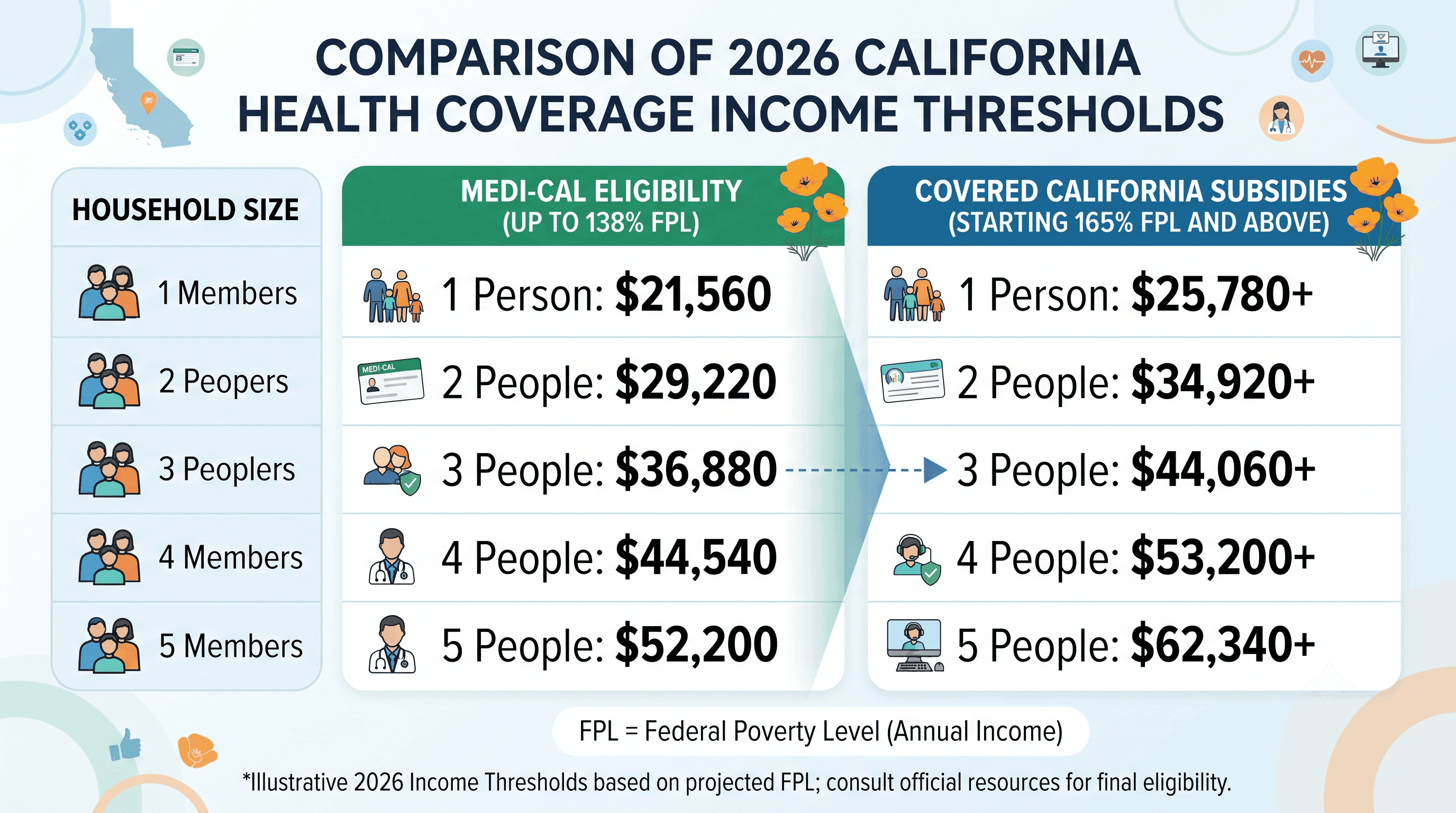
If you would rather have an ongoing doctor than a one-off visit, Momentary gives Californians a licensed California physician they can text any hour for $19.99 a month, with prescriptions, lab orders, and referrals included. If your income is at or below 138% of the federal poverty level ($22,025 for a single adult in 2026), you likely qualify for free Medi-Cal instead of paying out of pocket at all.
This article compares eight ways to get care in California without insurance, ranked by cost, availability, and usefulness for people who don't yet know what kind of care they need.
Top Picks
| Category | Recommendation |
|---|---|
| Best Overall | Sesame Care |
| Best Budget Option | Federally Qualified Health Centers (FQHCs) |
| Best for Ongoing Primary Care by Text | Momentary |
| Best for Getting Covered | Covered California / Medi-Cal |
Why People Look for Healthcare Without Insurance in California
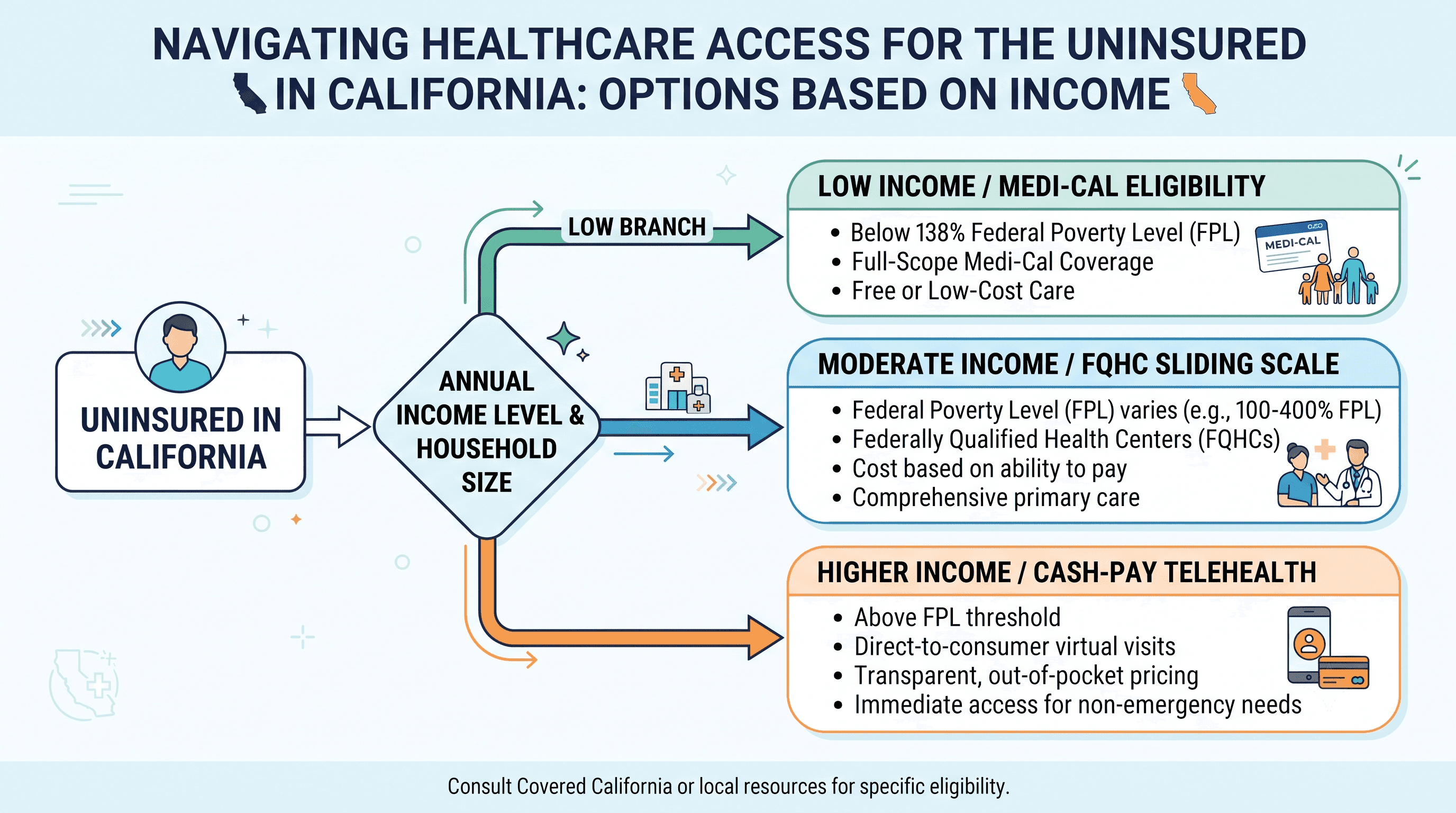
Millions of Californians go without employer or marketplace coverage at some point each year, whether from a job change, an immigration status gap, or premiums that don't fit the budget. Going without insurance doesn't mean going without care. It means paying differently.
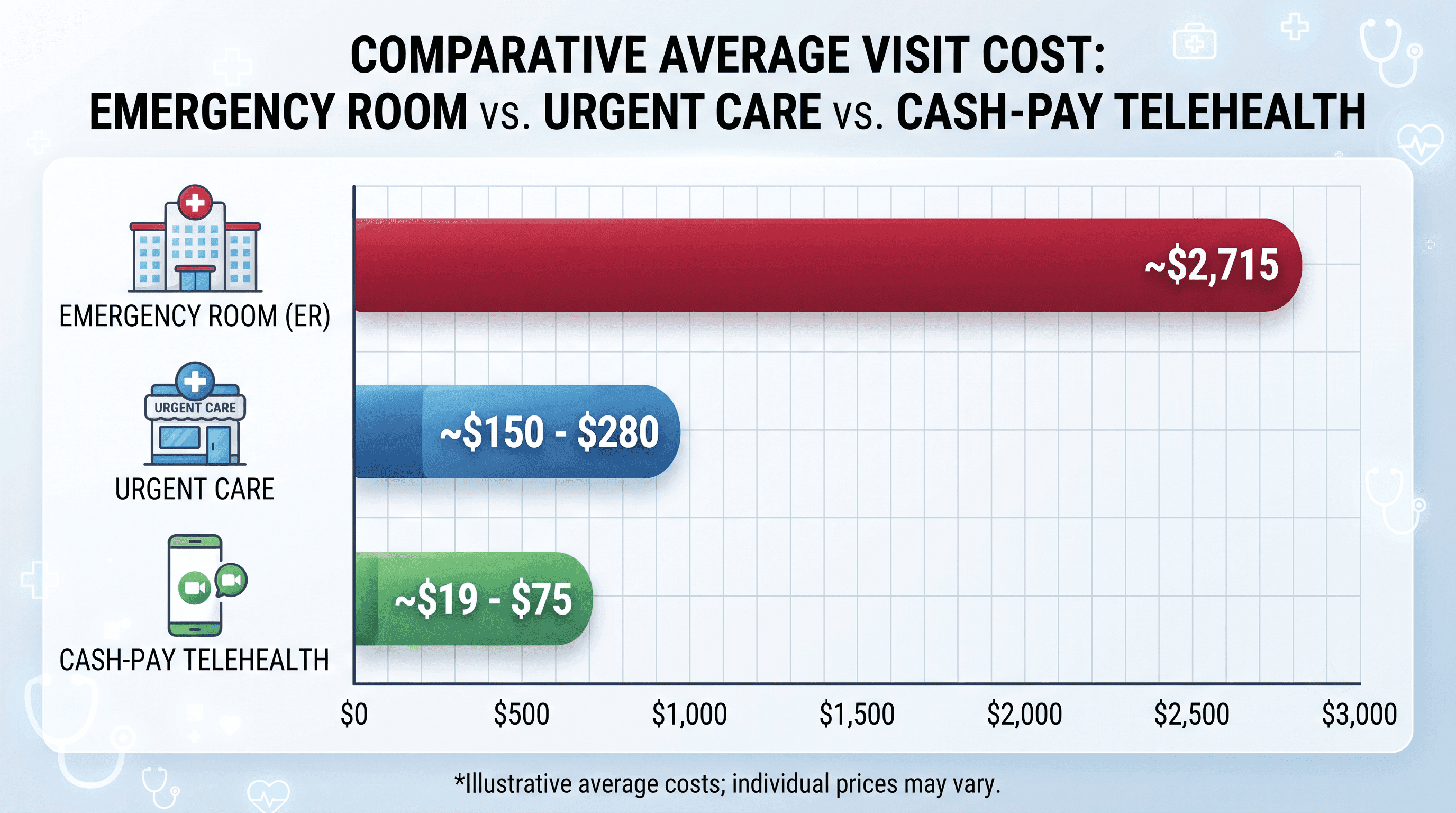
The uninsured often overpay for two reasons. First, they don't know that FQHCs and county clinics offer income-based pricing. Second, they end up in the emergency room for problems that didn't need one. The average uninsured ER visit costs around $2,715, compared to $150 to $280 for urgent care and $19 to $75 for a cash-pay telehealth visit. Knowing which option fits your symptoms is often the biggest cost lever available.
Comparison Table
| Platform | Best For | Pricing | Insurance | California Availability |
|---|---|---|---|---|
| Sesame Care | Fast, affordable doctor visits | $25 to $47 per visit (primary care from ~$29 to $34) | Self-pay only, no insurance billing | Statewide, telehealth and in-person in major metros |
| GoodRx Care | Cheap prescriptions and refills | $19 to $75 per visit; $39 to $70 without a membership | Self-pay only | Statewide telehealth |
| Federally Qualified Health Centers | Ongoing primary, dental, and mental health care | $0 to $20 per visit on a sliding scale, based on income | Bills insurance if you have it; sliding scale if not | In-person, statewide, find one at findahealthcenter.hrsa.gov |
| County and free clinics | No-cost or very low-cost care for low-income residents | Often free or nominal fee | Not required | Availability varies by county |
| Momentary | Ongoing primary care by text; prescriptions, labs, and referrals | $19.99/month membership (HSA/FSA eligible); no per-visit fees | Not billed; cash membership | California residents only; iOS app |
| Covered California / Medi-Cal | Getting covered instead of paying cash long-term | Free (Medi-Cal, under 138% FPL) or subsidized premiums | N/A, this is the insurance itself | Statewide |
| K Health | Ongoing virtual primary care with a subscription | Subscription-based, membership required for full access | Self-pay and some insurance plans | Statewide telehealth |
| Teladoc (self-pay) | Broader specialty and mental health access | Self-pay visits often $75 or more without insurance | Primarily insurance-based; self-pay available | Statewide telehealth |
Pricing reflects publicly listed rates as of mid-2026 and can vary by provider, location, and visit type. Confirm current pricing directly with each provider before booking.
Ranked Recommendations
1. Sesame Care
Why it's included: Sesame is a direct-pay marketplace where independent physicians set transparent, flat prices for telehealth and in-person visits. There's no insurance billing, so the price shown is the price you pay.
Best for: Uninsured Californians who want a same-day visit at a predictable price.
Strengths:
- Primary care visits typically start around $29 to $34
- Prices are visible before booking, with no surprise bills
- Covers primary care, urgent care, mental health, and dozens of specialties
- Same-day and evening appointments in many areas
Limitations:
- Does not bill insurance, so it won't help if you want to use existing coverage
- Provider availability varies by time of day and specialty
- Not appropriate for emergencies or controlled substance prescriptions
Pricing: Visits generally range from $25 to $47, depending on provider and specialty.
When to choose something else: If you need ongoing management of a chronic condition, a sliding-scale clinic or a primary care provider through Medi-Cal may serve you better long term.
2. Federally Qualified Health Centers (FQHCs)
Why it's included: FQHCs are community health centers that must, by federal law, offer a sliding-fee scale to uninsured and underinsured patients based on household income, regardless of immigration status.
Best for: Californians who want an ongoing primary care relationship without paying full price.
Strengths:
- Fees can drop to $0 to $20 per visit for patients at or near the poverty line
- Offers primary care, dental, and mental health care in one place
- No insurance, ID, or immigration documentation required to be seen
- Over 1,400 centers operate nationwide, including hundreds across California
Limitations:
- Appointments may take longer to schedule than telehealth
- You'll need to complete an income verification form annually to keep your discount
- Not designed for emergencies
Pricing: Based on a sliding scale tied to the federal poverty level; often free for the lowest-income patients.
When to choose something else: If you need care today and can't get a same-day appointment locally, a telehealth option like Sesame Care may be faster.
3. Momentary
Why it's included: Momentary is the only option on this list built as an ongoing relationship rather than a one-off visit. Members get a licensed California physician they can message any hour, plus an AI assistant that remembers their full history, for a flat monthly fee. Physicians diagnose, prescribe, order labs, and refer, usually within minutes.
Best for: Californians who want a personal doctor in their pocket for everyday primary care: refills, new symptoms, lab work, and follow-up questions, without booking an appointment for each one.
Pricing: $19.99 a month, HSA/FSA eligible. No per-visit fees and no insurance billing.
Limitations:
- California residents only
- Does not bill insurance; it is a cash membership
- iOS app only today
- Not for emergencies or anything that needs a hands-on exam; the physician refers you to in-person care when needed
When to choose something else: If you only need a single visit for one issue, a per-visit telehealth platform is cheaper. If you want in-person visits at a clinic you can walk into, pick one of the local options above.
4. GoodRx Care
Why it's included: GoodRx Care pairs low-cost telehealth visits with GoodRx's prescription discount network, which matters if a prescription is the main thing you need.
Best for: Quick refills and common, non-emergency conditions.
Strengths:
- Visits listed from $19 with a paid membership, or $39 to $70 without one
- Prescription savings can apply immediately after your visit
- Both asynchronous (message-based) and live video visits available
Limitations:
- Clinical scope is limited to conditions appropriate for telehealth
- Not built for complex or chronic condition management
- Membership adds a recurring cost if you use it regularly
Pricing: $19 to $75 per visit depending on membership status and condition.
When to choose something else: If you need a broader specialty visit, Sesame Care's marketplace has more provider variety.
5. Covered California and Medi-Cal
Why it's included: If you're paying cash for every visit, it's worth checking whether you actually qualify for free or subsidized coverage first. In 2026, adults earning at or below 138% of the federal poverty level ($22,025 for a single adult) generally qualify for Medi-Cal with no monthly premium. If your income is higher, Covered California offers subsidized marketplace plans, and a new state premium subsidy extends help to households up to 165% FPL.
Best for: Anyone who has been paying out of pocket for months and hasn't checked their eligibility.
Strengths:
- Medi-Cal covers doctor visits, hospital care, prescriptions, dental, and vision at little to no cost for most enrollees
- No asset test for adults 19 to 64
- Covered California removed the previous income cap on subsidies for 2026, so no household is automatically excluded from help
Limitations:
- Applications can take up to 45 days to process
- Enhanced federal subsidies expired at the end of 2025, so some middle-income households will see higher premiums in 2026
- Eligibility rules for undocumented adults changed in 2026; check current DHCS guidance for your situation
Pricing: Free for Medi-Cal-eligible adults; subsidized premiums for Covered California, based on income.
When to choose something else: If your income disqualifies you from meaningful subsidies, sliding-scale FQHCs and cash-pay telehealth may still be cheaper than a full-price marketplace plan.
6. County and Free Clinics
Why it's included: Beyond FQHCs, most California counties fund additional free or low-cost clinic networks for residents who fall through other gaps.
Best for: Very low-income residents needing basic medical, dental, or vision care.
Strengths:
- Many visits are free or cost a nominal fee
- No insurance or immigration documentation required at most sites
- Often paired with referrals to Medi-Cal enrollment assistance
Limitations:
- Hours and services vary widely by county and clinic
- Appointment availability can be limited
- Not a substitute for emergency care
Pricing: Often free; some clinics use a modest sliding scale.
When to choose something else: If you need a same-day appointment and your local clinic is booked, a $29 to $34 Sesame Care visit may be faster.
7. K Health
Why it's included: K Health offers ongoing virtual primary care through a subscription model, which can work for people who want a consistent provider relationship without traditional insurance.
Best for: Uninsured patients who want continuity of care rather than one-off visits.
Strengths:
- Subscription pricing can be predictable month to month
- Covers common primary care and some chronic condition management
Limitations:
- Requires an ongoing subscription rather than pay-per-visit pricing
- Less useful for a single, one-time issue
Pricing: Information not publicly available at time of writing; confirm current subscription pricing directly with K Health.
When to choose something else: If you only need one visit, GoodRx Care or Sesame Care will likely cost less overall.
8. Teladoc (Self-Pay)
Why it's included: Teladoc is one of the largest telehealth networks in the country and offers self-pay visits for people without insurance, though it's generally built around insurance billing.
Best for: People who want access to a large, established telehealth network and don't mind paying a higher self-pay rate.
Strengths:
- Broad specialty and mental health network
- Established platform with long operating history
Limitations:
- Self-pay visits often run $75 or more, higher than Sesame Care or GoodRx Care
- Best value typically requires insurance or employer coverage
Pricing: Self-pay visits typically start around $75, higher than most cash-pay competitors.
When to choose something else: For a lower-cost cash-pay visit, Sesame Care or GoodRx Care will usually be cheaper for the same type of care.
Pros and Cons Summary
Cash-pay telehealth (Sesame Care, GoodRx Care, Teladoc self-pay)
- Pros: Fast, transparent pricing, no insurance paperwork
- Cons: No insurance billing, limited scope for complex conditions
Sliding-scale clinics (FQHCs, county clinics)
- Pros: Lowest cost for qualifying patients, ongoing care available
- Cons: Slower scheduling, annual income re-verification required
Virtual primary care membership (Momentary)
- Pros: Unlimited messaging with a licensed California physician, any hour; prescriptions, labs, and referrals included; $19.99 a month and HSA/FSA eligible; remembers your history so you are not starting over each visit
- Cons: California residents only; does not bill insurance; iOS only; not for emergencies or hands-on exams
Getting covered (Medi-Cal, Covered California)
- Pros: Comprehensive coverage, often free or subsidized
- Cons: Application processing time, income limits apply
FAQ
Is there affordable healthcare in California without insurance? Yes. Federally Qualified Health Centers offer sliding-scale fees as low as $0 to $20 per visit, and cash-pay telehealth platforms like Sesame Care and GoodRx Care charge $19 to $75 per visit without any insurance requirement.
How much does a doctor visit cost without insurance in California? Cash-pay telehealth visits typically run $19 to $75. In-person urgent care averages $150 to $280. An uninsured ER visit averages around $2,715. Sliding-scale clinic visits can be $0 to $20 for qualifying low-income patients.
Do I qualify for free healthcare in California? If you're an adult aged 19 to 64 earning at or below 138% of the federal poverty level ($22,025 per year for a single person in 2026), you likely qualify for Medi-Cal with no monthly premium.
What is the cheapest telehealth option in California? GoodRx Care lists visits from $19 with a paid membership. Sesame Care's primary care visits typically start around $29 to $34 without any membership required.
Can I get a prescription without insurance in California? Yes. Cash-pay telehealth platforms like Sesame Care and GoodRx Care can write or refill many prescriptions during a visit, and GoodRx's discount network can lower the cost at the pharmacy. Controlled substances generally cannot be prescribed through these platforms.
What should I do if I'm not sure whether I need a doctor? Emergency symptoms such as chest pain, trouble breathing, signs of stroke, severe bleeding, or loss of consciousness mean 911 or the ER. Anything that needs a hands-on exam, imaging, or stitches is urgent care. Most other everyday issues can be handled remotely. If you would rather not guess, Momentary members can message a licensed California physician any hour and get a direct answer, plus a prescription or lab order if it can be handled remotely ($19.99 a month).
Are free clinics really free in California? Many are free or close to it for low-income residents, though exact costs depend on the clinic and your income. Some FQHCs and county clinics charge a small sliding-scale fee even for the lowest income bracket.
What if I think I'm having a medical emergency? If you think you may be experiencing a medical emergency, such as chest pain, difficulty breathing, signs of stroke, severe bleeding, or loss of consciousness, call 911 or go to the nearest emergency room immediately. Do not use telehealth or navigation tools in place of emergency care.


