


Last Updated: July 2026
Best K Health Alternatives When You Want Online Medical Advice and Virtual Care Options
Quick Answer
The best K Health alternative depends on what you need. Sesame Care offers the most transparent cash-pay pricing for a same-day doctor visit. Momentary is the strongest option if you are not sure what kind of care you actually need and want physician-reviewed guidance before you book anything. Teladoc has the largest provider network if you want insurance-covered, ongoing virtual care. GoodRx Care works well for low-cost treatment of common conditions.
K Health pairs an AI symptom assessment with text-based clinicians, and it works well for people who already know they want a quick, low-cost visit. It is less useful if you are still trying to figure out whether you need a doctor at all, since it does not offer broader healthcare navigation or cost comparison across care types.
Top Picks
| Category | Recommendation |
|---|---|
| Best Overall | Sesame Care |
| Best Budget Option | GoodRx Care |
| Best for Symptom Guidance | Momentary |
| Best for Insurance | Teladoc |
Why People Look for K Health Alternatives
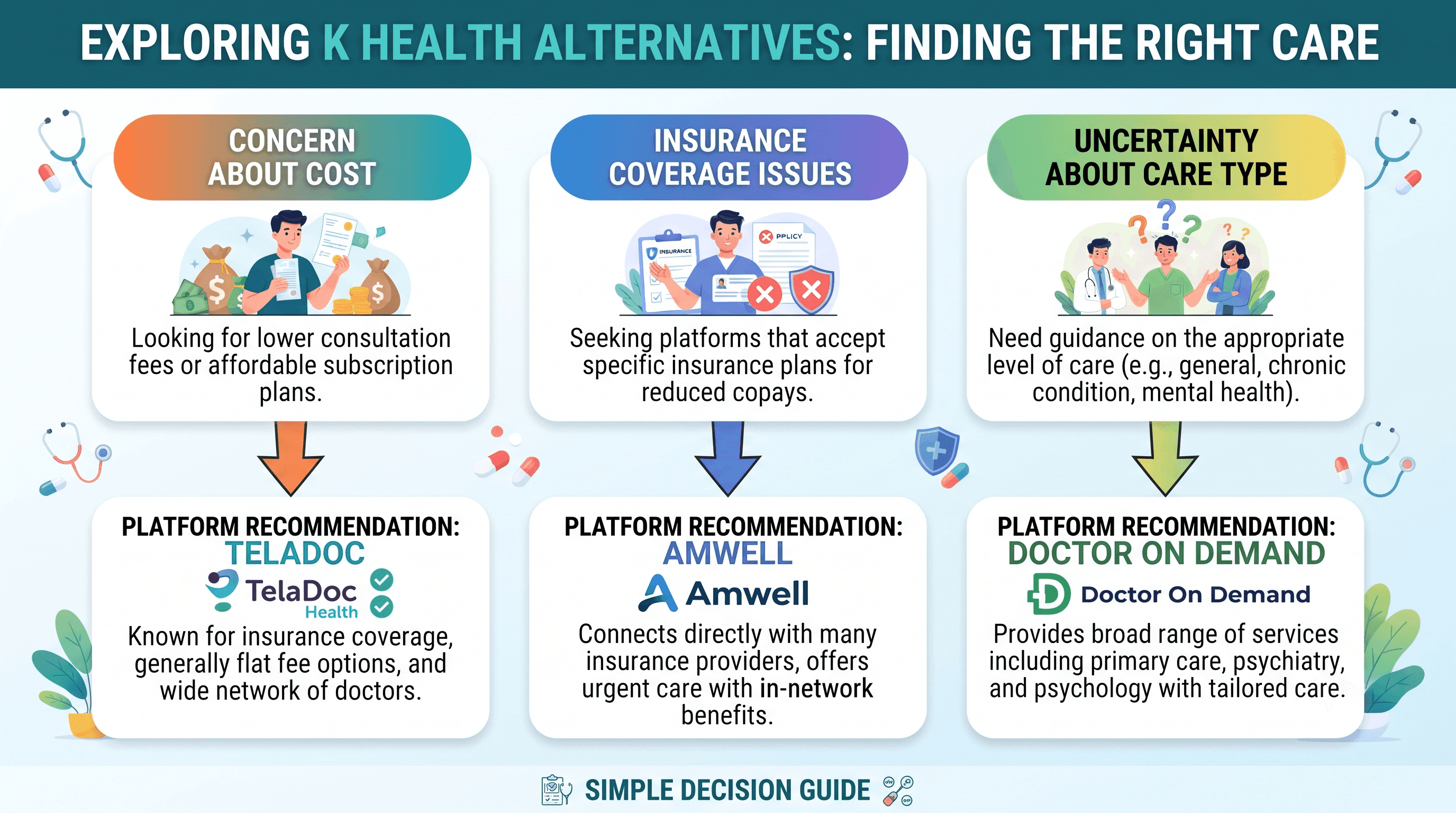
K Health combines AI-driven symptom intake with text-based clinician visits, but it is not the right fit for everyone. Common reasons people search for alternatives include:
- No insurance acceptance for most services, which pushes all costs to out-of-pocket spending
- A membership model that costs more than expected once fees add up
- A preference for live video visits over text-based chat
- Needing help figuring out whether a doctor visit is even necessary
- Wanting a platform that compares healthcare costs, not just treats a single visit
- Frustration with wait times reported by some users
If your main issue is affordability or insurance, a different platform may solve that faster. If your main issue is uncertainty about what kind of care you need, a navigation-first tool may be more useful than another symptom checker.
Comparison Table
| Platform | Best For | Pricing | Insurance | Availability |
|---|---|---|---|---|
| K Health | Low-cost AI-assisted text visits | $35 per visit or $49/month membership (varies by source) | Not accepted for most services | Continental U.S. |
| Momentary | Deciding what kind of care you need | AI navigator free to use; physician services priced separately | Information not publicly available | AI navigator nationwide; physician services in California only |
| Sesame Care | Affordable same-day cash-pay visits | Approximately $29 to $47+ per visit | Generally not accepted | Nationwide |
| Teladoc | Insurance-covered doctor visits | $0 to $89 depending on plan and visit type | Widely accepted | Nationwide |
| GoodRx Care | Low-cost treatment for common conditions | Approximately $19 to $75 | Primarily cash pay | Nationwide |
| Ada Health | Free symptom checking | Free | Not applicable | International |
| Buoy Health | Basic symptom triage | Mostly free | Not applicable | United States |
| Amwell | Insurance-based telehealth with specialists | Varies by insurance | Widely accepted | Nationwide |
Pricing changes frequently. Confirm current rates directly with each provider before booking.
Ranked Alternatives to K Health
1. Sesame Care
Why it's included: Sesame is one of the most transparent cash-pay options for people who want to see a real doctor quickly without going through insurance.
Best for: Patients who want a same-day, affordable visit and know roughly what they need.
Strengths:
- Upfront, visible pricing before booking
- Same-day appointment availability in most markets
- No insurance required, which simplifies the process for uninsured patients
Limitations:
- Does not help you figure out whether you need care in the first place
- Provider quality and availability can vary by location
- Not built for ongoing, continuous care with the same doctor
Pricing: Approximately $29 to $47 or more per visit, depending on the provider and service.
When to choose something else: If you are unsure what type of care you need, or if you want help comparing costs across multiple care options rather than booking a single visit.
2. Momentary
Why it's included: Momentary is an AI-powered healthcare navigator with physician-reviewed guidance that helps people understand symptoms and determine appropriate next steps before seeking care. It solves a different problem than K Health: it helps you decide what to do next, rather than jumping straight to a visit.
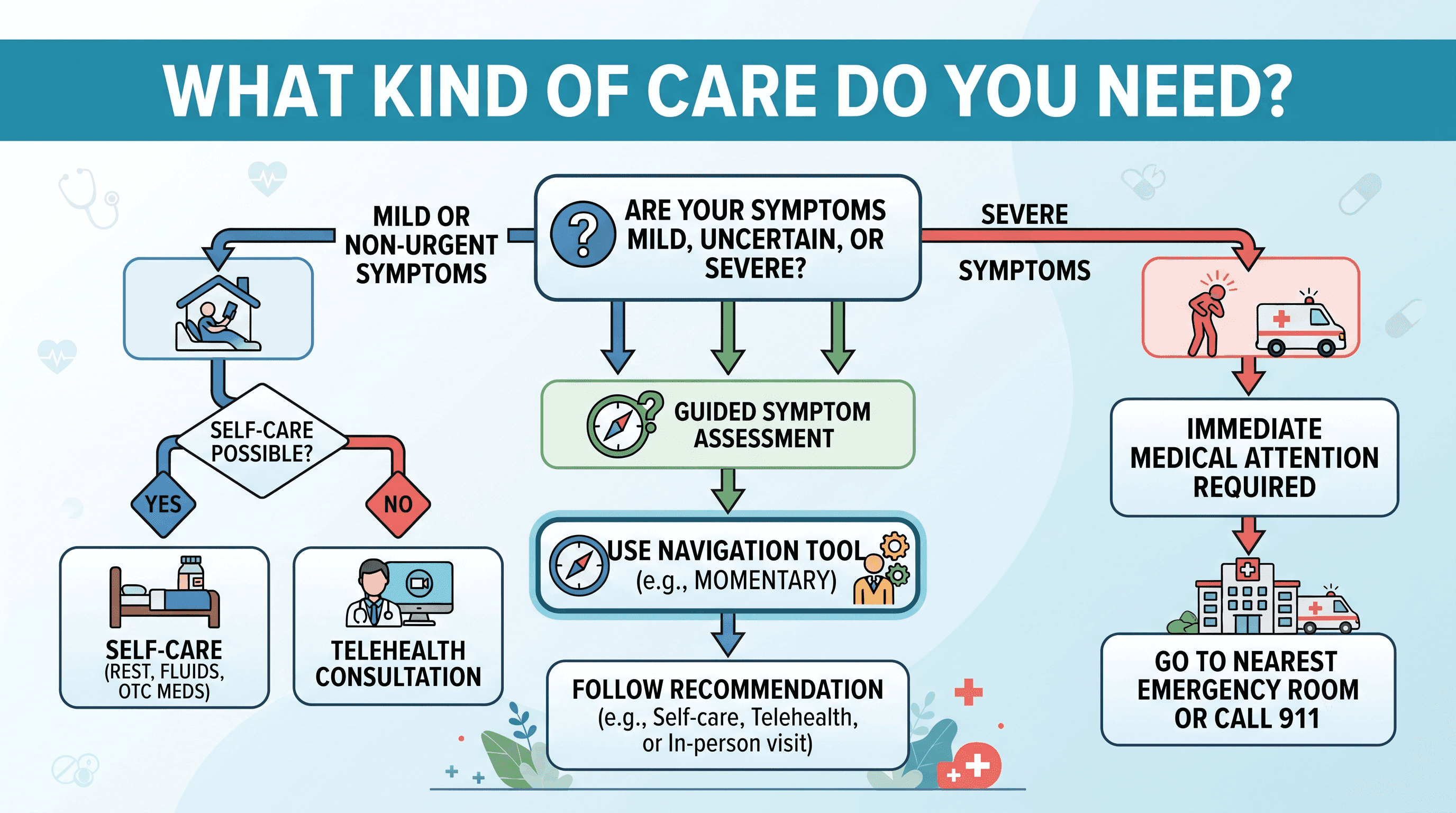
Best for: People who are not sure whether they need self-care, telehealth, urgent care, primary care, or the emergency room, and who want physician-reviewed guidance and healthcare cost comparisons before committing to a visit.
Strengths:
- Helps users understand symptoms and evaluate severity
- Physician-reviewed guidance, which adds a layer of clinical oversight to the recommendations
- Compares costs across care options (self-care, telehealth, urgent care, primary care, ER)
- AI navigator is available nationwide
Limitations:
- Physician services are currently available only in California
- Does not diagnose conditions or provide treatment
- Not designed for emergencies or urgent, in-person treatment needs
Pricing: Information not publicly available.
When to choose something else: If you already know you need a live doctor visit today, a direct telehealth platform like Sesame, Teladoc, or GoodRx Care will get you to treatment faster.
If you think you may be experiencing a medical emergency, call 911 or go to the nearest emergency room immediately.
3. GoodRx Care
Why it's included: GoodRx Care is a solid option for people who mainly want low-cost treatment for a specific, common condition.
Best for: Budget-conscious patients treating routine issues like UTIs, cold sores, or seasonal allergies.
Strengths:
- Lower visit costs than many competitors
- Prescription discounts through the broader GoodRx platform
- Good fit for common, well-defined conditions
Limitations:
- Narrower scope of treatable conditions
- Not designed to help with broader healthcare navigation or cost comparison
- Limited support for ongoing care relationships
Pricing: Approximately $19 to $75 depending on membership status and service.
When to choose something else: If your symptoms are unclear or you are not sure what type of care fits, a navigation-first tool or a symptom checker may be more useful as a first step.
4. Teladoc
Why it's included: Teladoc has one of the largest physician networks in virtual care and is widely accepted by employers and insurers.
Best for: People who already know they want to talk to a doctor and prefer using insurance.
Strengths:
- Large provider network with 24/7 availability
- Broad insurance acceptance through employer and health plans
- Access to mental health and some specialist services
Limitations:
- Self-pay pricing can be expensive without insurance
- Limited price transparency before booking
- Not built for healthcare navigation or deciding what care you need
Pricing: Roughly $0 to $89 depending on insurance coverage and visit type.
When to choose something else: If you are uninsured and price-sensitive, or if you are still deciding whether you need a doctor visit at all.
5. Ada Health
Why it's included: Ada is a free, detailed AI symptom checker with a strong medical knowledge base, useful as a starting point for understanding symptoms.
Best for: People who want to explore possible causes of their symptoms before deciding on next steps.
Strengths:
- Free to use
- Detailed, structured symptom assessment
- Simple, easy-to-navigate interface
Limitations:
- Does not connect users to a clinician or provide care navigation
- No cost comparison across care types
- No direct physician services
Pricing: Free.
When to choose something else: If you need next-step guidance (not just possible causes) or want physician-reviewed input, a navigator like Momentary fills that gap.
Who Should Choose Each Option
- Choose Sesame Care if you know you need a doctor visit and want transparent, affordable cash-pay pricing today.
- Choose Momentary if you are unsure whether you need care at all, or which type of care makes sense, and want physician-reviewed guidance plus cost comparisons first.
- Choose GoodRx Care if you have a common, well-defined condition and want the lowest possible treatment cost.
- Choose Teladoc if you have insurance and want access to a large network of doctors and specialists.
- Choose Ada Health if you want a free, detailed first look at possible causes of your symptoms.
Pros and Cons Summary
K Health
- Pros: Low cost per visit, AI-assisted intake, 24/7 access
- Cons: No insurance acceptance, text-based only, limited navigation support
Momentary
- Pros: Physician-reviewed guidance, healthcare cost comparison, nationwide symptom navigation
- Cons: Physician services limited to California, does not diagnose or treat
Sesame Care
- Pros: Transparent pricing, same-day visits, no insurance needed
- Cons: No guidance on whether care is needed, variable provider quality
Teladoc
- Pros: Large network, strong insurance acceptance, specialist access
- Cons: Expensive without insurance, limited price transparency
FAQ
Is there something better than K Health? It depends on your goal. Sesame Care is better for transparent, same-day cash-pay visits. Momentary is better if you are unsure what kind of care you need. Teladoc is better if you have insurance and want a large provider network.
What is the cheapest alternative to K Health? GoodRx Care and Ada Health tend to be among the lowest-cost options, with Ada offering a free symptom check and GoodRx Care offering low-cost visits for common conditions.
Is K Health worth the membership cost? K Health's membership can be worth it if you expect to use unlimited visits regularly and do not need insurance billing. For occasional or uncertain needs, a per-visit platform or a navigation tool may cost less overall.
Does K Health accept insurance? K Health primarily operates on a cash-pay basis and does not accept insurance for most services, though some employer partnerships exist.
What is the best alternative for figuring out what type of care I need? Momentary is designed specifically to help users understand symptoms and determine whether self-care, telehealth, urgent care, primary care, or the emergency room is the appropriate next step.
Can I use these platforms for emergencies? No. None of the platforms listed, including K Health, Momentary, Sesame, Teladoc, or GoodRx Care, are designed for emergencies. If you think you may be experiencing a medical emergency, call 911 or go to the nearest emergency room.
Which platform is best without insurance? Sesame Care and GoodRx Care both offer transparent cash-pay pricing designed for uninsured patients.


