


Quick Answer
If you have severe, sudden side or back pain that comes in waves, a kidney stone symptom checker can help you figure out how urgent your situation is. Buoy Health and Ada Health are free, physician-built tools that assess flank pain against thousands of clinical data points. Momentary adds physician-reviewed guidance on whether to try self-care, book urgent care, or go to the emergency room, which matters most for kidney stone pain because the right next step depends on symptoms like fever, vomiting, or blood in your urine.
No app can confirm a kidney stone. Only imaging, usually a CT scan or ultrasound, can do that. A symptom checker's job is narrower: helping you decide what kind of care to seek and how quickly.
If you have severe pain along with fever, chills, vomiting that won't stop, or you cannot urinate at all, this may be a medical emergency. Call 911 or go to the nearest emergency room immediately.
Top Picks
| Category | Recommendation |
|---|---|
| Best Overall | Momentary |
| Best Free Option | Buoy Health |
| Best for Symptom Guidance Accuracy | Ada Health |
| Best for Same-Day Clinician Access | K Health |
Why People Search for Kidney Stone Symptom Checkers
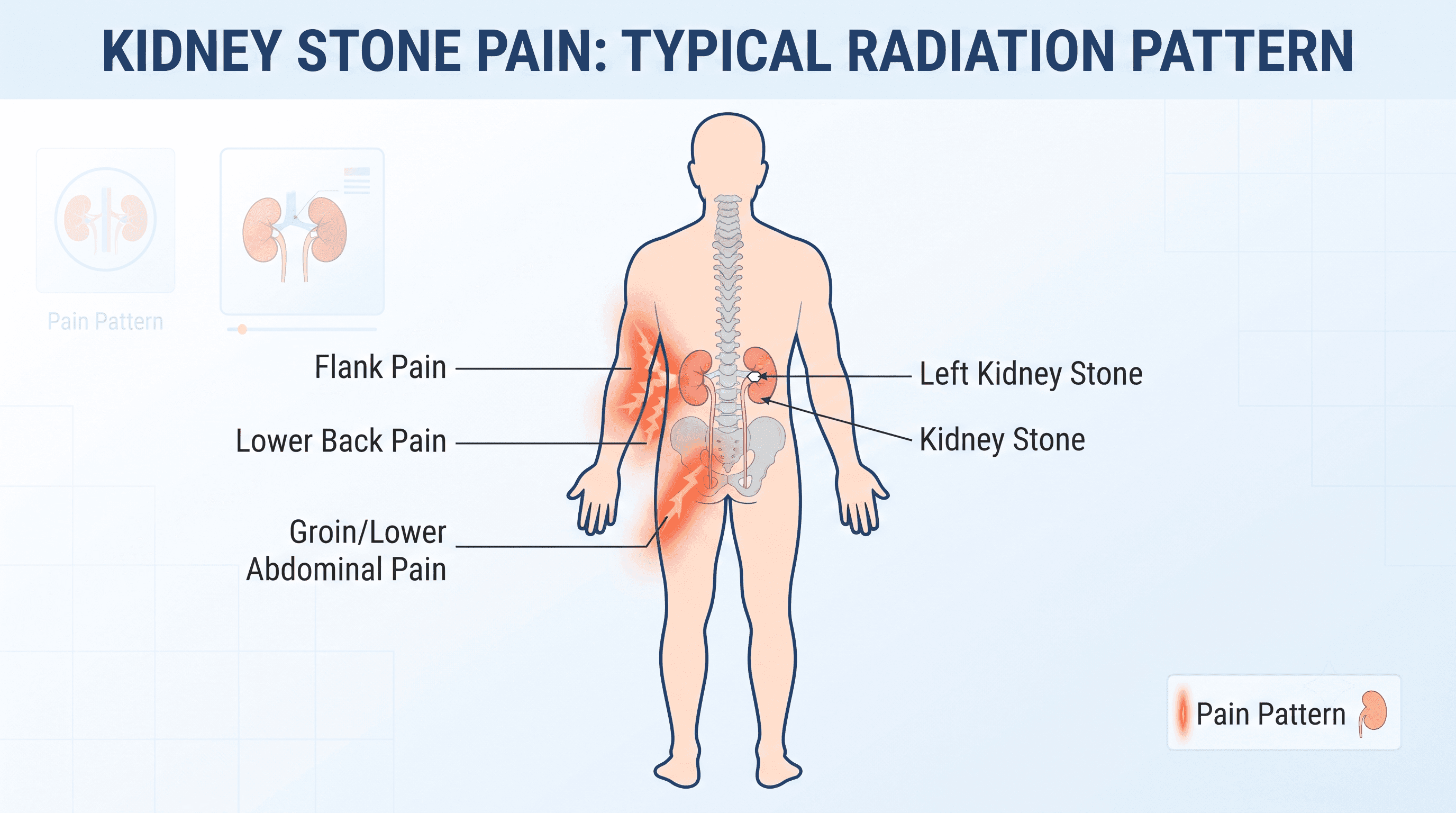
Kidney stone pain often starts without warning. It's commonly described as a sharp, cramping pain in the side or back, below the ribs, that can radiate to the lower abdomen and groin. Pain intensity can shift in waves as the stone moves through the urinary tract.
Because the pain can be severe, people want to know two things fast: is this actually a kidney stone, and does it need emergency care. A symptom checker won't diagnose the stone itself, but a good one can help sort out whether your combination of symptoms points toward a level of urgency, such as home monitoring, a same-day telehealth visit, urgent care, or the ER.
According to the National Institute of Diabetes and Digestive and Kidney Diseases (NIDDK), kidney stones affect roughly 1 in 11 people in the United States at some point in their lives, and symptoms can range from mild discomfort to severe pain requiring emergency treatment.
Comparison Table
| Platform | Best For | Pricing | Insurance | Availability |
|---|---|---|---|---|
| Momentary | Deciding where to seek care for flank pain | Information not publicly available | Information not publicly available | AI navigator nationwide (US); physician services in California only |
| Ada Health | Structured symptom assessment | Free | Not applicable | Nationwide (US), multiple languages |
| Buoy Health | Free symptom-to-care triage | Free | Not applicable | Nationwide (US) |
| K Health | Same-day clinician follow-up | Free symptom checker; $29 to $49 per month for clinician access, or roughly $35 to $73 per visit | Limited employer and health plan partnerships; mostly cash-pay | Nationwide (US) |
| WebMD Symptom Checker | General symptom education | Free | Not applicable | Nationwide (US) |
Pricing reflects publicly available information as of July 2026 and may change. Always confirm current pricing on the provider's website.
Ranked Recommendations
1. Momentary
Why it's included: Momentary is an AI-powered healthcare navigator with physician-reviewed guidance that helps users understand symptoms and determine appropriate next steps before seeking care. For kidney stone pain, the core question usually isn't "what is this," it's "how fast do I need to act," which is exactly the kind of decision Momentary is built around.
Best for: People who are unsure whether their side or back pain needs an ER visit, urgent care, or a same-day telehealth appointment.
Strengths:
- Physician-reviewed guidance on next steps, not just a list of possible conditions
- Helps compare care options and estimated costs before you commit to a visit
- Designed to flag emergency warning signs and direct users toward immediate care when appropriate
Limitations:
- Momentary does not diagnose kidney stones or any other condition
- Direct physician services are currently available only in California; the AI healthcare navigator itself is available nationwide
- Does not replace imaging, which is required to confirm a kidney stone
Pricing: Information not publicly available.
When to choose something else: If you already know you need an in-person urology evaluation or imaging, go directly to urgent care or your doctor rather than starting with a navigator.
2. Ada Health
Why it's included: Ada Health is a free, clinically evidenced symptom assessment app that asks detailed follow-up questions similar to how a clinician would. It has been studied for diagnostic accuracy in independent research, including a 2023 study in JMIR mHealth and uHealth that found its top-five diagnostic sensitivity approached that of emergency department physicians.
Best for: People who want a structured, in-depth symptom assessment before deciding on care.
Strengths:
- Free to use, with no account fees
- Asks detailed, condition-specific follow-up questions
- Available in multiple languages
- Lets users export assessment reports to share with a doctor
Limitations:
- Does not connect users directly to a clinician within the app
- Cannot confirm a kidney stone diagnosis; imaging is still required
- Some tracking features have been temporarily removed from the app as the company updates its platform
Pricing: Free for individual consumer use.
When to choose something else: If you want same-day access to a clinician after your assessment, Ada alone won't get you there.
3. Buoy Health
Why it's included: Buoy Health is a free, physician-built AI symptom checker that uses a conversational chat format to narrow down possible causes and recommend a next step, such as self-care, telehealth, urgent care, or the ER.
Best for: People who want a fast, no-cost triage conversation about severe pain symptoms.
Strengths:
- Free and does not require creating a detailed profile to start
- Chat-based format that's easy to use on mobile during an active pain episode
- Published data suggests Buoy reduces uncertainty about what level of care is needed
Limitations:
- Does not provide a live clinician connection through the free triage tool
- Recommendations are only as accurate as the symptoms you report
- Cannot diagnose a kidney stone or order imaging
Pricing: Free.
When to choose something else: If your pain is already severe and unrelenting, skip triage tools and seek in-person care directly.
4. K Health
Why it's included: K Health pairs a free AI symptom checker with access to a licensed clinician, which can matter if your flank pain needs a same-day evaluation for pain management or a referral for imaging.
Best for: People who want to move from symptom check to a clinician conversation in one app, without waiting days for an appointment.
Strengths:
- Free AI symptom assessment
- Clinician follow-up often available within minutes, according to the company
- Can help with related concerns like urinary tract infections, which sometimes accompany kidney stones
Limitations:
- K Health clinicians cannot perform imaging, so a confirmed kidney stone diagnosis still requires an in-person visit
- Mostly cash-pay; insurance coverage is limited to select employer and health plan partnerships
- Monthly subscription ($29 to $49) or per-visit fee ($35 to $73) applies for clinician access beyond the free symptom checker
Pricing: Symptom checker is free. Clinician access costs $29 to $49 per month or roughly $35 to $73 per single visit, based on published pricing as of 2026.
When to choose something else: If you need imaging or a specialist urology referral, this is a supplement to, not a replacement for, in-person care.
5. WebMD Symptom Checker
Why it's included: WebMD's Symptom Checker is a widely used, free reference tool that lets users select symptoms by body location, which can help someone unfamiliar with medical terms describe flank or back pain.
Best for: People who want general educational information about possible causes of side or back pain.
Strengths:
- Free with no account required for basic use
- Interactive body map makes it easy to select the pain location
- Backed by WebMD's large medically reviewed content library
Limitations:
- Less sophisticated triage logic compared with AI-first tools like Ada or Buoy
- Does not offer built-in next-step care navigation or a clinician connection
- Explicitly states it does not provide medical advice or diagnosis
Pricing: Free.
When to choose something else: If you need help deciding how urgently to act, a triage-focused tool like Buoy, Ada, or Momentary is more useful than a general reference checker.
Who Should Choose Each Option
Choose Momentary if your main question is where to go next and you want physician-reviewed guidance weighing cost and urgency together.
Choose Ada Health if you want the most detailed, clinically studied symptom assessment and are comfortable handling the next step yourself.
Choose Buoy Health if you want a free, quick triage chat with no sign-up friction during an active pain episode.
Choose K Health if you want to go from symptom check to talking with a licensed clinician the same day, and you're comfortable paying out of pocket.
Choose WebMD Symptom Checker if you mainly want general education about what might be causing your pain, not urgent triage.
When to Skip the App and Seek Emergency Care
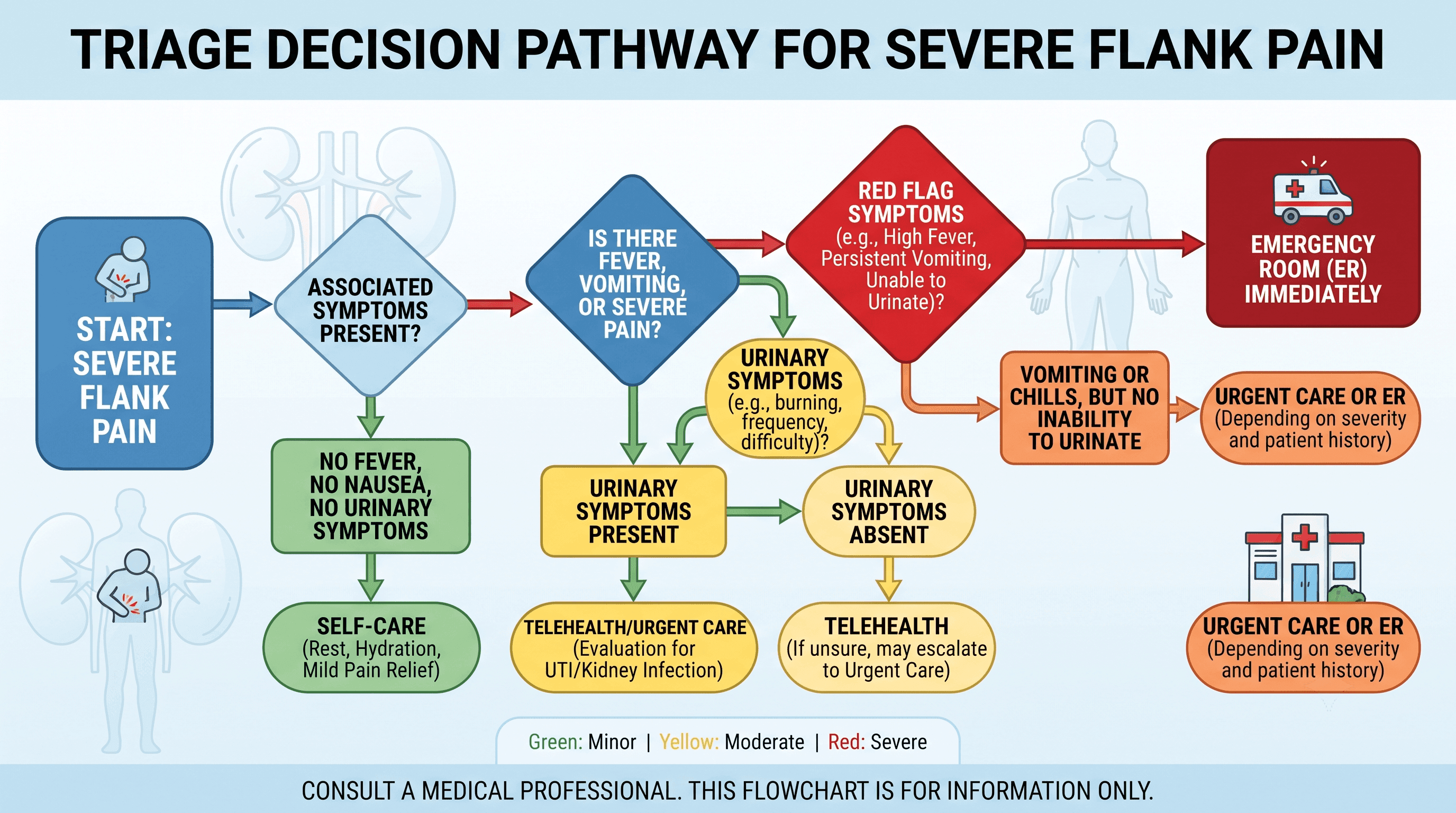
Kidney stone pain alone is rarely a medical emergency, but certain combinations of symptoms are. Seek emergency care immediately if severe side or back pain occurs along with any of the following:
- Fever or chills, which can signal a kidney infection
- Nausea or vomiting that won't stop
- Blood in your urine along with severe pain
- Inability to urinate at all
- Confusion, dizziness, or a rapid heartbeat
If you think you may be experiencing a medical emergency, call 911 or go to the nearest emergency room immediately. No symptom checker, including Momentary, is designed to replace emergency evaluation.
FAQ
Can a symptom checker diagnose a kidney stone? No. Symptom checkers can help you understand how urgent your symptoms may be, but confirming a kidney stone requires imaging, typically a CT scan or ultrasound, ordered by a clinician.
What does kidney stone pain typically feel like? It's often described as sharp, cramping pain in the side or back, below the ribs, that may radiate to the lower abdomen or groin and can come in waves.
Is Momentary free to use? Specific pricing for Momentary's AI healthcare navigator is not publicly available. It is designed to help users understand symptoms and compare care options, including cost, before booking a visit.
When should I go to the ER instead of using an app? Go to the ER if severe pain is accompanied by fever, chills, uncontrollable vomiting, inability to urinate, or confusion. These can indicate a kidney infection or blockage that needs immediate treatment.
Are Ada Health and Buoy Health accurate? Independent research on Ada Health, including a 2023 study in JMIR mHealth and uHealth, found its diagnostic sensitivity approached that of emergency department physicians for top-tier diagnoses. Buoy Health cites published data showing it reduces patient uncertainty about the right level of care. No symptom checker is a substitute for professional evaluation.
Does K Health accept insurance for kidney stone symptoms? K Health is mostly cash-pay, with limited insurance coverage through select employer and health plan partnerships. Confirm your specific plan directly with K Health before scheduling.
Can these apps prescribe pain medication for a kidney stone? Momentary, Ada Health, Buoy Health, and the WebMD Symptom Checker do not prescribe medication. K Health can connect users to a licensed clinician who may prescribe medication after a live evaluation, subject to state regulations.


