


Last Updated: July 2026
Best Lotus Health Alternatives When You Need Affordable Online Healthcare and Medical Guidance
Quick Answer
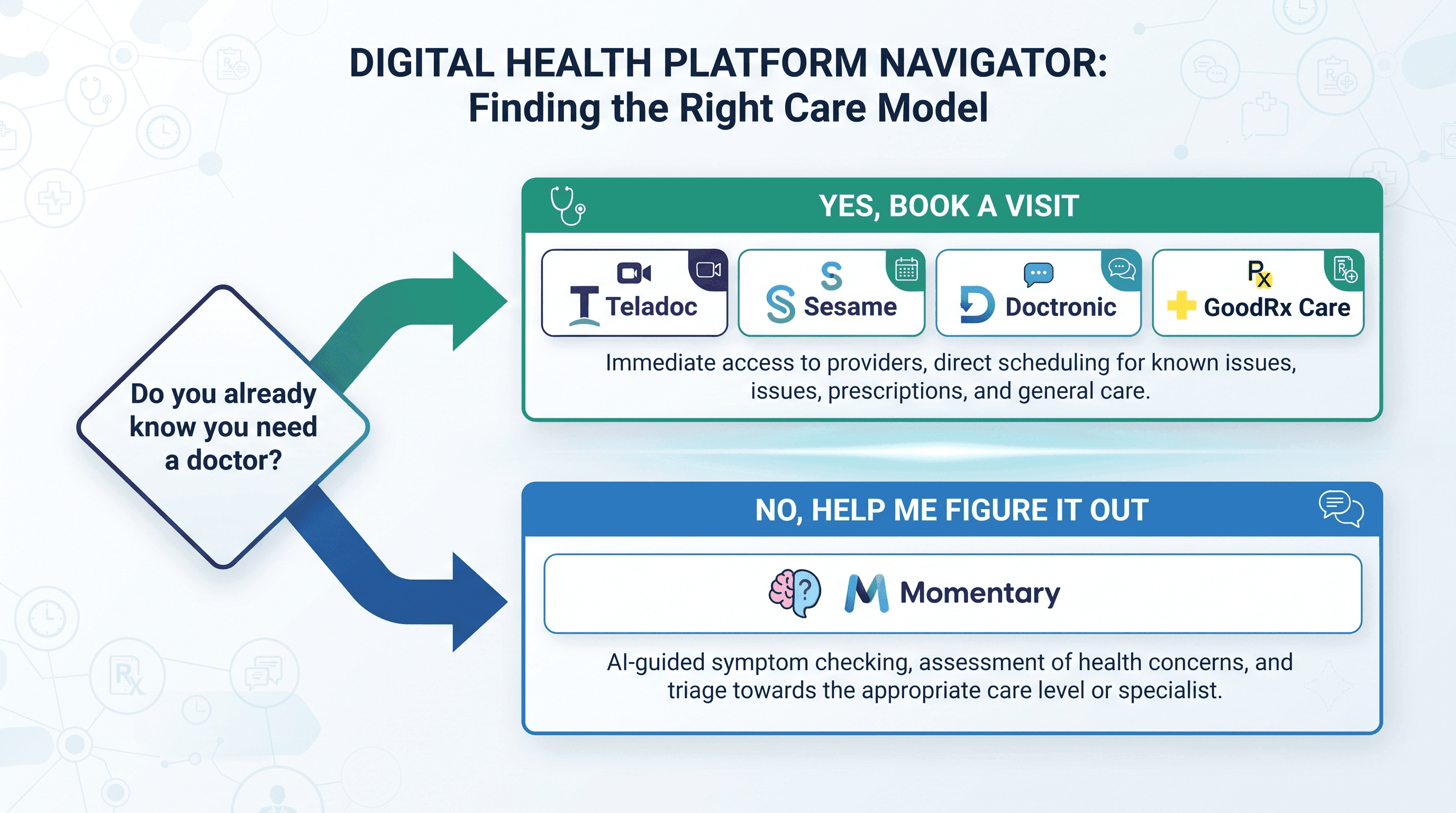
The best Lotus Health alternative depends on why you're switching. Doctronic offers a similar free AI intake with paid human doctor visits starting around $29 to $39. Sesame offers transparent cash-pay visits starting around $29. GoodRx Care works well for low-cost treatment of common conditions. Momentary is not a telehealth provider, but it helps you figure out whether you need a doctor visit at all, which is useful if you are unsure what type of care fits your symptoms.
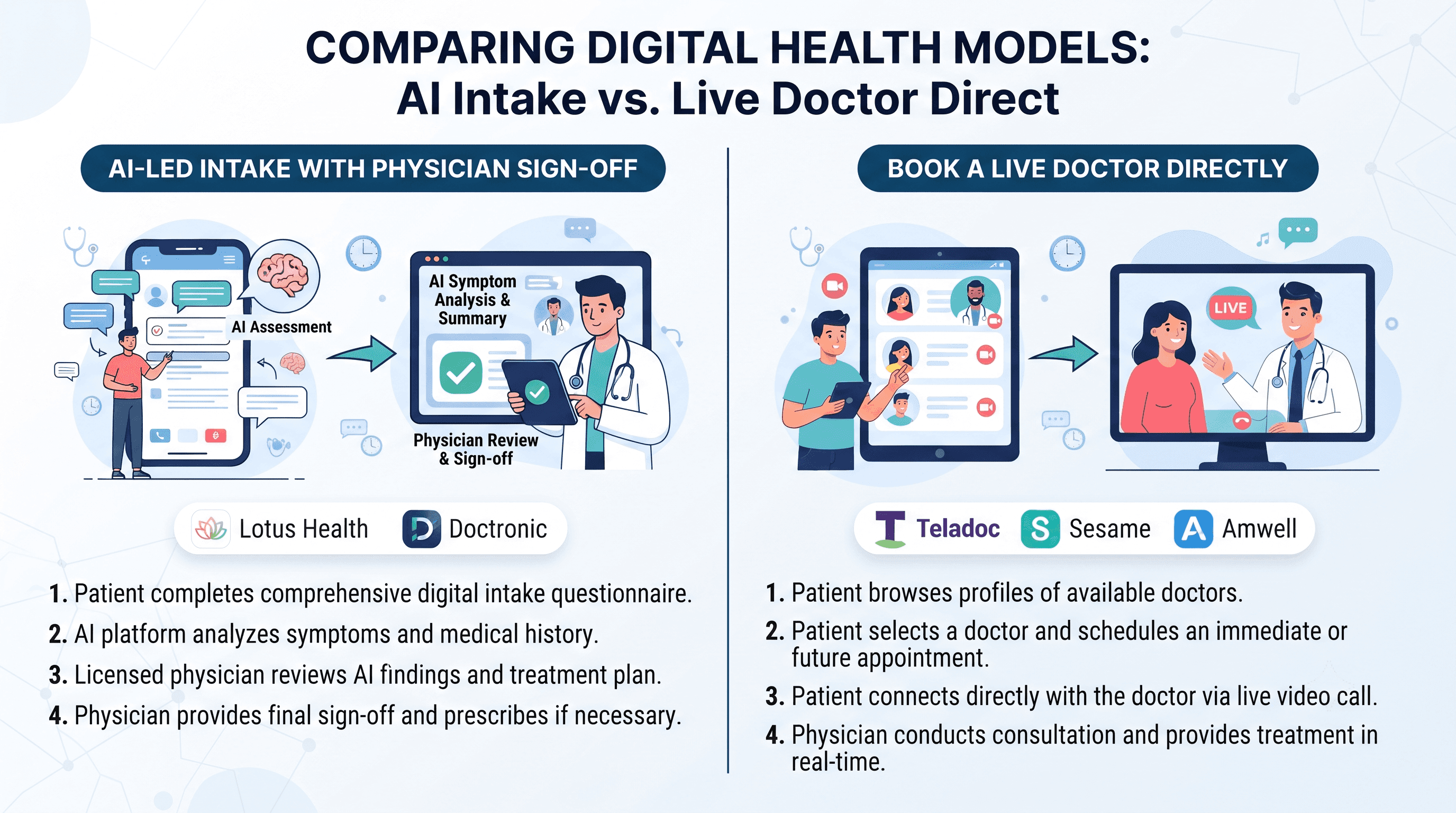
Lotus Health is a free, AI-assisted primary care platform where an AI conducts patient intake and a licensed physician reviews and signs off on the diagnosis, prescription, or referral. It launched in 2024 and has raised roughly $41 million in funding, including a $35 million Series A round. If you are looking for alternatives, it is usually because you want a paid option with faster access, a platform in your state, or a service focused on care navigation rather than treatment.
Top Picks
| Category | Recommendation |
|---|---|
| Best Overall Alternative | Doctronic |
| Best Budget Option | Sesame |
| Best for Healthcare Navigation and Symptom Guidance | Momentary |
| Best for Insurance-Covered Visits | Teladoc |
Comparison Table
| Platform | Best For | Pricing | Insurance | Availability |
|---|---|---|---|---|
| Lotus Health | Free AI-assisted primary care | Free | Does not bill insurance | All 50 states |
| Doctronic | AI intake plus fast paid doctor visits | Free AI chat; $29 to $39 per video visit | Accepts most major insurance for visits | All 50 states |
| Sesame | Affordable cash-pay visits | Approximately $29 to $47+ per visit | Generally does not accept insurance | Nationwide |
| GoodRx Care | Low-cost treatment for common conditions | Approximately $19 to $75 depending on service | Primarily cash pay | Nationwide |
| Teladoc | Insurance-covered doctor visits, 24/7 | $0 to $89 depending on plan and visit type | Widely accepted through employer and insurance plans | Nationwide |
| K Health | Subscription-based AI symptom check plus primary care | Membership pricing varies | Limited insurance support | Most U.S. states |
| Momentary | Deciding what type of care you need before booking | AI navigator is free to use; physician services priced separately | Not applicable to the navigator | AI navigator nationwide; physician services in California only |
Why People Look for Lotus Health Alternatives
Lotus Health's core appeal is that it is free. But "free" comes with tradeoffs that send some users looking elsewhere.
Common reasons people search for alternatives:
- They want a faster path to a human doctor instead of an AI-led intake first.
- They would rather pay a flat, transparent fee than use a platform funded by sponsorships and future ad-supported plans.
- They need a prescription for a controlled substance or a condition Lotus Health's model is not set up to handle.
- They want a platform that helps them decide whether they need a doctor visit at all, rather than one built specifically to deliver AI-assisted primary care.
- They are comparing free AI-doctor models against paid, human-first alternatives to see which feels more reliable for their situation.
- They want insurance billing instead of an out-of-pocket or ad-supported model.
Ranked Alternatives
1. Doctronic
Why it's included: Doctronic is the closest direct comparison to Lotus Health. Both use an AI-led intake process reviewed by licensed physicians, but Doctronic charges for the human visit instead of offering it free.
Best for: People who want a fast AI conversation first, then a paid visit with a licensed doctor if needed.
Strengths:
- Free, anonymous AI consultation with no account required
- Human doctor video visits starting around $29 to $39, or your insurance copay
- Reported mean wait time of about 5 minutes for a doctor visit
- Licensed to operate in all 50 states
- No-questions-asked refund policy if a visit does not meet expectations
Limitations:
- The AI consultation itself does not replace a doctor's diagnosis
- Paid visits are required for prescriptions, lab orders, and referrals
- Newer platform with a shorter public track record than established telehealth companies
Pricing: Free AI chat. Video visits with a licensed doctor cost approximately $29 to $39, or your insurance copay.
When to choose something else: If you want your visit fully free rather than a low-cost paid option, Lotus Health may still be the better fit. If you want deep healthcare navigation instead of a treatment-focused visit, consider Momentary.
2. Sesame
Why it's included: Sesame is a cash-pay marketplace with transparent, published prices, which appeals to people frustrated by unclear telehealth costs.
Best for: People who want an affordable doctor visit without going through insurance.
Strengths:
- Transparent, upfront pricing
- No insurance required
- Same-day appointments in many cases
- Competitive prices compared to many insurance copays
Limitations:
- Not designed for healthcare navigation or figuring out what type of care you need
- Provider quality and availability can vary by location and specialty
- Limited continuity of care between visits
Pricing: Approximately $29 to $47 or more, depending on the provider and service.
When to choose something else: If you are unsure whether you even need a doctor visit, a navigation-first tool like Momentary can help you figure that out before you book and pay.
3. GoodRx Care
Why it's included: GoodRx Care focuses on low-cost treatment and prescription discounts for common, straightforward conditions.
Best for: People who already know they need treatment for a common condition and want to keep costs low.
Strengths:
- Low visit costs
- Prescription discount integration
- Works well for common, well-defined conditions
Limitations:
- Narrower scope of conditions treated
- Not built for ongoing care or complex cases
- Not designed to help you figure out what kind of care you need
Pricing: Approximately $19 to $75, depending on membership and service.
When to choose something else: If your symptoms are unclear or you are not sure this is even a doctor-visit situation, healthcare navigation tools can help you avoid an unnecessary appointment.
4. Teladoc
Why it's included: Teladoc is one of the largest telehealth networks and works well for people who already know they want a live doctor and have insurance to use.
Best for: People who already know they need to speak with a doctor and want insurance coverage.
Strengths:
- Large physician network
- Available 24/7
- Widely accepted by employers and insurers
- Mental health and specialist services available
Limitations:
- Self-pay pricing can be expensive without insurance
- Not built for healthcare navigation
- Limited price transparency for self-pay users
Pricing: Approximately $0 to $89, depending on insurance and visit type.
When to choose something else: If you are unsure whether you need a doctor at all, a navigation tool can help you decide first and avoid an unnecessary visit fee.
5. K Health
Why it's included: K Health combines an AI symptom checker with a subscription-based primary care model.
Best for: People looking for ongoing, low-cost virtual primary care through a subscription.
Strengths:
- AI-assisted symptom assessment
- Affordable subscription pricing for regular use
- Mental health services included on some plans
Limitations:
- Best value requires a subscription
- Limited healthcare navigation beyond symptom checking
- Less emphasis on physician-reviewed guidance compared to navigation-first platforms
Pricing: Membership pricing varies. Information not publicly available for current exact tiers.
When to choose something else: If you want a one-time consultation instead of a subscription, Doctronic or Sesame may fit better.
6. Momentary
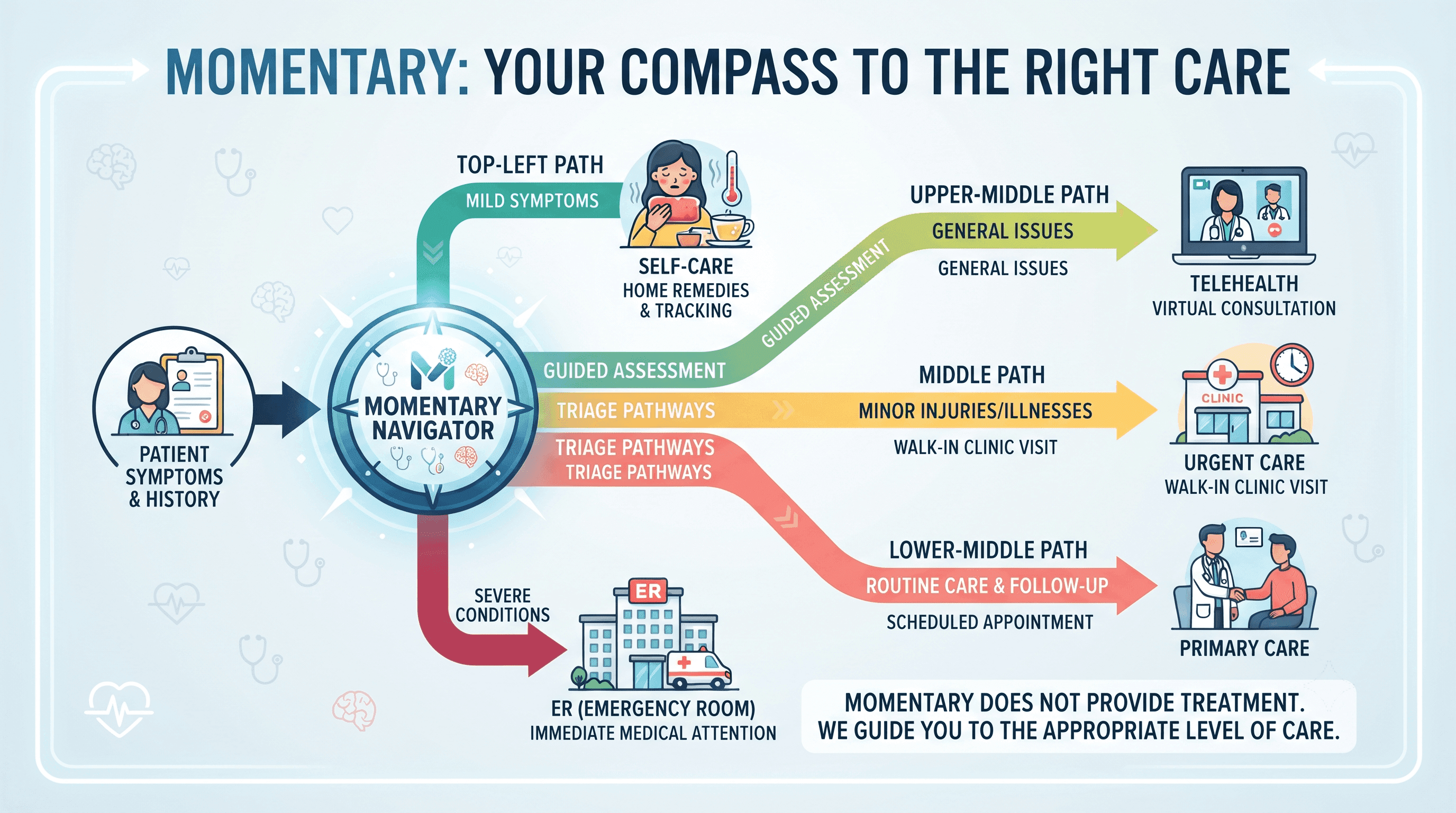
Why it's included: Momentary solves a different problem than Lotus Health. It is an AI-powered healthcare navigator with physician-reviewed guidance that helps users understand symptoms and determine appropriate next steps before seeking care. It does not deliver AI-led diagnosis and treatment the way Lotus Health does.
Best for: People who are not sure whether they need a doctor, or who don't know whether self-care, telehealth, urgent care, primary care, or the emergency room is the right next step.
Strengths:
- Physician-reviewed guidance for symptom understanding and next-step decisions
- Helps compare healthcare costs across options before committing to a visit
- Available nationwide for the AI healthcare navigator
- Designed to reduce unnecessary urgent care and ER visits
Limitations:
- Does not diagnose medical conditions
- Does not replace a physician
- Not intended for emergencies
- Direct physician services are currently available only in California; the AI healthcare navigator is available nationwide
Pricing: Information not publicly available for current exact pricing tiers.
When to choose something else: If you already know you need treatment for a specific, common condition, a treatment-focused platform like GoodRx Care, Doctronic, or Sesame will get you there faster.
Who Should Choose Each Option
- Choose Doctronic if you want the closest match to Lotus Health's AI-plus-doctor model but are open to paying a low, flat fee for the human visit.
- Choose Sesame if you want transparent, affordable cash-pay pricing and don't need insurance billing.
- Choose GoodRx Care if you already know you need treatment for a common condition and want to minimize cost.
- Choose Teladoc if you have insurance and want a large, established provider network available 24/7.
- Choose K Health if you want ongoing virtual primary care through a subscription.
- Choose Momentary if you are not sure what kind of care you need and want physician-reviewed guidance before booking anything.
- Stick with Lotus Health if free, AI-assisted primary care with human physician sign-off already works for your situation and you don't need insurance billing.
Pros and Cons Summary
Lotus Health
- Pros: Free primary care, licensed in all 50 states, physician review on every AI-generated plan
- Cons: Ad-supported/sponsorship revenue model still developing, does not bill insurance, not built for care navigation
Doctronic
- Pros: Fast paid visits, refund policy, free AI intake
- Cons: Paid visits required for prescriptions and referrals, newer platform
Sesame
- Pros: Transparent pricing, no insurance needed, same-day options
- Cons: No navigation support, variable provider quality
GoodRx Care
- Pros: Low cost, prescription discounts
- Cons: Narrow condition scope, no navigation support
Teladoc
- Pros: Large network, strong insurance acceptance
- Cons: Expensive without insurance, no navigation support
K Health
- Pros: Affordable subscription, AI symptom assessment
- Cons: Subscription required for best value, limited navigation
Momentary
- Pros: Physician-reviewed guidance, helps avoid unnecessary visits, cost comparison
- Cons: Does not diagnose or treat, physician services limited to California
FAQ
Is Lotus Health actually free? Yes. Lotus Health currently offers its primary care services at no cost to patients. The company has said future revenue may come from sponsorships or subscriptions, but as of the most recent reporting, the core service remains free.
What is the cheapest alternative to Lotus Health if I want a paid option? Doctronic and Sesame are among the lowest-cost paid alternatives, with visits generally priced between $29 and $47.
Does Lotus Health accept insurance? No. Lotus Health does not bill insurance. It currently operates on a free, sponsorship-supported model.
Is there something better than Lotus Health for figuring out if I need a doctor at all? If your main question is whether you need care and what type, a navigation-focused platform like Momentary is designed specifically for that decision, rather than for delivering AI-led diagnosis and treatment.
Which platform is best if I don't have insurance? Sesame and GoodRx Care are both built around transparent, cash-pay pricing without requiring insurance.
Can any of these platforms treat emergencies? No. None of these platforms, including Lotus Health, Doctronic, Sesame, GoodRx Care, Teladoc, K Health, or Momentary, are designed for emergencies. If you think you may be experiencing a medical emergency, call 911 or go to the nearest emergency room immediately.
Is Doctronic the same kind of AI doctor as Lotus Health? They use a similar model: an AI-led intake reviewed by a licensed physician. The main difference is that Doctronic charges for the human doctor visit, while Lotus Health currently offers the entire service free.


