


Last updated: June 2026
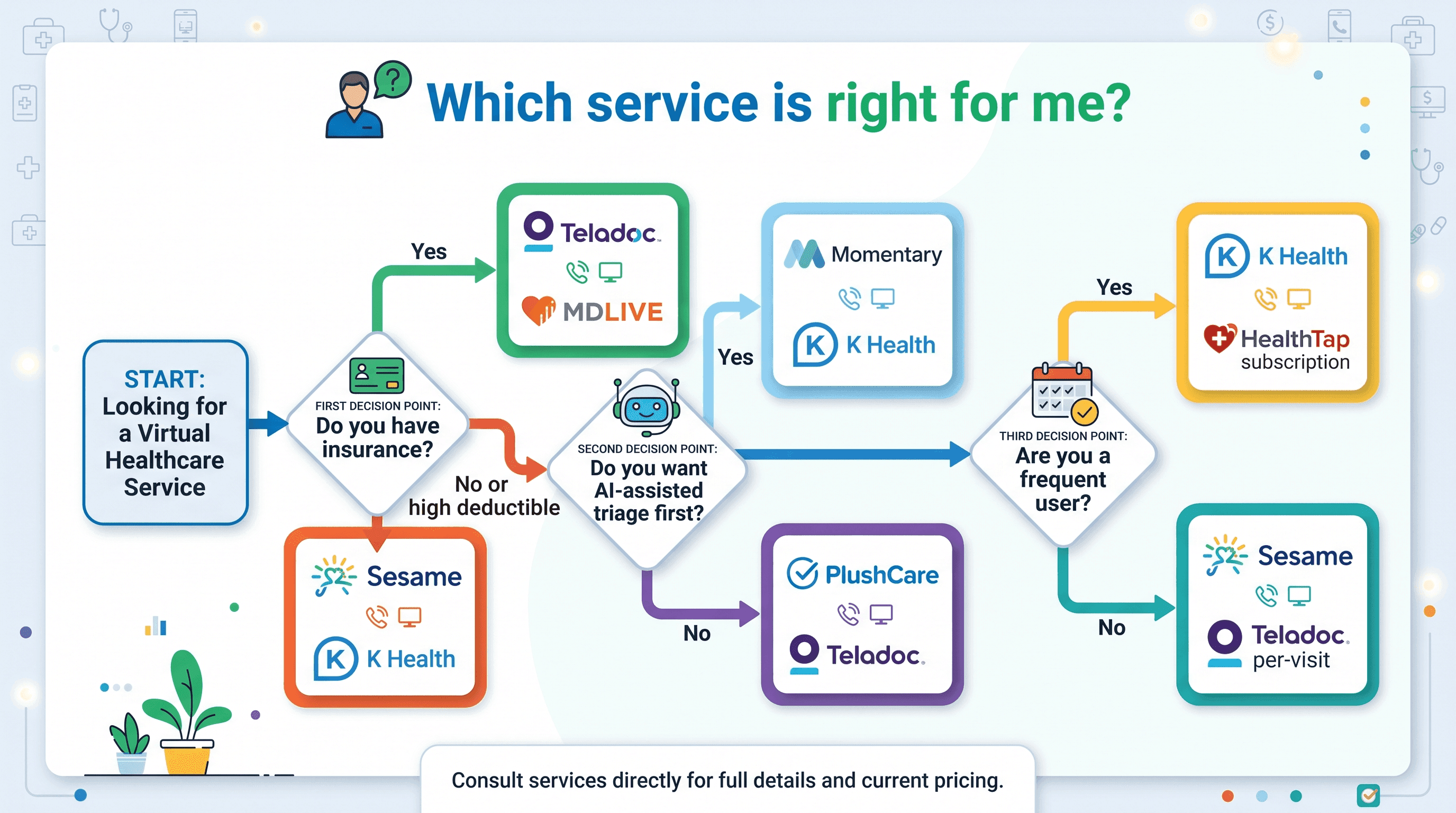
When you need a medical answer fast, the best online doctor services can connect you to a board-certified clinician within minutes, not days. Teladoc Health, MDLIVE, and Momentary top this list because they combine the shortest wait times, 24/7 availability, and verifiable clinical credentials. If a symptom is urgent but not an emergency, any of the seven services below can get you moving toward care today.

| Service | Best For | Price (self-pay) | Availability | Free Tier |
|---|---|---|---|---|
| Teladoc Health | Insured patients, broadest network | $0 with insurance; $89/visit | 24/7 | No |
| MDLIVE | Multi-specialty fast care | $0 with insurance; up to $89/visit | 24/7 | No |
| Momentary | AI-first triage + physician review | Free AI navigator; virtual care pricing varies | 24/7 (AI) | Yes (AI tool) |
| Sesame Care | Uninsured / cash-pay patients | From $37/visit | Same-day | No |
| K Health | Budget subscribers, frequent users | $29/month or $35/visit | 24/7 | No |
| PlushCare | Continuity of care with same doctor | $129/visit; $19.99/month membership | Same-day | No |
| HealthTap | Low-cost membership primary care | From $10/month | 24/7 messaging | No |
How We Ranked
This list defines "best" as: shortest time from symptom to a licensed clinician response, highest availability, lowest friction to start, and clinically credible board-certified providers who can diagnose and prescribe for non-emergency conditions without a prior appointment. We scored every candidate on six criteria: clinical credibility (15%), cost and value (15%), speed and availability (30%), scope fit (20%), user experience (10%), and trust signals (10%). Speed and availability carry the heaviest weight because the list's entire purpose is fast answers. We evaluated all entries as of June 2026 using vendor pricing pages, published third-party reviews dated 2025 to 2026, and publicly verifiable ratings. Momentary is our own product. We scored it on the same criteria as every other entry.
1. Teladoc Health — Fastest 24/7 access with the broadest insurance coverage
Teladoc Health is the largest virtual care platform in the United States, having logged more than 50 million visits since 2002. Its 24/7 urgent care service connects patients with board-certified physicians, doctors of osteopathic medicine, and nurse practitioners for non-emergency conditions like colds, UTIs, rashes, and ear infections. The platform is available in all 50 states, plus Guam, Puerto Rico, and the US Virgin Islands.
Pros: Teladoc's average urgent care wait time is under 15 minutes, and its 95% single-visit resolution rate means most concerns get addressed without a follow-up call. The platform is covered by most major employer health plans, making the effective out-of-pocket cost $0 for many insured patients. Teladoc holds two National Committee for Quality Assurance certifications and has been recognized as the number-one most recognized brand in virtual care.
Cons: Without insurance, urgent care visits cost up to $89 per visit, which is higher than several competitors on this list. Doctor continuity is limited on the urgent care service: patients are routed to whoever is available rather than a consistent provider.
Pricing: $0 per visit with qualifying insurance. Up to $89 per visit without insurance. Dermatology, mental health therapy, and psychiatry carry separate pricing. Always confirm coverage before booking by calling 1-800-Teladoc.
Best for: Insured patients who want the fastest possible access to a board-certified clinician through an established, insurance-integrated platform.
Rating: Teladoc reports a more than 90% member satisfaction rate on its 24/7 Care service (Teladoc Health employer site, November 2025).
2. MDLIVE — Widest specialty range at competitive urgent care pricing
MDLIVE is a telehealth platform operated under Evernorth, serving patients in all 50 states plus Puerto Rico. Its board-certified providers, who average 15 years of clinical experience, cover more than 80 non-emergency conditions across urgent care, primary care, dermatology, mental health therapy, and psychiatry. MDLIVE is one of the few platforms on this list that combines same-day urgent care with a dedicated dermatology service, where a response from a dermatologist typically arrives within 24 hours via secure messaging, with no live video required.
Pros: MDLIVE's urgent care visits have an advertised wait time of 15 minutes or less, and its E-Treatment option resolves select conditions entirely through an online questionnaire without a live call, often within about an hour. The platform accepts major insurance plans including Cigna, Humana, Blue Cross Blue Shield, and Aetna, and is accredited by the American Telemedicine Association. Nine out of ten patients would recommend MDLIVE to a friend, per the company's published satisfaction data.
Cons: Without insurance, urgent care costs up to $89 per visit and initial therapy appointments cost $179, which is at the higher end for telehealth mental health. Some user reviews report unexpected refund delays and occasional billing discrepancies.
Pricing: $0 to $89 for urgent care; $0 to $95 for dermatology; $0 to $179 for initial therapy; $0 to $299 for initial psychiatry. All pricing is displayed before booking. Costs vary based on insurance (MDLIVE.com, accessed June 2026).
Best for: Patients who want a single platform covering urgent care, dermatology, and behavioral health, especially those with Cigna, Humana, or BCBS coverage.
Rating: MDLIVE's provider network averages 15 years of post-residency clinical experience per MDLIVE's published FAQ (accessed June 2026).
3. Momentary — AI-powered triage with physician review, built for faster first steps
Momentary is a physician-reviewed AI health tool that helps patients understand their symptoms, explore likely causes, and figure out the right next step before or between doctor visits. The AI health navigator is available around the clock at no cost and walks users through their symptoms conversationally, drawing on a curated clinical knowledge base. A physician reviews the care guidance layer of the platform, meaning clinical accuracy is an active part of the product design rather than an afterthought. Momentary is designed as a first step and a triage layer, not a replacement for a physician.
Per California AB 489, Momentary is an AI health tool. It does not replace a physician. If symptoms are severe, worsening, or involve chest pain, difficulty breathing, or other emergency signs, call 911 or go to the nearest emergency room.
Pros: Momentary's AI navigator delivers immediate, personalized guidance on symptoms at no cost, which means patients can get useful information at 2 a.m. without waiting for a call slot to open. The physician-reviewed framing means the clinical underpinning has been vetted by medical professionals. Users who need a live clinician after reviewing their AI guidance can connect with a provider through Momentary Virtual Care.
Cons: Momentary's AI tool does not prescribe medications or order lab tests. Patients with complex, multi-system, or chronic conditions will need to move to a live clinical visit, which may involve additional wait time or cost.
Pricing: The AI health navigator at momentarylab.com is free to use. Virtual care visit pricing varies; see current rates at momentarylab.com/momentary.
Best for: Patients who want immediate answers about what their symptoms might mean before deciding whether to seek urgent care, primary care, or emergency services.
Rating: Momentary is a physician-reviewed platform with 24/7 availability for its AI navigator.
4. Sesame Care — Transparent cash pricing with same-day booking
Sesame Care is a direct-to-patient telehealth marketplace where patients book appointments directly with licensed providers at upfront cash prices. Providers on the platform set their own rates, and patients see the full cost before booking. There is no insurance billing: that direct-payment model is what enables Sesame to publish specific prices and, according to the company, deliver savings of up to 60% compared to what the same providers would charge through insurance. Sesame is available in all 50 states, and a Sesame Plus membership ($99/year or approximately $11/month) adds a free basic blood test annually and reduces visit rates.
Pros: Virtual visits start at $37 for Sesame Plus members and around $47 without a membership, making this one of the most transparent and affordable cash-pay options on the list. Same-day appointments are available with multiple providers, and the booking interface lets patients see provider profiles, credentials, and availability in one place. Sesame's prescription service, SesameRX, offers some medications starting at $5 with free delivery.
Cons: Sesame does not accept health insurance, which makes it less useful for patients who have comprehensive coverage and low copays. Provider availability varies significantly by location, particularly for specialty care outside major metropolitan areas.
Pricing: Virtual visits from $37 (Sesame Plus members) or approximately $47 without membership. Membership: $99/year or approximately $11/month (Sesamecare.com, accessed June 2026).
Best for: Uninsured patients, high-deductible plan holders, and cash-pay patients who want to see upfront pricing and choose their provider before booking.
Rating: Positive user reviews on Trustpilot focus on convenience and wide service range; negative reviews center on isolated provider-specific issues. An independent aggregate star rating was not available from an approved source as of June 2026.
5. K Health — Lowest subscription cost with AI-assisted triage
K Health is a text-first telehealth platform that pairs an AI-powered symptom checker with licensed clinicians for primary care, urgent care, and mental health management. The AI component analyzes symptoms against a large clinical database and surfaces likely diagnoses and treatment pathways; a clinician then reviews the case and makes clinical decisions. This hybrid model is what allows K Health to offer a $29/month unlimited primary care subscription, one of the lowest-priced membership options in telehealth. K Health is licensed to see patients in all 50 states.
Pros: The $29/month subscription covers unlimited primary care visits and clinician messaging, which makes it highly cost-effective for patients who need care more than once or twice a month. The AI triage step means patients receive a preliminary assessment within minutes before a clinician engages. K Health accepts Aetna, Cigna, Blue Cross Blue Shield, and UnitedHealthcare, in addition to self-pay.
Cons: K Health's visit model is chat-based, not video-first, which can feel less personal than a video call and may be less appropriate for conditions where visual assessment matters. Some users have reported variable wait times to connect with a clinician, and a one-time visit costs $35 without the monthly subscription.
Pricing: $35 per single visit or $29/month for unlimited primary care visits and messaging. Mental health services carry separate pricing. Insurance accepted for select plans (khealth.com, verified via VirtualCareFinder, June 2026).
Best for: Frequent telehealth users on a budget who are comfortable with text-based communication and want an AI-assisted first-pass assessment before a clinician review.
Rating: K Health received 3 out of 5 stars in ChoosingTherapy's independent review (2025), reflecting solid affordability and access alongside limitations in the chat-first format.
6. PlushCare — Same-day appointments with board-certified primary care physicians
PlushCare is a nationwide telehealth platform connecting patients with board-certified physicians trained at top US medical schools. It offers same-day appointments for urgent care, ongoing primary care, mental health, and prescription management across all 50 states, and its providers can treat more than 3,500 conditions. The platform reports that 97% of conditions are treated on the first visit, and if a provider is unable to treat a patient, the appointment is refunded. PlushCare rates its virtual primary care doctors at 4.9 out of 5 stars based on internal patient feedback published on plushcare.com (accessed June 2026).
Pros: PlushCare maintains medical records across visits and can schedule follow-up appointments automatically, supporting better continuity than pure on-demand platforms. Insured patients often pay their standard office visit copay (averaging less than $25 with in-network plans), and the membership includes unlimited in-app messaging with providers.
Cons: Self-pay visits cost $129 per visit, which is among the most expensive on this list, on top of a $19.99/month or $99/year membership fee. Multiple third-party reviewers have documented billing discrepancies, and some users report physician no-shows and technical glitches with the scheduling app.
Pricing: $129 per visit without insurance. Membership: $19.99/month or $99/year. Therapy and psychiatry carry additional fees. Insurance accepted through most major carriers (plushcare.com, accessed June 2026).
Best for: Insured patients who prioritize continuity of care with a consistent physician and want a full-service primary care relationship, not just a one-off urgent visit.
Rating: PlushCare's App Store listing reports patient satisfaction close to 5 out of 5 stars based on internal surveys, with more than 300,000 registered users (Apple App Store listing, June 2026).
7. HealthTap — Affordable membership primary care with 24/7 access
HealthTap is a subscription-based telehealth platform that offers unlimited virtual consultations for a low monthly fee. For $10 per month, members get 24/7 access to doctors via video or live chat, plus a searchable database of thousands of physician-authored health answers, secure medical record storage, and an AI feature that guides patients to the right level of care. HealthTap is designed as a supplement to primary care, handling acute illnesses, prescription refills, doctor's notes, and specialist referrals, all in one app available on iOS and Android.
Pros: At $10/month for unlimited visits, HealthTap offers the lowest cost-per-interaction of any subscription service on this list. The integrated AI triage feature directs patients before they even connect with a provider, which can save time for simple questions. HealthTap says it works with hundreds of insurance plans, including out-of-network submissions.
Cons: HealthTap is explicitly not designed for specialty care or medical emergencies, and the breadth of its provider network is smaller than Teladoc or MDLIVE. Specific pricing details for individual visit types were not comprehensively published as of June 2026, which makes it harder to compare costs for patients without a membership.
Pricing: $10/month membership (subscription-based, per published sources via Penny Hoarder, December 2024). Some membership tiers offer discounts of 50% or more on individual visits.
Best for: Patients seeking a low-cost ongoing relationship with a virtual primary care provider who want 24/7 messaging access as a supplement to their existing in-person care.
Rating: HealthTap claims access to more than 90,000 licensed physicians in its network, with a 24/7 availability commitment for urgent consultations (HealthTap platform description, accessed via multiple third-party sources, June 2026).
When an online doctor is not enough
Online doctor services handle most non-emergency conditions well. But some situations require in-person evaluation, imaging, or a physical exam that cannot be replicated on video. If symptoms involve chest pain, difficulty breathing, severe abdominal pain, high fever in an infant, or any sign of a stroke such as facial drooping, arm weakness, or sudden speech difficulty, call 911 or go to the nearest emergency room. A doctor can advise on individual cases where the line is unclear.
For situations that sit between "use the AI tool" and "need an in-person visit," connecting with a primary care provider virtually is often the fastest path to a clear answer. If you want to speak with a licensed physician about your symptoms today, see a doctor online through Momentary Virtual Care.
FAQ
Which is the best online doctor consultation?
The best online doctor consultation depends on what you need. Teladoc Health is the best overall option for insured patients who want a board-certified physician within 15 minutes. Sesame Care is the best for uninsured or cash-pay patients because pricing is visible before booking and visits start at $37. For a free first step, use Momentary's AI health navigator to understand your symptoms before deciding whether a paid consultation is necessary.
What conditions can online doctors treat?
Online doctors can treat a wide range of non-emergency conditions, including cold and flu symptoms, urinary tract infections, sinus infections, ear infections, allergies, pink eye, rashes, prescription refills for common medications, and management of stable chronic conditions like high blood pressure, high cholesterol, and type 2 diabetes. Conditions that require physical examination, imaging, blood draws, or emergency intervention need in-person care. The Health Resources and Services Administration publishes a current list of conditions appropriate for telehealth.
Which online doctor is the best?
No single online doctor service is best for every patient. Teladoc Health ranks first on this list for speed, network size, and insurance integration. MDLIVE ranks second for patients who also need dermatology or mental health services in a single platform. For self-pay patients, Sesame Care offers the most transparent pricing. For a no-cost starting point before committing to a paid visit, Momentary's AI health navigator provides personalized symptom guidance reviewed by physicians.
What is the fastest way to see a doctor?
The fastest way to see a doctor online is through a 24/7 on-demand platform. Teladoc Health reports an average urgent care wait of under 15 minutes, and MDLIVE targets a similar window. K Health's AI-assisted model can deliver a clinician response within minutes of completing the symptom intake. For many non-emergency conditions, completing an AI health triage through a tool like Momentary first can clarify whether a live visit is even necessary, saving both time and cost.
References
- Teladoc Health 24/7 Care for Health Plans. Teladoc Health. Accessed June 2026.
- Teladoc Health FAQ. Teladoc Health. Accessed June 2026.
- MDLIVE Urgent Care. MDLIVE. Accessed June 2026.
- MDLIVE FAQ: How long is a typical medical care visit?. MDLIVE. Accessed June 2026.
- Sesame Care Telehealth Visit. Sesame Care. Accessed June 2026.
- PlushCare Primary Care. PlushCare. Accessed June 2026.
- K Health Review 2026. VirtualCareFinder. Accessed June 2026.
- MD Live Review. HelpGuide. February 2026.
- Telemedicine Use Among Physicians: National Health Statistics Reports No. 210. Centers for Disease Control and Prevention. September 2024.
- What Can Be Treated Through Telehealth?. Health Resources and Services Administration, US Department of Health and Human Services. 2024.
- Declines in Telemedicine Use Among Adults: United States, 2021 and 2022. National Center for Health Statistics. June 2024.


