


Last updated: June 2026
The best personal health AI apps give you medically grounded answers about your symptoms, help you decide whether to seek care, and connect you with a real clinician when the situation calls for it. Ada Health leads on clinical evidence, Momentary leads on combining AI guidance with unlimited physician-reviewed primary care at an affordable monthly price, and Wysa leads for mental wellness support. The table below shows how all six ranked entries compare at a glance.
| Tool | Best For | Price | Rating | Free Tier |
|---|---|---|---|---|
| Ada Health | Symptom triage before a doctor visit | $0 | 4.6 stars (App Store) | Yes |
| Momentary | AI health navigation + unlimited primary care | $19.99/mo | LegitScript certified | Yes (AI navigator) |
| Wysa | Mental wellness and CBT-based emotional support | Free / $74.99/yr premium | 4.9 stars (App Store, 21.7K reviews) | Yes |
| K Health | On-demand primary care with AI intake | $29/mo or $35/visit | 4.7 stars (App Store, 41K+ reviews) | AI symptom check free |
| Buoy Health | Free symptom navigation and care routing | $0 | Active, 9M+ interactions logged | Yes |
| Noom | Behavior-based weight management | $17.42/mo (annual) | 4.2 stars (App Store, 900K+ reviews) | No (7-day trial) |
How We Ranked
For this list, "best" means: a consumer-facing AI health app that actively helps US users understand symptoms, manage their health, or access clinical guidance, with physician or clinical oversight, verifiable pricing, and a genuine free or low-cost option. We scored each eligible entry on six criteria: clinical credibility (30%), scope fit (20%), cost/value (15%), speed and availability (15%), user experience (10%), and trust signals (10%). Weights reflect the AI health tools category from our standard methodology. Every score rests on a logged source and a specific date. Evaluation date: June 2026. Momentary is our own product. We scored it on the same criteria as every other entry.
1. Ada Health — Strongest clinical evidence of any consumer symptom checker
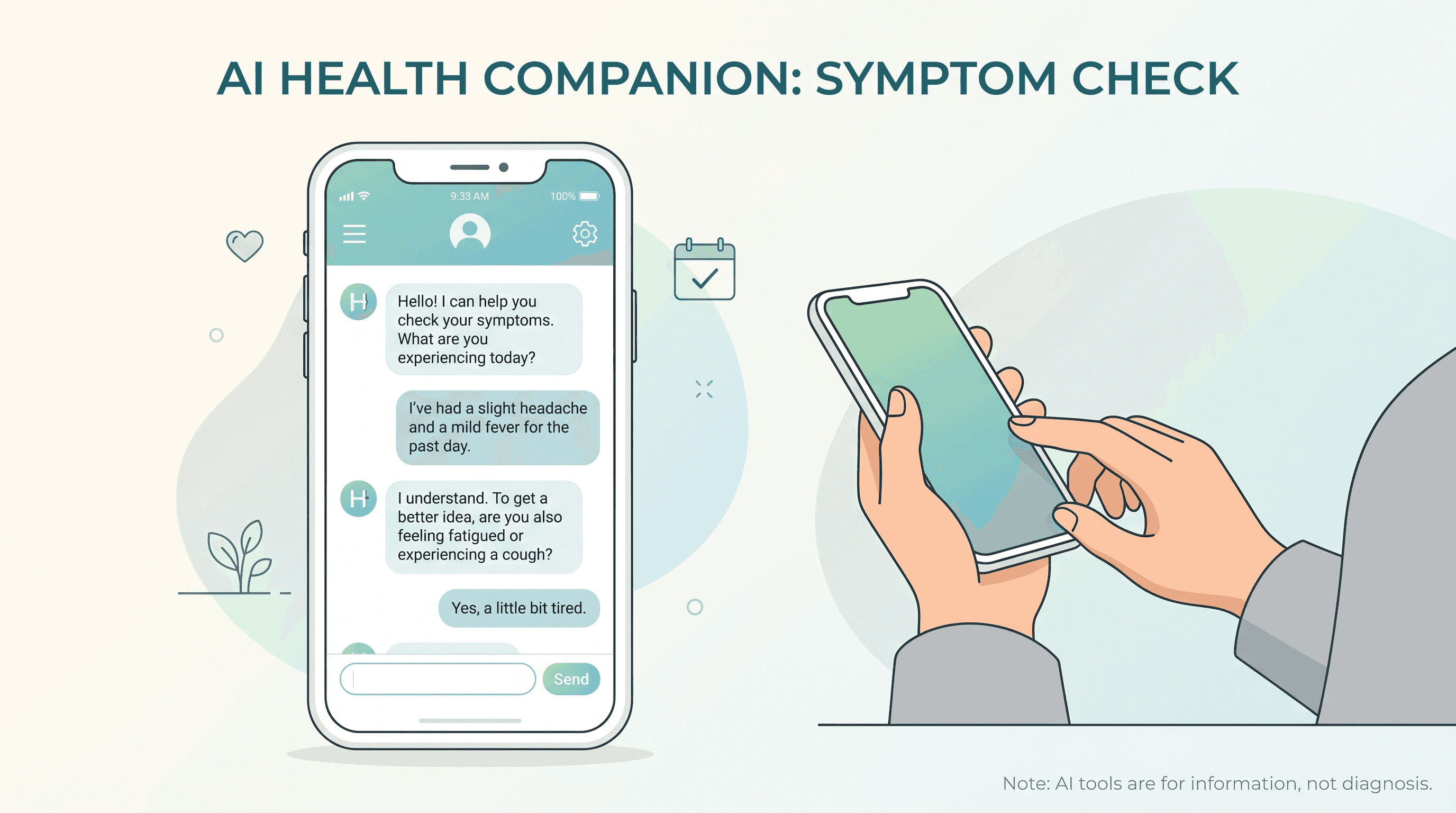
Ada Health is a free AI symptom checker built by doctors, scientists, and engineers. The app asks a structured series of questions about symptoms and medical history, then provides a personalized assessment with guidance on whether to seek emergency care, schedule a doctor's visit, or monitor symptoms at home. Ada has reported 10 million users and 20 million completed assessments, with someone opening the app roughly every three seconds globally.
Pros: A 2023 study published in JMIR mHealth and uHealth found Ada's diagnostic sensitivity for its top-5 diagnoses at 70%, approaching the 68.9% top-3 accuracy of emergency department physicians, making it the most clinically validated consumer symptom checker available. The app supports a wide range of medical categories including skin conditions, indigestion, respiratory issues, and sleep problems, and allows users to export assessment reports as PDFs to share with a doctor. Ada is available 24/7 at no cost on iOS, Android, and web, with no account required to begin.
Cons: Ada is a triage tool, not a diagnostic one. A 2025 study in npj Digital Medicine confirmed that physicians still significantly outperform all symptom checkers in listing the correct diagnosis first, so Ada is best used as a first step rather than a final answer. Advanced features and some enterprise integrations require an upgraded or partner plan.
Pricing: $0 for the core symptom checker. Some advanced features may require an upgraded plan; pricing available at ada.com.
Best for: Anyone trying to understand what a symptom might mean before deciding whether to see a doctor.
Rating: 4.6 stars on the App Store (June 2026, source: GetApp/Capterra aggregate). 10 million users as of 2026 (Ada Health company data).
2. Momentary — AI health navigation combined with unlimited physician-reviewed primary care
Momentary is a physician-built AI health platform combining an AI healthcare navigator with access to unlimited primary care from licensed physicians, at $19.99 per month. The AI navigator helps users understand symptoms, explore health options, and determine next steps before or between doctor visits. Physicians review care and are available for diagnoses, prescriptions, lab orders, and referrals. The service is built by healthcare veterans, LegitScript certified, HIPAA-compliant, and currently licensed in California. It is built by physicians trained at Harvard and UC Berkeley.
Pros: At $19.99 per month, Momentary offers unlimited primary care access at a price lower than a single copay at most practices (average primary care office visit: $185, per US healthcare cost benchmarks). The combination of a free AI navigator for self-guided triage and physician-reviewed care in one platform makes it the most complete personal health AI offering on this list by scope. The service is HSA/FSA eligible, which reduces the effective out-of-pocket cost further for users with qualifying accounts.
Cons: Momentary is currently licensed in California only, which makes it unavailable to users in the other 49 states. The platform is newer, so independent third-party ratings are limited compared to more established competitors.
Pricing: AI health navigator: $0. Full membership with unlimited primary care, prescriptions, labs, and referrals: $19.99/month (HSA/FSA eligible). Verified at momentarylab.com, June 2026.
Best for: California residents who want a single app covering AI-guided self-triage and ongoing physician-reviewed primary care at a predictable monthly cost.
Rating: LegitScript certified as of June 2026 (verified at momentarylab.com). LegitScript certification is the healthcare industry's standard for verified, compliant online health providers.
Momentary is a physician-reviewed AI tool, not a replacement for a physician. Physicians review your care, and the platform is designed as a first step and ongoing triage layer before and between in-person visits.
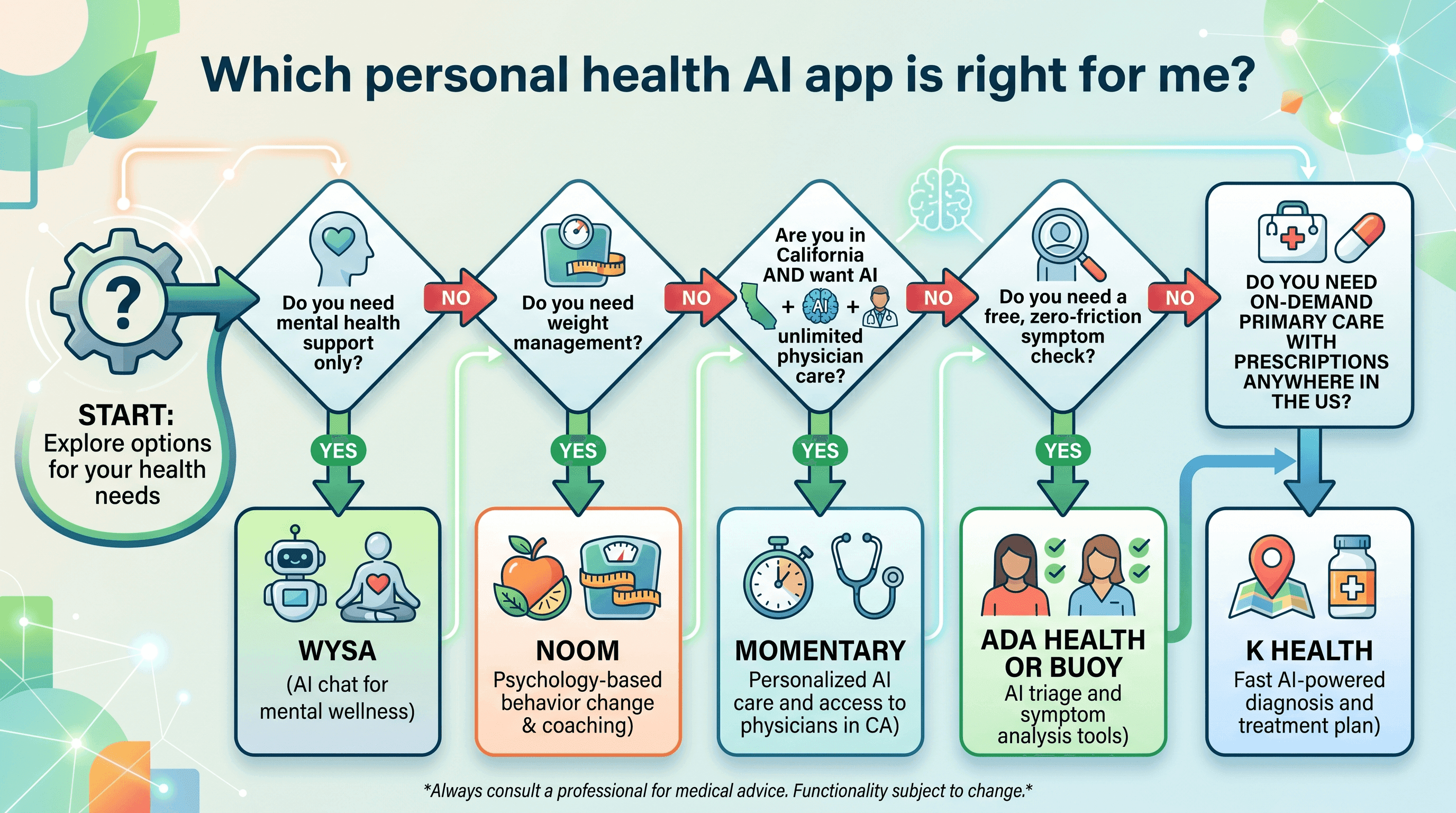
3. Wysa — Most evidence-backed AI mental wellness app for everyday stress and low mood
Wysa is an AI mental health companion built on cognitive behavioral therapy (CBT), dialectical behavior therapy (DBT), and mindfulness techniques. The app uses a conversational AI chatbot represented by a penguin to guide users through structured exercises, breathing tools, mood tracking, and journaling. Optional human coaching sessions are available via text for users who need support beyond the AI layer. Wysa has supported over 6 million users across 105 countries and is backed by more than 45 peer-reviewed publications.
Pros: Wysa holds FDA Breakthrough Device Designation for its potential to provide more effective treatment for serious mental health conditions, a distinction held by fewer than a handful of consumer mental health apps. The app requires no real name or account to begin, making it one of the most privacy-protective mental health tools available, and conversations are end-to-end encrypted. The free tier is genuinely functional, with access to the AI chatbot and a limited set of exercises.
Cons: The AI chatbot does not carry context meaningfully from one session to the next as of early 2026, so each conversation can feel like a fresh start, and longer chats can feel scripted or repetitive. Wysa is a self-help companion for mild-to-moderate stress and low mood, not a substitute for therapy, and it cannot diagnose or treat clinical conditions.
Pricing: Free (core AI chatbot and limited exercises). Premium: $74.99/year or approximately $19.99/month (full exercise library). Human coaching available at an additional tier. Verified at wysa.com, June 2026.
Best for: Adults managing everyday stress, anxiety, or low mood who want anonymous, 24/7 support grounded in CBT and want the option to add human coaching.
Rating: 4.9 stars on the App Store (June 2026, 21.7K ratings). 4.7 stars on Google Play (147K ratings). 45+ peer-reviewed publications as of June 2026 (Wysa company data, wysa.com).
4. K Health — AI-assisted primary care with clinician follow-through
K Health pairs an AI symptom checker with licensed clinicians to provide text-based primary care, urgent care, and mental health treatment for anxiety and depression. The AI conducts a structured intake comparing symptoms to a large medical database, and a clinician then reviews the assessment and responds, often within minutes. K Health is available to adults 18 and older across the continental US and accepts several major insurance plans including Aetna, Cigna, Blue Cross Blue Shield, and UnitedHealthcare, in addition to self-pay.
Pros: The $29/month subscription provides unlimited clinician messaging and visits, making it one of the most cost-effective telehealth subscriptions available for users who need frequent access to primary care. Clinicians are available seven days a week without an appointment, and prescriptions are sent directly to a preferred pharmacy. The hybrid AI and clinician model is well-suited to common conditions including infections, allergies, skin conditions, blood pressure management, and prescription refills.
Cons: K Health holds a 3.4 out of 5 rating on Trustpilot based on 1,530 reviews (January 2026), with recurring complaints about response times during high-demand periods, app stability issues, and billing transparency. The AI-clinician model is less suited to complex medical histories or conditions requiring specialist evaluation. K Health does not accept insurance for mental health services, and all costs are out-of-pocket for that category.
Pricing: $29/month subscription (unlimited visits) or $35 per individual visit. Mental health services priced separately. Verified at khealth.com and virtualcarefinder.com, June 2026.
Best for: Adults in the continental US who want affordable, on-demand primary care for routine conditions and are comfortable with text-based consultations.
Rating: 4.7 stars on the App Store (41K+ reviews, per choosingtherapy.com review, June 2026).
5. Buoy Health — Free AI symptom navigator with care routing
Buoy Health is a free AI-powered symptom navigation tool that guides users through a conversational assessment, then recommends the most appropriate next step, whether that is self-care at home, an urgent care visit, a primary care appointment, or emergency services. The platform has logged more than 9 million interactions with US consumers and is designed to reduce unnecessary emergency room visits. Buoy is available on web and mobile at no cost.
Pros: The core service is entirely free with no subscription or account required, which makes Buoy one of the lowest-friction entry points on this list for users who simply need guidance on what to do about a symptom. The conversational format is accessible for users who find traditional symptom checkers too clinical or rigid, and the platform integrates telehealth referral options when care is needed.
Cons: Buoy's clinical evidence base is thinner than Ada's. Published accuracy data specific to Buoy's triage algorithm is less available compared to the peer-reviewed literature supporting Ada, which limits the clinical credibility score. The free model means no direct clinician access within the platform itself.
Pricing: $0 for the consumer symptom checker. Verified at buoyhealth.com, June 2026.
Best for: Users who want a quick, free, no-account-needed AI triage tool to decide whether a symptom warrants a doctor visit.
Rating: 9 million+ consumer interactions as of 2025 (Buoy Health company data, sourceforge review, 2025).
6. Noom — Behavior-based AI weight management with optional GLP-1 support
Noom is a psychology-first weight management app that pairs cognitive behavioral therapy-grounded lessons with food logging, goal tracking, and a human coaching layer. In 2026, Noom has expanded into Noom Med, a clinical program offering access to licensed clinicians and prescription GLP-1 medications including Ozempic and Wegovy for eligible users. The core Noom Weight program costs $17.42 per month on the annual plan, making it one of the more affordable structured coaching options in the weight management category.
Pros: A 2023 study in JMIR mHealth found that 56% of Noom Weight users achieved at least 5% body weight loss after six months. The addition of Noom Med and GLP-1 prescriptions makes the platform one of the few consumer apps that bridges behavioral coaching and clinical weight management in a single product. The App Store rating of 4.2 stars across 900,000+ reviews reflects a large, engaged user base.
Cons: The monthly plan at $59.99 to $70/month is expensive for what is primarily a coaching and tracking app, and the annual plan requires a $209 upfront commitment. The Better Business Bureau has received over 1,200 complaints about billing and cancellation difficulty (WebMD, 2026), and the coaching model places each coach across hundreds of simultaneous users, which limits the depth of individual interaction. Noom's scope on this list is narrower than other entries, covering weight management specifically rather than broad personal health AI triage.
Pricing: Noom Weight: $17.42/month (annual plan, $209 upfront) or $59.99 to $70/month (monthly). Noom Med starts at $69/month (telehealth access, medication billed separately). Verified at noom.com, June 2026.
Best for: Adults focused specifically on weight management who want behavior-change coaching and the option to add clinical GLP-1 support.
Rating: 4.2 stars on the App Store (900,000+ reviews, June 2026, verified at apps.apple.com).
When an AI app surfaces something that needs a clinical eye, the right move is to talk to an actual doctor. California residents can see a doctor online through Momentary Virtual Care, which provides unlimited primary care, prescriptions, and lab orders for $19.99 per month, built by physicians from Harvard and UC Berkeley and LegitScript certified.
FAQ
Which AI app is best for health?
Ada Health leads on clinical validation, with published peer-reviewed accuracy data showing 70% diagnostic sensitivity approaching emergency physician benchmarks. For users who also want AI-guided guidance plus access to unlimited physician-reviewed primary care in one place, Momentary combines both in a single $19.99/month membership. The right choice depends on whether the primary need is symptom triage, mental wellness support, or ongoing primary care.
Which AI is best for health care?
For general health AI, Ada Health has the strongest published accuracy data for symptom assessment. For clinical care delivery, Momentary pairs AI navigation with licensed physician access for primary care, prescriptions, and lab orders. K Health is well-suited for users outside California who want on-demand AI-assisted primary care at $29/month. A doctor can advise on individual cases where an AI tool may or may not be appropriate.
Which is the best AI app for personal use?
For everyday personal health management, Momentary offers the broadest scope: a free AI health navigator for self-guided triage and unlimited physician-reviewed primary care for users in California at $19.99 per month. For mental wellness specifically, Wysa's 4.9-star App Store rating across 21.7K reviews and 45+ peer-reviewed publications reflect a strong evidence base. Use Momentary's AI health navigator to explore symptoms, understand your health options, or get guidance on your next steps before deciding whether to book a clinical appointment.
Which is the best AI for personal advice?
No AI app replaces a licensed physician for personal medical advice on diagnosed conditions. For pre-visit symptom triage, Ada Health and Buoy Health are the strongest free options. For behavioral and emotional support, Wysa's CBT-grounded approach is backed by more clinical research than most consumer apps. For users who want personalized guidance from an AI system connected to physician-reviewed care, Momentary is the most complete personal health AI available at this price point. A doctor can always advise on individual cases.
References
- Ada Health vs WebMD vs ChatGPT vs Physicians study, JMIR mHealth and uHealth, 2023 — Clinical accuracy benchmark for Ada Health symptom checker.
- Accuracy of Symptom Assessment Applications vs Laypeople, npj Digital Medicine, 2025 — Physicians outperform all symptom checkers in listing correct diagnosis first.
- Noom Weight user outcomes, JMIR mHealth, 2023 — 56% of users achieved 5% or greater body weight loss at six months.
- FDA Digital Health Center of Excellence, FDA.gov — Regulatory context for digital health tools and Breakthrough Device Designation.
- Wysa — FDA Breakthrough Device Designation and clinical evidence, wysa.com — 45+ peer-reviewed publications and FDA recognition as of June 2026.
- LegitScript certification, Momentary, momentarylab.com — Verified June 2026.
- K Health pricing and insurance acceptance, virtualcarefinder.com, June 2026
- Ada Health user and assessment data, ada.com, June 2026
- Noom pricing, noom.com, June 2026


