


Best Post-Surgery Recovery Apps When You Want to Track Healing, Symptoms, and Recovery Progress
The best post-surgery recovery app for most people is not one you can simply download and start using. Apps like Force Therapeutics, Hinge Health, and Kaia Health are usually only accessible if your surgeon, hospital, employer, or health plan has enrolled you. If you want something you can use immediately, without a referral, a general symptom and recovery tracker or a physician-reviewed navigation tool like Momentary is a better starting point.
This matters more than most reviews mention. A recovery app that a magazine calls "the best" may be completely unavailable to you if your surgical practice doesn't use it.
Quick Answer
- If your surgeon or hospital already uses a recovery platform, use it. Force Therapeutics, Hinge Health, and PeerWell (now part of Bardavon Health Innovations) are built into surgical care pathways and are typically free when prescribed.
- If you want a free app you can download yourself, use a general recovery diary such as CareClinic to log symptoms, medication, and pain levels day to day.
- If you're unsure whether a new symptom is normal healing or something that needs medical attention, an AI-powered healthcare navigator such as Momentary can help you understand what you're feeling and decide whether to call your surgeon, use telehealth, or seek urgent or emergency care.
- If you need physical therapy exercises as part of recovery, Hinge Health and Kaia Health are usually available at no cost through an employer or health plan benefit, but neither currently offers a self-pay option.
Top Picks
| Category | Recommendation |
|---|---|
| Best Overall for Self-Directed Tracking | CareClinic |
| Best for Surgeon-Prescribed Recovery Programs | Force Therapeutics |
| Best for Deciding What Your Symptoms Mean | Momentary |
| Best for Employer or Insurance-Covered PT | Hinge Health |

Comparison Table
| App | Best For | Pricing | How You Get Access | Availability |
|---|---|---|---|---|
| Force Therapeutics | Surgeon-guided pre-op and post-op care pathways | Free to patients when prescribed | Provided by your surgical practice or hospital | US, prescribed access only |
| Hinge Health | Guided physical therapy exercises during recovery | Free to eligible members; no public self-pay plan | Employer or health plan benefit | US, benefit-based access only |
| Kaia Health | Musculoskeletal exercise therapy with human coaching | Free to eligible members; no self-pay option | Employer or health plan benefit | Select countries, benefit-based access only |
| PeerWell (Bardavon Health Innovations) | Pre-surgery and post-surgery preparation for joint replacement | Not publicly listed; provided through healthcare partners | Hospital, surgeon, or workers' comp program | US, partner-based access only |
| CareClinic | Self-directed symptom, medication, and pain tracking | Free version available; premium plans for advanced analytics | Direct download, self-pay | Nationwide, iOS and Android |
| Momentary | Understanding symptoms and deciding on next steps | $19.99 per month | Direct download, self-pay | AI navigator nationwide; physician services in California only |
Why People Look for Recovery Apps After Surgery
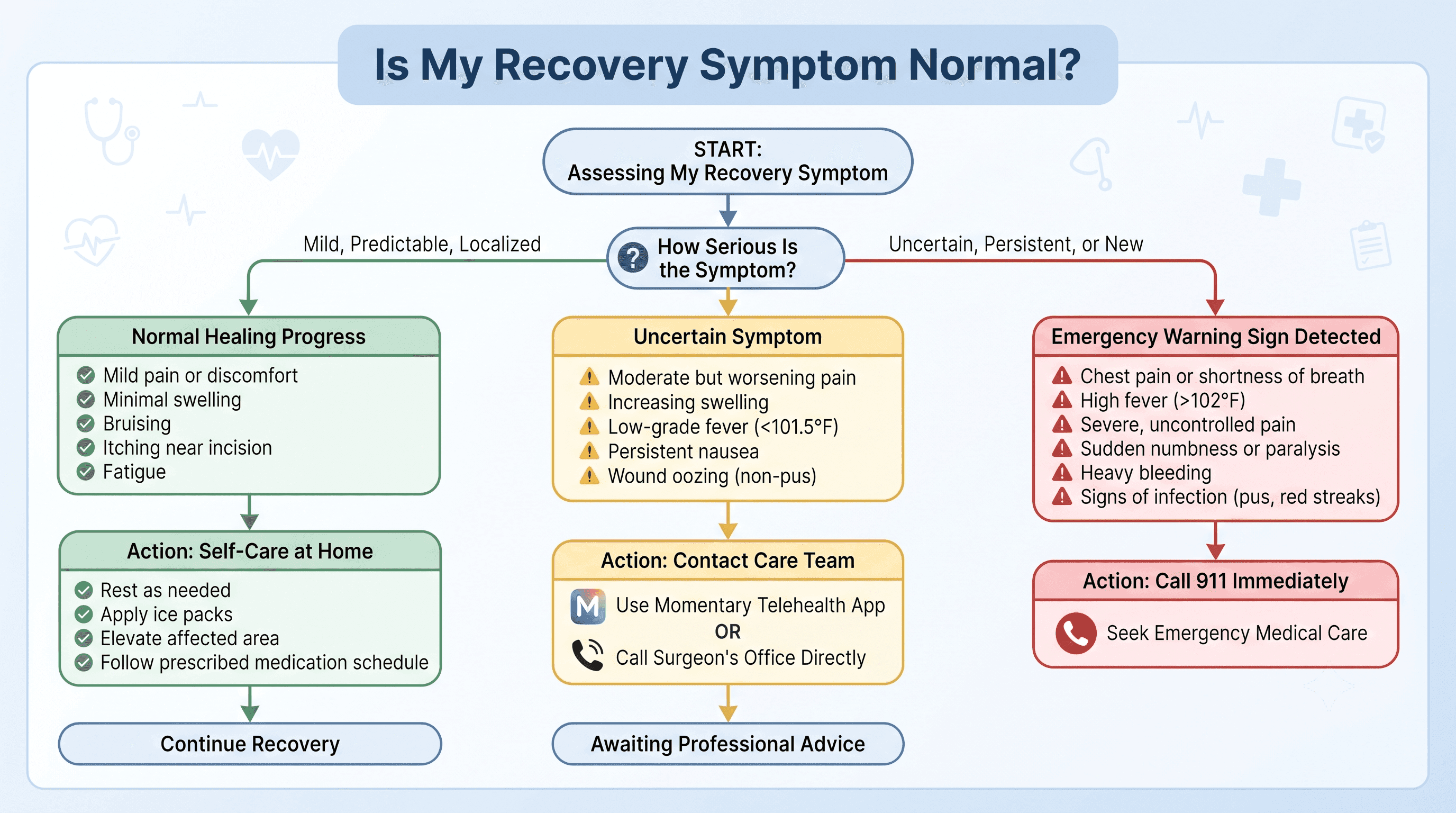
Recovery rarely follows a straight line. Swelling, pain, and fatigue can spike unexpectedly, and it's often unclear whether a change is expected or a warning sign.
People search for recovery apps because they want to:
- Track pain, swelling, medication, and physical therapy exercises in one place.
- Understand whether a new symptom, such as increased redness or a fever, is normal or concerning.
- Stay on schedule with prescribed exercises and follow-up appointments.
- Avoid unnecessary trips to urgent care or the emergency room, while still catching real complications early.
The right app depends on which of these problems matters most to you right now.
Ranked Recommendations
1. Force Therapeutics
Why it's included: Force Therapeutics is one of the most widely used digital care pathway platforms in orthopedic and surgical practices, guiding patients through pre-op and post-op recovery with prescribed exercise videos, education, and secure messaging with the care team.
Best for: Patients whose surgeon or hospital already uses the platform.
Strengths: Built around evidence-based care pathways designed with clinicians. Messaging directly with the surgical care team can reduce unnecessary phone calls and office visits.
Limitations: Not available to the general public. You can only use it if your provider has enrolled you, and access ends when your care pathway does.
Pricing: Free for patients when prescribed by a Force-enabled practice.
When to choose something else: If your surgeon doesn't offer Force Therapeutics, a self-pay tracking app or navigation tool is the practical alternative.
2. Hinge Health
Why it's included: Hinge Health pairs guided exercise therapy with human physical therapists and health coaches, and its HingeSelect network now coordinates pre-surgical evaluation, surgery referrals, and post-operative recovery for musculoskeletal conditions.
Best for: People with employer or health plan coverage who need structured physical therapy during recovery.
Strengths: Personalized exercise plans, real-time movement feedback, and direct messaging with a dedicated physical therapist, all at no direct cost to covered members.
Limitations: There is currently no public self-pay plan. Access depends entirely on whether your employer or insurer offers it as a benefit.
Pricing: Free to eligible members; not available for individual purchase.
When to choose something else: If you're not covered through work or insurance, look at CareClinic for tracking or ask your surgeon about in-clinic physical therapy instead.
3. Momentary
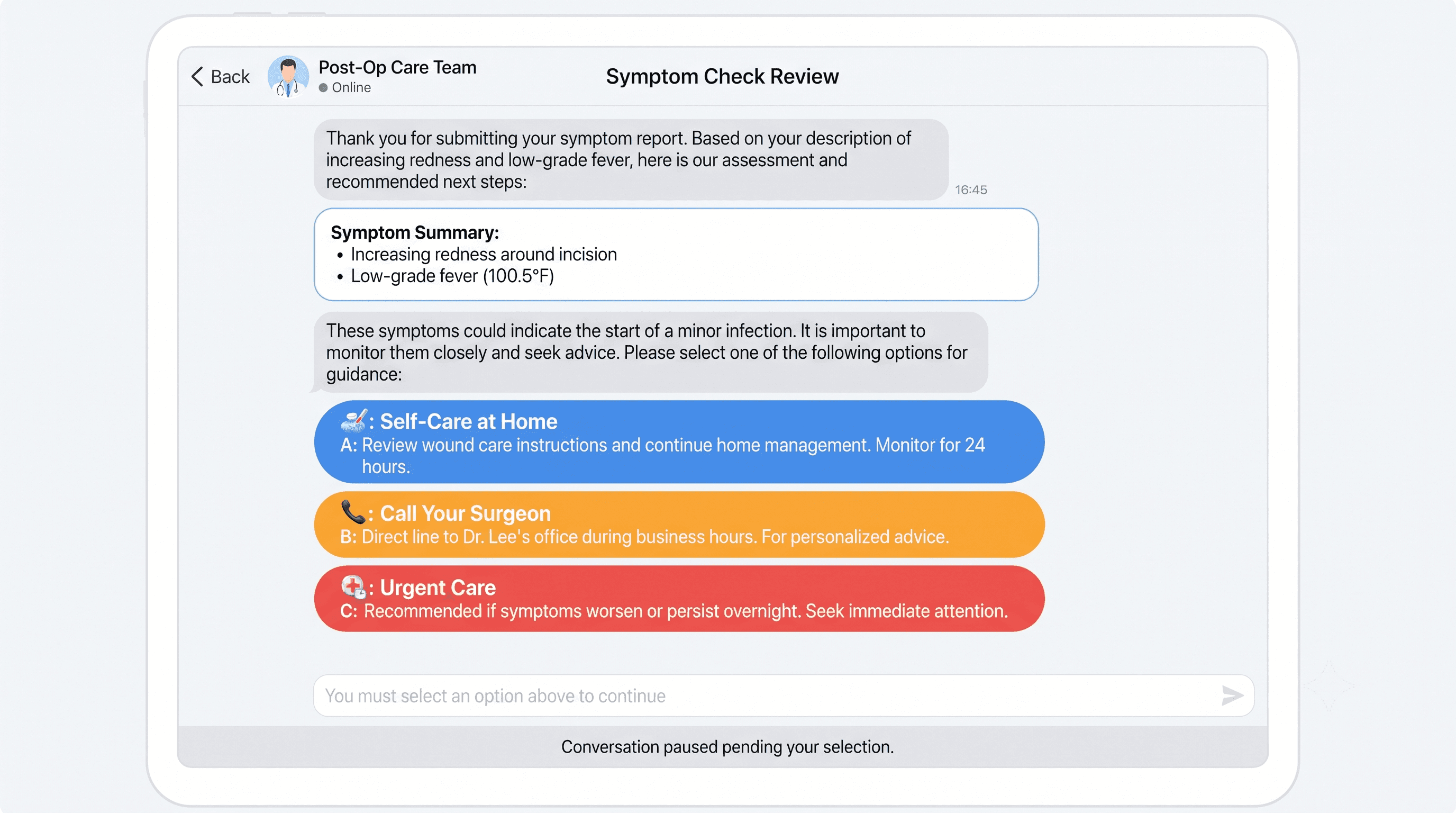
Why it's included: A recurring problem during recovery is uncertainty: is this pain level normal, or should you call someone? Momentary is an AI-powered healthcare navigator with physician-reviewed guidance that helps people understand symptoms and figure out the appropriate next step, whether that's self-care, a call to the surgeon, telehealth, urgent care, or the emergency room.
Best for: Patients who are unsure whether a recovery symptom needs medical attention and want guidance before deciding where to go.
Strengths: Available nationwide with no referral required. Physician-reviewed guidance adds a layer of clinical oversight beyond a basic symptom checker. Helps compare costs across care options, which matters for anyone weighing an unplanned urgent care or ER visit.
Limitations: Momentary does not diagnose conditions, treat surgical complications, or replace your surgeon's post-op instructions. Direct physician services are currently available only in California; the AI navigator itself is available nationwide.
Pricing: $19.99 per month.
When to choose something else: For symptoms that clearly indicate an emergency, such as heavy bleeding, difficulty breathing, chest pain, or signs of a serious infection, call 911 or go to the nearest emergency room immediately rather than using any app.
4. Kaia Health
Why it's included: Kaia Health delivers exercise therapy for musculoskeletal pain, including presurgical and postsurgical conditions, with programs developed by an in-house team of physical therapists and support from human health coaches.
Best for: Members whose health plan or employer already offers Kaia as a covered benefit.
Strengths: Short daily sessions, condition-specific programs for joints commonly involved in surgery such as the hip and knee, and ongoing coach support.
Limitations: Kaia is not currently available on a self-pay basis and is only accessible in select countries, so eligibility must be verified through an employer or insurance plan before you can create an account.
Pricing: Free to eligible members; no individual subscription option.
When to choose something else: If you can't verify coverage, a self-pay tracker or your in-person physical therapist is the more reliable path.
5. PeerWell (Bardavon Health Innovations)
Why it's included: PeerWell's PreHab and ReHab programs prepare patients for joint replacement and other major surgeries, delivering daily checklists covering nutrition, exercise, and home preparation before and after the procedure.
Best for: Patients scheduled for joint replacement or similar orthopedic surgery through a hospital, surgeon, or workers' compensation program that partners with the platform.
Strengths: Research cited by the company has associated the program with shorter hospital stays and higher rates of patients discharging directly home rather than to a nursing facility.
Limitations: PeerWell was acquired by Bardavon Health Innovations in 2022, and access today runs through healthcare and workers' compensation partners rather than a public app store listing for individual signup. Publicly listed self-pay pricing is not available: Information not publicly available.
Pricing: Provided through partner organizations; direct consumer pricing is not publicly listed.
When to choose something else: If your surgical team doesn't partner with PeerWell, ask about Force Therapeutics or a general tracking app instead.
6. CareClinic
Why it's included: For anyone who wants a recovery tracker they can download today without waiting on a referral or benefit eligibility check, CareClinic offers symptom, medication, and pain logging with charts that can be shared with your care team.
Best for: Self-directed tracking of pain, medication adherence, and recovery patterns, independent of any specific surgeon or employer.
Strengths: Immediate self-pay access, a free core tier for basic logging, and reports that can be exported for follow-up appointments.
Limitations: Several core organizational features, such as unlimited editing and detailed analytics, sit behind a paid subscription. It is a tracking tool, not a source of medical guidance, so it does not tell you whether a symptom is dangerous.
Pricing: Free version available; premium plans add advanced analytics and unlimited history editing.
When to choose something else: If your main need is understanding whether a symptom is serious rather than logging it, pair CareClinic with a navigation tool like Momentary.
Who Should Choose Each Option
- Prescribed by your surgeon: Use Force Therapeutics or PeerWell if offered. These are built for your exact procedure and connect you directly to your care team.
- Covered through work or insurance: Check Hinge Health or Kaia Health before paying for anything else, since both are typically free when eligible.
- Want to track recovery yourself, starting today: CareClinic works without a referral or coverage check.
- Unsure if a symptom is normal or needs care: Momentary is designed specifically for this decision and is available nationwide for $19.99 per month.
Pros and Cons Summary
Force Therapeutics Pros: clinician-built pathways, direct care team messaging. Cons: access requires enrollment through your provider.
Hinge Health Pros: free when covered, real human PT support. Cons: no self-pay option currently available.
Momentary Pros: nationwide access, physician-reviewed guidance, cost comparison support. Cons: does not diagnose or treat; physician services limited to California.
Kaia Health Pros: short daily sessions, coach access. Cons: benefit-based access only, limited country availability.
PeerWell Pros: strong outcomes data for joint replacement prep. Cons: consumer access and pricing are not publicly available.
CareClinic Pros: free core version, immediate self-pay access. Cons: many features require a paid plan; tracking only, no clinical guidance.
FAQ
Is there a free app to track recovery after surgery? Yes. CareClinic offers a free tier for logging symptoms, medications, and pain levels. Force Therapeutics, Hinge Health, and Kaia Health are also free, but only if your surgeon, employer, or health plan has enrolled you.
Can an app tell me if my surgical wound is infected? No app should be used to diagnose an infection. If you notice increasing redness, warmth, swelling, drainage, fever, or worsening pain, contact your surgeon promptly, and seek emergency care if you also have a high fever, spreading redness, or feel seriously unwell.
What should I do if I'm not sure whether my symptoms after surgery are normal? A physician-reviewed healthcare navigator such as Momentary can help you understand your symptoms and decide whether self-care, a call to your surgeon, telehealth, urgent care, or the emergency room is the appropriate next step. If you think you may be experiencing a medical emergency, call 911 or go to the nearest emergency room immediately.
Is Hinge Health available if I pay out of pocket? Not currently. Hinge Health is offered as a benefit through employers and health plans, and there is no public self-pay plan listed at this time.
How much does Momentary cost? Momentary costs $19.99 per month. The AI healthcare navigator is available nationwide; direct physician services are currently available only in California.
Does PeerWell still exist? Yes, but it operates under Bardavon Health Innovations after a 2022 acquisition, and access is provided through hospitals, surgeons, or workers' compensation programs rather than direct consumer download.
Can these apps replace my surgeon's post-op instructions? No. Every app in this guide is designed to support recovery, not replace your surgeon's specific instructions or emergency care. Always follow your surgical team's discharge guidance first.


