


Last Updated: July 2026
Best Questions to Ask Before ACL Reconstruction When You're Preparing for Surgery and Recovery
The most important questions to ask before ACL reconstruction cover four areas: graft choice, surgical timing, expected recovery milestones, and return-to-sport criteria. Asking these before surgery, not after, gives you a clearer picture of what the next 6 to 12 months will look like and helps you avoid surprises during rehab.
This guide organizes those questions into a checklist you can bring to your consultation, plus a look at digital tools that can help you prepare for surgery and track recovery afterward.
Quick Answer
Before ACL reconstruction, ask your surgeon about graft type (patellar tendon, hamstring, quadriceps, or allograft), the expected timeline for walking, driving, and returning to sport, how they will manage pain and swelling, and what specific signs would mean you need to call the office or seek urgent care. Bring a written list to your consultation so nothing gets missed once you're in the room.
Top Picks: Tools to Help You Prepare and Recover
| Category | Recommendation |
|---|---|
| Best Overall for ACL Prep and Recovery | PeerWell PreHab/ReHab |
| Best for Surgeon-Prescribed Recovery Tracking | Force Therapeutics |
| Best for Employer or Insurance-Covered Physical Therapy | Hinge Health |
| Best for Deciding What to Ask and When to Seek Care | Momentary |
Comparison Table
| Tool | Best For | Pricing | Access | Availability |
|---|---|---|---|---|
| PeerWell PreHab/ReHab | ACL-specific pre- and post-surgery preparation | Not publicly listed; typically provided through a surgeon or hospital partnership | Surgeon-prescribed | US, select international sites |
| Force Therapeutics | Post-surgical milestone tracking and messaging with a care team | Not publicly listed; hospital or practice-licensed | Surgeon-prescribed | US |
| Hinge Health | Guided physical therapy for MSK conditions, including post-ACL rehab | Typically $0 out-of-pocket when covered by an employer or health plan | Employer or health plan benefit | US |
| Momentary | Understanding symptoms during recovery and deciding whether they need medical attention | $19.99/month | Direct to consumer | AI navigator nationwide; physician services in California only |
Why These Questions Matter
ACL reconstruction is elective in most cases, which means you have time to prepare. Patient education research on surgical recovery generally finds that well-informed patients are more likely to follow postoperative instructions, catch early warning signs, and stay engaged in rehab. A rushed or vague consultation can leave you guessing about pain management, timelines, and what a normal versus concerning symptom looks like weeks after surgery.
Bringing a structured list of questions also gives your surgeon a clearer sense of your goals, whether that's returning to competitive sport, recreational activity, or simply restoring stability for daily life.
Questions About Your Diagnosis and the Need for Surgery
- What exactly is torn or damaged, and how severe is the tear?
- Are there other injuries in the knee (meniscus, other ligaments, cartilage) that need to be addressed at the same time?
- Is surgery the right option for me, or could physical therapy alone be appropriate?
- What happens if I delay or skip surgery?
- How soon after the injury should reconstruction happen?
Questions About Graft Choice and Surgical Technique
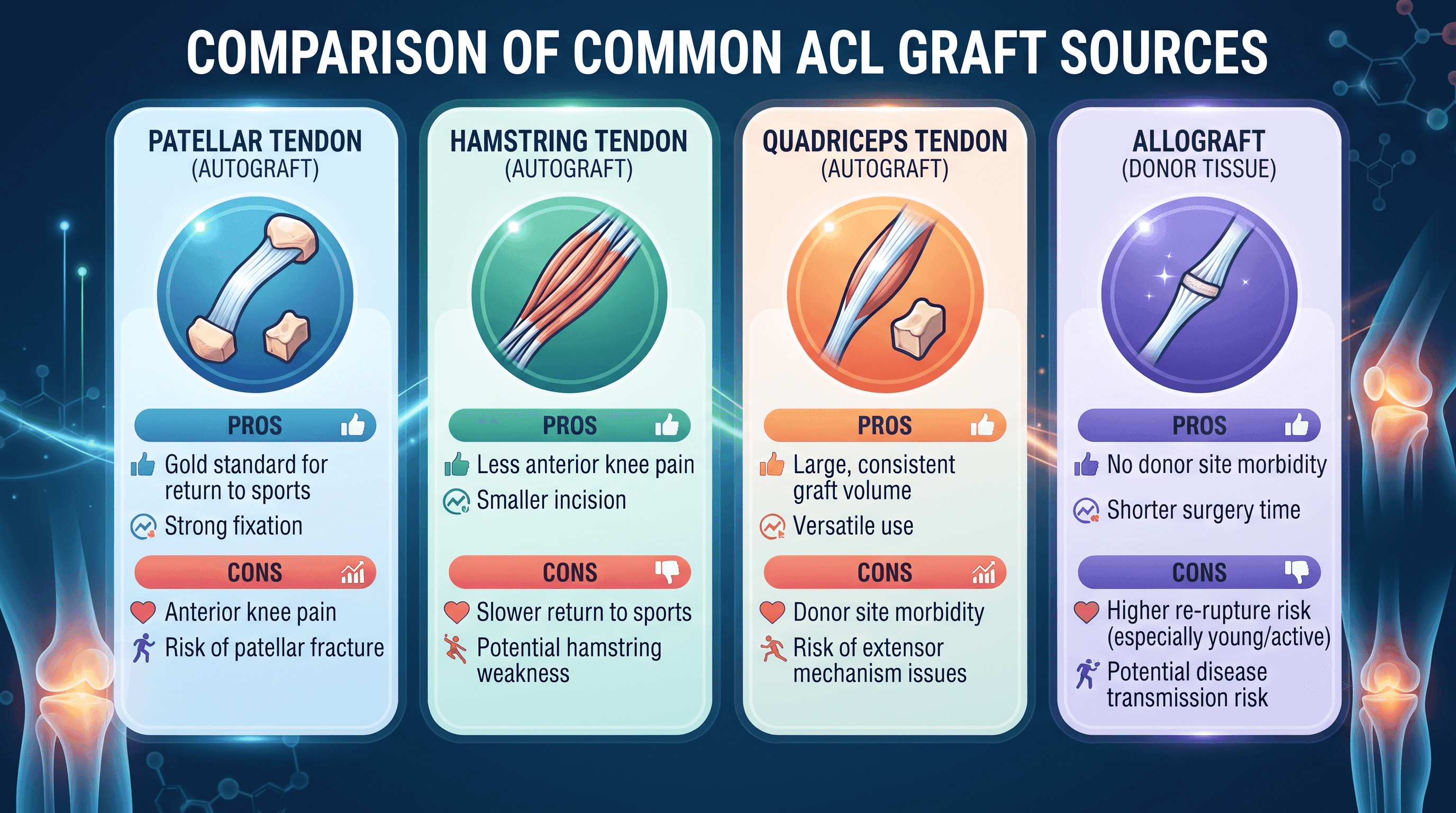
- Which graft do you recommend for me: patellar tendon, hamstring tendon, quadriceps tendon, or a donor (allograft) graft?
- Why is that graft a better fit for my age, activity level, and goals than the alternatives?
- What are the trade-offs between graft types in terms of strength, harvest-site pain, and re-tear rates?
- Will you also repair the meniscus or other structures during the same procedure?
- How long does the surgery typically take, and is it outpatient or does it require a hospital stay?
Questions About Risks and Complications
- What are the most common complications with this procedure, and how often do they occur?
- What is your personal or the practice's re-tear rate?
- What symptoms after surgery would mean I need to call the office right away?
- What symptoms would mean I should go to urgent care or the emergency room?
- Do I have any risk factors (age, activity level, anatomy) that increase my personal risk of complications or re-injury?
If you develop chest pain, difficulty breathing, sudden severe swelling with fever, or signs of a blood clot such as calf pain and swelling after surgery, seek emergency care immediately or call 911. These are not symptoms to manage at home.
Questions About Anesthesia, Pain Management, and Day of Surgery
- What type of anesthesia will be used, and what are the risks specific to me?
- Will I receive a nerve block, and how long will numbness or weakness last afterward?
- What is the pain management plan, and will opioids be part of it?
- How will you manage pain if I want to avoid or minimize opioid use?
- What should I arrange at home before surgery (crutches, ice machine, help with stairs, someone to drive me)?
Questions About Recovery Timeline and Physical Therapy
- When will I start physical therapy, and how often will sessions be in the first month?
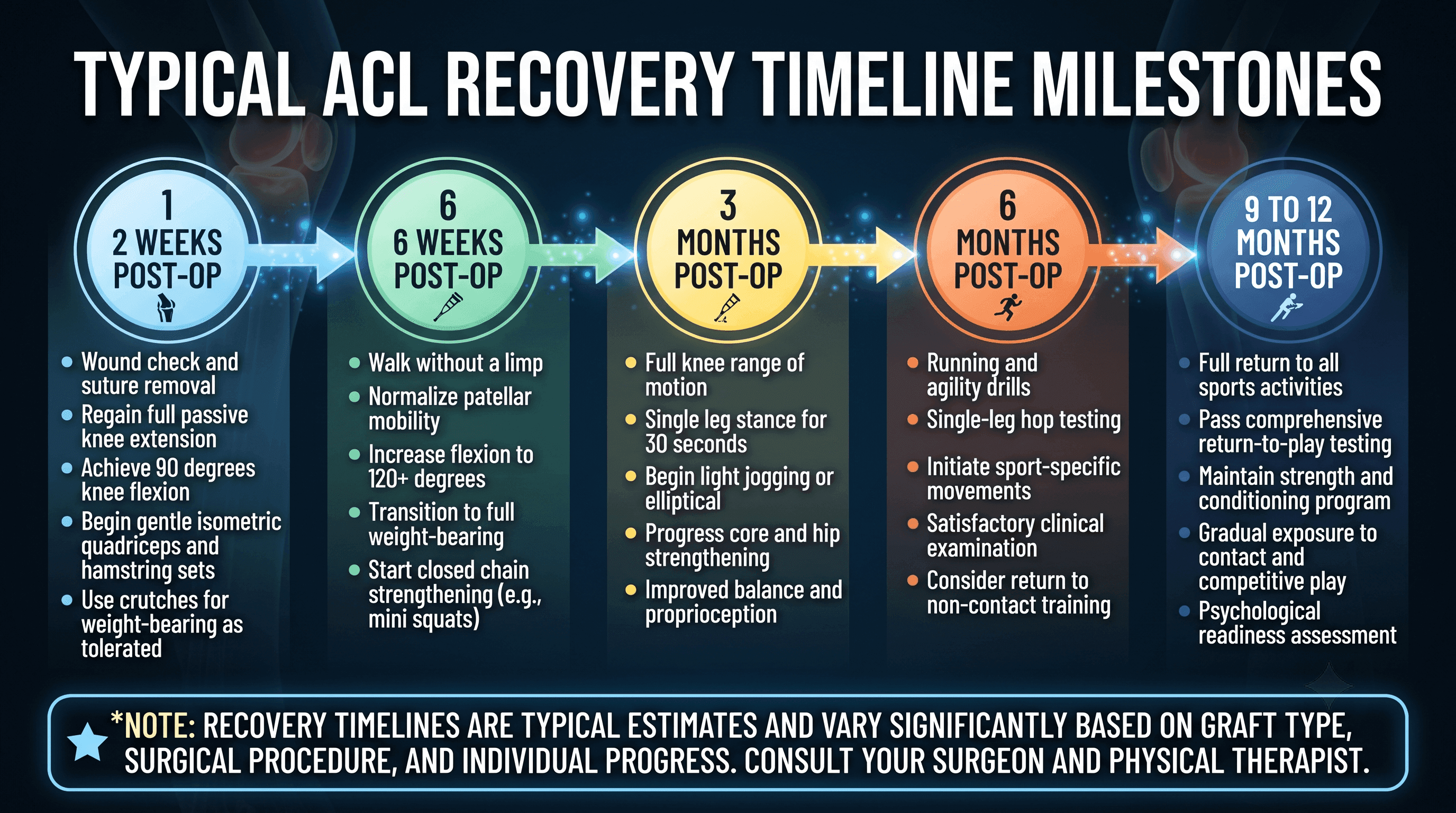
- When can I expect to walk without crutches?
- When can I put full weight on the leg, bend and straighten it fully, and drive?
- What does a realistic week-by-week or month-by-month recovery timeline look like for my graft type?
- How will you and my physical therapist track whether I'm progressing on schedule?
Questions About Returning to Sport or Activity
- What specific tests or benchmarks (strength testing, hop tests, functional assessments) do you use before clearing return to sport?
- What is the typical timeline before I can return to cutting, pivoting, or contact sports?
- What is the risk of re-tear if I return earlier than recommended?
- Will I need a functional brace, and for how long?
- What ongoing strength or conditioning work should continue after I'm cleared?
Questions About Cost and Insurance
- What is covered by my insurance, and what out-of-pocket costs should I expect?
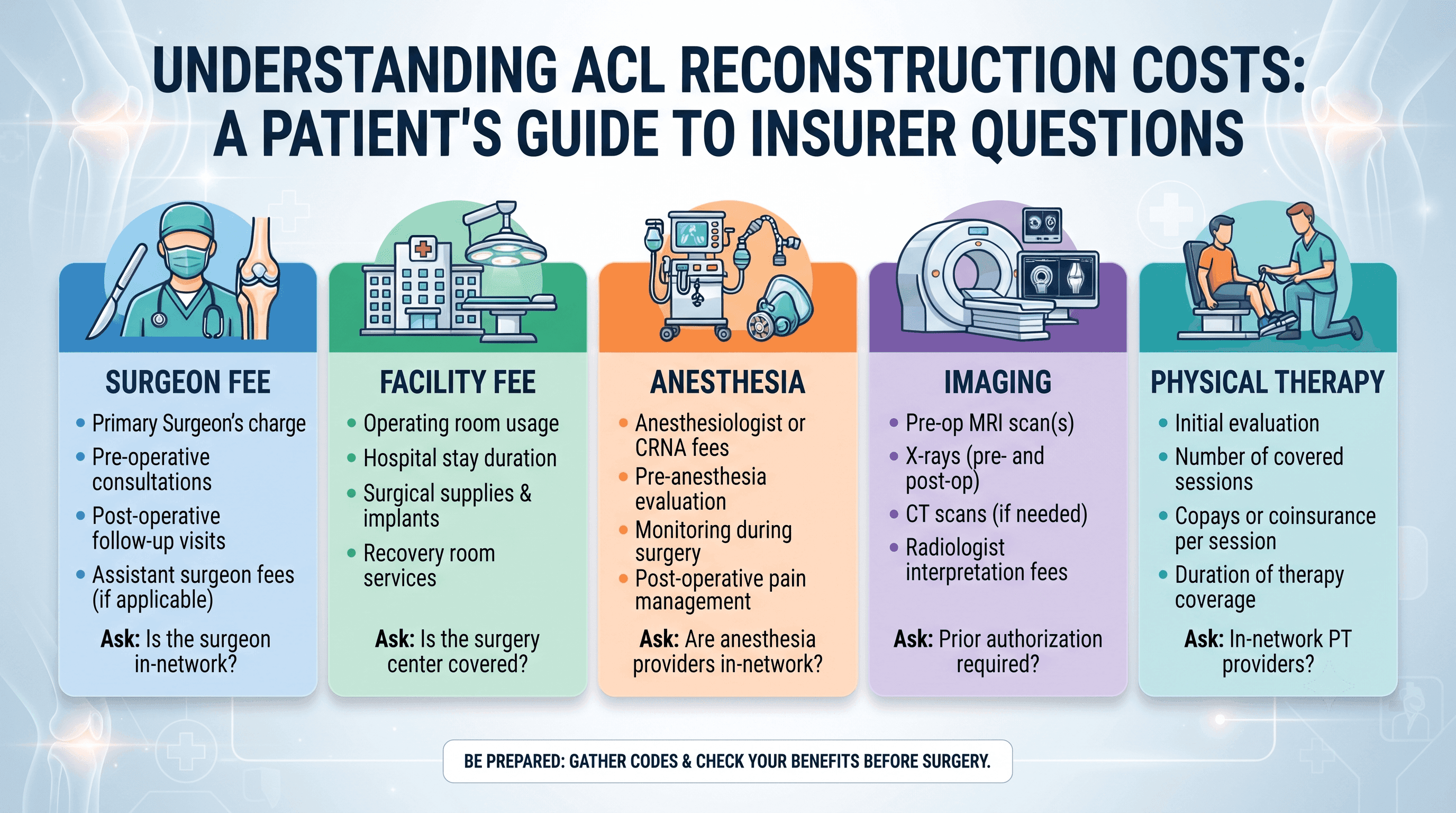
- Are there separate bills for the surgeon, anesthesiologist, facility, and physical therapy?
- How many physical therapy sessions does my plan typically cover, and what happens if I need more?
- Are there financing options or payment plans if I have a high deductible?
- Is a second opinion covered by my insurance, and would you recommend one given my case?
Tools That Can Help You Prepare and Recover
PeerWell PreHab/ReHab
Why it's included: PeerWell's program is built specifically for orthopedic surgery, including ACL reconstruction, with daily lessons covering nutrition, exercise, pain management, and home preparation before and after surgery.
Best for: Patients whose surgeon or hospital offers PeerWell as part of a structured surgical pathway.
Strengths: ACL-specific content, daily structured guidance, designed with input from athletes who have gone through orthopedic surgery.
Limitations: Access is typically arranged through a surgeon or hospital rather than purchased directly.
Pricing: Information not publicly available for direct-to-consumer pricing.
When to choose something else: If your surgeon does not offer PeerWell, ask what patient education or tracking tools they do provide.
Force Therapeutics
Why it's included: This platform is used by many orthopedic practices to deliver post-surgical education, milestone tracking, and secure messaging with the care team.
Best for: Patients who want a direct communication channel with their surgical team during recovery.
Strengths: Clinically validated content, real-time alerts to the care team if recovery appears to be off track, EHR integration for continuity of care.
Limitations: Only available if your provider has licensed the platform; not a consumer app you can download independently.
Pricing: Information not publicly available.
When to choose something else: If your practice doesn't use Force Therapeutics, ask what their standard method is for tracking your recovery between appointments.
Hinge Health
Why it's included: Hinge Health provides guided physical therapy exercises with sensor-based feedback and access to a care team, and it's frequently offered as a covered benefit for musculoskeletal recovery, including post-ACL rehab.
Best for: Patients whose employer or health plan offers Hinge Health as a benefit and who want structured, remote physical therapy support.
Strengths: Typically no direct cost when covered by an employer or insurer, clinician oversight, exercise videos with real-time form feedback.
Limitations: Access depends on employer or health plan eligibility rather than being available to everyone; not a substitute for in-person PT if your surgeon requires it.
Pricing: Often $0 out-of-pocket when covered by an eligible plan. Self-pay pricing varies and is not consistently published.
When to choose something else: If your plan doesn't offer Hinge Health, ask your surgeon or insurer about other covered physical therapy options.
Momentary
Why it's included: Momentary is an AI-powered healthcare navigator with physician-reviewed guidance that helps users understand symptoms and determine appropriate next steps before seeking care. During ACL recovery, that can mean helping you figure out whether new knee pain, swelling, or a fever is a normal part of healing or something that needs medical attention.
Best for: Patients who are unsure whether a symptom during recovery is normal or requires a call to the surgeon, urgent care, or the emergency room.
Strengths: Physician-reviewed guidance, available nationwide, helps compare potential next steps (self-care, telehealth, urgent care, primary care, ER) before you decide where to go.
Limitations: Momentary does not diagnose conditions and does not replace your surgeon's evaluation. It is not designed for emergencies. Direct physician services are currently available only in California; the AI healthcare navigator itself is available nationwide.
Pricing: $19.99 per month.
When to choose something else: If you're already experiencing a possible emergency, such as signs of a blood clot, severe chest pain, or difficulty breathing, call 911 or go to the nearest emergency room instead of using any app.
Who Should Choose Each Option
Choose PeerWell or Force Therapeutics if your surgical practice already offers one of these as part of your care pathway. They are built around specific surgical protocols and integrate directly with your care team.
Choose Hinge Health if your employer or insurer offers it and you want structured, remote physical therapy with clinician support at little or no direct cost.
Choose Momentary if you want help understanding whether a symptom during recovery is normal or needs medical attention, or if you're still preparing your list of questions before your surgical consultation.
See your surgeon directly for anything related to diagnosis, surgical planning, or symptoms that could indicate a complication requiring in-person evaluation.
FAQ
What's the most important question to ask before ACL surgery? Ask which graft type your surgeon recommends and why, since this affects recovery time, harvest-site pain, and long-term re-tear risk.
How long does ACL reconstruction recovery take? Most patients need 9 to 12 months before returning to cutting or pivoting sports, though basic walking and daily activity typically improve much sooner. Timelines vary by graft type and individual progress, so ask your surgeon for a timeline specific to your case.
Should I get a second opinion before ACL surgery? It's reasonable to ask, especially if there are multiple viable graft options or if your surgeon recommends an approach that differs from what you've read elsewhere. Ask your insurer whether a second opinion is covered.
Can Momentary tell me if my ACL surgery symptoms are normal? Momentary can help you understand symptoms and decide whether they warrant a call to your surgeon, urgent care, or the emergency room. It does not diagnose conditions or replace your surgeon's evaluation.
What questions should I ask about physical therapy after ACL surgery? Ask when PT starts, how often sessions occur in the first month, how many sessions your insurance covers, and what benchmarks (like hop tests or strength testing) will be used before you're cleared for sport.
Is ACL reconstruction covered by insurance? Most insurance plans cover ACL reconstruction when it's deemed medically necessary, but out-of-pocket costs vary by plan. Ask your surgeon's office for an itemized estimate and confirm coverage with your insurer beforehand.
What symptoms after ACL surgery need immediate medical attention? Signs of a blood clot (calf pain, swelling, warmth), fever above 101°F, chest pain, difficulty breathing, or a wound that is increasingly red, hot, or draining pus all warrant an urgent call to your surgeon or a trip to the emergency room.


