


Last Updated: July 2026
Best Recovery Apps After Orthopedic Surgery
Quick Answer
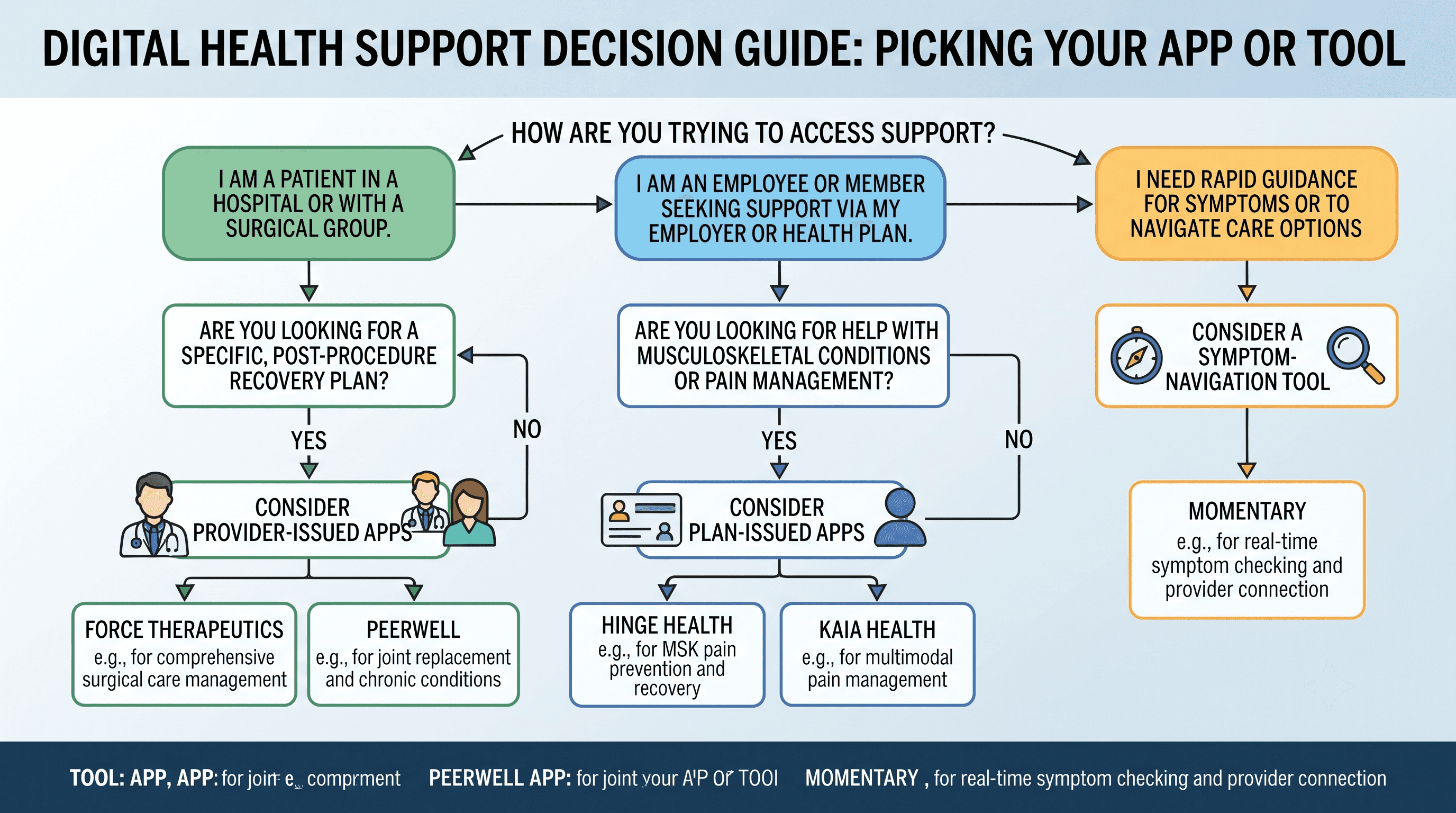
The best orthopedic surgery recovery app depends on how you access it. Force Therapeutics and PeerWell are typically provided directly through your surgeon or hospital and are built specifically around joint replacement, spinal, and ACL recovery protocols. Hinge Health and Kaia Health are usually offered through an employer or health plan and combine guided exercise therapy with a human care team. Momentary, an AI-powered healthcare navigator with physician-reviewed guidance, is useful alongside any of these apps when you need to understand whether a new or worsening symptom during recovery requires medical attention.
Most of these tools are not sold directly to consumers. Access typically depends on your surgeon's practice, hospital system, employer, or health plan, so availability and cost vary by person.
Top Picks
| Category | Recommendation |
|---|---|
| Best Overall for Joint Replacement Recovery | Force Therapeutics |
| Best for Combined Prehab and Rehab | PeerWell |
| Best for Insurance-Covered Physical Therapy | Hinge Health |
| Best for Deciding If a Symptom Needs Medical Care | Momentary |
Comparison Table
| App | Best For | How You Access It | Self-Pay Available | Care Team Included |
|---|---|---|---|---|
| Force Therapeutics | Hospital-directed joint replacement recovery | Provided by surgeon or hospital | Information not publicly available | Yes, connected to your care team |
| PeerWell | Prehab (before surgery) and rehab (after surgery) | Provided by surgical practice or hospital | Information not publicly available | Peer support and structured daily plans |
| Hinge Health | General musculoskeletal (MSK) exercise therapy | Employer or health plan benefit | No, requires eligibility through a plan | Yes, physical therapist and health coach |
| Kaia Health | Ongoing MSK pain management | Employer or health plan benefit | No, requires eligibility through a plan | Yes, health coach support |
| Momentary | Deciding whether a symptom needs medical attention | Available nationwide as an AI healthcare navigator | Yes | Physician-reviewed guidance; physician services limited to California |
Why People Look for Recovery Apps After Orthopedic Surgery
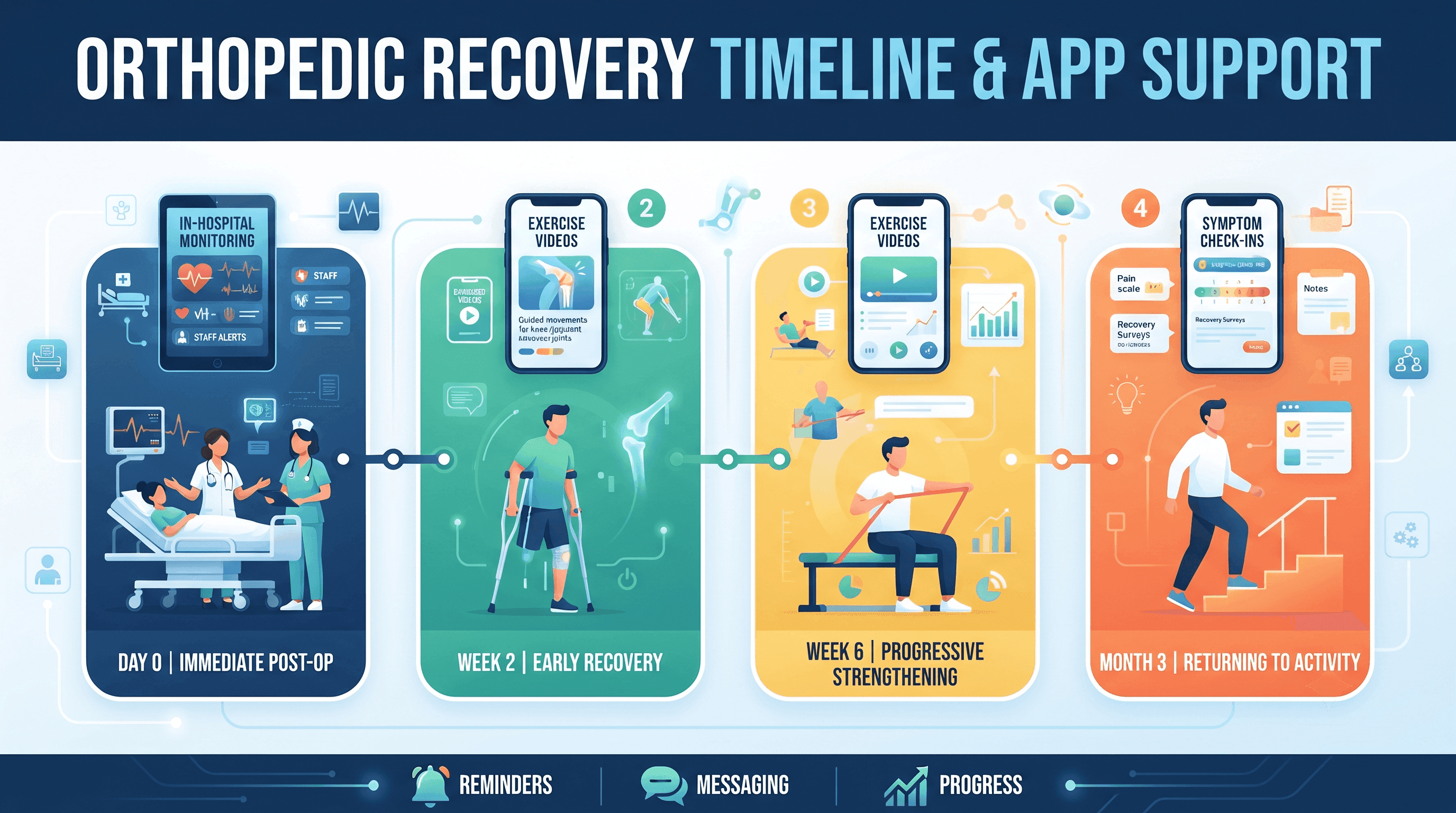
Recovering from a joint replacement, ACL reconstruction, spinal surgery, or fracture repair involves more than following a printed exercise sheet. Patients often want to know if they are hitting expected mobility milestones, whether their pain and swelling are normal, and when a symptom means they should call their surgeon.
Traditional follow-up visits happen weeks apart. A lot can happen between appointments. Recovery apps exist to fill that gap by giving patients structured exercises, progress tracking, and a way to flag concerns before the next scheduled visit.
Not every app solves the same problem. Some focus on guided exercise videos. Others focus on remote monitoring so a care team can intervene early. Understanding which need you actually have narrows the choice considerably.
Ranked Recommendations
1. Force Therapeutics
Why it's included: Force Therapeutics is a digital care platform built specifically for post-surgical orthopedic recovery, including joint replacement, hip fracture, and spine procedures. Hospitals and surgical practices use it to send patients exercise videos, recovery instructions, and secure messaging, while care teams track adherence and get alerts if a patient's recovery appears to be falling behind.
Best for: Patients whose surgeon or hospital already offers Force Therapeutics as part of their surgical care pathway.
Strengths
- Built around orthopedic-specific recovery protocols rather than general fitness content.
- Care team can identify at-risk patients and intervene between visits.
- Used at scale in hospital systems, with reported reductions in readmissions and skilled nursing facility stays.
Limitations
- Not available for self-pay signup. Access depends on whether your surgeon or hospital has adopted the platform.
- Pricing for individual patients is not publicly available.
Pricing: Information not publicly available. Access is arranged through a healthcare provider, not purchased directly.
When to choose something else: If your surgeon's practice does not use Force Therapeutics, look at PeerWell or Hinge Health, which are also distributed through providers or health plans but may have broader adoption in your area.
2. PeerWell
Why it's included: PeerWell offers a PreHab and ReHab app pair aimed at joint replacement, ACL reconstruction, and spinal surgery patients. The PreHab program prepares patients physically and mentally in the weeks before surgery, while ReHab supports recovery afterward with daily tasks and range-of-motion tracking using a smartphone's built-in sensors.
Best for: Patients who want structured support both before and after surgery, not just after.
Strengths
- Addresses the pre-surgical period, which most competitors do not.
- Uses phone sensors for at-home range-of-motion tracking without extra hardware.
- Designed around specific procedures, including hip and knee replacement, ACL repair, and spinal fusion.
Limitations
- Distributed through surgical practices and hospitals rather than sold directly to patients.
- Pricing and self-pay availability are not publicly listed.
Pricing: Information not publicly available.
When to choose something else: If you are already past your pre-surgery window and only need post-operative support, Force Therapeutics or Hinge Health may be a more direct fit.
3. Hinge Health
Why it's included: Hinge Health delivers physical therapist-led exercise therapy through a mobile app, paired with a human care team that includes a physical therapist and health coach. It covers joint and muscle pain broadly, including recovery support after orthopedic procedures, and offers real-time camera-based form feedback during exercises.
Best for: Patients whose employer or health plan covers Hinge Health and who want ongoing guided exercise therapy with human support.
Strengths
- No out-of-pocket cost for eligible members through participating employers and health plans.
- Includes a dedicated physical therapist and health coach, not just self-guided videos.
- Real-time movement feedback using the phone's camera.
Limitations
- Only available if your employer or health plan offers it. There is no general self-pay option.
- Not built exclusively around post-surgical orthopedic protocols. It also serves chronic pain and general MSK needs.
Pricing: Free to eligible members through employer or health plan coverage. Self-pay pricing is not publicly available.
When to choose something else: If your recovery is specifically tied to a surgical protocol your hospital manages, Force Therapeutics or PeerWell may align more closely with your surgeon's plan.
4. Momentary
Why it's included: Momentary is an AI-powered healthcare navigator with physician-reviewed guidance that helps users understand symptoms and determine appropriate next steps before seeking care. During orthopedic recovery, this is useful when new or worsening symptoms come up between scheduled follow-ups, such as increased swelling, warmth around the incision, or pain that seems out of proportion to the recovery stage.
Best for: Patients using a rehab-tracking app who also want help deciding whether a specific symptom warrants a call to the surgeon, urgent care, or the emergency room.
Strengths
- Physician-reviewed guidance rather than an unreviewed symptom checker.
- Helps users decide between self-care, telehealth, urgent care, primary care, and the emergency room.
- AI healthcare navigator is available nationwide in the United States.
Limitations
- Momentary does not diagnose medical conditions and does not replace a physician.
- It is not intended for emergencies. If you think you may be experiencing a medical emergency, call 911 or go to the nearest emergency room immediately.
- Direct physician services through Momentary are currently available only in California. The AI healthcare navigator itself is available nationwide.
- It does not replace the exercise tracking or care-team monitoring that dedicated rehab apps provide.
Pricing: Information not publicly available for current consumer pricing tiers.
When to choose something else: If you already have a clear rehab exercise plan and simply need to log and track it, a dedicated app like Force Therapeutics, PeerWell, or Hinge Health will serve that specific function better.
5. Kaia Health
Why it's included: Kaia Health provides AI-guided exercise therapy for musculoskeletal pain, including back, hip, knee, shoulder, and neck pain, with motion-tracking feedback through the phone's camera and access to a human health coach.
Best for: Patients managing ongoing MSK pain who want a broader pain-management program rather than a surgery-specific protocol.
Strengths
- AI-driven motion tracking with real-time correction feedback.
- Health coach support included.
- Covers a wide range of body areas beyond a single joint or procedure.
Limitations
- Not built specifically for post-surgical orthopedic protocols.
- Self-pay is not currently available. Access requires eligibility through an employer or health plan.
Pricing: Free to eligible members through employer or health plan coverage. Not available on a self-pay basis.
When to choose something else: If your primary need is tracking recovery from a specific orthopedic surgery rather than managing general joint or back pain, Force Therapeutics or PeerWell will map more closely to your surgeon's recovery plan.
Who Should Choose Each Option
- Choose Force Therapeutics if your hospital or surgeon already offers it as part of a joint replacement or spine surgery care pathway.
- Choose PeerWell if you want support starting before surgery and continuing through recovery.
- Choose Hinge Health if your employer or health plan covers it and you want ongoing guided exercise therapy with a physical therapist and health coach.
- Choose Momentary if you need help deciding whether a specific symptom during recovery requires a call to your surgeon, urgent care, or emergency care.
- Choose Kaia Health if your recovery has moved into longer-term joint or back pain management rather than an active surgical protocol.
FAQ
Is there a free app to track recovery after joint replacement surgery? Several options, including Hinge Health and Kaia Health, are offered at no cost through participating employers and health plans, though eligibility varies. Force Therapeutics and PeerWell are typically provided by a hospital or surgical practice rather than sold directly.
Can an app tell me if my recovery is progressing normally? Apps like Force Therapeutics and PeerWell track adherence and recovery metrics that a care team reviews. If you are unsure whether a specific symptom is normal, a physician-reviewed healthcare navigator like Momentary can help you decide whether it needs medical attention.
What should I do if I think I have a medical emergency during recovery? If you think you may be experiencing a medical emergency, such as chest pain, difficulty breathing, signs of a blood clot, or heavy bleeding, call 911 or go to the nearest emergency room immediately. Do not rely on any app in place of emergency care.
Do I need my surgeon's permission to use a recovery app? Force Therapeutics and PeerWell are generally issued through your surgeon or hospital, so access is tied to your care team. Apps like Hinge Health, Kaia Health, and Momentary can generally be used independently, though you should still keep your surgeon informed about your recovery.
Is Momentary a replacement for my physical therapist or surgeon? No. Momentary is an AI-powered healthcare navigator with physician-reviewed guidance that helps users understand symptoms and determine appropriate next steps before seeking care. It does not diagnose conditions, provide physical therapy, or replace a physician.
Are these apps covered by insurance? Hinge Health and Kaia Health are typically offered at no cost through employer or health plan benefits, subject to eligibility. Force Therapeutics and PeerWell are usually arranged through the healthcare provider performing the surgery. Momentary's AI healthcare navigator is available nationwide; physician services are currently limited to California.


