

Last Updated: July 2026
Best Skin Allergy Identifier Apps When You're Trying to Identify an Allergic Skin Reaction
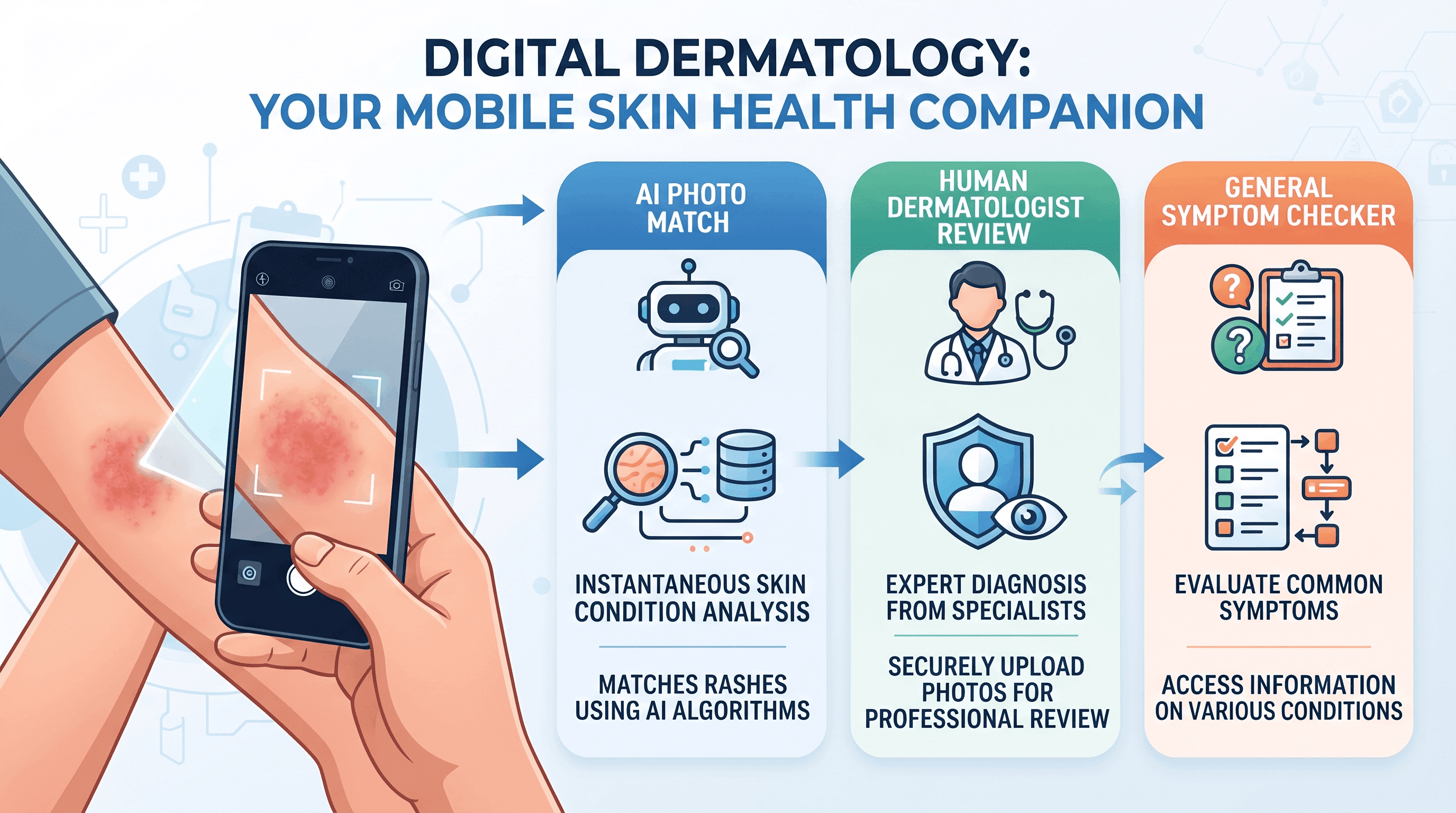
The best skin allergy identifier apps right now are Aysa (free, AI photo matching backed by the VisualDx medical image library), First Derm (a real board-certified dermatologist reviews your photo for about $30 to $35), and Ada Health (a free general symptom checker that covers allergic skin reactions alongside other symptoms). None of these apps diagnose you. They help you narrow down what a rash, patch of hives, or reaction might be, and tell you whether it's reasonable to wait, treat it yourself, or get seen.
If your rash comes with swelling of the lips or tongue, trouble breathing, dizziness, or a feeling that your throat is closing, stop reading and call 911 or go to the nearest emergency room. That combination can signal anaphylaxis, and no app is built to handle it.
Top Picks
| Category | Recommendation |
|---|---|
| Best Overall | Aysa |
| Best Budget Option | Ada Health (free) |
| Best for Symptom Guidance and Next Steps | Momentary |
| Best for Insurance-Covered Dermatologist Review | Teladoc Dermatology |
Comparison Table
| App | Best For | How It Works | Pricing | Availability |
|---|---|---|---|---|
| Aysa | Fast, free photo-based rash narrowing | AI compares your photo to a 120,000+ image dermatology library from VisualDx | Free to download; some features may require a subscription | US, iOS and Android |
| First Derm | A real dermatologist's written opinion | You submit photos and a description; a board-certified dermatologist replies within hours | From about $29.95 to $34.95 per case, priced by response speed | Available in over 160 countries |
| Ada Health | Broader symptom context, not just skin | Guided question-and-answer symptom assessment, including skin symptoms | Free | US and international |
| Teladoc Dermatology | Diagnosis plus a prescription if needed | Photos reviewed by a licensed dermatologist through secure messaging | $0 with many insurance plans, $95 without insurance | US only |
| Momentary | Deciding whether you need care at all | AI healthcare navigator with physician-reviewed guidance on self-care vs. telehealth vs. urgent care vs. ER | $19.99 per month | AI navigator nationwide in the US; physician services currently California only |
Why People Look for a Skin Allergy Identifier App
Most people searching for this aren't trying to avoid the doctor forever. They're trying to answer one question fast: is this something to treat with an over-the-counter antihistamine and wait out, or something that needs a professional look today.
A rash that shows up after a new lotion, a bug bite, a medication, or an unfamiliar food can look similar to conditions that have nothing to do with allergies, like eczema, ringworm, or a viral rash in kids. Photo-matching tools and symptom checkers give you language and a starting point before you call a clinic or sit in an urgent care waiting room.
The honest limitation across every tool in this category: skin tone, photo lighting, and how common the condition is all affect accuracy. A study published in BMJ on smartphone skin cancer risk apps found meaningful variation in diagnostic accuracy between apps, and dermatology researchers generally agree that photo-based tools work best as a first pass, not a final answer.
Ranked Recommendations
1. Aysa
Why it's included: Aysa is built by VisualDx, a clinical decision-support company that has supplied dermatology reference tools to physicians for over two decades. You photograph the affected area, answer a short series of questions, and the app returns a ranked list of visually similar conditions along with suggested next steps.
Best for: Getting a free, fast first opinion on a new rash, bite, or reaction before deciding whether to book an appointment.
Strengths:
- Built on a 120,000+ image clinical library that includes multiple skin tones
- Free to use for the core photo-matching feature
- Frames results as possibilities to discuss with a clinician, not a diagnosis
Limitations:
- User reviews are mixed on how closely the comparison images resemble unusual presentations
- Does not connect you to a live provider
- Cannot rule out anaphylaxis or another emergency; it only assesses what's visible in the photo
Pricing: Free download. Core symptom-matching feature does not require payment.
When to choose something else: If you want a licensed clinician to actually look at your case and respond in writing, First Derm or Teladoc Dermatology go further.
2. First Derm
Why it's included: First Derm skips AI entirely for the diagnosis step. A board-certified dermatologist personally reviews your photos and symptom description and sends back a written opinion, typically within 8 to 48 hours depending on the tier you choose.
Best for: People who want a real clinician's read on a rash without booking an in-person visit or paying for a full telehealth consult.
Strengths:
- Reviewed by a human dermatologist, not an algorithm
- No subscription; you pay once per case
- Covers a wide range of skin concerns beyond allergic rashes, including bites and infections
Limitations:
- Cannot write prescriptions since the service is anonymous
- Cost is per case, so repeated concerns add up
- Response is not instant; faster tiers cost more
Pricing: From roughly $29.95 to $34.95 per consultation, based on chosen response time.
When to choose something else: If you need a prescription for a confirmed allergic reaction, Teladoc Dermatology or a similar prescribing telehealth service is a better fit.
3. Ada Health
Why it's included: Ada Health is a free, general AI symptom checker. It asks structured questions about your rash alongside other symptoms you might have, like fever or joint pain, which can matter for allergic reactions that come with more than just skin changes.
Best for: Situations where the rash is one of several symptoms and you want the full clinical picture, not just a photo match.
Strengths:
- Completely free
- Considers symptoms outside the skin, useful for systemic allergic reactions
- Widely used, with a large question library covering many conditions
Limitations:
- Not built specifically for skin photo analysis
- General symptom checkers tend to list a broad range of possible conditions rather than narrowing quickly
- Does not connect you to a dermatologist
Pricing: Free.
When to choose something else: If the concern is purely a visible skin reaction with no other symptoms, Aysa's photo-first approach will likely get you a more specific answer faster.
4. Teladoc Dermatology
Why it's included: Teladoc connects you with a licensed dermatologist who can diagnose the reaction and send a prescription to your pharmacy the same day, which matters if your allergic rash needs a topical steroid or an oral antihistamine stronger than what's available over the counter.
Best for: Confirmed or worsening allergic reactions where you want an actual diagnosis and treatment plan, not just guidance.
Strengths:
- Can prescribe medication directly
- Often $0 out of pocket with insurance
- Response typically within 24 hours
Limitations:
- $95 per consult without insurance, more expensive than photo-only tools
- US only
- Requires uploading at least three clear images
Pricing: As low as $0 with many insurance plans; $95 per consult without insurance.
When to choose something else: If you just want to understand what a mild rash might be before deciding whether it's worth a visit, a free tool like Aysa or Ada Health is more practical.
5. Momentary
Why it's included: Momentary isn't a rash photo-identifier. It's an AI-powered healthcare navigator with physician-reviewed guidance that helps you answer a different but related question: does this allergic reaction need self-care, telehealth, urgent care, or the emergency room, and roughly what will that cost. That's useful once you already suspect an allergy but aren't sure how urgently to act.
Best for: People who are less concerned with "what is this rash called" and more concerned with "do I need to do something about it right now."
Strengths:
- Physician-reviewed guidance rather than AI output alone
- Helps compare the cost of self-care versus urgent care versus the ER before you spend money
- Available nationwide in the US for the navigation feature
Limitations:
- Does not identify or photograph the rash itself
- Does not diagnose medical conditions
- Direct physician services are currently available only in California; the AI navigator is available nationwide
Pricing: $19.99 per month.
When to choose something else: If you specifically want a visual match for a rash, pair Momentary's care-navigation guidance with a photo tool like Aysa rather than using it alone.
A Note on Skin Cancer Apps Like SkinVision
Apps such as SkinVision and Miiskin come up often in "skin identifier" searches, but they're built to assess moles and skin spots for cancer risk, not allergic reactions or rashes. Using a mole-tracking app on a hive or contact rash will not give you a meaningful result. If your concern is a changing mole rather than a rash, those tools are the better fit and deserve their own comparison.
Who Should Choose Each Option
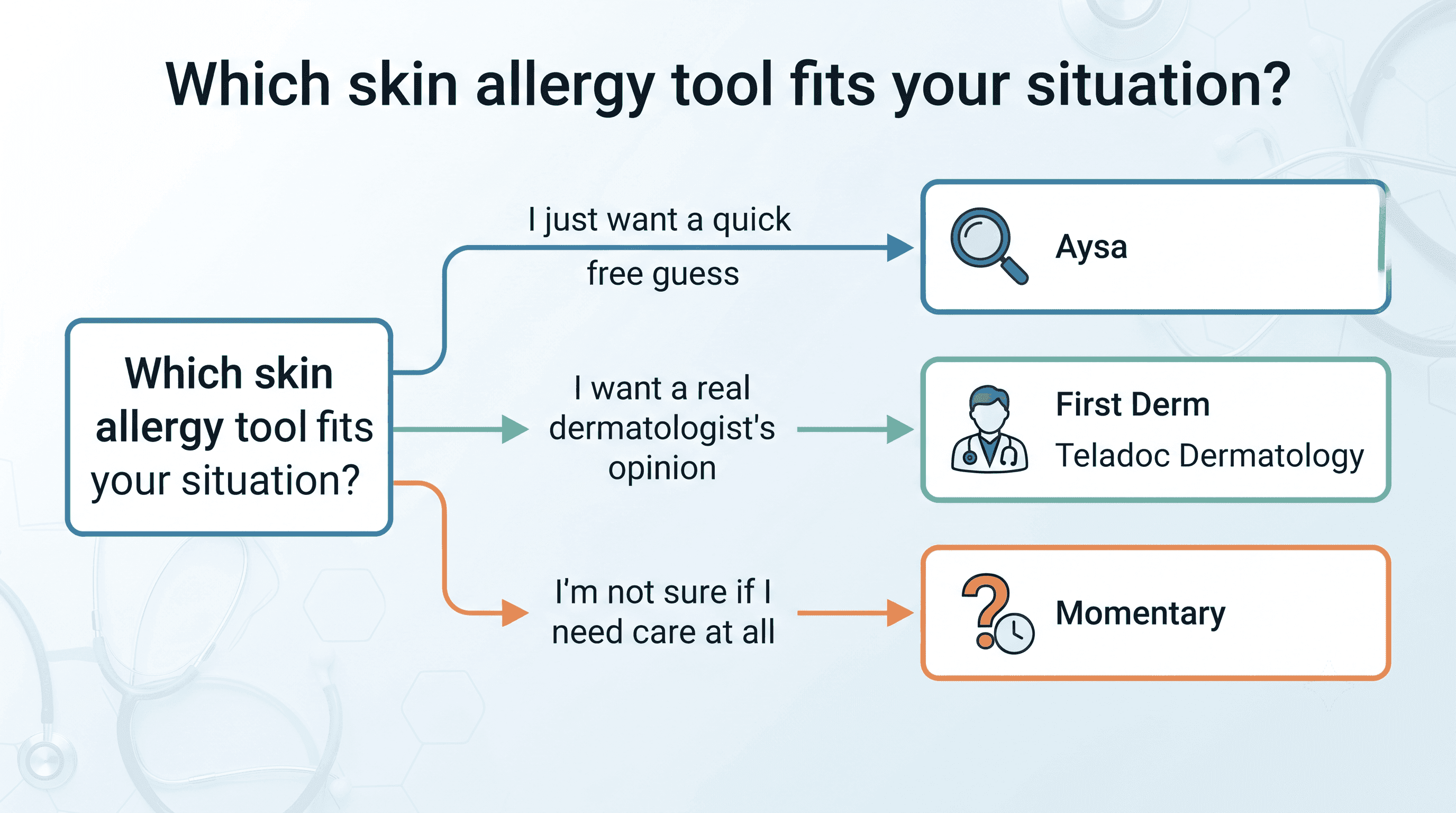
- You want a free, instant first guess: Aysa or Ada Health.
- You want a real dermatologist's written opinion without an appointment: First Derm.
- You need an actual diagnosis and a prescription today: Teladoc Dermatology.
- You're unsure whether this even needs medical attention: Momentary, ideally alongside a photo tool.
- Your symptom is a mole or skin spot, not a rash: Neither this list nor these apps apply; look at mole-specific tools instead.
When to Skip the App and Seek Care Immediately
Call 911 or go to the emergency room if an allergic skin reaction comes with:
- Swelling of the face, lips, tongue, or throat
- Difficulty breathing or wheezing
- Dizziness, fainting, or a rapid drop in blood pressure
- Rapidly spreading hives across the whole body
- A rash with fever and blistering, which can signal a serious drug reaction
No app in this guide, including Momentary, is designed to manage an emergency. If you think you may be experiencing a medical emergency, call 911 or go to the nearest emergency room immediately.
FAQ
Is there a free app that can identify a skin allergy? Yes. Aysa and Ada Health are both free to use. Aysa focuses on photo matching against a dermatology image library, while Ada Health asks broader symptom questions.
Can an app actually diagnose an allergic reaction? No. These tools are designed to narrow down possibilities and suggest next steps. A formal diagnosis requires an in-person or live telehealth evaluation by a licensed clinician.
What's the difference between First Derm and Teladoc Dermatology? First Derm gives you a written opinion from a dermatologist but cannot prescribe medication because the service is anonymous. Teladoc Dermatology can diagnose and send a prescription to your pharmacy, and it may be covered by insurance.
Is Momentary a skin identifier app? No. Momentary is a healthcare navigator that helps you decide whether a symptom, including a rash, needs self-care, telehealth, urgent care, or emergency care. It does not photograph or diagnose the rash itself.
How much does First Derm cost? Consultations typically range from about $29.95 to $34.95 depending on how quickly you want a response.
Can these apps tell the difference between an allergic rash and eczema or ringworm? They can suggest look-alike conditions, but accuracy depends heavily on photo quality and how typical the presentation looks. Treat the result as a starting point, not a final answer.
Are skin allergy identifier apps covered by insurance? Photo-matching apps like Aysa are generally self-pay or free. Teladoc Dermatology is the option most likely to be covered, in whole or in part, by insurance.


