


Best Symptom Checker Apps After Surgery When You're Monitoring Your Recovery at Home
Quick Answer
There is no single "best" post-surgery symptom checker, because most tools serve different jobs. Momentary is the strongest general option for understanding whether a new or worsening symptom needs same-day care, telehealth, or can wait. Force Therapeutics and Hinge Health are the strongest options if your surgeon or employer has already enrolled you in a structured recovery program with exercise tracking and care team messaging. Ada Health and Buoy Health are useful free symptom checkers for general triage, though neither is built specifically for surgical recovery.
No app replaces your surgeon's post-op instructions. Call your surgical team or go to the emergency room for warning signs like spreading redness, fever above 101°F (38.3°C), chest pain, shortness of breath, or a wound that reopens or won't stop bleeding.
Top Picks
| Category | Recommendation |
|---|---|
| Best Overall for Symptom Understanding | Momentary |
| Best for Structured Surgical Recovery Programs | Force Therapeutics |
| Best for Joint Replacement Recovery | Hinge Health |
| Best Free General Symptom Checker | Ada Health |
Why People Search for Post-Surgery Symptom Checker Apps
After surgery, patients are typically sent home with a printed instruction sheet and a follow-up appointment weeks away. In between, questions come up constantly: Is this swelling normal? Is this incision draining too much? Is this pain level expected on day four?
Most people are not trying to diagnose a complication. They are trying to answer a narrower question: does this need attention now, or can it wait for the next scheduled visit? That is a care navigation problem, not just a symptom identification problem, and it shapes which type of app is actually useful here.
Comparison Table
| App | Best For | Pricing | Physician Involvement | Availability |
|---|---|---|---|---|
| Momentary | Deciding if a post-op symptom needs care now | $19.99/month | Physician-reviewed guidance | AI navigator nationwide (US); physician services in California only |
| Force Therapeutics | Provider-issued surgical recovery tracking | Not publicly listed (provided through hospital or surgeon) | Care team messaging, provider-monitored | US, distributed through partnered health systems |
| Hinge Health | Joint and muscle pain recovery, pre/post-surgery exercise | Typically $0 through employer or health plan; not sold direct-to-consumer | Physical therapists, physicians on care team | US, requires employer/health plan eligibility |
| Ada Health | General symptom triage | Free | AI assessment referencing medical knowledge base; not a live physician review | Available in 148 countries, 7 languages in-app |
| Buoy Health | General symptom triage and care recommendations | Free | AI-driven; partners with health systems for referrals | US-focused, web-based |
Ranked Recommendations
1. Momentary
Why it's included: Momentary is an AI-powered healthcare navigator with physician-reviewed guidance built to answer exactly the question most post-surgical patients have: does this symptom need medical attention, and if so, how soon and where. It is not a recovery-tracking or exercise app. It is designed for the moment a new symptom shows up and you need to decide what to do next.
Best for: Patients who want help interpreting a specific post-op symptom (fever, incision changes, unusual pain, swelling) and deciding between self-care, telehealth, urgent care, or the emergency room.
Strengths:
- Physician-reviewed guidance rather than AI output alone
- Designed specifically around the "what should I do next" decision, which is the core need after surgery
- Helps compare costs across care options before booking
Limitations:
- Does not replace your surgeon's specific post-op protocol or wound care instructions
- Does not diagnose complications
- Direct physician services are currently available only in California; the AI navigator itself is available nationwide
- Not designed for emergencies. Call 911 or go to the nearest emergency room for symptoms that may be life-threatening
Pricing: $19.99 per month.
When to choose something else: If your surgeon has already enrolled you in a dedicated post-op monitoring program (common after joint replacement), use that program first, since it's built around your specific procedure and care team.
2. Force Therapeutics
Why it's included: Force Therapeutics gives patients a library of configurable, clinically validated care instructions and virtual physical therapy programs, tracks recovery metrics against a care plan, and flags underperforming patients so care teams can intervene early. It functions less like a consumer app you download on your own and more like a structured recovery program your surgeon or hospital enrolls you in.
Best for: Patients recovering from orthopedic or ambulatory surgery whose surgical practice already uses the platform.
Strengths:
- Includes in-app secure messaging so patients can be triaged remotely, reducing unnecessary calls and office visits
- Built around specific surgical protocols rather than generic symptoms
- Care team has direct visibility into a patient's reported recovery data
Limitations:
- Not available as a general consumer download. Access typically requires enrollment through a participating hospital, surgery center, or orthopedic practice
- Pricing is not publicly listed and is arranged at the institutional level
- If your surgeon's practice doesn't use Force, you cannot sign up independently
Pricing: Not publicly available for individual patients; access is provided through participating healthcare organizations.
When to choose something else: If you were not given a login by your surgical team, this isn't an option you can self-enroll in. Consider Momentary or a general symptom checker instead.
3. Hinge Health
Why it's included: Hinge Health provides a personalized exercise therapy plan customized to a patient's needs and designed to evolve as they progress, with content delivered by physical therapists in the app. It is positioned for chronic conditions, flareups, pre- and post-surgery recovery, and injuries.
Best for: Patients recovering from joint or muscle-related surgery who have access through an employer or health plan and want structured exercise-based rehab with access to a care team.
Strengths:
- Care team includes physical therapists, orthopedic doctors, and other specialists.
- Reports an average 68% reduction in pain within 12 weeks among members, according to company data.
- Strong focus on exercise-based rehab rather than symptom identification alone
Limitations:
- Available at no cost through more than 2,800 employers and health plans, but is not something most people can purchase directly if their employer or insurer doesn't offer it.
- Focused on musculoskeletal recovery, not general post-surgical symptoms like fever, infection signs, or non-orthopedic complications
- Not built to help decide between telehealth, urgent care, or the ER for a new or worsening symptom
Pricing: Typically $0 to eligible members through participating employers or health plans; not available at a flat consumer price. Check eligibility directly with Hinge Health.
When to choose something else: If your employer or insurer doesn't offer Hinge Health, or if your concern is a possible complication rather than exercise-based rehab, a symptom navigator is a better fit.
4. Ada Health
Why it's included: Ada offers a free symptom checker built on AI and clinical evidence, describing itself as an accurate option based on clinical studies. The app connects users to a symptom assessment covering pain, headache, anxiety, allergy, and other concerns, from home.
Best for: General symptom triage when you want a free, quick assessment of a symptom that may or may not be related to your surgery.
Strengths:
- Free to use, available 24/7.
- Available in multiple languages including English, German, French, Portuguese, Spanish, Swahili, and Romanian.
- Lets users export historical assessment reports to share with a doctor.
Limitations:
- The app explicitly states it cannot give a medical diagnosis and does not replace a healthcare professional's advice.
- Not built specifically for post-surgical recovery, so it won't recognize surgery-specific context like which procedure you had or your expected recovery timeline
- No option for physician-reviewed guidance or care navigation built into the free tier
Pricing: Free.
When to choose something else: If your primary question is "should I go to urgent care or can this wait," a care-navigation tool with physician-reviewed guidance, such as Momentary, is more directly built for that decision than a general symptom checker.
Who Should Choose Each Option
- Choose Momentary if you're not sure whether a specific symptom needs care today, and you want physician-reviewed guidance on next steps and cost comparisons.
- Choose Force Therapeutics if your surgical practice has already enrolled you and given you app access.
- Choose Hinge Health if your surgery involved a joint or muscle recovery, and your employer or health plan offers it.
- Choose Ada Health if you want a free, general first pass at understanding a symptom, understanding it won't be surgery-specific.
When to Skip All Apps and Seek Immediate Care
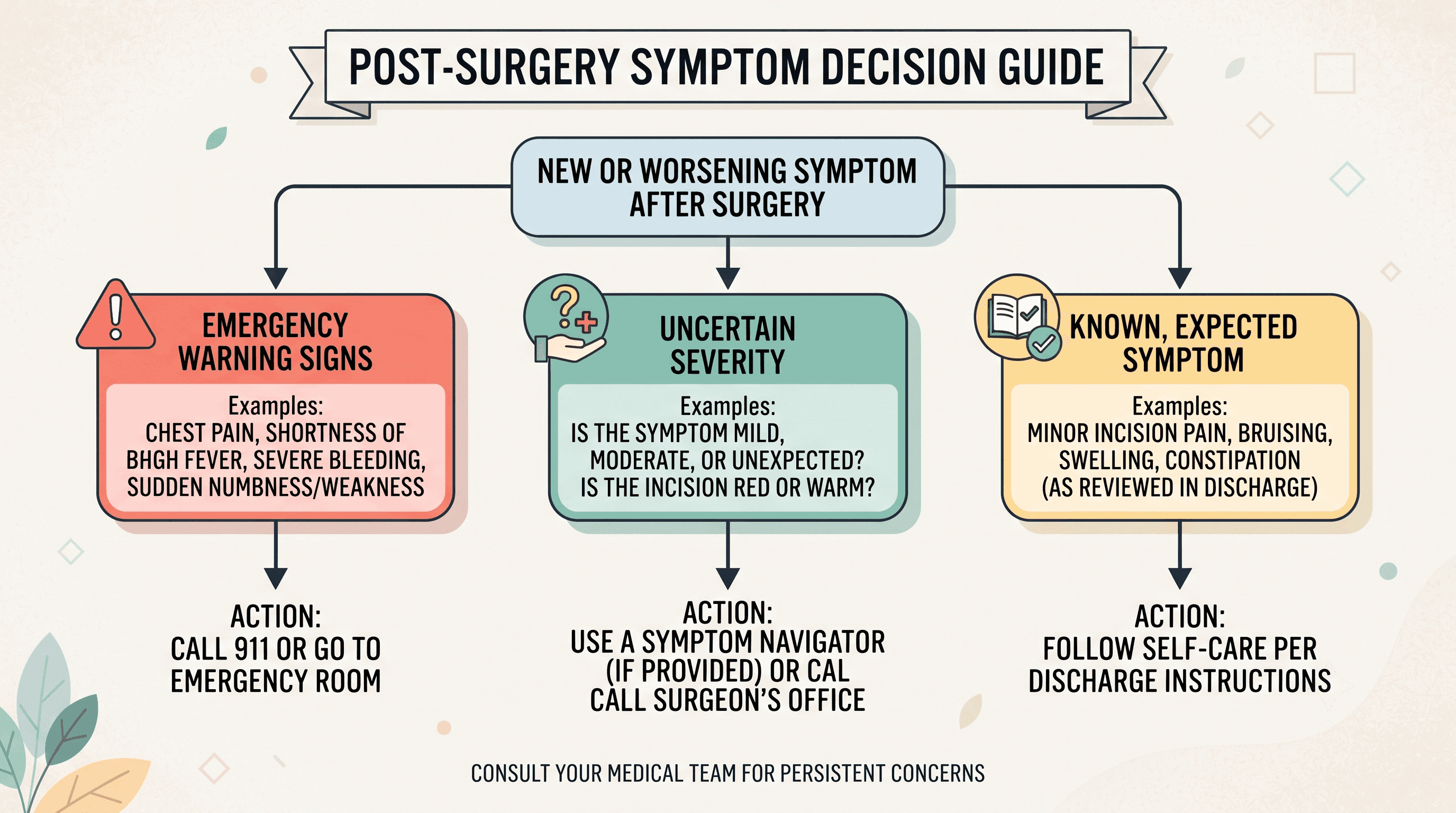
Call 911 or go to the nearest emergency room immediately for:
- Chest pain or pressure
- Difficulty breathing
- Signs of stroke (facial drooping, arm weakness, slurred speech)
- Heavy or uncontrolled bleeding
- A surgical wound that reopens significantly
- Fever above 101°F (38.3°C), especially with chills
- Sudden, severe swelling, redness, or warmth spreading from the incision
- Loss of consciousness or confusion
- Signs of a blood clot, such as one-sided leg swelling with pain, or sudden shortness of breath
No app, including Momentary, is designed to replace emergency care or your surgeon's specific post-operative instructions.
FAQ
Is there an app that tells me if my surgery incision looks infected? No consumer app can reliably diagnose a wound infection from a description or photo alone. If you notice increasing redness, warmth, swelling, drainage that smells bad or changes color, or fever, contact your surgeon's office the same day. A healthcare navigator like Momentary can help you decide whether that warrants urgent care or a same-day telehealth visit while you wait to reach your surgeon.
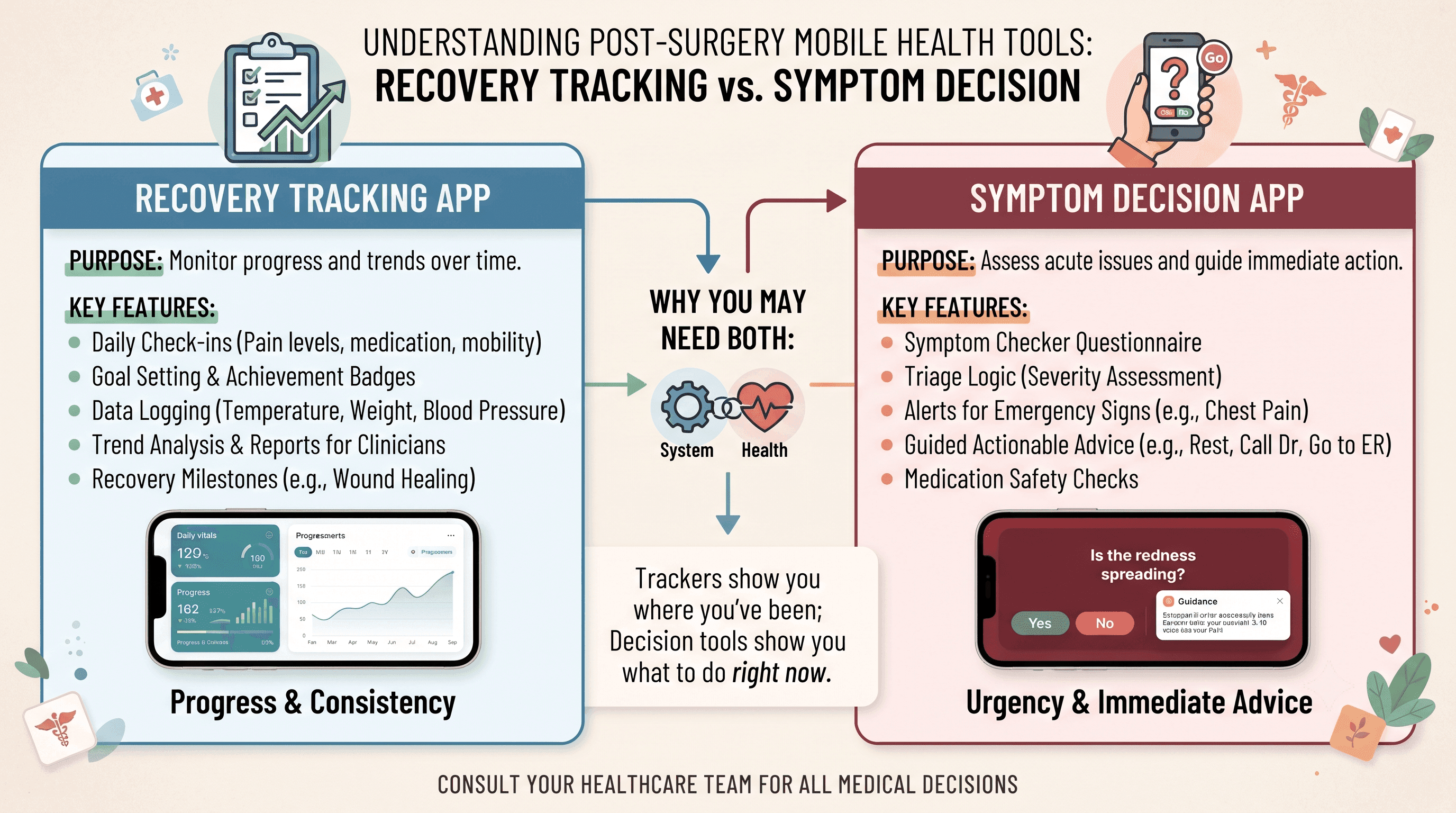
What's the difference between a symptom checker and a recovery tracking app? A symptom checker (like Ada Health or Momentary) helps you understand a new or changing symptom and what to do about it. A recovery tracking app (like Force Therapeutics or Hinge Health) is usually tied to a structured program from your surgeon or employer that monitors exercises, adherence, and progress over weeks. Many patients benefit from both.
Can I use Force Therapeutics or Hinge Health without my surgeon or employer offering it? Generally no. Force Therapeutics is distributed through partnered hospitals and surgical practices. Hinge Health is typically offered at no cost through employer benefits or health plans rather than sold directly to individual consumers. Check with your surgical team or HR benefits page for eligibility.
Is Momentary a replacement for my surgeon's follow-up appointment? No. Momentary is an AI-powered healthcare navigator with physician-reviewed guidance designed to help you understand symptoms and decide on next steps. It does not replace your surgeon's evaluation, diagnose complications, or provide emergency care.
How much does Momentary cost? Momentary costs $19.99 per month for the AI healthcare navigator. Physician services are currently available only in California; the navigator itself is available nationwide in the US.
What symptoms are considered normal in the first week after surgery? This varies significantly by procedure, so always follow your surgeon's specific discharge instructions first. General patterns include mild-to-moderate pain that gradually improves, some swelling and bruising, and mild fatigue. Any symptom outside what your surgeon described as expected, or any symptom that is worsening rather than improving, is worth checking on.
Are free symptom checkers like Ada Health accurate enough for post-surgical concerns? Ada Health is a general-purpose symptom checker not built specifically for surgical recovery context. It can be a reasonable first step for general symptom understanding, but it won't factor in your specific procedure, incision location, or surgeon's post-op protocol the way a surgery-specific program would.


