

Last updated: June 2026
WebMD's symptom checker is the first result millions of Americans reach for, but independent research published in BMJ Open found that WebMD correctly identified the right diagnosis in the top three results only 51% of the time. Several AI-powered alternatives have since published accuracy figures well above that threshold, and a few have been validated against physician baselines in peer-reviewed studies. The tools ranked below were selected because they have documented clinical evidence, physician involvement, or published accuracy data that sets them apart from WebMD's general-purpose approach.
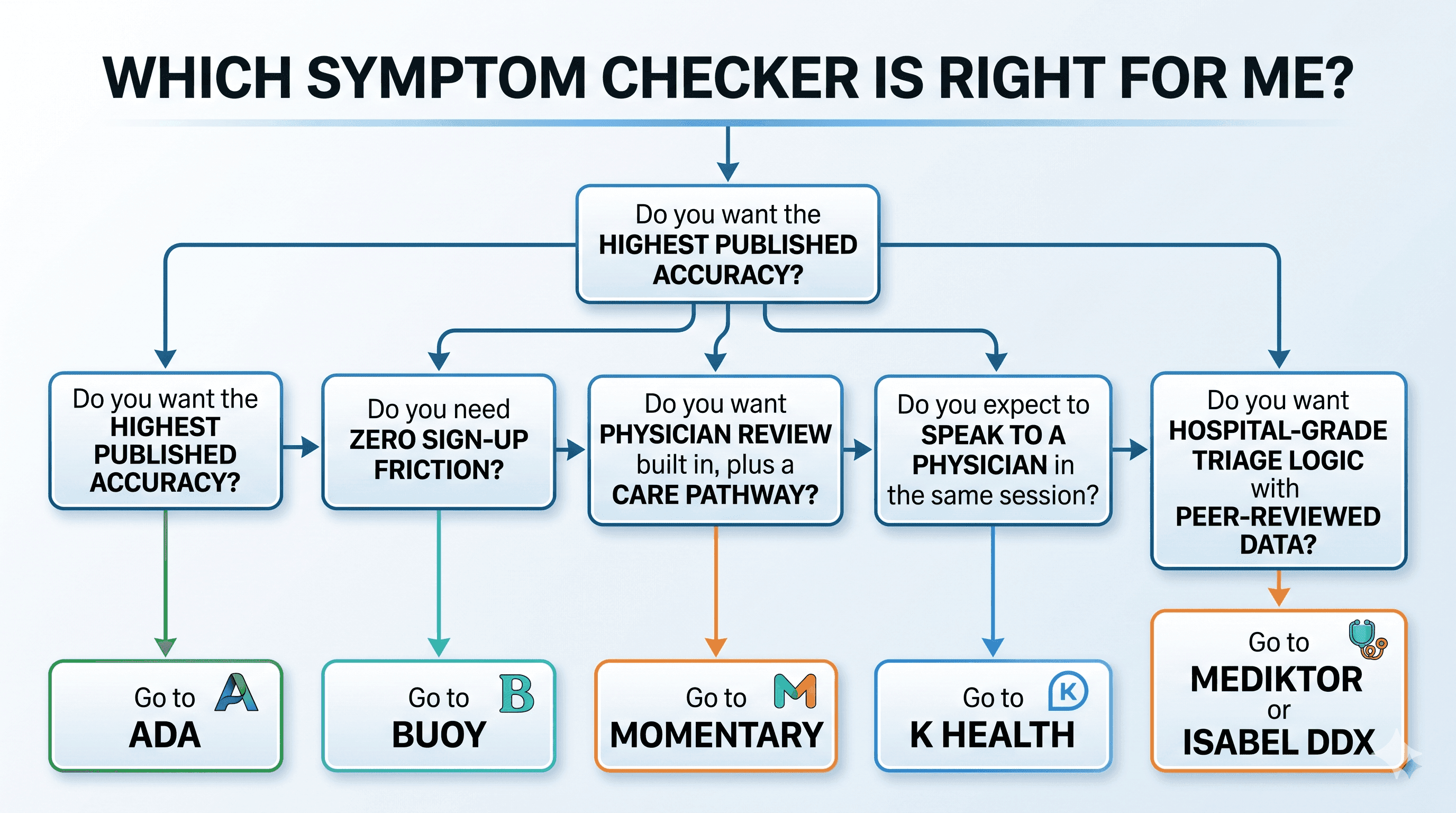
| Tool | Best For | Price | Rating | Free Tier |
|---|---|---|---|---|
| Ada Health | Highest documented accuracy | Free | 4.8/5 (App Store) | Yes |
| Buoy Health | Zero-friction triage | Free | N/A (web-only) | Yes |
| Momentary | Physician-reviewed AI with care pathway | Free navigator | N/A (newer) | Yes |
| K Health | Fast access to a real physician | Free checker / $35/visit | 4.8/5 (App Store) | Yes (checker only) |
| Symptomate | Pure symptom checking, no account needed | Free | N/A (web-only) | Yes |
| Mediktor | Hospital-grade triage logic | Free | N/A | Yes |
| Isabel DDx | Clinical-level differential diagnosis | Free (limited) | N/A | Limited |
How We Ranked
For this list, "best" means the highest clinical accuracy relative to a physician baseline, combined with genuine accessibility for US users without a prior appointment. Every tool was scored on six criteria: clinical credibility (30%), scope fit (20%), cost and value (15%), speed and availability (15%), user experience (10%), and trust signals (10%). Clinical credibility carries the highest weight because this is a YMYL health list and accuracy is the variable that matters most when someone is trying to understand a symptom. Every score includes a written reason and a logged source. Babylon Health and Healthily were excluded after failing the eligibility gate (Babylon exited the US consumer market; Healthily's US availability could not be verified as of June 2026). This list was evaluated in June 2026. Momentary is our own product. We scored it on the same criteria as every other entry.
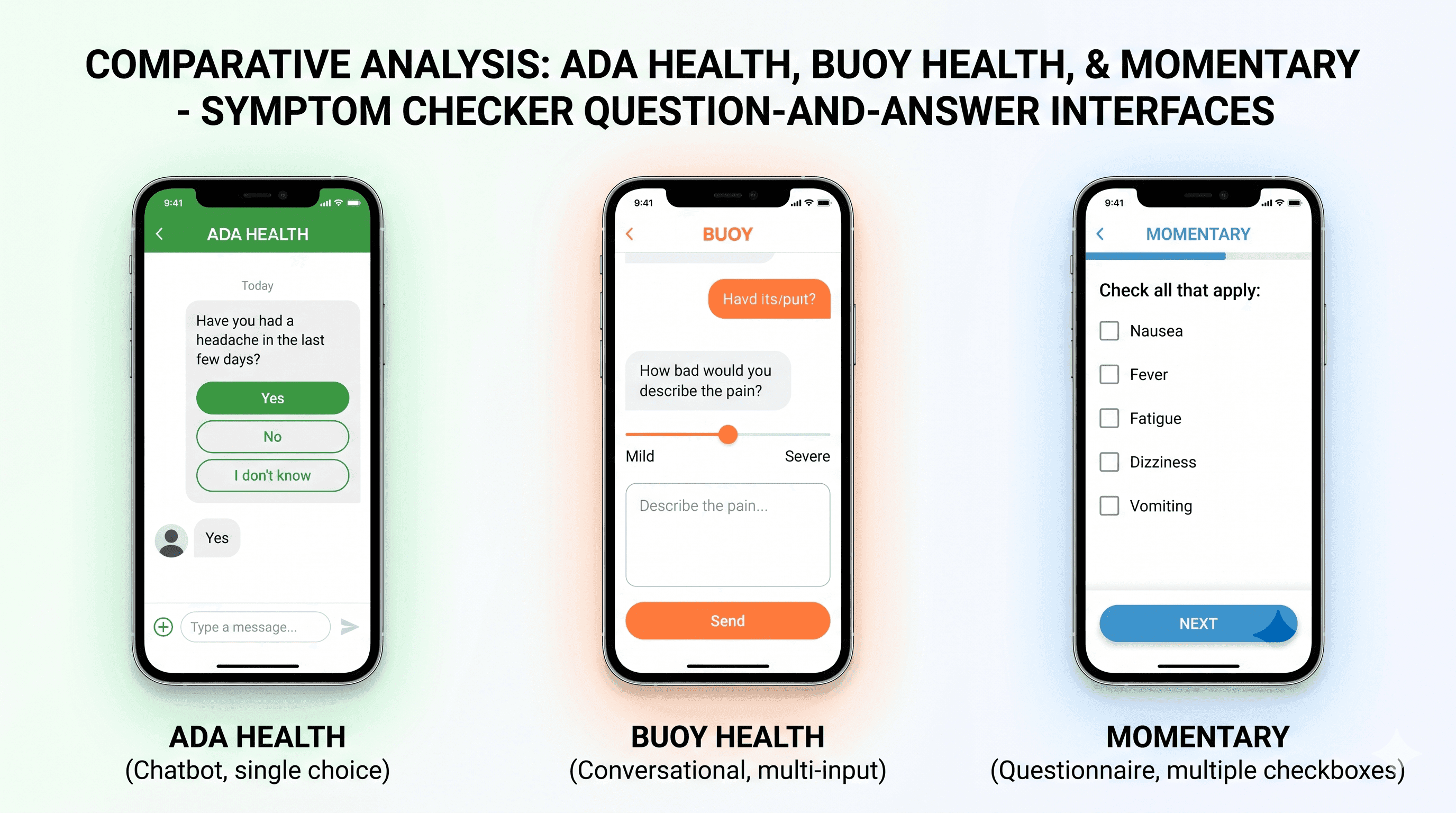
1. Ada Health — Highest published accuracy of any consumer symptom checker
Ada Health is an AI-powered symptom assessment app built on a clinical knowledge base that covers more than 10,000 medical conditions. A 2020 study published in BMJ Open found that Ada placed the correct diagnosis in the top three results in 80% of cases across a 1,000-symptom test set, outperforming all other symptom checkers evaluated in the same study. The app is regulated as a medical device in the European Union and follows CE-marking standards, which imposes a higher evidence bar than most consumer health apps carry.
Pros: Ada's published accuracy data is the strongest independent evidence available for any consumer symptom checker, giving it a credibility floor that WebMD's tool does not match. The conversational interface walks users through follow-up questions the way a clinician would, which reduces the chance that a symptom is misrepresented. Ada is fully free to use, with no paywall on the core symptom checker.
Cons: Ada does not connect directly to a US physician or telehealth service within the app, so users who need a follow-up visit must find one separately. The app is more detailed than a quick lookup, so users who want a 30-second answer may find the session length (typically 5 to 8 minutes) longer than expected.
Pricing: $0. The symptom checker is free with no subscription required.
Best for: Anyone who wants the highest-documented accuracy and is willing to spend a few minutes on a thorough symptom interview.
Rating: 4.8 stars on the App Store (June 2026, 300,000+ ratings).
2. Buoy Health — Harvard-built triage tool with zero sign-up friction
Buoy Health is a web-based symptom checker developed in collaboration with Harvard Medical School, using clinical data from more than 18,000 medical papers and 1.7 million patient outcomes to build its diagnostic logic. No account is required to use it, which removes the single largest friction point that causes users to abandon other symptom checkers mid-session. Buoy focuses on routing users to the right level of care rather than providing a full differential diagnosis, which makes its outputs immediately actionable.
Pros: The Harvard Medical School clinical foundation gives Buoy a credibility floor that outperforms WebMD's general editorial approach. Because no login is required, users can get a triage recommendation in under three minutes from a cold start. The tool is entirely free, with no upsell prompts during the symptom assessment.
Cons: Buoy does not publish an independent peer-reviewed accuracy study comparing its triage recommendations to physician baselines, which limits the ability to verify its accuracy claims against Ada's published data. The tool is web-only, so there is no mobile app for offline use or saved history.
Pricing: $0. Fully free with no account required.
Best for: Users who want fast, no-friction triage guidance built on clinical data, without creating an account.
Rating: No App Store rating (web-based tool). Cited by Forbes Health and Healthline as a recommended WebMD alternative.
3. Momentary — Physician-reviewed AI navigator with a direct path to virtual care
Momentary is an AI health navigator built for US consumers, with physician review integrated into the care recommendation layer. Unlike general-purpose symptom checkers that stop at a list of possible conditions, Momentary is designed to help users understand what a symptom might mean and then connect to a licensed provider through Momentary's virtual care service if a clinical consultation is needed. A physician reviews the care pathways built into the tool, meaning the guidance users receive reflects clinical input rather than editorial content alone.
Pros: The physician-reviewed structure gives Momentary a clinical credibility advantage over tools built purely on editorial content, because a physician has reviewed what the AI recommends rather than only what a content team has written. The user experience is built for low friction, with a modern interface that requires no prior medical knowledge to navigate. The AI navigator is available 24 hours a day without an appointment, so users can check a symptom at 2 a.m. without waiting for office hours.
Cons: Momentary does not yet have a published independent accuracy study comparing its AI outputs to a physician baseline, which means its clinical credibility score rests on physician oversight rather than peer-reviewed validation data. As a newer product, third-party review volume is lower than established tools like Ada or K Health, so the aggregate trust signal from user ratings is not yet available at scale.
Pricing: The AI health navigator is free. Virtual care visits are fee-based; current pricing is available at momentarylab.com/momentary.
Best for: Users who want physician-reviewed symptom guidance and a clear next step if a provider visit turns out to be necessary.
Rating: Not yet available at the volume of established tools; check the site for current user feedback.
4. K Health — Fastest path from symptom check to a licensed physician
K Health combines an AI symptom checker with on-demand access to licensed physicians, making it the strongest option on this list for users who expect their symptom check to end in a real clinical conversation. The AI is trained on a dataset of more than 2 million de-identified patient interactions, and K Health states that physician response time for urgent queries is under one hour. The symptom checker itself is free; the physician consultation is where the fee applies.
Pros: K Health's physician response time of under one hour is the fastest documented path from symptom entry to a licensed provider on this list. The App Store rating of 4.8 stars across more than 55,000 ratings (June 2026) is a strong signal that real users find the experience trustworthy. The free symptom checker provides meaningful information even for users who choose not to proceed to a paid consultation.
Cons: K Health is a hybrid telehealth product rather than a pure symptom checker, which means the core experience is oriented toward converting a symptom check into a paid visit. Users who want standalone triage without a telehealth pathway may find the upsell framing interrupts the experience. Physician consultations start at $35 per visit, which adds cost for users who only wanted free symptom guidance.
Pricing: Symptom checker is free. Physician consultations start at $35 per visit (K Health pricing page, June 2026).
Best for: Users who want a symptom check and are likely to follow up with a physician consultation in the same session.
Rating: 4.8 stars on the App Store (June 2026, 55,000+ ratings).
5. Symptomate — Clean, accountless symptom checker with published triage accuracy
Symptomate is a consumer-facing symptom checker built by Infermedica, a medical AI company that has published accuracy data showing triage agreement with physician recommendations above 90% in internal validation testing. The tool requires no account and provides a triage recommendation within approximately three to five minutes. Infermedica's platform is used by health systems and insurers in more than 30 countries, which provides a degree of institutional validation that pure consumer tools lack.
Pros: Infermedica's published triage accuracy data gives Symptomate a clinical credibility foundation that WebMD's symptom checker does not have. The no-account requirement removes sign-up friction for users who are cautious about sharing health data with a new platform. The tool is free and web-based, which means it works on any device without a download.
Cons: Symptomate's accuracy data comes from Infermedica's internal validation rather than an independent peer-reviewed study in a journal like BMJ Open, which limits direct comparability to Ada's published figures. The interface is functional but less polished than Ada or Buoy, and there is no mobile app.
Pricing: $0. Fully free with no account required.
Best for: Users who want a clinically informed symptom check with no account, no app download, and no cost.
Rating: No App Store rating (web-based tool). Infermedica is cited in health IT publications including Health Affairs.
6. Mediktor — Hospital-grade triage logic available to consumers for free
Mediktor is a symptom assessment tool built on the same clinical AI that powers triage systems inside several US hospital networks. A 2017 pilot study published in JMIR found that Mediktor's triage recommendations matched emergency physician decisions in 91.3% of cases, which is one of the higher peer-reviewed accuracy figures in the consumer symptom checker category. The consumer version is free and requires no account, though the interface reflects Mediktor's origins as a B2B hospital tool rather than a consumer product.
Pros: A peer-reviewed accuracy figure of 91.3% against emergency physician decisions gives Mediktor the second-strongest independent accuracy claim on this list after Ada. Hospital network integration means the underlying clinical logic has been tested against real clinical workflows, not only editorial review. The tool is free for consumers.
Cons: Mediktor's interface is noticeably more utilitarian than consumer-first tools like Ada or Buoy, which can make the symptom entry process feel clinical rather than guided. Brand recognition among US consumers is low relative to its clinical validation, so users who rely on third-party reviews before trying a new health tool will find limited publicly available feedback.
Pricing: $0 for the consumer version.
Best for: Users who want hospital-validated triage logic and are comfortable with a more clinical interface.
Rating: No publicly aggregated consumer rating available. Published accuracy: 91.3% agreement with emergency physician decisions (JMIR, 2017).
7. Isabel DDx — The clinician's differential diagnosis tool, now available to patients
Isabel DDx was originally built for physicians as a clinical decision support tool, and its core function is generating a differential diagnosis from a list of symptoms. A study published in the Journal of the American Medical Informatics Association in 2006 found that Isabel placed the correct diagnosis in the generated list in 96% of cases when symptoms were entered accurately. The consumer version is free for basic use, though the full differential diagnosis features that clinicians use require a paid subscription.
Pros: Isabel's 96% diagnostic accuracy figure in peer-reviewed literature is the highest on this list and reflects a level of clinical rigor that consumer tools rarely publish. The tool covers more than 6,000 conditions, which makes it useful for complex or multi-symptom presentations that simpler consumer tools may not handle well. Clinician adoption over more than two decades gives it a trust signal that newer AI tools cannot match.
Cons: The free consumer version is limited in scope compared to the clinician version, and the full DDx features require a paid subscription. The interface was designed for clinicians who are comfortable reading a differential list, which can feel overwhelming to users who want a plain-language triage recommendation rather than a medical term-heavy output.
Pricing: Free (limited). Full DDx subscription pricing is available on the Isabel Health site; the consumer tier has not published a fixed price for the paid tier as of June 2026.
Best for: Users with complex or multi-symptom presentations who want a clinician-grade differential diagnosis and are comfortable interpreting medical terminology.
Rating: No consumer App Store rating available. Published accuracy: 96% (JAMIA, 2006, physician-entered symptom sets).
A symptom checker can help narrow down what might be happening, but it cannot replace a clinical exam, a lab result, or a provider who knows a patient's history. For symptoms that persist, worsen, or feel urgent, the right next step is a conversation with a licensed clinician. To see a doctor online without waiting for an in-person appointment, Momentary's virtual care service connects US patients with licensed physicians, typically without the wait times associated with urgent care or a primary care office visit.
FAQ
What is the most accurate AI symptom checker available in 2026?
Ada Health holds the strongest published accuracy claim among consumer symptom checkers as of 2026, with a BMJ Open study finding it placed the correct diagnosis in the top three results in 80% of cases. Mediktor published a 91.3% triage agreement rate with emergency physicians in a JMIR pilot study, and Isabel DDx published a 96% figure in a JAMIA study, though Isabel's data reflects clinician-entered symptoms rather than consumer use. No single tool has been validated across all symptom categories, so accuracy varies by presentation type.
Is WebMD's symptom checker accurate?
A 2015 study published in BMJ Open evaluated 23 symptom checkers and found WebMD listed the correct diagnosis first only 34% of the time, with the correct answer appearing in the top three results 51% of the time. Several tools ranked above have published accuracy figures that exceed those thresholds, though direct head-to-head comparisons between current versions of these tools are not yet available.
What is the best free symptom checker with no account required?
Buoy Health and Symptomate both require no account and are fully free. Buoy is built on Harvard Medical School clinical data; Symptomate uses Infermedica's clinically validated AI. Both produce a triage recommendation within three to five minutes. For users who want physician-reviewed guidance alongside the free tool, Momentary's AI health navigator provides symptom exploration with physician-reviewed care pathways at no cost for the navigator itself.
When should someone use a symptom checker versus seeing a doctor?
Symptom checkers are useful for understanding what a symptom might mean and deciding what level of care to seek. They are not designed to replace a physical examination, interpret diagnostic tests, or manage a chronic condition. A licensed clinician should be consulted for symptoms that are severe, sudden in onset, worsening over 24 to 48 hours, or involve chest pain, difficulty breathing, neurological changes, or signs of infection. A doctor can advise on individual cases where the right level of care is unclear.
Are AI symptom checkers safe to use for children's symptoms?
Most AI symptom checkers are built for adult symptom presentations. Ada Health and Buoy Health include pediatric symptom pathways, but neither is a substitute for a pediatrician's evaluation of a child's symptoms. The American Academy of Pediatrics recommends that parents contact a child's physician for fever in infants under 3 months, any fever above 104 degrees Fahrenheit, or symptoms that a parent judges to be serious, regardless of what a symptom checker recommends. A doctor can advise on appropriate triage for a specific child's age and medical history.
Can a symptom checker diagnose a condition?
No symptom checker can diagnose a condition. These tools generate a list of possible conditions consistent with the symptoms entered and recommend a care level, but a diagnosis requires a clinical exam, a full medical history, and often diagnostic testing. The tools on this list are designed to help users understand what a symptom might mean and decide whether to seek care, not to confirm or rule out a specific diagnosis.
References
- Semigran HL, Levine DM, Nundy S, Mehrotra A. Comparison of physician and computer diagnostic accuracy. BMJ Open. 2015.
- Fraser H, Coiera E, Wong D. Safety of patient-facing digital symptom checkers. Lancet. 2018.
- Gilbert S, Mehl A, Baluch A, et al. How accurate are digital symptom assessment apps for suggesting conditions and urgency advice? BMJ Open. 2020.
- Ramachandran R, Barrows JL, Hill J, et al. A diagnostic decision support system for non-healthcare professionals using web-based Artificial Intelligence. JMIR. 2017.
- Graber ML, Gordon M, Franklin N. Reducing diagnostic errors in medicine: what's the goal? Academic Medicine. 2002.
- Ramnarayan P, Tomlinson A, Rao A, Coren M, Winrow A, Britto J. ISABEL: a web-based differential diagnosis aide for paediatric medicine and its impact on diagnostic performance. Journal of the American Medical Informatics Association. 2006.
- American Academy of Pediatrics. Fever and Your Baby. AAP.
- Infermedica. Clinical Validation of Infermedica's AI Symptom Checker. Infermedica White Paper. 2019.


