


Last updated: June 2026
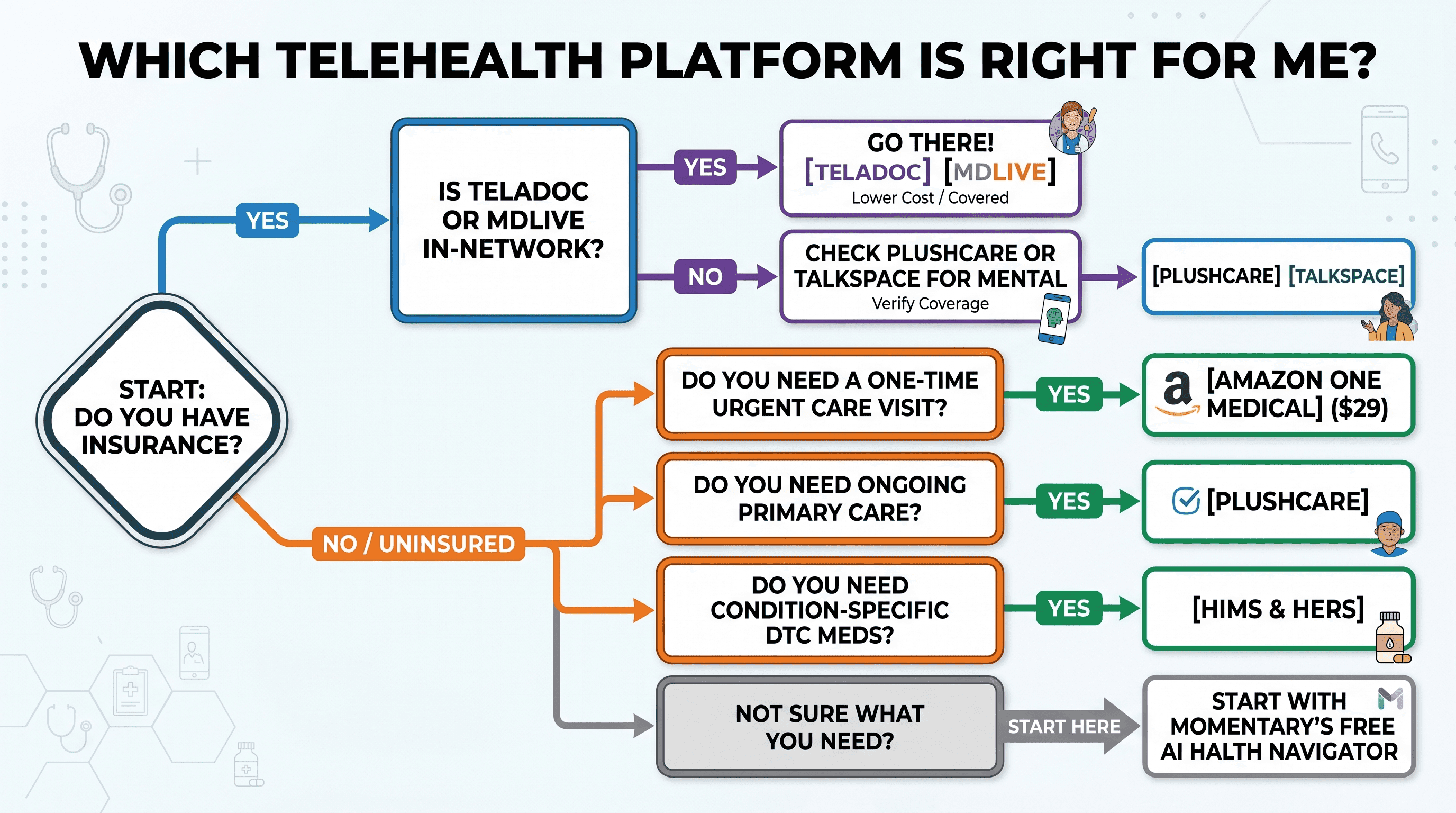
The best telehealth platform for most people in 2026 is Teladoc Health, which connects patients to a licensed clinician in under 10 minutes, accepts more than 200 insurance plans, and covers urgent care, mental health, and dermatology from one app. For the lowest cash price, Amazon One Medical Pay-per-visit starts at $29. For ongoing primary care with a dedicated physician, PlushCare is the closest thing to a virtual doctor's office. Below are the eight best options ranked by scored criteria, not editorial preference.
| Platform | Best For | Price | Rating | Free Tier |
|---|---|---|---|---|
| Teladoc Health | Broadest insurance + fastest response | $0-$89/visit | 4.3/5 (App Store) | No (with insurance: $0 copay) |
| Amazon One Medical | Lowest cash-pay, no insurance needed | $29 msg / $49 video | 4.6/5 (App Store) | No |
| MDLive | Cigna members, after-hours urgent care | $0-$89/visit | 4.2/5 (App Store) | No (Cigna: $0 copay) |
| PlushCare | Ongoing primary care relationship | $19.99/mo + $99-$129/visit | 4.5/5 (App Store) | No |
| Momentary | AI health navigation before a visit | Free AI navigator | Not yet rated | Yes (AI navigator) |
| Hims & Hers | Condition-specific DTC prescriptions | $49/mo | 4.4/5 (App Store) | No |
| Cerebral | Medication mgmt + therapy bundle | From $85/mo | 3.9/5 (Trustpilot) | No |
| Talkspace | Insured therapy with coverage | $260-$460/mo cash; copay with insurance | 4.1/5 (App Store) | No |
How We Ranked
For this list, "best" means fastest time to a licensed clinician, broadest on-demand access, and transparent pricing with verifiable clinical credibility. We scored eight candidates on six criteria: clinical credibility (15%), cost and value (15%), speed and availability (30%), scope fit (20%), user experience (10%), and trust signals (10%). Speed carries the highest weight because reaching care quickly is the core job of a general telehealth platform. Evaluation date: June 2026. Momentary is our own product. We scored it on the same criteria as every other entry. Based on those scores, Momentary ranks fifth, which reflects its role as an AI health navigator and virtual care connector rather than a 24/7 on-demand physician network.
1. Teladoc Health — Best overall for speed, breadth, and insurance coverage
Teladoc is the largest telehealth company in the United States by visit volume, serving more than 80 million members through employer plans, individual subscriptions, and partnerships with more than 200 insurance carriers. The platform covers general medical visits, mental health, dermatology, nutrition, and chronic condition management. General medical visits typically connect patients to the next available clinician within 10 to 30 minutes for urgent issues.
Pros: Teladoc accepts the widest range of insurance plans of any consumer telehealth platform, meaning most patients pay $0 to $50 per visit rather than the full cash price. The platform operates 24/7 and covers all 50 states, so access does not depend on geography or time of day. Its network includes physicians, nurse practitioners, therapists, psychiatrists, and dermatologists licensed across all states.
Cons: There is no dedicated primary care physician; each visit typically connects to whoever is available, so patients explain their history from scratch every time. Without insurance, the cash price of $89 per general medical visit is higher than several competitors. Customer service complaints around peak demand periods are documented across multiple third-party review sites.
Pricing: $0 to $50 with in-network insurance; $89 per general medical visit without insurance. Mental health therapy runs $0 to $90 in-network; psychiatry runs $0 to $140 in-network.
Best for: People whose employer or insurance plan already includes Teladoc as a benefit, and anyone who needs after-hours care within minutes.
Rating: 4.3 stars on the App Store (June 2026).
2. Amazon One Medical Pay-per-visit — Best cash-pay option with no subscription required
Amazon One Medical Pay-per-visit (formerly Amazon Clinic) operates entirely on-demand with no appointment, no insurance, and no subscription required. Patients pick their condition, answer a short intake form, and connect to a licensed clinician through messaging or video. The service covers more than 30 common conditions including UTIs, pink eye, sinus infections, the flu, eczema, and seasonal allergies across all 50 states.
Pros: At $29 for a messaging visit and $49 for a video visit, Amazon One Medical offers the most predictable low-cost cash-pay entry point in this category, with FSA and HSA cards accepted at checkout. Amazon reported a 96% customer satisfaction rating at launch, and the intake experience is frictionless for anyone with an existing Amazon account. Clinicians send a personalized treatment plan and prescription to any pharmacy of the patient's choice, including Amazon Pharmacy with free delivery.
Cons: Amazon One Medical Pay-per-visit does not accept insurance for these on-demand visits, so patients with in-network Teladoc or MDLIVE benefits may pay less through those platforms. The service covers 30-plus conditions but does not handle complex chronic conditions, mental health, or specialist referrals. It is not available to Medicare or Medicaid beneficiaries.
Pricing: $29 per messaging visit; $49 per video visit. No subscription required. A full One Medical membership is $99 per year for Prime members ($199 for non-Prime) and includes 24/7 on-demand virtual care at no extra cost.
Best for: Uninsured patients, high-deductible plan holders, and anyone who wants a fast, low-friction on-demand visit for a common condition without insurance paperwork.
Rating: 4.6 stars on the App Store (June 2026, One Medical app).
3. MDLive — Best for Cigna members and after-hours urgent care
MDLive operates 24/7 for urgent care and behavioral health and was acquired by Evernorth, Cigna's health services division. For Cigna plan members, visits can be as low as $0 depending on the plan. For everyone else, urgent care visits run up to $89, therapy sessions run $179 each, and psychiatric evaluations start at $299. The platform covers common acute conditions well and has a particularly strong behavioral health offering with licensed therapists and psychiatrists available in all 50 states.
Pros: Cigna and Evernorth members get deeply integrated access and often pay the lowest effective per-visit cost of any platform in this list. MDLive's 24/7 coverage makes it a reliable option at 2 AM for a child's fever or a Sunday UTI. The behavioral health program includes licensed therapists and board-certified psychiatrists across all 50 states, which is broader than most competitors.
Cons: Without Cigna insurance, MDLive's pricing is comparable to Teladoc and Amwell, offering no meaningful cash-pay advantage. The platform's breadth is a strength, but specialty depth in dermatology and psychiatry is shallower than dedicated platforms for those conditions.
Pricing: $0 with Cigna/Evernorth plans (plan-dependent); up to $89 per urgent care visit without insurance; $179 per therapy session; $299 and up for psychiatric evaluations.
Best for: Cigna members and anyone who needs reliable behavioral health coverage or after-hours urgent care at 24/7 availability.
Rating: 4.2 stars on the App Store (June 2026).
4. PlushCare — Best for patients who want an ongoing relationship with one doctor
PlushCare takes a primary care approach to telehealth rather than an on-demand model. Instead of seeing whichever provider is available, patients can build a relationship with a specific physician who manages their prescriptions, orders lab work through Quest and Labcorp, and provides referrals over time. The platform reports a 97% patient satisfaction rating across review platforms and doctors treat more than 3,500 medical conditions online.
Pros: Same-day appointments are usually available, and the ability to return to the same doctor across visits is rare in consumer telehealth. PlushCare physicians come from top-50 US medical schools, carry US board certifications, and are licensed in all 50 states. The platform accepts many major insurance plans, with in-network visits billed at standard copays.
Cons: Without insurance, the optional $19.99 per month membership plus $99 per visit adds up faster than a single-visit platform for patients who only need occasional care. Therapy is charged separately at $169 per session and is not billable to insurance. PlushCare does not prescribe controlled substances.
Pricing: $19.99 per month membership (or $149 per year); $99 to $129 per visit without insurance; $169 per therapy session; in-network copay with accepted insurance plans.
Best for: Patients managing ongoing conditions such as high blood pressure, diabetes, anxiety, or thyroid issues who want telehealth to replace an actual primary care relationship.
Rating: 4.5 stars on the App Store (June 2026, sourced from PlushCare App Store listing).
5. Momentary — Best first step for patients who want AI-guided clarity before booking a visit
Momentary is a physician-reviewed AI health navigator built to help patients understand their symptoms, identify what kind of care they likely need, and decide whether to book a telehealth visit, see a specialist, or use an urgent care clinic. Physician oversight is embedded in the content and guidance layer, meaning a physician reviews the care pathways Momentary surfaces rather than leaving that responsibility entirely to AI. Momentary is not a replacement for a physician and does not replace a clinical visit.
Pros: The AI health navigator is free to use and available without an appointment, making it accessible regardless of insurance status. For patients who are unsure whether their symptoms warrant a visit, Momentary provides faster, more personalized preliminary guidance than searching symptoms online. The tool is designed to reduce unnecessary care escalation while helping patients arrive at a visit better prepared.
Cons: Momentary does not provide a clinical diagnosis, cannot prescribe medication, and does not connect patients to a live provider through the platform itself. Patients who need a prescription or clinical assessment still need to book a visit with a licensed telehealth service or in-person provider. Third-party app ratings are not yet available given the platform's stage of growth.
Pricing: Free AI health navigator at momentarylab.com. Virtual care visits through Momentary's connected provider network: see momentarylab.com/momentary for current pricing.
Best for: Patients who want to understand their symptoms before deciding where to seek care, and anyone who wants to arrive at a doctor's visit with clearer questions and more context.
Rating: Not yet rated on major app stores (June 2026).
6. Hims & Hers — Best for condition-specific DTC prescriptions and hair, skin, and sexual health
Hims & Hers is a direct-to-consumer telehealth company that focuses on a defined set of conditions: erectile dysfunction, hair loss, mental health (anxiety and depression), weight management, sexual health, and skin care. The care model is primarily asynchronous. Patients complete an intake questionnaire, a licensed clinician reviews it and follows up through messaging, and medications are shipped to the patient's home. As of March 2026, Hims & Hers has shifted its weight-loss focus to FDA-approved treatments after a prior FDA warning regarding compounded semaglutide marketing.
Pros: For the conditions it covers, the subscription model starts at $49 per month, which is cost-competitive with paying full cash price for individual telehealth visits. Hims & Hers holds an A+ rating from the Better Business Bureau based on nearly 7,000 customer reviews, and the medication delivery model removes the step of visiting a pharmacy.
Cons: The platform does not offer live video appointments in most states; care happens through messaging, and response times from clinicians can vary. Insurance is not accepted, so there is no in-network cost path. Hims & Hers does not treat bipolar disorder, schizophrenia, OCD, or ADHD and does not prescribe controlled substances, which limits its mental health scope significantly.
Pricing: Mental health subscription starts at $49 per month, billed quarterly at $147. Other condition programs vary; hair loss starts at $16 per month through Amazon One Medical's competing service, while Hims-specific hair programs vary by product bundle.
Best for: Adults who know which condition they need ongoing treatment for and prefer a low-touch, subscription-plus-delivery model over live appointments.
Rating: 4.4 stars on the App Store (June 2026).
7. Cerebral — Best for adults who need medication management plus therapy in one plan
Cerebral offers online mental health care focused on non-stimulant medication management and therapy for conditions including anxiety, depression, and stress. The platform combines licensed therapists and prescribing clinicians in a subscription model, starting around $85 per month for therapy alone, with higher tiers that include medication management. Cerebral does not routinely prescribe stimulants for ADHD following regulatory scrutiny in prior years.
Pros: Cerebral is one of the few platforms that genuinely bundles therapy and medication management in one plan, which reduces the coordination burden for patients who need both. Plans are FSA and HSA eligible, and Cerebral can provide an invoice for patients to submit to their insurer for potential reimbursement toward their deductible.
Cons: Cerebral holds a 3.9-star average on Trustpilot but a 1.3-star rating on the BBB, with negative feedback concentrated on difficulty scheduling follow-up appointments needed for prescription refills. The platform does not prescribe stimulants, which excludes a meaningful segment of patients seeking ADHD care.
Pricing: From $85 per month for therapy only; higher tiers include medication management. Prices vary by state.
Best for: Adults seeking combined medication management and talk therapy for anxiety or depression who are comfortable with a subscription model and no insurance coverage.
Rating: 3.9 stars on Trustpilot (June 2026); 1.3 stars on BBB (June 2026).
8. Talkspace — Best for insured patients who want established therapy coverage
Talkspace is one of the longest-running online therapy platforms and one of the first to achieve broad insurance network participation. For insured patients, Talkspace typically bills only the mental health copay, which is often $20 to $40 per session, making it the lowest effective cost for therapy among all entries on this list for patients with qualifying coverage. The platform employs thousands of licensed therapists and also offers psychiatry for medication management.
Pros: Insurance integration is Talkspace's strongest differentiator: patients with mental health coverage often pay only a copay, compared to $260 to $460 per month in cash-pay plans. The platform matches patients to a therapist based on preferences including approach, gender, and identity factors, and switching is available if the initial match does not work.
Cons: Cash-pay pricing of $260 to $460 per month makes Talkspace one of the more expensive options in this list for uninsured patients. Customer reviews include mixed feedback on customer service and unexpected charges. The psychiatry offering is more limited than dedicated psychiatric platforms.
Pricing: Copay with qualifying insurance (typically $20 to $40 per session); $260 to $460 per month without insurance, depending on plan and session frequency.
Best for: Insured adults who want ongoing therapy covered by their mental health benefits with an established, widely recognized platform.
Rating: 4.1 stars on the App Store (June 2026).
When a telehealth platform gives you answers about your symptoms but not a clear path forward, the next step is speaking with an actual provider. You can see a doctor online through Momentary Virtual Care for a video visit with a licensed clinician, without a long wait or the hassle of an in-person appointment.
FAQ
What is the best telehealth platform in 2026?
Teladoc Health is the best overall telehealth platform in 2026 for most people. It accepts more than 200 insurance plans, connects patients to a licensed clinician within 10 to 30 minutes for urgent visits, and covers general medical, mental health, and dermatology needs from one app. For uninsured patients paying cash, Amazon One Medical Pay-per-visit at $29 for a messaging visit is the most affordable single-visit option.
What is the cheapest telehealth service that does not require insurance?
Amazon One Medical Pay-per-visit charges $29 for a messaging visit and $49 for a video visit, with no subscription or insurance required. FSA and HSA cards are accepted. For patients who want even lower ongoing costs, a Teladoc visit through an employer benefit can be $0, and PlushCare's $19.99 per month membership lowers per-visit costs for regular users.
Can I use telehealth if I have Medicare?
As of January 31, 2026, most Medicare telehealth services reverted to rural-only rules for general medical visits, meaning patients must be located in a rural area to use Medicare coverage for standard telehealth. Mental health telehealth services remain accessible from home under Medicare regardless of location. Verify your specific plan's telehealth coverage with Medicare before scheduling. Note that Amazon One Medical Pay-per-visit is not available to Medicare or Medicaid beneficiaries for its on-demand service.
What is the best telehealth option for mental health in 2026?
Talkspace is the best choice for insured patients seeking therapy, because insurance typically covers visits at a copay of $20 to $40 per session. For patients who need both therapy and medication management in one plan, Cerebral offers a bundled subscription starting around $85 per month. For quick access to mental health medication for anxiety or depression without insurance, Hims & Hers starts at $49 per month. If you want to understand your symptoms before booking a mental health visit, explore your symptoms with Momentary's AI health navigator to get a clearer picture of what kind of support you might need.
Is telehealth as effective as in-person care?
For many common conditions, telehealth is clinically equivalent to in-person care. The National Center for Health Research reports that virtual sessions are as effective as office visits for treating trauma, anxiety, and depression. Telehealth works well for acute conditions like UTIs, sinus infections, and allergies, as well as for ongoing management of stable chronic conditions including hypertension and diabetes. A doctor can advise on individual cases where in-person physical examination is needed.
References
- Teladoc Health. Teladoc General Medical Visit Pricing and Services. teladochealth.com. Accessed June 2026.
- Amazon One Medical. Pay-per-Visit Telehealth FAQs. health.amazon.com. Accessed June 2026.
- About Amazon. Amazon Clinic Now Available Nationwide. aboutamazon.com. August 2023.
- About Amazon. Amazon Clinic is now Amazon One Medical Pay-per-visit. aboutamazon.com. June 2024.
- PlushCare. PlushCare App Store Listing and Patient Satisfaction. apps.apple.com. Accessed June 2026.
- PlushCare. Telehealth Appointments. plushcare.com. Accessed June 2026.
- Healthline. Hers Review 2026. healthline.com. March 2026.
- DrChrono. Virtual Care in 2026: Trends, Technologies, and What Providers Need to Know. drchrono.com. March 2026.
- CMS. Medicare Telehealth Services Coverage 2026. cms.gov. Accessed June 2026.


