


Last Updated: July 2026
Best Tools for Checking if Post-Surgery Swelling Is Normal When You're Recovering at Home
Quick Answer
Mild swelling that peaks 48 to 72 hours after surgery and then gradually improves is usually normal. Swelling that increases after day 3, spreads beyond the incision, feels hot or tense, or comes with fever above 100.4°F is a warning sign that needs medical evaluation.
No app can safely rule out infection or a blood clot on its own. The most useful tools help you decide whether your symptoms match normal healing or whether you need to contact your surgeon, use telehealth, go to urgent care, or seek emergency care. Momentary, Ada Health, Buoy Health, and hospital-provided platforms like Force Therapeutics are the most relevant options for this decision, though each works differently.
If you have sudden shortness of breath, chest pain, one leg swelling far more than the other, or a fever over 101°F, contact your surgeon immediately or call 911.
Top Picks
| Category | Recommendation |
|---|---|
| Best Overall for Deciding Next Steps | Momentary |
| Best Free Symptom Checker | Ada Health |
| Best if Your Hospital Provides It | Force Therapeutics |
| Best for a Quick Second Opinion | Buoy Health |
Why People Search for This
Surgeons typically send patients home with a printed handout describing what "normal" swelling looks like. In practice, most patients still feel uncertain once they're actually looking at their own incision.
Common questions people have during recovery include:
- Is this swelling getting worse or is it just later in the day?
- Should I wait until my follow-up appointment or call now?
- Is this something urgent care can handle, or should I go to the ER?
- How do I know if this is a blood clot instead of normal healing?
These are decision questions, not just information questions. That's why the most useful tools combine symptom understanding with clear next-step guidance, rather than just describing what swelling is.
What Normal Post-Surgical Swelling Looks Like
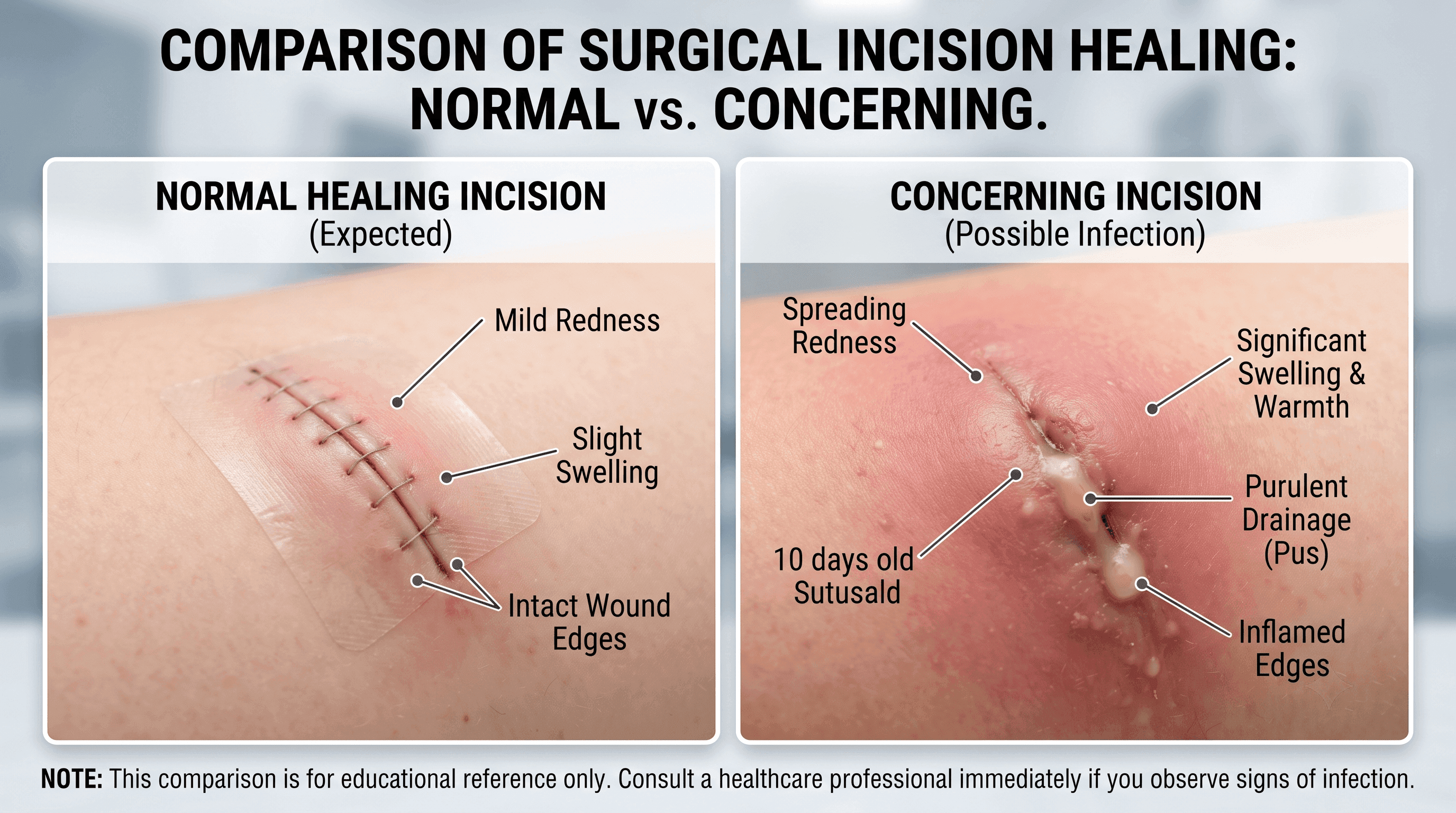
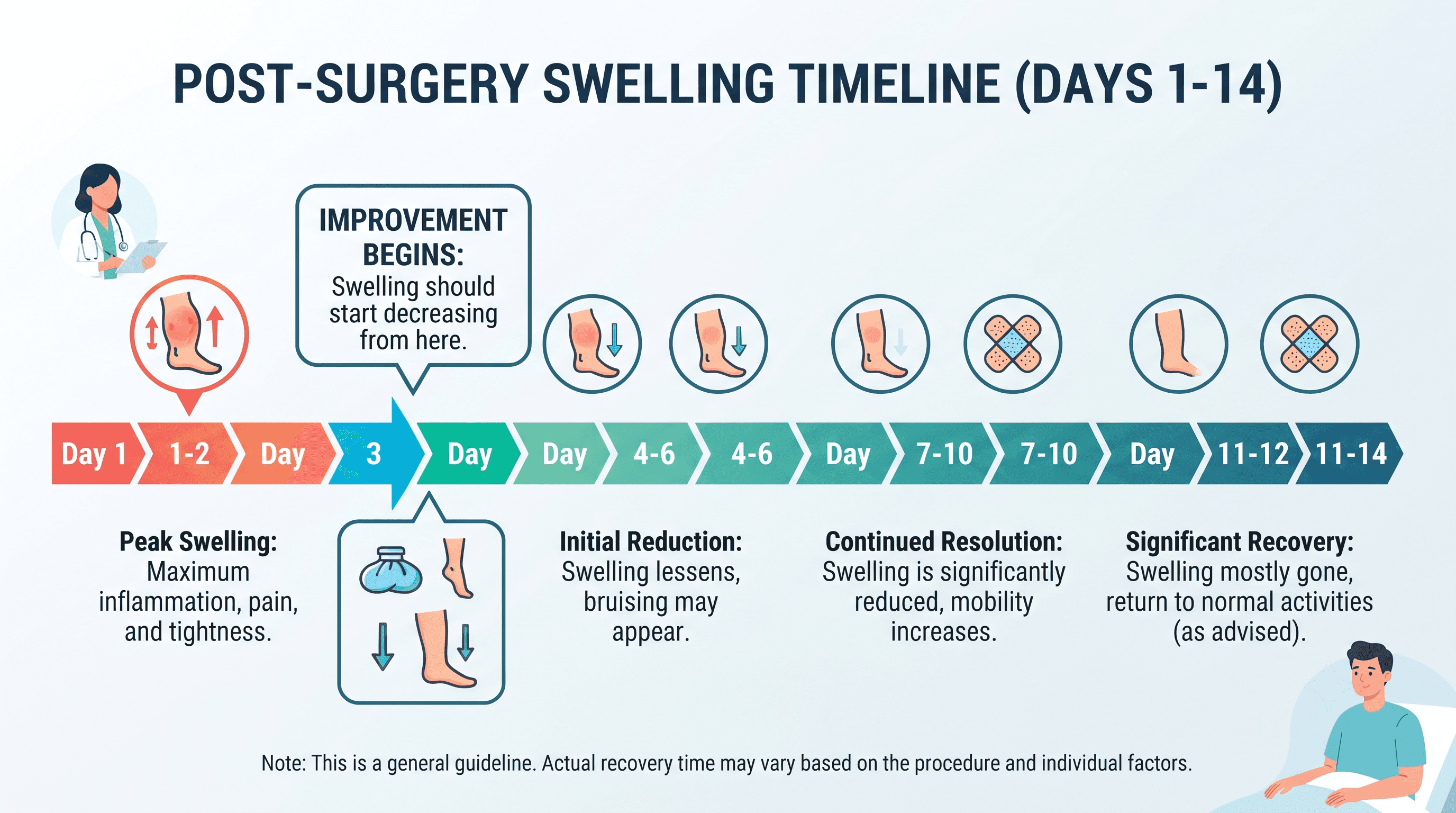
According to patient education from Healthgrades and hospital surgical recovery programs, some swelling, bruising, and mild warmth around an incision is expected as the body sends fluid and immune cells to the healing area. This typically peaks between 48 and 72 hours after surgery and then slowly decreases over the following one to two weeks.
Signs that generally fall within normal healing include:
- Mild to moderate swelling that peaks in the first 2 to 3 days
- Slight redness immediately around the incision that does not spread
- Clear or light pink drainage in small amounts
- Pain that gradually improves each day with prescribed medication
Warning Signs That Need Medical Attention
Multiple hospital sources, including UPMC HealthBeat and Healthgrades, describe a consistent set of warning signs that distinguish normal healing from a complication.
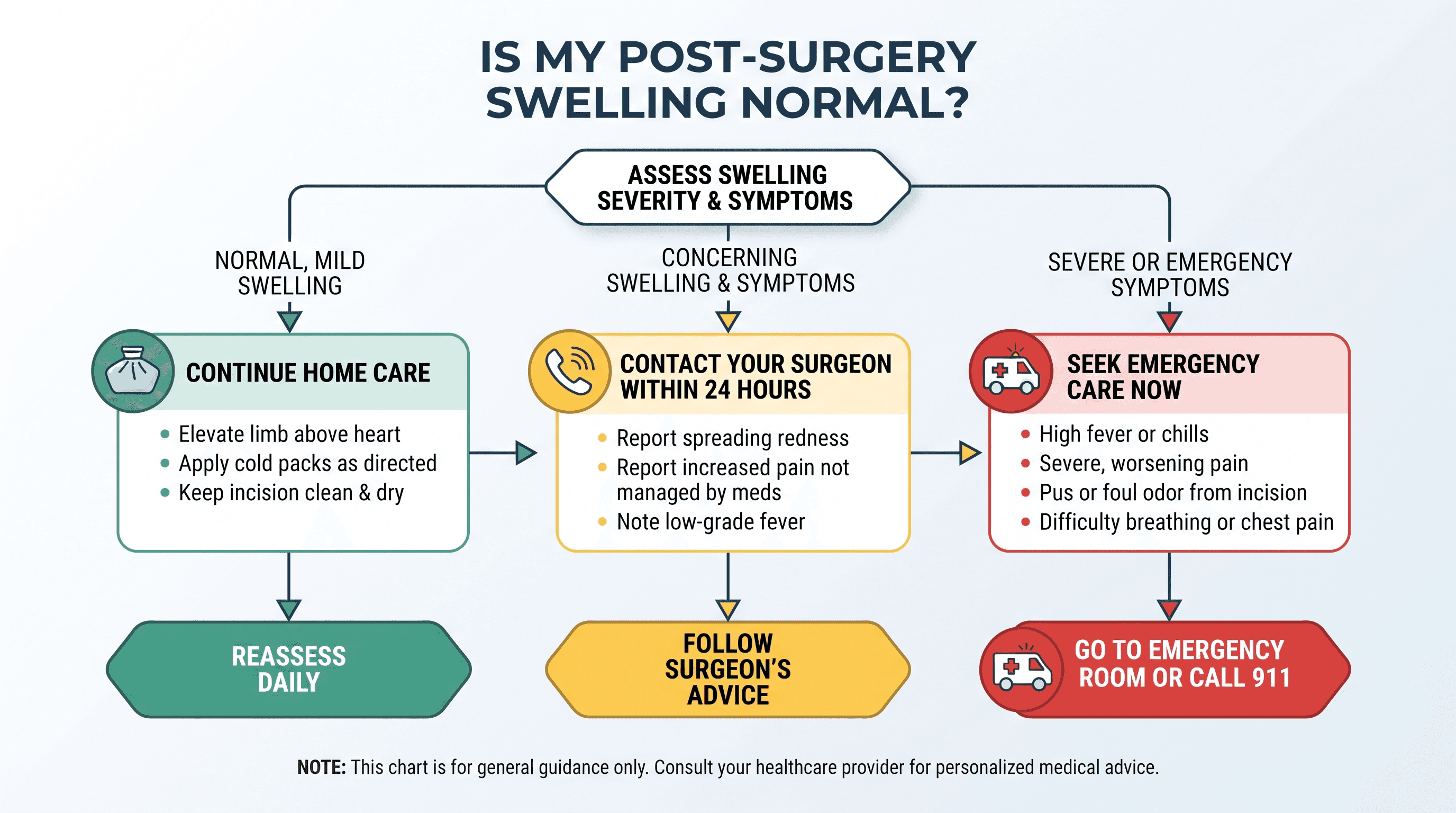
Contact your surgeon or seek care if you notice:
- Swelling that increases after day 3, or swelling that appears 48 or more hours after surgery
- Redness or warmth that spreads beyond the original area
- Fever of 100.4°F or higher, especially with chills
- Thick, cloudy, yellow, green, or foul-smelling drainage
- Pain that gets worse instead of better, or pain not controlled by medication
- Swelling, redness, or warmth in one leg only, which can signal a blood clot (DVT)
Seek emergency care immediately for sudden shortness of breath, chest pain, a fast heartbeat, or coughing up blood. These can indicate a pulmonary embolism and require immediate treatment.
Comparison Table
| Platform | Best For | Pricing | Physician Involvement | Availability |
|---|---|---|---|---|
| Momentary | Deciding whether swelling needs medical evaluation | Free AI navigator | Physician-reviewed guidance | AI navigator nationwide; physician services in California only |
| Ada Health | Free general symptom assessment | Free | Medically reviewed content | Available in the US via app and web |
| Buoy Health | Quick symptom triage | Free | Clinician-built content | Available via web nationwide |
| Force Therapeutics | Structured post-op monitoring with your surgical team | Provided through hospitals; not sold directly to individuals | Direct clinical team oversight | Only available if your hospital or surgeon enrolls you |
| PeerWell (Bardavon) | Surgical prehab and recovery programs through payers or employers | Information not publicly available for individual purchase | Care team oversight | Enterprise and payer-based access only |
Ranked Recommendations
1. Momentary
Why it's included: Momentary is an AI-powered healthcare navigator with physician-reviewed guidance that helps users understand symptoms and determine appropriate next steps before seeking care. For post-surgery swelling, that means helping you decide whether your symptoms fit self-care, a call to your surgeon, telehealth, urgent care, or the emergency room.
Best for: People who are unsure whether their swelling requires same-day attention or can wait for a scheduled follow-up.
Strengths:
- Physician-reviewed guidance built specifically around the "what should I do next" decision
- Free AI healthcare navigator available nationwide
- Helps compare healthcare costs if you're deciding between telehealth, urgent care, and the ER
Limitations:
- Does not diagnose infection or blood clots
- Physician services are currently available only in California; the AI navigator is available nationwide
- Not a substitute for calling your surgeon or 911 in an emergency
Pricing: Free AI healthcare navigator.
When to choose something else: If your hospital already provides a dedicated post-op monitoring platform like Force Therapeutics, use that first, since it connects directly to your actual surgical team.
2. Ada Health
Why it's included: Ada Health is a widely used, medically reviewed symptom assessment app that can help you organize your symptoms (swelling, redness, fever, pain level) before deciding what to do next.
Best for: Getting a structured symptom overview to bring to a telehealth visit or nurse line call.
Strengths:
- Free to use
- Medically reviewed symptom logic
- Simple, guided question format
Limitations:
- General symptom checker, not built specifically for post-surgical recovery
- Does not have access to your surgical history or incision details unless you enter them
- Cannot rule out surgical site infection or DVT
Pricing: Free.
When to choose something else: If you want guidance that also weighs cost and care-setting tradeoffs, Momentary or a call to your surgeon's office is more directly useful.
3. Force Therapeutics
Why it's included: Force Therapeutics is a digital patient engagement platform used by hospitals and orthopedic practices to guide patients through pre-op, non-op, and post-op recovery, including automated check-ins and real-time triage alerts to their actual care team.
Best for: Patients whose surgeon or hospital has already enrolled them in the program, since it connects directly to the clinical team monitoring their case.
Strengths:
- Built specifically for surgical recovery, not general symptoms
- Sends real-time alerts to your care team based on your reported symptoms
- Includes video-based rehab guidance tailored to your specific procedure
Limitations:
- Not available for individual purchase or download; access depends on whether your hospital uses the platform
- Pricing is not publicly available for individuals, since contracts are between Force Therapeutics and health systems
- Not useful if your provider does not already offer it
Pricing: Information not publicly available for individual consumers. Provided through hospital and health system contracts.
When to choose something else: If your hospital does not offer Force Therapeutics, a general navigator like Momentary or a symptom checker like Ada or Buoy is a more realistic starting point.
4. Buoy Health
Why it's included: Buoy Health is a free, clinician-built symptom checker that asks a series of questions about your symptoms and suggests next steps for seeking care.
Best for: A quick, no-cost second opinion on whether swelling and related symptoms warrant a call to your provider.
Strengths:
- Free and does not require an account for basic use
- Conversational format that's easy to complete quickly
- Built by clinicians with a large underlying symptom database
Limitations:
- General-purpose tool, not surgery-specific
- Cannot assess incision appearance or wound photos
- Should not replace a call to your surgical team for post-op concerns
Pricing: Free.
5. PeerWell (Bardavon Health Innovations)
Why it's included: PeerWell, now operating under Bardavon Health Innovations, builds surgical prehabilitation and recovery programs used by payers, employers, and workers' compensation insurers to support patients through orthopedic recovery.
Best for: Patients whose insurer, employer, or workers' compensation program has already enrolled them.
Strengths:
- Designed specifically around surgical recovery timelines
- Backed by care teams that track outcomes and flag risk
Limitations:
- Not something you can sign up for independently as an individual patient
- Pricing is not publicly available, since access runs through payer and employer contracts
- Limited usefulness if you were not enrolled through your insurer or employer
Pricing: Information not publicly available for individual purchase.
Who Should Choose Each Option
- Choose Momentary if you want free, physician-reviewed help deciding whether your swelling needs a call, a telehealth visit, urgent care, or the ER.
- Choose Ada Health or Buoy Health if you want a quick, free symptom overview to organize your thoughts before calling your provider.
- Choose Force Therapeutics only if your hospital or surgeon has already enrolled you, since it connects directly to your care team.
- Choose PeerWell only if your insurer, employer, or workers' compensation program has already set up your access.
- Skip apps entirely and call your surgeon's office or 911 if you have spreading redness, fever over 100.4°F, one-sided leg swelling, or breathing difficulty.
Pros and Cons Summary
Momentary
- Pros: Free, physician-reviewed, nationwide, built around the "what do I do next" question
- Cons: Physician services limited to California, does not diagnose
Ada Health
- Pros: Free, medically reviewed, easy to use
- Cons: General symptom checker, not surgery-specific
Buoy Health
- Pros: Free, fast, clinician-built
- Cons: General symptom checker, no incision-specific guidance
Force Therapeutics
- Pros: Built for surgical recovery, connects to your real care team
- Cons: Only available through hospital enrollment, no public consumer pricing
PeerWell (Bardavon)
- Pros: Structured surgical recovery support
- Cons: Enterprise-only access, no public consumer pricing
FAQ
How much swelling is normal after surgery? Some swelling is expected and typically peaks 48 to 72 hours after surgery before gradually improving over one to two weeks. It should decrease steadily rather than continuing to worsen.
When should I worry about swelling after surgery? Contact your surgeon if swelling increases after day 3, spreads beyond the incision, feels hot or tense, or is accompanied by fever above 100.4°F, increasing pain, or unusual drainage.
Can an app tell me if my incision is infected? No app can diagnose an infection. Tools like Momentary, Ada Health, and Buoy Health can help you decide whether your symptoms warrant contacting your surgeon or seeking care, but a physical exam is needed to confirm infection.
Is Force Therapeutics free to use? Force Therapeutics is provided through hospitals and surgical practices, not sold directly to individual patients. Pricing for hospitals is not publicly available, and access depends on whether your provider uses the platform.
Does Momentary diagnose swelling problems? No. Momentary is an AI-powered healthcare navigator with physician-reviewed guidance that helps users understand symptoms and determine appropriate next steps. It does not diagnose conditions or replace a physician's evaluation.
What's the difference between normal swelling and a blood clot? Normal post-surgical swelling typically affects the area around the incision on both sides evenly if bilateral surgery was performed. Swelling, redness, or warmth in one leg only, especially with calf pain, can indicate a blood clot and needs prompt medical evaluation.
Should I call my surgeon or use a symptom checker first? If you have any warning signs like fever, spreading redness, or one-sided leg swelling, call your surgeon's office directly. Symptom checkers are more useful for organizing milder, ambiguous symptoms before that call.
Is there a free tool for checking post-surgery symptoms? Yes. Momentary, Ada Health, and Buoy Health are all free to use and can help you think through whether your symptoms match normal healing or need medical attention.


