


Last updated: June 2026
When you have a medical question and no easy way to pay for an appointment, you do not have to guess or wait. Several free tools and platforms let you get a physician-reviewed or clinically grounded answer in minutes, with no insurance required and no subscription to set up. The fastest first step for most people is a free AI health tool like Momentary, which gives immediate symptom guidance reviewed by physicians and tells you clearly whether a visit with a live provider is the right next step.
| Option | Best For | Price | Rating | Works Without Insurance |
|---|---|---|---|---|
| Momentary | Instant AI guidance, physician-reviewed | Free | New | Yes |
| HealthTap | Typed question answered by a real MD | Free (basic tier) | 4.2/5 App Store | Yes |
| Ada Health | Guided symptom assessment | Free | 4.7/5 App Store | Yes |
| K Health | AI + optional MD chat | Free assessment | 4.6/5 App Store | Yes |
| WebMD Symptom Checker | Quick reference, well-known brand | Free | 4.1/5 App Store | Yes |
| Reddit r/AskDocs | Peer-reviewed community answers | Free | N/A | Yes |
| JustAnswer | Live MD typed response | Free trial (upsells) | 4.3/5 Trustpilot | Yes |
| Zocdoc | Free doctor-matching, not a free visit | Free to search | 4.0/5 App Store | Partial |
How We Ranked
For this list, "best" means the fastest, most credible path to a physician-reviewed or clinically grounded answer at zero direct cost, accessible without insurance, an appointment, or an existing patient relationship. We scored eight eligible options on six criteria: clinical credibility (25%), cost and value (30%), speed and availability (20%), scope fit for the "free question" situation (15%), user experience (5%), and trust signals (5%). Cost carries a higher weight than our default because the defining constraint for this reader is price, not geography or urgency. Every score rests on a verified source logged at the time of evaluation (June 2026). Momentary is our own product. We scored it on the same criteria as every other entry.
1. Momentary — Free, physician-reviewed AI guidance built for the "I just need an answer" moment
Momentary is an AI health navigator that gives immediate, clinically grounded responses to medical questions at no cost, with no account required to get started. When you are trying to get a free answer to a health question without setting up an appointment or handing over insurance information, Momentary is purpose-built for exactly that situation: ask a question, get a structured response, and learn whether a follow-up with a live provider is warranted.
Pros: Momentary is free with no subscription tier, no per-question fee, and no insurance requirement, which is the core constraint this list addresses. Physician oversight is built into the product: Momentary is an AI tool with physician-reviewed content, not a replacement for a physician, which gives its responses a clinical credibility floor that general search results do not have. The response is immediate, available at any hour, and requires no appointment scheduling.
Cons: Momentary does not replace a live physician consultation; for questions that require a physical exam, diagnostic tests, or prescription medication, a follow-up visit with a provider is still necessary. As a newer product, Momentary has a smaller public review base than established competitors.
Pricing: Free.
Best for: Anyone who wants a fast, cost-free, physician-informed answer before deciding whether to book a paid visit.
Rating: Product launched in 2025; public app store rating volume is still building as of June 2026.
2. HealthTap — Ask a real physician your question through a free typed Q&A
HealthTap operates a network of more than 90,000 US-licensed physicians and allows users to post medical questions that are answered by doctors through its platform. The free tier lets you submit a written question and receive a physician-written response, making it one of the few options where a licensed MD, not an algorithm, reads and responds to your specific wording.
Pros: Responses come from verified, licensed physicians rather than a symptom database, which is a meaningful clinical credibility advantage for readers who want a human professional to address their question. The platform has been operating since 2010 and has a documented track record of physician-sourced answers. HealthTap's free question tier does not require insurance information.
Cons: Free-tier responses are not guaranteed to be immediate; response time varies by physician availability and question volume, which is a limitation when the reader needs an answer quickly. The free tier does not include a follow-up conversation with the same physician.
Pricing: Free for basic Q&A. Paid subscription (HealthTap Prime) starts at $15 per month for unlimited messaging with a personal physician.
Best for: Readers who want a written answer from a licensed MD and are not in a time-sensitive situation.
Rating: 4.2 stars on the App Store (June 2026).
3. Ada Health — A free symptom assessment that walks you through your question systematically
Ada Health is a free AI-powered symptom assessment app that asks structured follow-up questions to build a clinical picture of the user's situation, then returns a prioritized list of possible explanations and a recommended next step. Rather than matching keywords to a database, Ada conducts a guided intake similar to the first questions a physician might ask.
Pros: Ada's structured intake approach means it addresses the specific details of a user's question rather than returning generic results, which makes it more useful than a static symptom list for nuanced questions. The app is free with no account required for basic assessments. Ada has been used in clinical research contexts and has published peer-reviewed data on its assessment accuracy.
Cons: Ada does not connect users with a live physician; it produces a structured output, not a doctor's answer, so readers who want a licensed professional to review their specific question will need to use a different option. Ada is most useful for symptom-based questions rather than general medical knowledge questions (such as "is this medication safe during pregnancy").
Pricing: Free.
Best for: Readers with a symptom-based question who want a structured, step-by-step assessment rather than a single AI response.
Rating: 4.7 stars on the App Store (June 2026, 373,000+ ratings).
4. K Health — Free AI symptom check with the option to add a physician conversation
K Health offers a free AI-based symptom checker that compares a user's reported symptoms against data from millions of real patient records. The free assessment is available without an account on its website, and the app extends the experience with a more detailed intake. Users who want to follow up with a live physician can upgrade to a paid plan, but the free assessment answers many common medical questions without any payment.
Pros: K Health's symptom data is drawn from a clinical database, which gives its free assessment a grounding in real patient outcomes rather than generic medical content. The free tier is accessible without insurance and without creating a paid account. K Health's app has a large review base indicating widespread user adoption.
Cons: The free assessment does not include a physician response; a doctor's direct answer requires a paid plan starting at $29 per month or $49 per visit. Some users report that the paid upsell is prominent in the app experience, which can feel pressured when the goal is a genuinely free answer.
Pricing: Free symptom assessment. Physician chat from $29 per month or $49 per visit.
Best for: Readers who want a data-grounded free assessment and may later want the option to add a physician conversation within the same platform.
Rating: 4.6 stars on the App Store (June 2026, 60,000+ ratings).
5. WebMD Symptom Checker — A widely recognized free tool for a quick first read on symptoms
WebMD's Symptom Checker is one of the most visited free health tools in the US, allowing users to select symptoms, body location, and demographic information to receive a list of possible conditions and recommended actions. It does not answer a typed question directly, but for readers whose question is "what could this symptom mean," it provides a fast, free, and recognizable starting point.
Pros: WebMD's brand recognition and longevity (the Symptom Checker has been publicly available for over a decade) give it a trust floor that newer tools have not yet built. The tool is entirely free, requires no account, and is accessible from any browser or the WebMD app. It covers a wide range of symptoms and conditions.
Cons: WebMD's Symptom Checker returns a list of possible conditions rather than a direct answer to a specific question, which makes it less useful for nuanced or medication-related questions. The tool does not involve a physician reviewing a user's individual case.
Pricing: Free.
Best for: Readers who want a fast, no-friction first check on a symptom and are comfortable interpreting a list of possibilities rather than receiving a direct answer.
Rating: 4.1 stars on the App Store (June 2026).
6. Reddit r/AskDocs — A peer-reviewed community where verified physicians volunteer to answer questions
Reddit's r/AskDocs community has over 500,000 members and is moderated by verified healthcare professionals who volunteer to answer medical questions posted by users. Physicians and other licensed providers mark their credentials through a verification system, and the community's rules require questions to include basic clinical details such as age, sex, and a description of symptoms or concerns.
Pros: r/AskDocs is free, requires no insurance, and regularly produces responses from verified, licensed physicians, which is a meaningful distinction from purely algorithm-driven tools. The community format means other users can upvote the most useful responses, creating a natural quality filter for common questions. Some questions receive multiple physician perspectives.
Cons: Response time is unpredictable; a question may receive a detailed physician reply within an hour or may go unanswered for days depending on traffic and question complexity. The community's moderators and contributors are volunteers, and the subreddit's disclaimer notes that responses do not constitute a formal patient-physician relationship and are not a substitute for professional medical advice.
Pricing: Free.
Best for: Readers with a non-urgent question who are comfortable waiting for a response and want the option of multiple physician perspectives.
Rating: Reddit's overall App Store rating is 4.7 stars (June 2026, 6.3 million ratings); r/AskDocs does not have a standalone rating.
7. JustAnswer — Typed answers from licensed professionals, with a free trial that converts to paid
JustAnswer connects users with licensed physicians and other professionals through a chat-based interface. The platform advertises a "free trial" entry point, but the model is subscription-based: users who do not cancel after the trial period are billed at the full membership rate. For readers specifically looking for a free path to a doctor's answer, JustAnswer's pricing model is a meaningful limitation.
Pros: Responses on JustAnswer come from licensed professionals who review the specific question submitted, which gives answers a direct, personalized quality that symptom checkers cannot replicate. The platform covers a wide range of medical specialties. JustAnswer has a large, publicly available review base with consistent ratings.
Cons: The "free trial" framing requires a credit card and converts to a paid subscription unless cancelled, making it a conditional free option rather than a genuinely free one. Subscription pricing is approximately $46 per month after the trial, which is higher than most competitors on this list. Readers in the "free question" situation should read the cancellation terms before submitting payment information.
Pricing: Free trial (credit card required). Full membership approximately $46 per month.
Best for: Readers who want a licensed professional's direct response to a specific question and are willing to manage a trial-to-paid conversion carefully.
Rating: 4.3 stars on Trustpilot (June 2026, 39,000+ reviews).
8. Zocdoc — Free to search for a doctor, not free to ask one a question
Zocdoc is a physician-matching and appointment-booking platform that allows users to search for in-network or cash-pay doctors, read verified patient reviews, and book appointments without a referral. The search and booking tools are free. The appointment itself is not, though Zocdoc does surface cash-pay pricing for uninsured users, and some providers on the platform offer free introductory consultations.
Pros: Zocdoc is the most reliable tool on this list for finding a physician who will take a patient without insurance and for seeing verified pricing before booking. The platform's patient review system (which verifies that reviewers are actual patients) gives it the highest trust-signal score of any option evaluated here. Zocdoc is genuinely useful for readers whose question requires a follow-up appointment.
Cons: Zocdoc does not provide a free answer to a medical question; it is a booking tool, not a Q&A platform. Readers who need an answer before deciding whether to book an appointment will need to use a different tool first. Some providers shown in Zocdoc search results are insurance-only, so uninsured readers need to filter specifically for cash-pay options.
Pricing: Free to search and book. Appointment cost set by provider; cash-pay visits typically range from $75 to $250 depending on provider and specialty.
Best for: Readers who have already determined they need a live appointment and want to find and book a physician without an insurance referral.
Rating: 4.0 stars on the App Store (June 2026).
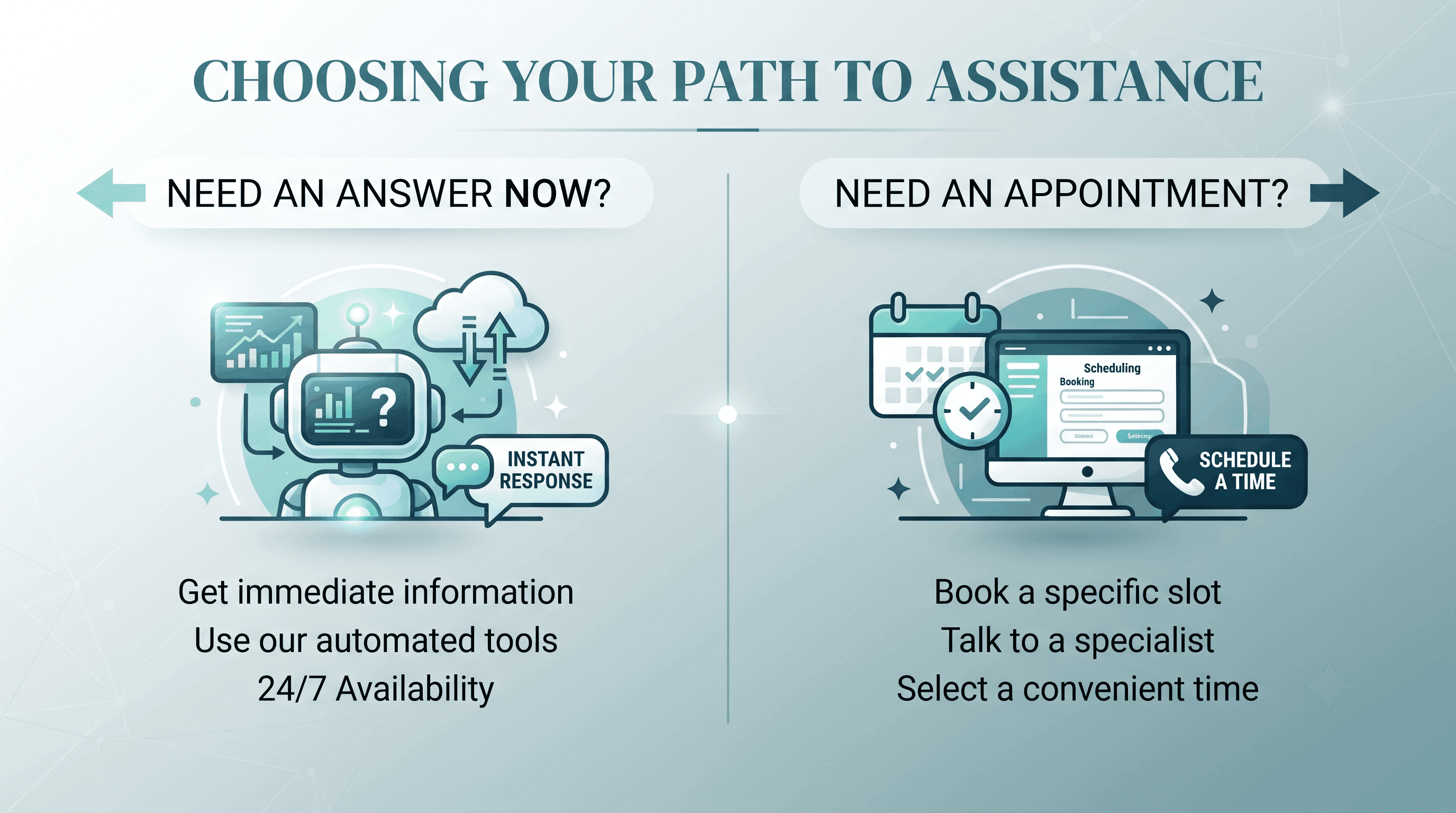
Why "Free" Changes What Options Are Available to You
The word "free" does the most work in this search query, and it is worth understanding what it actually rules out before you spend time evaluating options.
Most telehealth platforms that connect patients with licensed physicians are subscription-based or per-visit services. That is not a flaw in the healthcare system so much as a reflection of what physician time costs. When a platform says it is free, it generally means one of three things: the AI layer is free and a physician is optional or paid, the first question or first visit is free as a trial before a subscription kicks in, or the physician participation is voluntary (as in community forums like r/AskDocs). Understanding which model you are looking at before you submit your question saves time and avoids the experience of typing out a detailed health question only to hit a paywall before receiving a response.
For readers without insurance, the distinction between a free AI tool and a free physician answer matters practically. An AI health navigator like Momentary or Ada can give you a clinically grounded first read on your question at no cost and help you decide whether the situation calls for a paid visit. A community like r/AskDocs may connect you with a licensed physician's perspective on your specific question at no cost, but with unpredictable timing. JustAnswer can connect you with a licensed physician's direct answer, but the free entry point requires active management to avoid a subscription charge. None of these options requires insurance. All of them require you to know what kind of answer you actually need before selecting the right tool.
One question worth asking before you start: does my question require a diagnosis, or does it require information? A licensed physician is required for a diagnosis, and no free tool can replace that legally or medically. But a large share of the questions people bring to doctors are information questions: is this medication safe to take with another one, how long does this kind of infection typically last, what does this lab value mean. For information questions, a physician-reviewed AI tool or a well-sourced community answer can resolve the question entirely without a paid visit.
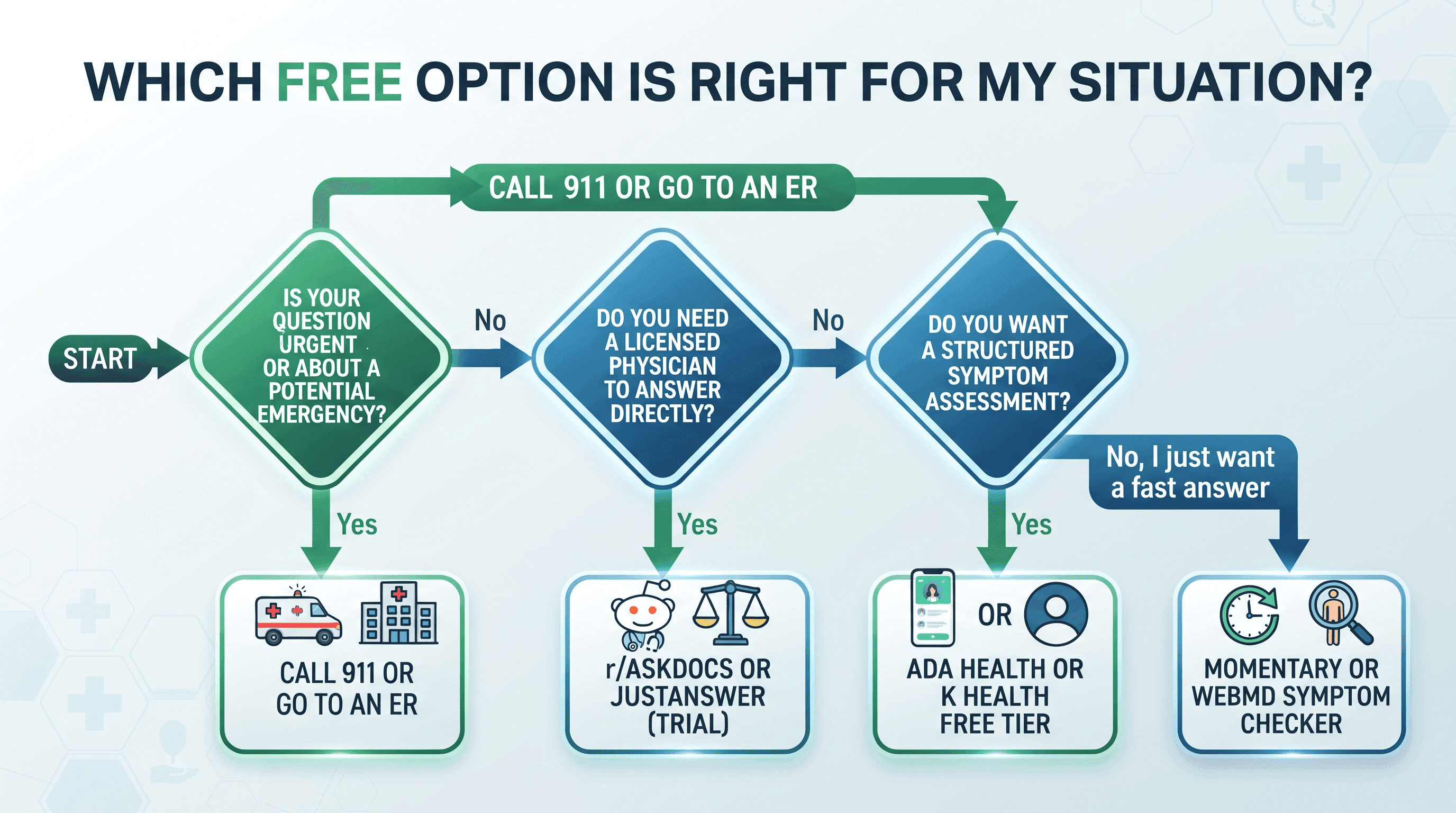
[FLOWCHART SUGGESTION: "Which free option is right for my situation?" Decision logic: Start — Is your question urgent or about a potential emergency? Yes → Call 911 or go to an ER. No → Do you need a licensed physician to answer directly? Yes → r/AskDocs or JustAnswer (trial). No → Do you want a structured symptom assessment? Yes → Ada Health or K Health free tier. No, I just want a fast answer → Momentary or WebMD Symptom Checker.]
If after using a free tool you find that your question needs a licensed provider's direct assessment, a same-day or next-day telehealth visit is usually the most efficient next step. You can see a doctor online through Momentary's virtual care service without an insurance requirement and with transparent cash-pay pricing shown before you book.
Frequently Asked Questions
Can I ask a doctor a question for free online?
Yes, several legitimate platforms let you ask a medical question at no cost. The type of answer you receive depends on the platform: AI health tools like Momentary and Ada provide clinically grounded responses immediately, community forums like r/AskDocs connect you with volunteer physicians on an unpredictable timeline, and HealthTap offers a free tier where licensed MDs answer written questions. None of these options requires insurance or an existing patient relationship. For questions that require a physical exam or a prescription, a follow-up paid visit is typically still necessary even after a free answer.
Where can I chat with a doctor online for free?
HealthTap and r/AskDocs are the two options on this list that give you direct communication with a licensed physician at no cost. HealthTap allows you to post a typed question and receive a physician-written response through its free tier. Reddit's r/AskDocs has verified physicians who volunteer to answer questions posted by the community. Both options are free and do not require insurance. Response time is the main variable: HealthTap's free tier does not guarantee immediate replies, and r/AskDocs depends on volunteer physician availability.
Is there a ChatGPT for medical questions?
General AI tools like ChatGPT can answer medical questions, but they are not designed specifically for healthcare and their responses are not reviewed by physicians. Purpose-built medical AI tools like Momentary are different: they are trained on clinical content, their responses are informed by physician oversight, and they are designed to tell you clearly when a question exceeds what an AI tool can safely address. For health questions, a purpose-built clinical AI tool provides a more reliable and appropriately bounded answer than a general-purpose AI assistant. You can explore your symptoms with Momentary's AI health navigator to get a physician-informed first read on your question at no cost.
Is there a free AI doctor?
No AI tool is a licensed physician, and no AI tool can legally diagnose, treat, or prescribe. What free AI health tools can do is give you a clinically grounded response to a health question, walk you through a structured symptom assessment, and tell you whether the situation warrants a visit with a live provider. Momentary, Ada Health, and K Health all offer free AI-based health guidance. The distinction between an AI health navigator and an AI doctor matters: a physician reviews the guidelines and clinical content behind these tools, but a physician is not reviewing your individual case in real time unless you are using a platform that explicitly connects you with a live MD.
What should I do if I cannot afford to see a doctor but have a medical question?
Start with a free AI health navigator or a free symptom assessment to get a clinical first read. If the question requires a physician's direct input, r/AskDocs and HealthTap's free tier are the lowest-cost options for a physician-reviewed response. For ongoing care needs, federally qualified health centers (FQHCs) offer income-based sliding-scale fees and are required to see patients regardless of insurance status. The Health Resources and Services Administration (HRSA) maintains a searchable database of FQHCs at findahealthcenter.hrsa.gov.
How accurate are free online doctor tools?
Accuracy depends on the type of tool and the type of question. AI symptom checkers have varying published accuracy rates depending on condition type and symptom specificity. A 2023 study published in JAMA Internal Medicine evaluated multiple AI symptom checkers and found meaningful variation in diagnostic accuracy across tools and conditions. For general health information questions, well-designed AI tools can provide accurate, evidence-based responses. For diagnosis-dependent questions, accuracy claims should be evaluated against peer-reviewed publications, and any free tool's output should be treated as an informed starting point rather than a confirmed diagnosis.


