

Last Updated: July 2026
A medical bill full of codes and abbreviations can feel impossible to read. That confusion is common, and it is not a sign that something is wrong with you. It is a sign that medical billing was not designed to be read by patients.
Quick Answer
Start by requesting an itemized bill from the provider, which breaks charges into individual line items with CPT, HCPCS, or revenue codes. Compare it to your Explanation of Benefits (EOB) from your insurer, which shows what your plan paid and what you may owe. Free tools like the AMA and CMS code lookup databases can translate individual codes into plain language. If you spot possible errors, duplicate charges, or an amount that seems too high, nonprofit patient advocates such as the Patient Advocate Foundation and Dollar For can help you dispute or apply for financial assistance at no cost. For hospital bills specifically, negotiation services like Goodbill or Resolve work on a contingency basis. If your bill involves a surprise out-of-network charge, the No Surprises Act gives you dispute rights through CMS.
Top Picks at a Glance
| Resource | Best For | Cost | Physician Reviewed | Availability |
|---|---|---|---|---|
| CMS No Surprises Help Desk | Disputing surprise or out-of-network bills | Free | No | Nationwide |
| Patient Advocate Foundation | Case management for chronic or serious conditions | Free | No | Nationwide |
| Dollar For | Applying for hospital charity care | Free | No | Nationwide (nonprofit hospitals) |
| Goodbill | Negotiating hospital bill overcharges | Free unless savings found | No | Nationwide |
| Resolve | Full-service bill review and negotiation | Contingency fee | No | Nationwide |
| AMA / CMS Code Lookup Tools | Looking up what a specific CPT or HCPCS code means | Free | No | Nationwide |
| Momentary | Comparing lab, imaging, and screening prices before you get care | Free AI navigation; physician services CA only | Yes | AI: nationwide. Physician services: California only |
What Is Actually on a Medical Bill?
Before you can decode a bill, it helps to know what type of document you are looking at.
A summary bill shows only a total amount due. It is hard to audit because it does not break out individual charges.
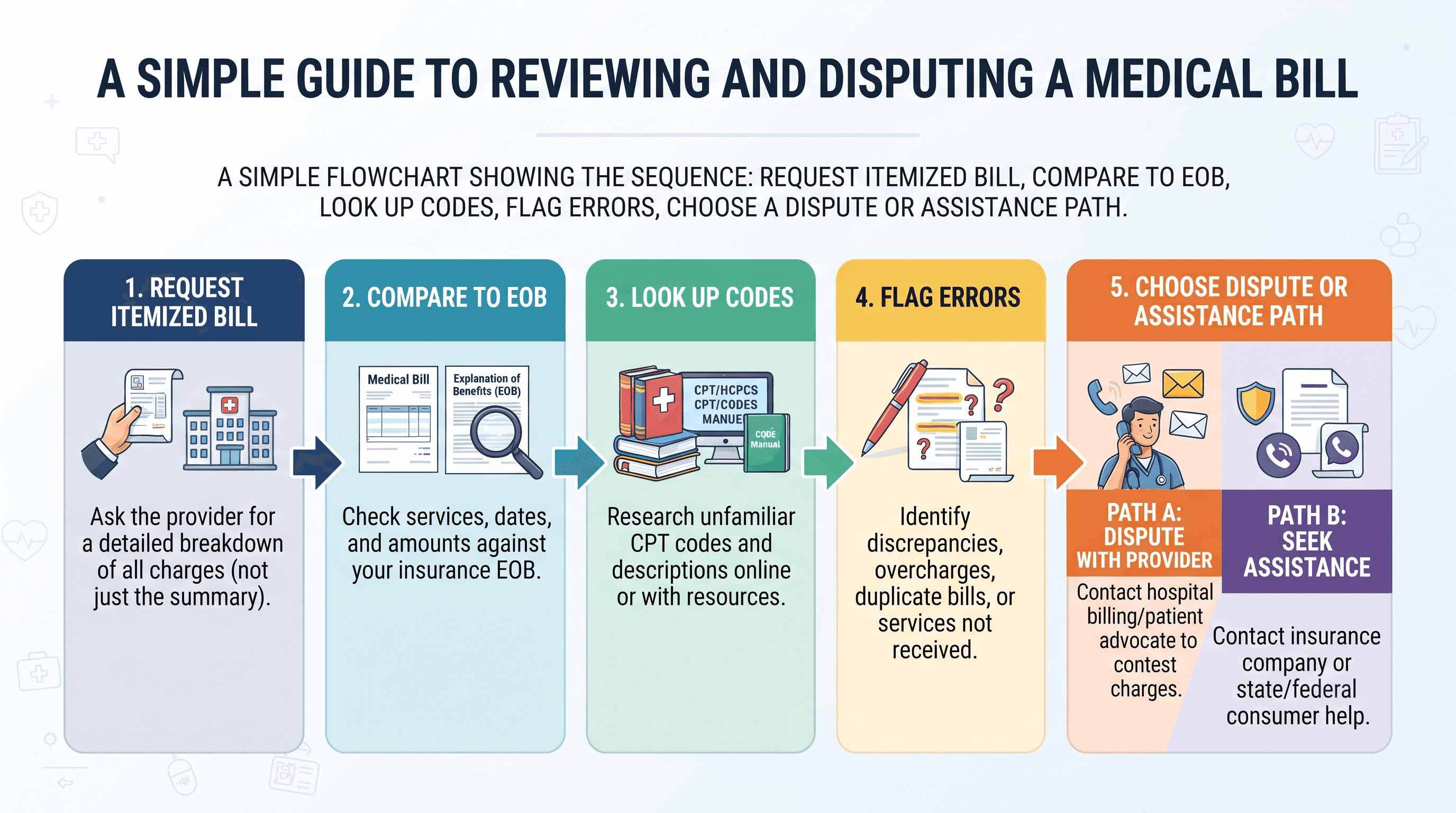
An itemized bill lists every service, supply, and code separately, along with the date of service and the charge for each line. This is the version you need in order to check for errors.
An Explanation of Benefits (EOB) comes from your insurance company, not your provider. It shows what was billed, what your plan paid, and what portion may be your responsibility. An EOB is not a bill, and most EOBs say so directly on the document.
If your provider only sent you a summary bill, you have the right to request an itemized version. Providers are generally expected to send it within about 30 days of your request.
How Do I Read the Codes on My Bill?
Medical bills rely on a small number of standardized coding systems. Understanding what each one does makes the rest of the bill much easier to interpret.
- CPT codes are five-digit codes maintained by the American Medical Association that identify a specific procedure, test, or office visit (for example, a Level 4 established-patient office visit).
- HCPCS codes are similar to CPT codes but typically cover drugs, medical supplies, and services not delivered directly by a physician. They usually start with a letter followed by four numbers.
- ICD-10 codes identify your diagnosis. Every billed CPT code should connect to a diagnosis code that makes clinical sense together.
- Revenue codes are four-digit, hospital-specific codes that identify which department provided a service.
- Modifiers are short codes, often two digits or letters, added to a CPT code to explain special circumstances, such as a procedure performed alongside a separate office visit.
You do not need to memorize these systems. Free lookup tools from the AMA and the federal Medicare code list let you enter a code from your bill and see what it represents in plain language.
What Should I Look for to Spot a Billing Error?
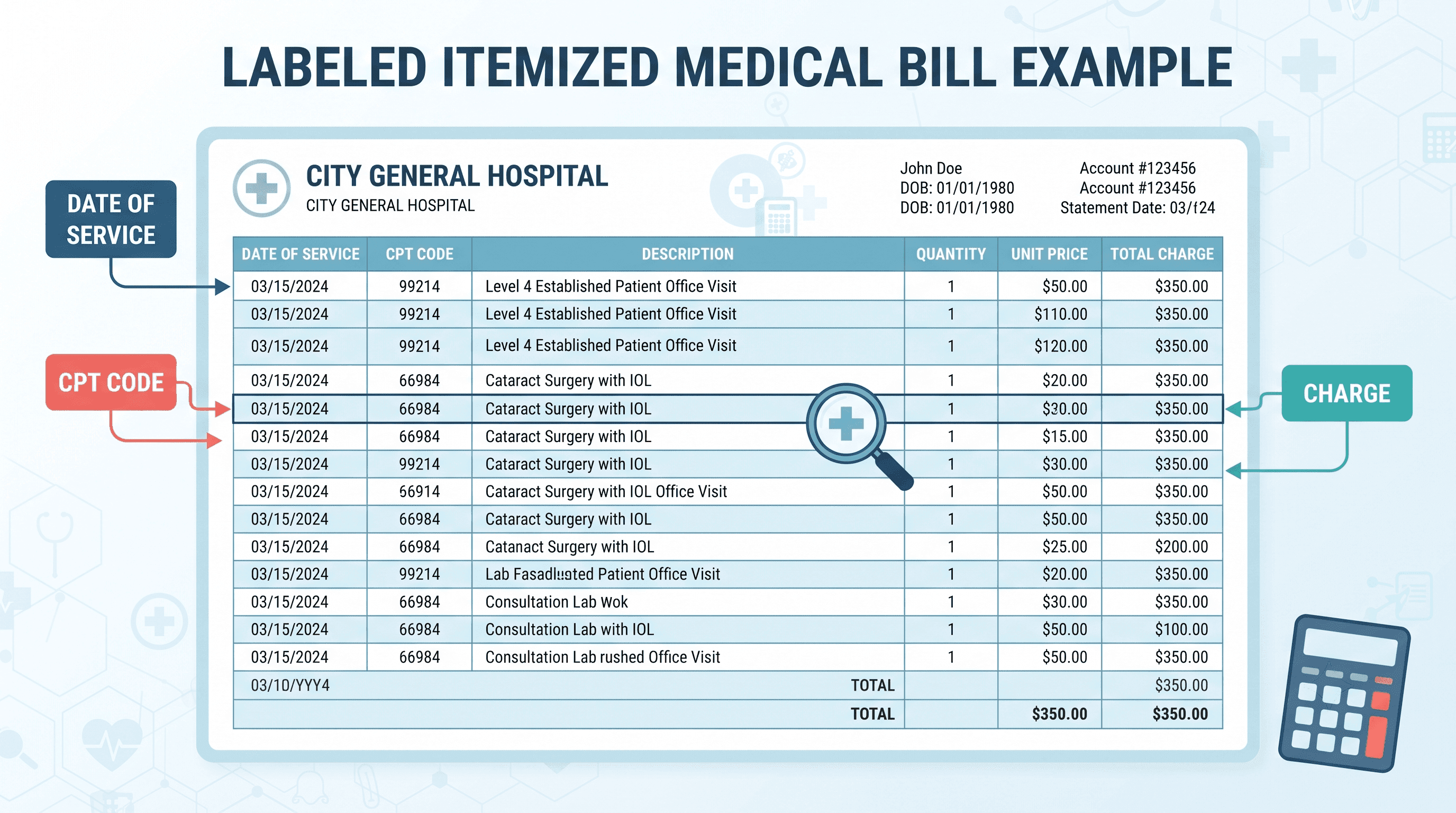
Once you have your itemized bill and your EOB side by side, check for these common issues:
- Duplicate charges. The same code billed twice for the same date of service.
- Unbundling. Separate charges for services that should have been billed together as one code.
- Upcoding. A higher-complexity code (like a Level 5 office visit) billed for what was actually a routine, shorter visit.
- Mismatched codes. A procedure code that does not logically connect to your diagnosis code.
- Services you did not receive. Medications ordered but never taken, or supplies you brought from home.
Estimates of how often hospital bills contain at least one error vary widely by source and bill complexity, ranging from roughly 30% to as high as 80% in some analyses of complex hospital stays. Even at the lower end of that range, a careful review is worth your time.
Best Ways to Decode and Dispute a Medical Bill
The right resource depends on whether you mainly need help understanding the bill, disputing an error, or affording what you owe.
1. CMS No Surprises Help Desk and Medical Bill Rights
Best for: Disputing a surprise or out-of-network bill
The federal No Surprises Act bans balance billing for emergency care, for out-of-network providers at in-network facilities, and for air ambulance services. If you are uninsured or self-pay and your final bill comes in $400 or more above the Good Faith Estimate you were given, you can file a dispute through the federal patient-provider dispute resolution process. CMS also runs a help desk for complaints about balance billing violations.
Strengths: Free, backed by federal law, applies nationwide, and covers the most financially serious billing surprises.
Limitations: Only applies to specific situations (emergency care, out-of-network care at in-network facilities, air ambulance, and Good Faith Estimate overages). It does not help you decode routine line-item charges or negotiate a bill that was correctly billed but simply expensive.
Choose something else if: Your bill is accurate but you simply cannot afford it. In that case, a charity care or negotiation resource below is a better fit.
2. Patient Advocate Foundation (PAF)
Best for: Ongoing case management for chronic, serious, or complex conditions
PAF is a national nonprofit that assigns patients a dedicated case manager at no cost. Case managers can help interpret bills, contact insurers, and pursue appeals over time, which is useful for people managing an ongoing illness rather than a single one-time bill.
Strengths: Free case management, no time limit on support, and experience with complex, multi-provider situations.
Limitations: Best suited to chronic or serious diagnoses rather than a single confusing bill from a routine visit. Response times depend on current case volume.
Choose something else if: You have a one-time bill and just need to check it for errors. A negotiation service or code lookup tool may be faster.
3. Dollar For
Best for: Applying for hospital charity care
Nonprofit hospitals are required to maintain financial assistance (charity care) policies, but most patients never apply because they do not know the programs exist or find the paperwork confusing. Dollar For is a nonprofit that screens patients for eligibility and completes hospital charity care applications at no cost.
Strengths: Completely free, specializes specifically in charity care paperwork, and can apply even to bills already in collections in many cases.
Limitations: Only helps with hospital bills, not physician, dental, ambulance, or pharmacy bills. Only applies to nonprofit hospitals, which have these legal obligations; for-profit hospitals are not required to offer the same programs.
Choose something else if: Your bill is from a physician's office, dentist, or ambulance company rather than a hospital.
4. Goodbill
Best for: Negotiating a hospital bill you believe is inflated
Goodbill reviews your itemized bill and medical record for coding errors and overcharges, then negotiates directly with the hospital on your behalf.
Strengths: Free unless the company finds savings, which limits your financial risk, and focused specifically on identifying coding-level errors.
Limitations: Works only on hospital bills, and outcomes depend on the specific hospital and the nature of the charges.
Choose something else if: You want a broader review that also covers charity care eligibility and insurance appeals, not just negotiation.
5. Resolve
Best for: A full-service advocate who handles review, appeals, and negotiation together
Resolve combines bill auditing, insurance appeal filing, charity care applications, and direct negotiation with providers into one service.
Strengths: Covers more of the process in one place than a single-purpose tool, and pricing is typically contingency-based.
Limitations: As with any contingency service, exact savings and fee structures vary by case, and the company's own reported outcomes have not been independently verified by Momentary.
Choose something else if: You prefer to handle the dispute yourself using free federal and nonprofit resources first, and only bring in a paid advocate if you get stuck.
6. AMA and CMS Code Lookup Tools
Best for: Looking up exactly what one confusing code on your bill means
If you just need to understand a single CPT or HCPCS code, the AMA and CMS both maintain databases where you can search a code and see its official description.
Strengths: Free, authoritative, and useful even if you plan to handle the rest of the process yourself.
Limitations: These tools explain what a code means. They do not tell you whether you were billed correctly, and they will not negotiate or dispute anything on your behalf.
Choose something else if: You have already identified a probable error and need help acting on it, not just understanding the code.
Where Does Momentary Fit In?
Momentary is an AI-powered healthcare navigator that helps people understand symptoms, decide on next steps, and compare healthcare prices, including laboratory, imaging, and screening costs, before they seek care. Momentary provides physician-reviewed guidance nationwide, though physician services are currently available only in California.
Momentary does not decode itemized bills, look up CPT codes, or negotiate charges with hospitals. That is a different task than the one Momentary is built for.
Where Momentary can genuinely help is earlier in the process: if you are trying to compare the cost of a lab test, imaging scan, or screening before you book it, Momentary's cost comparison tools can help you avoid an unexpectedly high bill in the first place. Think of it as a way to prevent billing confusion for planned, non-emergency care, rather than a tool for untangling a bill you have already received.
Quick Take
Best for: People trying to compare lab, imaging, or screening prices before scheduling care.
Avoid if: You already have a confusing bill in hand and need help decoding, disputing, or negotiating it. Use one of the resources above instead.
Next step: For an existing bill, start with a free itemized bill request and an EOB comparison. For upcoming, non-emergency care, compare prices in advance to reduce the chance of a surprise bill later.
How Do I Dispute a Medical Bill Once I Find an Error?
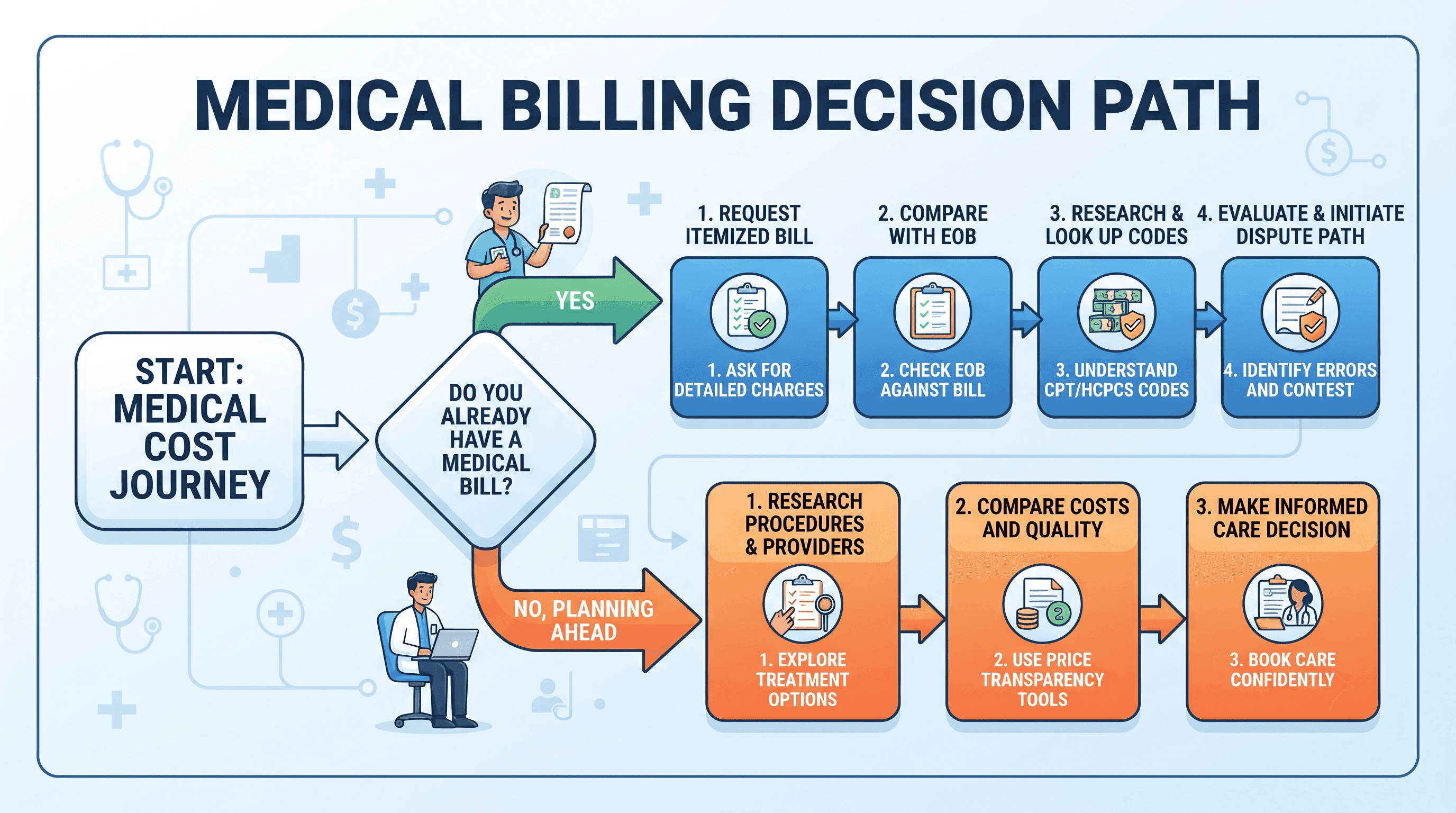
- Request the itemized bill in writing if you have not already received one.
- Compare it line by line to your EOB. Flag anything billed twice, priced strangely high, or unrelated to the care you remember receiving.
- Look up unfamiliar codes using the AMA or CMS code databases.
- Send a written dispute to the billing department, referencing the specific line item, code, and reason you believe it is incorrect. Keep a copy.
- Escalate if needed. Ask for a billing supervisor or patient advocate, and if the issue involves a surprise out-of-network charge, file a complaint with the CMS No Surprises Help Desk.
- Apply for financial assistance if the bill is accurate but unaffordable. Nonprofit hospitals are required to offer charity care programs, and organizations like Dollar For can help you apply.
Frequently Asked Questions
Can I refuse to pay a medical bill until I get an itemized version? Yes. You have the right to request a detailed, itemized statement before paying, and providers are generally expected to provide it within about 30 days.
Is an EOB the same as a bill? No. An EOB comes from your insurance company and explains what was billed and what your plan paid. It typically states directly that it is not a bill. Your actual bill comes from the provider or hospital.
How common are medical billing errors? Estimates vary depending on the source and the type of bill, ranging from roughly 30% to as high as 80% for complex hospital stays in some analyses. Because estimates vary this widely, it is worth reviewing any bill you do not fully understand rather than assuming it is correct.
What is the No Surprises Act, and does it apply to my bill? The No Surprises Act is a federal law that bans balance billing for emergency care, for out-of-network providers at in-network facilities, and for air ambulance services. If you are uninsured or self-pay and your bill is $400 or more above your Good Faith Estimate, you can also dispute it through the federal patient-provider dispute resolution process.
Can medical debt hurt my credit score? Under current major credit bureau policies, paid medical debt and unpaid medical debt under $500 are generally excluded from credit reports, and unpaid medical debt typically will not appear until it is at least a year past due. Policies can change, so check current guidance from the credit bureaus or a consumer finance resource for your specific situation.
Can Momentary negotiate my medical bill for me? No. Momentary is a healthcare navigator focused on symptom guidance, next-step decisions, and price comparison for services like lab tests, imaging, and screenings before you receive care. For decoding, disputing, or negotiating a bill you already have, use a resource like the ones listed above.


