


Last updated: September 2026
If you just enrolled in a new health plan in California, the fastest path to an in-network primary care doctor starts with your plan's own provider directory or Zocdoc, both of which let you filter by insurance before you ever pick up the phone. Under California's timely access rules, your plan must offer you a non-urgent primary care appointment within 10 business days of your request, so if a listed provider can't meet that window, call your plan's member services line and ask them to help you find one who can. The steps below walk through eight ways to establish care, ranked by how well each one solves the specific problem of finding someone who is actually in-network and actually taking new patients.
| Option | Best For | Price | Rating | In-Network With Your Plan |
|---|---|---|---|---|
| Zocdoc | Fast, insurance-filtered booking | Free | 4.9 stars, App Store (July 2026, 140,000+ ratings) | Filters by plan, provider self-reported |
| CA medical group/health system | Ongoing care with specialist access | Billed to insurance | Varies by group | Contracted directly with most major CA plans |
| Your health plan's directory | Verified in-network search | Free | N/A | Yes, by definition |
| FQHC | Sliding-scale, comprehensive care | Sliding scale, often $0 to low cost | N/A | Accepts most insurance plus uninsured |
| Momentary | Ongoing primary care by text; prescriptions, labs, and referrals | $19.99/month membership (HSA/FSA eligible); no per-visit fees | Newer service; limited third-party reviews | Not billed; cash membership |
| One Medical | Same/next-day virtual-first care | $199/year ($99/year with Amazon Prime) plus insurance billing per visit | 4.8 stars, Trustpilot (July 2026) | Accepts most major plans, not Kaiser |
| Employer portal/HR line | Employer-sponsored plan holders | Free | N/A | Pre-vetted for your specific plan |
| Direct Primary Care | Frequent visits, HDHP pairing | $50 to $100/month (AAFP, 2024 data brief) | N/A | Does not bill insurance |
How we ranked this list: For someone newly enrolled in a California health plan, "best" means the fastest, most reliable way to confirm a primary care doctor is actually in-network and accepting new patients, not just generally available. We scored eight approaches on six criteria: clinical credibility, cost and value, speed and availability, scope fit, user experience, and trust signals. Because the reader's core problem is matching a doctor to a specific plan rather than affording care from scratch, we weighted scope fit at 25% and cost and value at 15% (down from the 20% default), keeping clinical credibility, speed, user experience, and trust at their standard weights. Evaluation date: July 2026. Momentary is our own product. We scored it on the same criteria as every other entry.
1. Zocdoc — Filter by your exact plan and book same-day
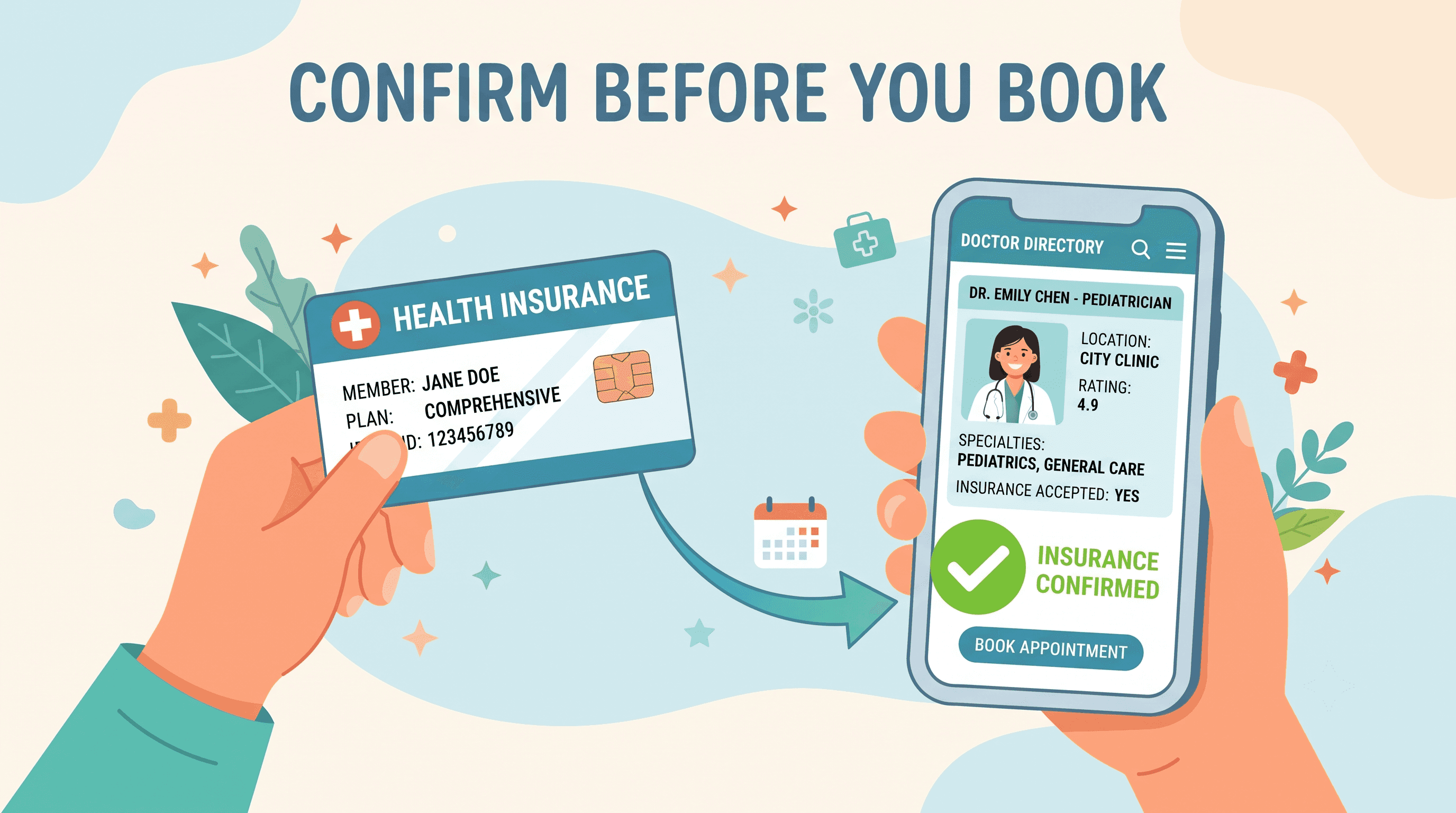
Zocdoc is a free online directory that lets you search for a primary care doctor by specialty, location, and insurance plan, then book directly if a same-day or next-day slot is open. For someone who just switched plans, this matters because you can see real-time availability filtered by your specific carrier before calling anyone.
Pros: You can filter results by your insurance plan and see which providers list themselves as in-network before booking. Same-day online booking is available for many primary care listings, which matters if you need care within the 10-business-day window California law requires. Verified patient reviews give you a sense of a provider's communication style before your first visit.
Cons: Providers self-report their insurance status on their profiles, and several patient reviews describe being billed as out-of-network despite a listing saying otherwise, so it's worth confirming directly with the office before your visit.
Pricing: Free to search and book.
Best for: Readers who want to compare several in-network options quickly and book without a phone call.
Rating: 4.9 stars on the App Store (July 2026, based on more than 140,000 ratings).
2. A California multi-specialty medical group or health system — Best for continuity once you've picked
Large California medical groups and health systems employ primary care physicians alongside specialists, labs, and imaging under one umbrella, and most maintain direct contracts with the major carriers people commonly enroll in during open enrollment. Choosing a doctor inside one of these groups means referrals, records, and specialist visits stay connected instead of scattered across separate systems.
Pros: These groups are directly contracted with most major California insurers, so network status is usually straightforward to confirm through the group's own scheduling line. Having your primary doctor, specialists, and labs under one system reduces the paperwork and referral delays that come with piecing together separate providers. Physicians in these groups typically have the deepest resources for managing an existing chronic condition long-term.
Cons: New patient wait times can run several weeks depending on the group and location, and some panels are temporarily closed to new patients in high-demand areas.
Pricing: Billed to insurance; your copay or coinsurance depends on your specific plan.
Best for: Readers managing a chronic condition remotely who want one connected system rather than scattered providers.
Rating: Varies by system; check the group's own new-patient satisfaction data or ask your plan for group-specific ratings.
3. Your health plan's own provider directory — Best starting point for network accuracy
Every California health plan, including Blue Shield, Anthem, Kaiser, Aetna, and UnitedHealthcare, maintains its own searchable directory of contracted providers. This is the only option on this list where "in-network" is guaranteed by definition rather than self-reported, which makes it the natural first stop after enrollment.
Pros: Because the plan itself maintains the listing, network status is accurate at the source rather than relying on a third party's data. Directories typically let you filter by accepting new patients, language spoken, and distance from your home or work. Plan member services can help you book directly if the online tool doesn't show availability.
Cons: Directories are sometimes out of date on which doctors are still accepting new patients, so a follow-up call to the office is usually still necessary before assuming a slot is open.
Pricing: Free to use as part of your plan membership.
Best for: Readers who want the single most reliable confirmation that a doctor is in-network before booking anything.
Rating: Not independently rated; accuracy varies by carrier and is monitored under California's Department of Managed Health Care access standards.
4. Federally Qualified Health Centers (FQHCs) — Best for sliding-scale, comprehensive care
FQHCs are community health centers that receive federal funding under Section 330 of the Public Health Service Act and are required to serve patients on a sliding fee scale based on income, regardless of insurance status. As of 2026, HRSA funds about 1,400 health centers running more than 16,200 service sites nationwide, including dozens across California's major metro areas.
Pros: FQHCs accept most insurance plans in addition to serving uninsured patients, so your new coverage typically works there without complication. Sliding-scale pricing means your cost is tied to what you can actually afford rather than a fixed rate. Many locations offer on-site labs, pharmacy, and mental health services alongside primary care.
Cons: Appointment wait times for new patients can run longer than a private practice or medical group, particularly in high-demand urban areas, and some locations have capped new-patient panels.
Pricing: Sliding scale based on income; often $0 to a modest per-visit fee for qualifying patients, billed to insurance when applicable.
Best for: Readers who want comprehensive care regardless of how much their new plan actually covers.
Rating: Not centrally rated; check individual center reviews through the HRSA health center locator.
5. Momentary — An ongoing California doctor you can text, for $19.99 a month
Why it's included: Momentary is the only option on this list built as an ongoing relationship rather than a one-off visit. Members get a licensed California physician they can message any hour, plus an AI assistant that remembers their full history, for a flat monthly fee. Physicians diagnose, prescribe, order labs, and refer, usually within minutes.
Best for: Californians who want a personal doctor in their pocket for everyday primary care: refills, new symptoms, lab work, and follow-up questions, without booking an appointment for each one.
Pricing: $19.99 a month, HSA/FSA eligible. No per-visit fees and no insurance billing.
Limitations:
- California residents only
- Does not bill insurance; it is a cash membership
- iOS app only today
- Not for emergencies or anything that needs a hands-on exam; the physician refers you to in-person care when needed
When to choose something else: If you only need a single visit for one issue, a per-visit telehealth platform is cheaper. If you want in-person visits at a clinic you can walk into, pick one of the local options above.
6. One Medical — Best for same-day virtual-first access
One Medical combines an annual membership with 24/7 on-demand virtual visits and in-person offices in many California cities. Membership gets you fast access to a care team, but scheduled visits are still billed to your insurance the way a typical doctor's office would bill it.
Pros: On-demand video visits and messaging through the app are available 24/7 at no extra charge beyond the membership. Same or next-day scheduled appointments are common, which helps if you're trying to establish care quickly after enrolling. The service accepts most major insurance plans for scheduled visits.
Cons: You pay the membership fee on top of whatever your insurance already bills for the visit itself, and One Medical does not currently work with Kaiser Permanente plans.
Pricing: $199 per year for an individual membership, or $99 per year through Amazon Prime; scheduled visits are billed separately to insurance.
Best for: Readers who want fast, app-based access and don't mind an added annual fee.
Rating: 4.8 stars on Trustpilot (July 2026).
7. Employer benefits portal or HR care-navigator line — Best for employer-sponsored plans
If your new coverage came through a job, many employers offer a benefits portal or a dedicated navigator phone line that has already been briefed on which local doctors are in-network for your specific plan. This shortcut skips some of the trial and error of a general directory search.
Pros: The people staffing these lines already know your specific plan design and can often tell you same-day which nearby doctors are accepting new patients. This service is included in your benefits package at no added cost. Some employers pair this with a dedicated care coordinator for complex or chronic conditions.
Cons: Not every employer offers this service, and where it exists, the quality and responsiveness varies significantly by company.
Pricing: Free as part of your employer's benefits package, where available.
Best for: Readers whose new plan came through a job with a benefits team or navigator line.
Rating: Not independently rated; varies by employer.
8. Direct Primary Care — Best for frequent visits paired with a high-deductible plan
Direct Primary Care practices charge a flat monthly membership, typically $50 to $100 for an individual adult according to the American Academy of Family Physicians' most recent data brief, in exchange for largely unlimited primary care visits. These practices generally do not bill insurance at all, which is worth understanding clearly before signing up right after enrolling in a new plan.
Pros: Same or next-day appointments are common, and visits often run 30 to 60 minutes instead of the shorter windows typical of insurance-billed practices. Since 2026, HSA funds can be used for qualifying DPC memberships up to $150 a month for an individual, under the One Big Beautiful Bill Act. Physicians typically manage smaller patient panels, which can mean more attention for chronic condition management.
Cons: DPC does not replace your new insurance, since it doesn't cover hospitalization, specialists, or emergency care, so you're paying the membership on top of your existing premium.
Pricing: $50 to $100 per month for an individual adult (AAFP, 2024 data brief).
Best for: Readers who want frequent, unhurried visits and are willing to pay a membership fee alongside their insurance premium.
Rating: Not centrally rated; check individual practice reviews.
Why "new to a plan" changes what's actually available to you
Enrolling in a new insurance plan changes the primary care question from "who's a good doctor nearby" to "who's actually in-network for the specific plan I just chose." California health plans are required under state timely access rules to offer a non-urgent primary care appointment within 10 business days of your request, and to make sure a network provider is available within 15 miles or 30 minutes of where you live or work. That's a floor, not a guarantee that every listed doctor is currently accepting new patients, which is why cross-checking a directory listing with a phone call to the office still matters.
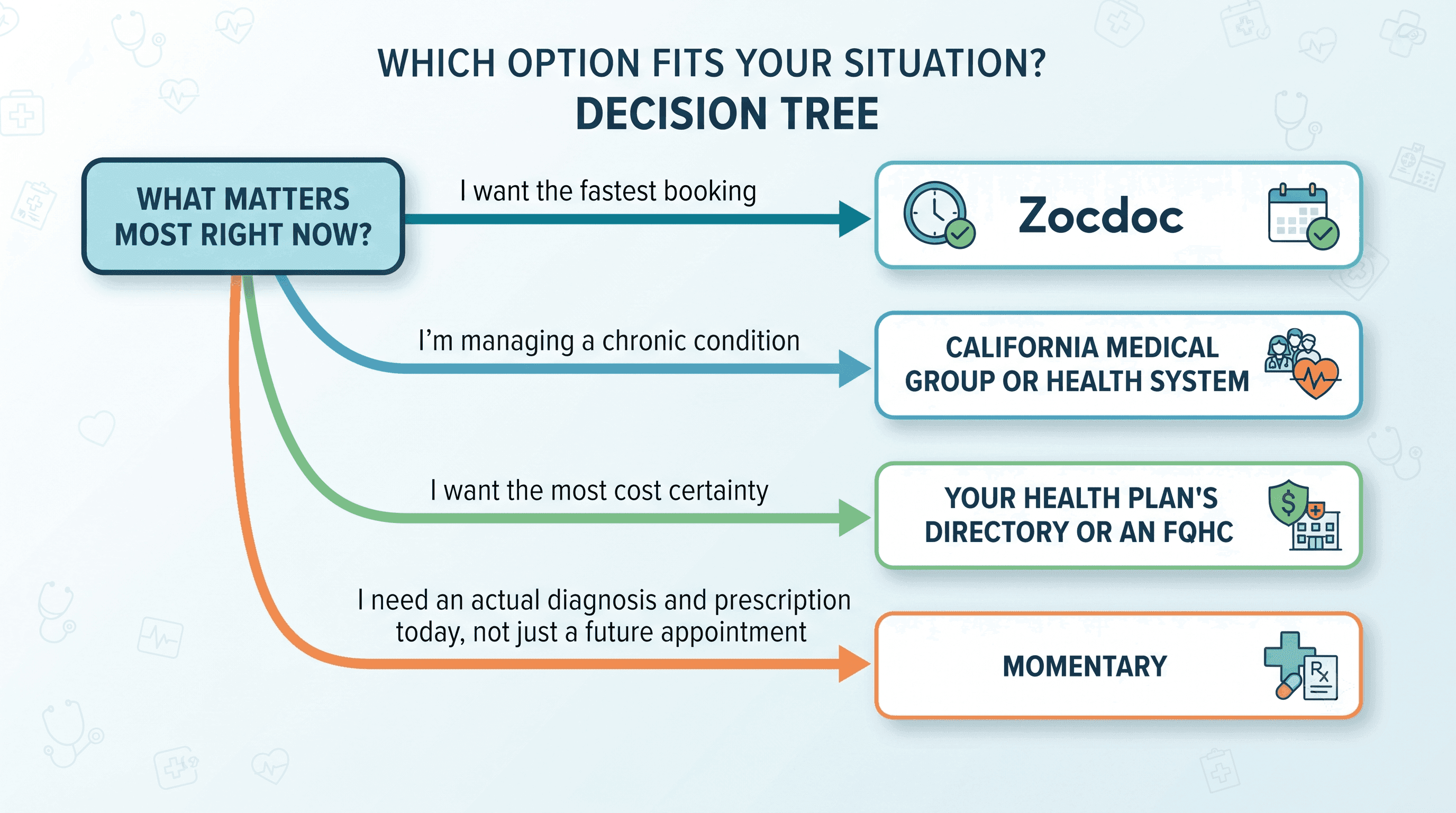
It also means cost isn't usually the deciding factor the way it would be for someone without coverage. Your bigger risk is picking a provider who looks available online but turns out to be out-of-network, or whose panel closed to new patients since the listing was last updated. That's part of why plan-verified directories and real-time booking tools rank ahead of options like Direct Primary Care on this list. DPC can be a great fit for some households, particularly those pairing it with a high-deductible plan, but it doesn't solve the specific problem of using the insurance you just enrolled in.
If you're managing a chronic condition and switched plans, ask any prospective office two things before booking: whether they're currently accepting new patients under your specific plan, not just your carrier generally, and whether they can access or request your prior records. A medical group or health system with in-house specialists tends to make that second part easier.
Once you've narrowed things down using your plan's directory or Zocdoc, the next step for many people is simply talking to someone. If you'd rather skip the wait and see a doctor online while you finish choosing a primary care provider, a virtual primary care visit can cover common concerns, prescription refills, and referrals in the meantime.
FAQ
How do I find a primary care doctor who takes my new insurance in California? Start with your health plan's own provider directory, since that's the only source guaranteeing network status by definition. Cross-check with Zocdoc for real-time booking, then call the office directly to confirm they're still accepting new patients before your first visit.
How long does it take to get a primary care appointment with a new plan in California? California law requires health plans to offer a non-urgent primary care appointment within 10 business days of your request. If no in-network provider can meet that window, contact your plan's member services line and ask them to help you find one who can.
Should I choose Family Medicine, Internal Medicine, or a Nurse Practitioner as my new primary care provider? Family Medicine physicians treat patients of all ages and are a common default choice. Internal Medicine physicians focus specifically on adult care and are often a strong fit if you're managing a chronic condition. Nurse practitioners can serve as your primary care provider in California and often have shorter wait times for new patients. A doctor can advise on individual cases where a specific health history points toward one option over another.
Can I find a virtual primary care doctor in California who accepts my insurance? Yes. Options like One Medical accept most major insurance plans for scheduled visits, and community health centers and larger medical groups increasingly offer virtual visit options alongside in-person care. Check with your specific plan's directory to confirm virtual visit coverage before booking.
What should I do if I need to see a doctor today but haven't found an in-network primary care doctor yet? Call your health plan's member services line to ask about an in-network urgent care option, and consider a same-day virtual visit as a bridge while you finish choosing a longer-term primary care doctor. If you are in California, Momentary gives you a licensed physician you can message today for a diagnosis and prescription if needed, and can serve as your ongoing doctor for $19.99 a month while you decide whether you still want an in-network office.
What should I bring to my first primary care appointment after switching plans? Bring your new insurance card, a photo ID, a list of current medications, and any recent records you can request from a previous provider. If you're establishing care for a chronic condition, ask your prior doctor's office to send records ahead of the visit.


