


Last updated: June 2026
Whether a symptom is worrying you at midnight or a prescription ran out before a follow-up was scheduled, getting a medical opinion used to mean waiting days for an appointment. Now there are real options, spanning free AI symptom tools and sub-$40 telehealth visits, that let most people get a clinically grounded response within hours, or sometimes within minutes. If what you need is a quick read on your symptoms before deciding whether to see someone, start with a free AI symptom checker such as Ada Health or Momentary's AI health navigator. If you need a physician's formal assessment, a diagnosis, or a prescription, a paid telehealth visit from Sesame Care or K Health is likely the fastest and most affordable path.
[IMAGE SUGGESTION: Clean, calm illustration of a person on a laptop or phone, with a soft healthcare-themed background showing a video chat interface with a physician icon, no real faces, no distress imagery, horizontal format for hero placement]

| Option | Best For | Price | Rating | Works Without Insurance |
|---|---|---|---|---|
| Sesame Care | Affordable physician visit, any budget | From $34/visit | 4.8/5 App Store | Yes |
| Momentary AI Health Navigator | Free first read on symptoms, next step clarity | $0 to start | N/A (web tool) | Yes |
| K Health | Frequent users, unlimited monthly text care | $29/mo or $35/visit | 4.7/5 App Store | Yes |
| Ada Health | Free, structured symptom assessment | $0 | 4.8/5 App Store | Yes |
| Teladoc Health | Insured patients, employer benefit holders | $0 with insurance / $75+ cash | 4.5/5 App Store | With cash pay |
| PlushCare | Insurance holders wanting top-50 medical school physicians | $30 copay / $129 without | 4.7/5 App Store | With cash pay |
| MDLive | Employer benefit holders | $0-89 with insurance | 2.0/5 Trustpilot | With cash pay |
How We Ranked
For this list, "best" means the fastest, most accessible path to a qualified medical opinion through a digital channel, without requiring an in-person visit, for readers across the cost spectrum from $0 to affordable cash-pay. We scored each entry on six criteria: clinical credibility (25%), cost and value (25%), speed and availability (15%), scope fit (20%), user experience (10%), and trust signals (5%). Cost and value received elevated weight because the list explicitly spans free and paid options and cost sensitivity is a core part of the reader's situation. Scope fit received elevated weight because entries that only work if you have insurance are less useful to the full audience this piece addresses. We evaluated based on publicly available pricing, app store ratings, and user experience as of June 2026. Momentary is our own product. We scored it on the same criteria as every other entry.
1. Sesame Care -- The most affordable direct-physician visit online
Sesame is a cash-pay marketplace that connects patients directly with board-certified physicians across all 50 states, cutting out insurance middlemen entirely. When you want an actual physician's opinion online without paying $75 or more, and without insurance complications, Sesame is where most readers should look first. Urgent care visits for common conditions such as sinus infections, UTIs, pink eye, and rashes start at $34, with providers posting their own transparent prices upfront so you know what you are paying before booking.
Pros: Pricing starts at $34 and is posted per-provider before you book, so there are no surprise bills. Appointments are available within 1 to 2 hours for most common conditions, including evenings and weekends. Sesame works without any insurance, membership, or subscription for most visits, making it practical regardless of coverage status.
Cons: Sesame does not accept insurance directly, so it does not satisfy a deductible or count toward out-of-pocket maximums under an insurance plan. Provider availability varies by state, and rural users in some areas may find fewer same-day options.
Pricing: From $34/visit (urgent care); $37+ for general physician visits; provider rates vary. Optional Sesame Plus membership is $10.99/month or $99/year for additional discounts and a free annual lab.
Best for: Anyone who wants an online physician opinion at the lowest verifiable price, with or without insurance.
Rating: 4.8 stars on the App Store (June 2026); 95% patient satisfaction reported by Sesame (sesamecare.com).
2. Momentary AI Health Navigator -- The best free first step before a paid visit
Momentary is a physician-reviewed AI health tool that helps you understand what your symptoms might mean, explore likely causes, and figure out whether you need a telehealth visit or something more urgent. As a first step when you are looking at a symptom and deciding what to do next, Momentary provides a structured, medically grounded starting point without a visit fee. Because a physician reviews the AI's approach, the guidance reflects clinical logic rather than generic web search results.
Pros: Free to use with no signup barrier, which makes it accessible as a true first step in the decision process. Physician oversight distinguishes it from general-purpose chatbots not built for healthcare contexts. The tool is designed to help you arrive at a telehealth or in-person visit better informed, reducing wasted appointments.
Cons: Momentary is not a replacement for a physician. It cannot issue prescriptions, diagnose conditions, or order labs. If your symptoms need a formal assessment, a paid telehealth visit remains the appropriate next step.
Pricing: $0 to use the AI health navigator. Momentary Virtual Care for physician-led telehealth visits is a separate paid service; visit https://momentarylab.com/momentary for current pricing.
Best for: Anyone who wants to understand their symptoms before deciding whether to pay for a telehealth visit, or who wants to arrive at a paid appointment with sharper questions.
Rating: The AI navigator is a web tool; third-party app store ratings are not applicable at this time.
3. K Health -- The best value for frequent or ongoing text-based care
K Health combines an AI symptom assessment layer with licensed clinicians who can diagnose, prescribe, and follow up with you by text. The model works well for patients who want ongoing access, low visit cost, and do not need a video call for routine issues. For a $29 monthly subscription, you get unlimited primary care messaging and visits, which works out to less than a typical urgent care copay for most Americans who use it more than once a month.
Pros: At $29 per month, K Health offers unlimited primary care messaging and visits, which is substantially cheaper per episode than any per-visit telehealth option if the condition requires multiple touchpoints. The AI-assisted intake is fast, and clinicians respond within minutes for most common conditions. A peer-reviewed study published in the Annals of Internal Medicine found that K Health's AI matched physician-level clinical decision-making in a virtual urgent care setting in approximately two-thirds of cases.
Cons: K Health does not accept insurance, so the $29 monthly fee is entirely out-of-pocket. The text-based model, while convenient, does not offer a face-to-face video visit by default, which some patients prefer and some conditions benefit from.
Pricing: $29/month for unlimited primary care visits and messaging; $35 per single visit. Mental health services are separately priced at $49/month.
Best for: Patients who expect to use telehealth more than once a month and want predictable monthly costs without insurance involvement.
Rating: 4.7 stars on the App Store (June 2026, cited by VirtualCareFinder.com, accessed June 2026).
4. Ada Health -- The best free structured symptom assessment
Ada is a free AI symptom checker that takes a conversational, clinical interview approach: it asks about your symptom in detail, including onset, severity, and related factors, then produces a ranked list of possible causes and recommends a next step. It does not provide a diagnosis and cannot prescribe, but it gives you a structured, evidence-grounded starting point that is more rigorous than typing a symptom into a search engine.
Pros: Completely free, available 24/7, and available in all 50 states with no account required for basic use. Ada is rated by its own clinical studies as the most accurate consumer symptom checker app, with peer-reviewed validation. The assessment report can be shared with a physician, making your actual appointment more efficient.
Cons: Ada explicitly states it cannot provide a medical diagnosis, and clinical studies consistently show symptom checker accuracy is below physician-level performance in head-to-head comparisons, per a meta-analysis in BMJ Open. Ada collects identified health data tied to your account, which is a consideration for privacy-minded users.
Pricing: $0 for the core symptom checker. The consumer app is free on iOS and Android.
Best for: Anyone who wants a free, structured, evidence-based read on their symptoms before deciding whether a paid visit is warranted.
Rating: 4.8 stars on the App Store (June 2026, ada.com/app) and 4.6 stars on Google Play.
5. Teladoc Health -- The best option for insured patients using an employer benefit
Teladoc is the largest telehealth platform in the United States by visit volume, serving more than 80 million members through employer-sponsored plans and insurance partnerships. For patients whose employer or insurance plan includes Teladoc as a benefit, a general medical visit may cost $0 or only a standard copay. For cash-pay patients without this benefit, Teladoc's pricing is higher than Sesame or K Health.
Pros: With insurance or an employer benefit, visits can cost $0, making Teladoc the most affordable option for insured patients whose plans include it. Teladoc's board-certified physicians average more than 20 years of experience and are credentialed every three years to NCQA standards. The platform covers all 50 states and is available 24 hours a day, 7 days a week.
Cons: Without insurance, a general medical visit starts at $75, which is higher than Sesame or K Health for the same type of visit. Teladoc's condition management programs (diabetes, weight management, hypertension) are not available to self-pay patients.
Pricing: $0 with many employer or insurance plans; approximately $75 per general medical visit without insurance (Teladoc.com, accessed June 2026). Dermatology starts at $75; mental health therapy starts at $99.
Best for: Patients who already have Teladoc through an employer benefit or insurance plan at low or no cost.
Rating: 4.5 stars on the App Store (June 2026).
6. PlushCare -- The best for insured patients who want top-credentialed physicians
PlushCare recruits physicians exclusively from top-50 US medical schools, and its network is in-network with most major insurers including Aetna, Cigna, UnitedHealthcare, and Anthem Blue Cross. For insured patients, the typical out-of-pocket cost is approximately $30 per visit, and 97% of conditions are treated on the first visit. For cash-pay patients, the $129 per-visit price is substantially higher than comparable services.
Pros: In-network with most major US insurance plans, making it one of the only telehealth options where visits count toward deductibles. Physicians from top-50 medical schools are a meaningful clinical credibility differentiator. Same-day appointments are typically available, including evenings and weekends.
Cons: At $129 per visit without insurance, PlushCare is among the most expensive cash-pay telehealth options and is not competitive with Sesame or K Health for uninsured users. A $19.99 monthly membership is required, adding ongoing cost even for infrequent users.
Pricing: $30 average with in-network insurance; $129 per visit without insurance. Membership is $19.99/month or $149/year (30-day free trial, PlushCare.com, accessed June 2026).
Best for: Insured patients who want a physician from a top-50 medical school and visits that count toward their deductible.
Rating: 4.7 stars on the App Store (June 2026, PlushCare App Store listing).
7. MDLive -- An established option, with meaningful user experience caveats
MDLive is one of the original national telehealth platforms, with board-certified physicians available 24 hours a day. For employer benefit holders whose plan includes MDLive coverage, the cost can reach $0 for general medical visits. The platform also offers mental health, dermatology, and primary care services. However, based on current public review data, MDLive has significant user experience issues that prospective users should weigh seriously.
Pros: Available 24/7 across all 50 states and Puerto Rico. MDLive holds two National Committee for Quality Assurance certifications, which is a meaningful clinical credentialing signal. For employer benefit holders with MDLive included at no cost, it represents accessible care.
Cons: MDLive carries a 2.0 out of 5 Trustpilot rating based on 12,136 reviews (as of June 2026), with widespread reports of billing errors, appointment cancellations with no notification, and customer service issues. Cash-pay pricing for urgent care starts at approximately $89, which is higher than Sesame and K Health. App performance problems are a recurring complaint.
Pricing: $0 with employer benefit or in-network insurance; $89 per urgent care visit (self-pay). Mental health therapy starts at approximately $179 for an initial visit (MDLive.com, accessed June 2026).
Best for: Patients whose employer benefit plan includes MDLive at zero cost, who are prepared for potential administrative friction.
Rating: 2.0 out of 5 on Trustpilot (June 2026, 12,136 reviews); App Store rating available but offset by Trustpilot user experience complaints at scale.
Why Getting a Doctor's Opinion Online Is Different From Seeing One in Person
Getting an online medical opinion works differently from an office visit in ways that directly affect what you should expect and what you should ask for. Understanding these differences helps you choose the right tool for your specific situation.
The most important difference is what online physicians can and cannot do. A telehealth physician can diagnose most common acute conditions, prescribe most non-controlled medications, order labs in some cases, and issue referrals. What they cannot do is perform a physical examination. A physician seeing you for a skin rash over video is working with what the camera shows and what you describe, not a hands-on exam. For most straightforward conditions, such as UTIs, sinus infections, allergies, and prescription refills, this constraint rarely changes the clinical outcome. For ambiguous conditions or anything that might require a physical finding to rule out a serious diagnosis, an in-person visit remains the higher-confidence path.
The second difference is what qualifies as a "medical opinion." In this list, the entries range from AI symptom checkers (which produce a probabilistic assessment, not a clinical opinion) to licensed physicians doing live telehealth visits (which produce a formal clinical assessment). A symptom checker like Ada is best understood as an organized search tool with medical guardrails: it narrows the field of possibilities and helps you decide whether to seek care. A telehealth physician visit is an actual clinical encounter with formal documentation, prescribing authority, and a provider who can be held accountable for their recommendations. Both have value, but they serve different purposes, and conflating the two is one of the most common mistakes patients make when researching online health options.
Cost also works differently online. Cash-pay telehealth can be substantially cheaper than in-person care, with a 2024 study by Penn Medicine published in JAMA Network Open finding that telemedicine averaged $96 per episode compared to $509 for in-person care across 160,000 visits. However, some telehealth visits, including many PlushCare and Teladoc encounters, do not directly reduce your insurance deductible unless the platform is in-network with your insurer. If reducing your deductible matters, verify in-network status before booking. If cash-pay transparency is the priority, Sesame's model is built around it.
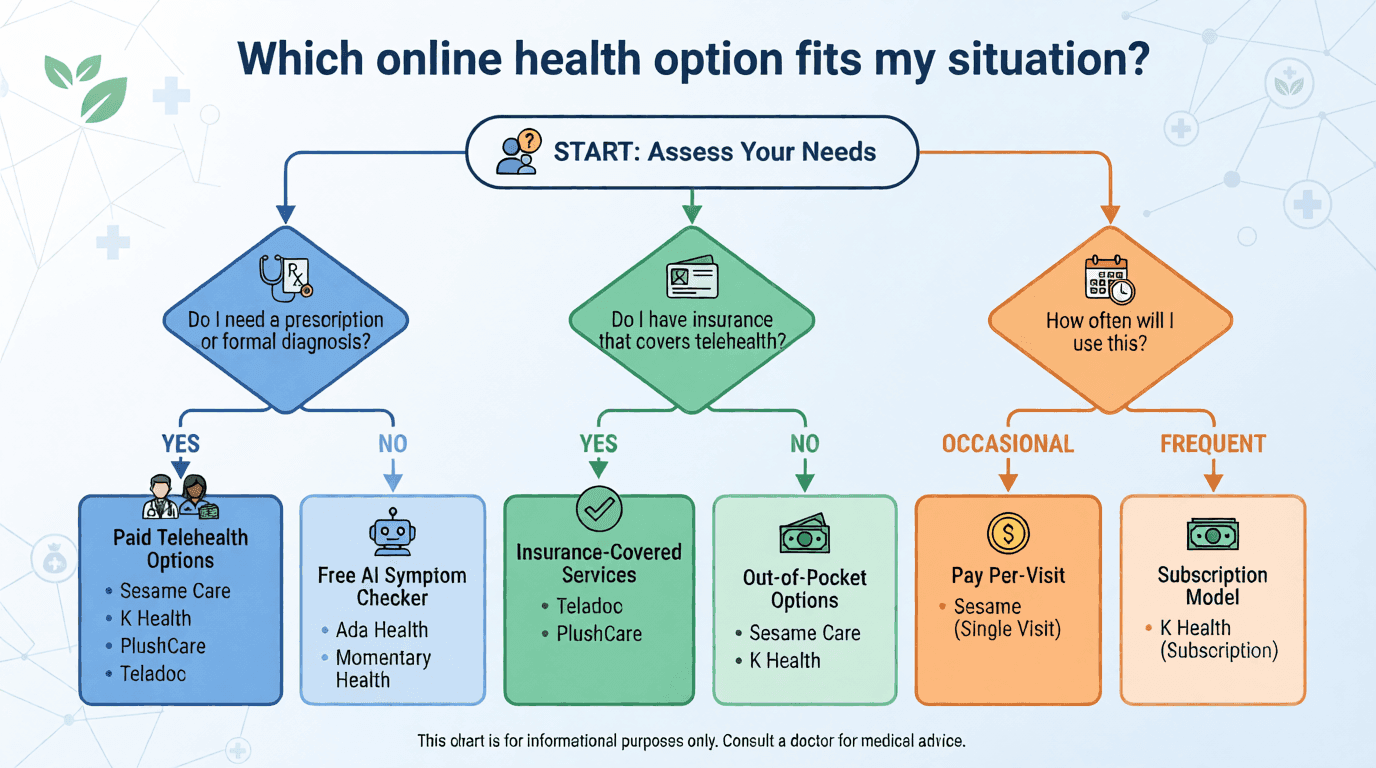
[FLOWCHART SUGGESTION: "Which online health option fits my situation?" Decision tree with three branches: (1) "Do I need a prescription or formal diagnosis?" - Yes leads to paid telehealth (Sesame, K Health, PlushCare, Teladoc); No leads to free AI checker (Ada, Momentary). (2) "Do I have insurance that covers telehealth?" - Yes leads to Teladoc or PlushCare; No leads to Sesame or K Health. (3) "How often will I use this?" - Occasional leads to Sesame per-visit; Frequent leads to K Health subscription.]
When an Online Opinion Is a First Step, Not a Final Answer
Online care is not the right path for every situation, and recognizing the boundaries is as important as knowing the options. If symptoms are severe, rapidly worsening, or involve chest pain, difficulty breathing, signs of a stroke, or serious injury, call 911 or go to an emergency room. Telehealth providers cannot perform emergency interventions.
For situations that are not emergencies but need more than an online opinion, a live physician can point you toward the next appropriate step. To see a doctor online for a virtual primary care visit and have a physician assess your situation and refer you further if needed, Momentary Virtual Care connects you to a licensed provider who can evaluate your specific case and advise on next steps.
Frequently Asked Questions
Can I consult a doctor online for free?
Yes, with the right expectations. Free options such as Ada Health and Momentary's AI health navigator provide medically grounded symptom assessments at no cost and without a subscription. What free tools cannot do is prescribe medication, issue a formal diagnosis, or order labs. If you need any of those, a paid telehealth visit from Sesame Care (starting at $34) or K Health ($29/month) is the lowest-cost path to an actual physician opinion.
Is there a free AI doctor?
Several free AI tools are available, including Ada Health (4.8 stars on the App Store as of June 2026), Momentary's AI health navigator, and K Health's free symptom checker tier. These tools assess symptoms, suggest possible causes, and advise on whether to seek care. They are not licensed physicians, cannot prescribe, and explicitly do not provide medical diagnoses. For most straightforward symptom questions, including "do I need to see someone for this?", a free AI tool is a reasonable starting point before deciding whether to book a paid visit. You can also explore your symptoms with Momentary's AI health tool to get a clearer picture of your next step.
Is ChatGPT better than a doctor?
No. ChatGPT is a general-purpose language model. It was not trained specifically on clinical data and cannot access your medical history, order labs, perform a physical exam, or prescribe. Studies comparing general large language models to physicians on diagnostic tasks show performance that depends heavily on the task and condition. A 2026 systematic review cited in the Stanford-Harvard State of Clinical AI Report found that generalist AI models averaged 52.1% diagnostic accuracy across diverse clinical contexts. A licensed physician using clinical judgment, a full history, and examination typically outperforms that threshold considerably for real-world cases. Purpose-built clinical AI tools with physician oversight, such as K Health's hybrid model, narrow the gap in structured use cases but are still not equivalent to a physician consultation.
What is the 30% rule for AI?
The "30% rule" is a shorthand reference to findings in clinical AI research suggesting that in a meaningful share of cases, AI recommendations and physician recommendations diverge. A study K Health published in the Annals of Internal Medicine, examining its AI in a virtual urgent care setting, found agreement with physician decisions in approximately two-thirds of cases, with the remaining third showing variation in either direction. This finding is often cited to illustrate that AI can be a useful clinical co-pilot in routine scenarios but requires physician oversight for the cases where it and human judgment part ways. It does not mean AI is wrong 30% of the time; it means the two do not always agree, and the clinical significance of that divergence depends on the condition and context. A doctor can advise on individual cases where the stakes of that divergence are higher.
How quickly can I get an online doctor's opinion?
Paid telehealth platforms typically connect patients with a physician within 15 to 30 minutes for on-demand urgent care visits. Sesame Care reports appointment availability within 1 to 2 hours for most common conditions. Free AI symptom checkers like Ada provide an immediate assessment, usually within 5 to 10 minutes of completing the questionnaire. K Health clinicians respond by text typically within minutes during staffed hours.
What conditions can online doctors actually treat?
Online physicians can evaluate and treat most common acute conditions including sinus infections, UTIs, allergies, rashes, pink eye, cold and flu, and prescription refills for stable chronic conditions such as blood pressure medications, antidepressants, and birth control. Conditions that typically require an in-person visit include anything requiring a physical examination to rule out a serious cause, broken bones, emergency situations, and prescriptions for controlled substances, which federal law requires an in-person evaluation to issue for new patients.


