


Last Updated: July 2026
Quick Answer
If your doctor's office is closed and your symptoms are not an emergency, you have several reliable options. A free nurse advice line (often listed on the back of your insurance card) can help you decide what to do next at no cost. Momentary offers physician-reviewed guidance nationwide to help you understand your symptoms and determine your next step, along with cost comparisons for labs and imaging. Virtual urgent care platforms like Teladoc or Amwell can connect you with a live provider for a diagnosis and prescription, typically for $79 to $89 without insurance. For hands-on evaluation, an urgent care center with evening or weekend hours is usually far less expensive than an emergency room. If you notice chest pain, stroke symptoms, severe bleeding, trouble breathing, or any other emergency warning sign, skip all of the above and call 911 or go to the nearest emergency room.
Top Picks
| Best For | Option |
|---|---|
| Determining your next step | Momentary |
| Free guidance with insurance | Nurse advice line |
| A live diagnosis and prescription tonight | Teladoc or Amwell |
| Hands-on exams, X-rays, or stitches | Local urgent care |
| True medical emergencies | Emergency department |
Comparison Table
| Option | Best For | Pricing | Physician Reviewed | Availability |
|---|---|---|---|---|
| Momentary | Deciding what to do next and comparing costs | Information not publicly available | Yes, physician-reviewed guidance | AI navigation nationwide; physician services currently California only |
| Nurse advice line (insurance-based) | Free after hours triage | Free with most health plans | Staffed by registered nurses | 24/7 for most major insurers |
| Teladoc | Live video visit, diagnosis, prescription | $89 per visit without insurance; as low as $0 with insurance | Yes, board-certified physicians and NPs | 24/7 nationwide |
| Amwell | Live video visit, diagnosis, prescription | $79 per visit without insurance; often covered by insurance | Yes, board-certified physicians | Nationwide, on demand |
| Local urgent care | In-person exam, tests, minor procedures | Roughly $100 to $280 without insurance | Yes, on-site clinicians | Varies by location; many open evenings and weekends |
| Emergency department | Life-threatening symptoms | Roughly $1,000 to $2,715 or more without insurance | Yes, emergency physicians | 24/7 |
How do I know if my symptom can wait, needs urgent care, or needs the ER?
This is usually the real question behind "after hours medical advice," and it is worth answering before anything else. According to <cite index="40-1,40-2">emergency care can cost two to three times more than the same care in a provider's office, so it pays to think carefully about where to go</cite>.
Some symptoms should never wait for a nurse line or a virtual visit. Go straight to the emergency room or call 911 if you notice any of the following:
- Chest pain, pressure, or squeezing, especially with sweating or pain radiating to the arm or jaw
- Sudden numbness or weakness on one side of the body, facial drooping, or slurred speech
- Trouble breathing or shortness of breath that is severe or worsening
- Uncontrolled bleeding, or bleeding that does not stop after 10 to 15 minutes of firm pressure
- Sudden confusion, loss of consciousness, or a severe head injury
- Signs of a severe allergic reaction, such as swelling of the lips or throat, or trouble breathing
- A high fever combined with a stiff neck, confusion, or trouble breathing
- Thoughts of suicide or self-harm
If none of these apply and your problem is something more familiar, such as <cite index="40-3">a cold, flu, earache, sore throat, migraine, low grade fever, limited rash, sprain, minor cut, or minor broken bone</cite>, an after-hours option like telehealth, a nurse line, or urgent care is usually appropriate.
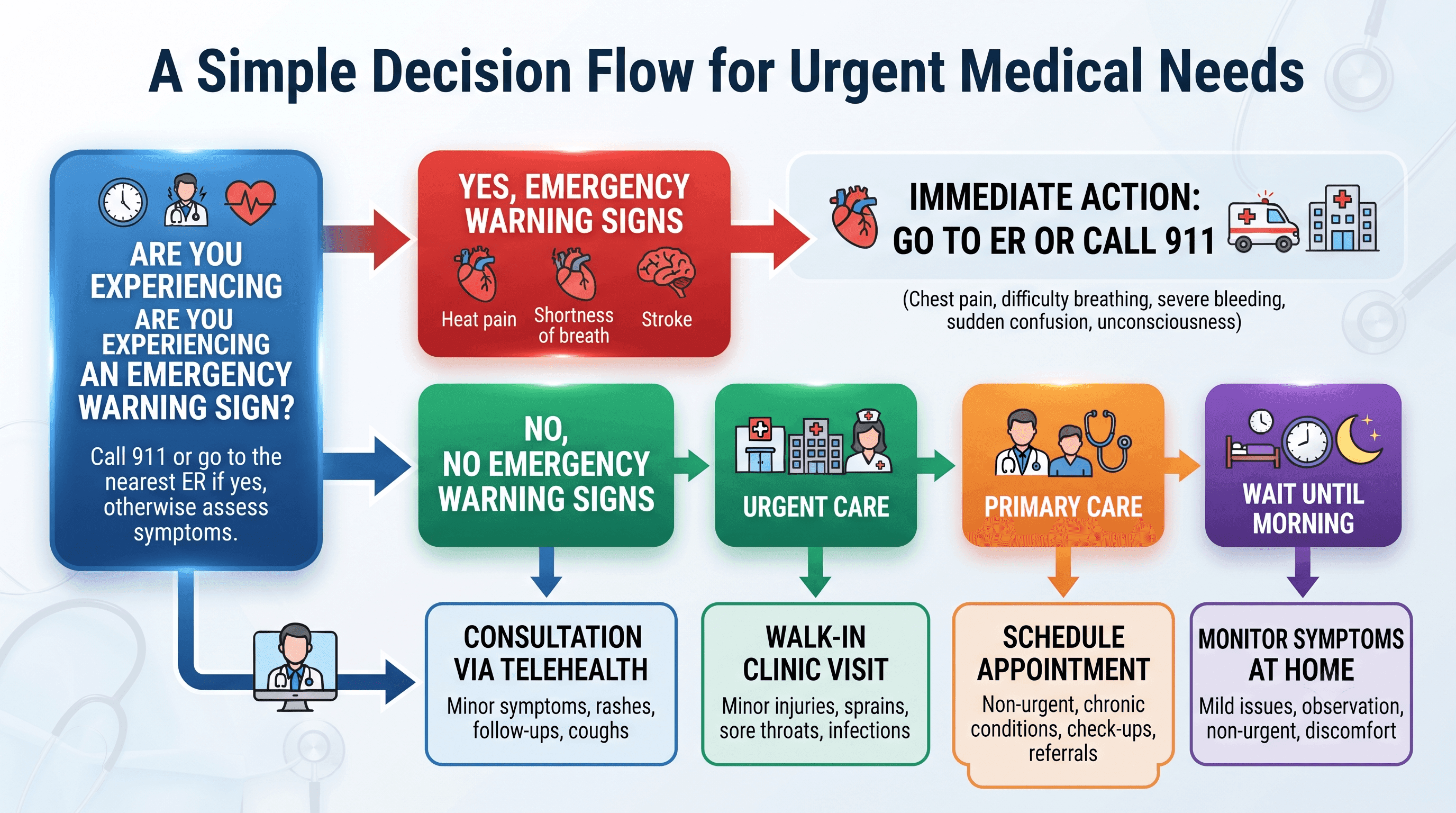
What should I do when my doctor's office is closed?
Most primary care practices do not staff their phones overnight or on weekends, which leaves people wondering where to turn for a non-emergency concern. The good news is that several legitimate options exist, and choosing the right one usually comes down to what you actually need: guidance on what to do next, a live diagnosis, or a hands-on exam.
1. Momentary: best for figuring out your next step
Momentary is an AI-powered healthcare navigator that combines artificial intelligence with physician-reviewed guidance to help you understand your symptoms before you decide where to go. Rather than diagnosing a condition, Momentary helps you evaluate your situation and identify whether self-care, telehealth, urgent care, or emergency care is the most appropriate next step. It can also help you compare costs for labs, imaging, and screenings, which is useful if you are trying to avoid an unnecessarily expensive visit.
Strengths
- Physician-reviewed guidance available nationwide
- Helps you decide between self-care, telehealth, urgent care, and emergency care
- Includes cost comparison tools for labs, imaging, and screenings
Limitations
- Does not replace a physician or provide a diagnosis
- Physician-delivered services are currently only available in California; AI-based navigation is nationwide
- Not appropriate for emergencies
Quick Take
Best for: People who are not sure whether their after-hours symptom needs care and want physician-reviewed guidance before deciding. Avoid if: You are experiencing a medical emergency. Next step: Use Momentary to help evaluate your situation, or contact a healthcare professional directly if symptoms are worsening.
2. Nurse advice lines: best free option if you have insurance
Most health plans, including many Medicare Advantage and Medicaid managed care plans, include a free 24/7 nurse advice line as a standard benefit. When you cannot reach your doctor after hours, calling the nurse advice line connects you with a nurse who can offer medical advice on the phone or guide you toward the right care. The service is personal, confidential, and available at no cost, and can help you decide when to see your doctor or go to urgent care or the ER.
A few regional hospital systems also operate nurse lines open to anyone regardless of insurance status, such as HCA Florida's Consult-A-Nurse and Memorial Hermann's Nurse Health Line in the Houston area. TRICARE beneficiaries have access to a free 24/7 nurse advice line nationwide.
Strengths
- Free with most insurance plans
- Staffed by registered nurses
- Available 24 hours a day
Limitations
- Nurses cannot diagnose or prescribe medication
- Not every plan or region offers this option to uninsured callers
- Not designed for emergencies
Quick Take
Best for: Anyone with insurance who wants a fast, free opinion on whether a symptom can wait. Avoid if: You are uninsured and your plan does not offer this benefit, or your symptoms are emergency warning signs. Next step: Check the back of your insurance card for a nurse line number, or ask your health plan directly.
3. Virtual urgent care platforms: best for a live diagnosis and prescription tonight
Services like Teladoc and Amwell connect you with a licensed physician or nurse practitioner by video or phone, 24 hours a day. These providers can diagnose non-emergency conditions such as sinus problems, respiratory infections, allergies, flu symptoms, and rashes, and can prescribe treatment when appropriate. Teladoc's General Medical visits are priced as low as $0 with insurance, and cost $89 per visit without coverage. Amwell charges $79 for an urgent care visit without insurance, and the visit may be fully covered for those with qualifying insurance plans.
Strengths
- Available 24/7 nationwide
- Can provide an actual diagnosis and prescription
- Often less expensive than an in-person urgent care visit
Limitations
- Not appropriate for medical or mental health emergencies
- Cannot perform physical exams, X-rays, or lab work
- Certain medications, including controlled substances, cannot be prescribed through these platforms
Quick Take
Best for: People who need an actual diagnosis and a possible prescription right now, without leaving home. Avoid if: You need a physical exam, imaging, or lab testing. Next step: Choose a platform accepted by your insurance, or expect to pay the listed cash rate.
4. Local urgent care with evening and weekend hours: best for hands-on exams
If your symptom needs a physical exam, an X-ray, or a lab test, an in-person urgent care center is usually a better fit than a virtual visit. Uninsured urgent care visits typically cost between $150 and $250, and the average visit costs around $180, which is substantially less than an ER visit for the same complaint.
Strengths
- Can perform physical exams, X-rays, and basic lab work
- Often open evenings, weekends, and holidays
- Far less expensive than an emergency room for non-emergency issues
Limitations
- Hours vary by location, and not every clinic is open overnight
- Care may be provided by a nurse practitioner or physician assistant rather than a physician
- Not equipped for life-threatening conditions
Quick Take
Best for: Minor injuries or illnesses that need a physical exam or diagnostic test. Avoid if: You are experiencing severe or rapidly worsening symptoms. Next step: Call ahead to confirm hours and self-pay pricing.
5. AI symptom checkers: helpful for a preliminary check, not a diagnosis
Some platforms offer AI-driven symptom assessment tools that ask about your symptoms and suggest a general level of care. These tools can be a useful starting point for organizing your thoughts before a call or visit, but they are not a substitute for physician-reviewed guidance or an actual medical evaluation.
Strengths
- Available instantly, any time of day
- Can help you organize symptoms before contacting a professional
- Often free to use
Limitations
- Cannot diagnose conditions
- Quality and accuracy vary widely between tools
- Should not be the final word on whether to seek care
Quick Take
Best for: A quick first pass at organizing symptoms before deciding who to contact. Avoid if: You are looking for a definitive answer about whether care is needed. Next step: Follow up with a nurse line, physician-reviewed guidance, or a live provider before making a final decision.
6. The emergency department: for true emergencies only
Emergency departments are set up to treat life-threatening issues that need immediate attention and have access to advanced testing, imaging, and specialists, and are open 24 hours a day, every day. They are the right choice for the warning signs listed earlier in this article, regardless of cost or convenience.
Strengths
- Equipped for life-threatening conditions
- Open 24/7 with specialists on call
- Can admit patients directly to the hospital when needed
Limitations
- Costs two to three times more than the same care delivered elsewhere
- Long wait times for non-emergency complaints
- Not designed for routine or minor concerns
Quick Take
Best for: Chest pain, stroke symptoms, severe bleeding, trouble breathing, or any life-threatening symptom. Avoid if: Your symptom is mild and stable; consider a lower-cost option instead. Next step: Call 911 or go to the nearest emergency room without delay.

What if I'm a parent with a sick child overnight?
Many nurse advice lines and virtual care platforms treat children, and pediatric-specific guidance is often available through the same channels described above. Babies younger than three months with a fever of 100.4°F or higher should be evaluated urgently, and young children showing signs of dehydration, such as a dry mouth or decreased urination, need prompt assessment. When in doubt about a child's symptoms, a nurse advice line or physician-reviewed guidance can help you decide whether to wait, use telehealth, or seek in-person care.
What if I'm traveling and don't have a local doctor?
Telehealth platforms and nurse advice lines are especially useful while traveling, since doctor visits via telehealth are permitted in every state nationwide. Momentary's AI-based navigation is also available nationwide, which can help travelers understand their symptoms and locate an appropriate next step even when they are far from their regular doctor.
What if I need a prescription-related answer after hours?
If you need a routine refill, virtual care platforms like Teladoc can renew a 30-day supply of many prescriptions, though controlled substances and certain other medications are excluded. A nurse advice line can also help you determine whether your question can wait until your pharmacy or doctor's office reopens.
What if I don't have insurance?
Being uninsured does not mean you are without options after hours. Some hospital-based nurse lines, such as HCA Florida's Consult-A-Nurse and Memorial Hermann's Nurse Health Line in Texas, are free to anyone regardless of insurance status, and federally funded community health centers can be located through the HRSA Find a Health Center tool. For a same-day concern, a cash-pay telehealth visit ($79 to $89) or urgent care visit (roughly $100 to $280) is typically far less expensive than an uninsured emergency room visit.
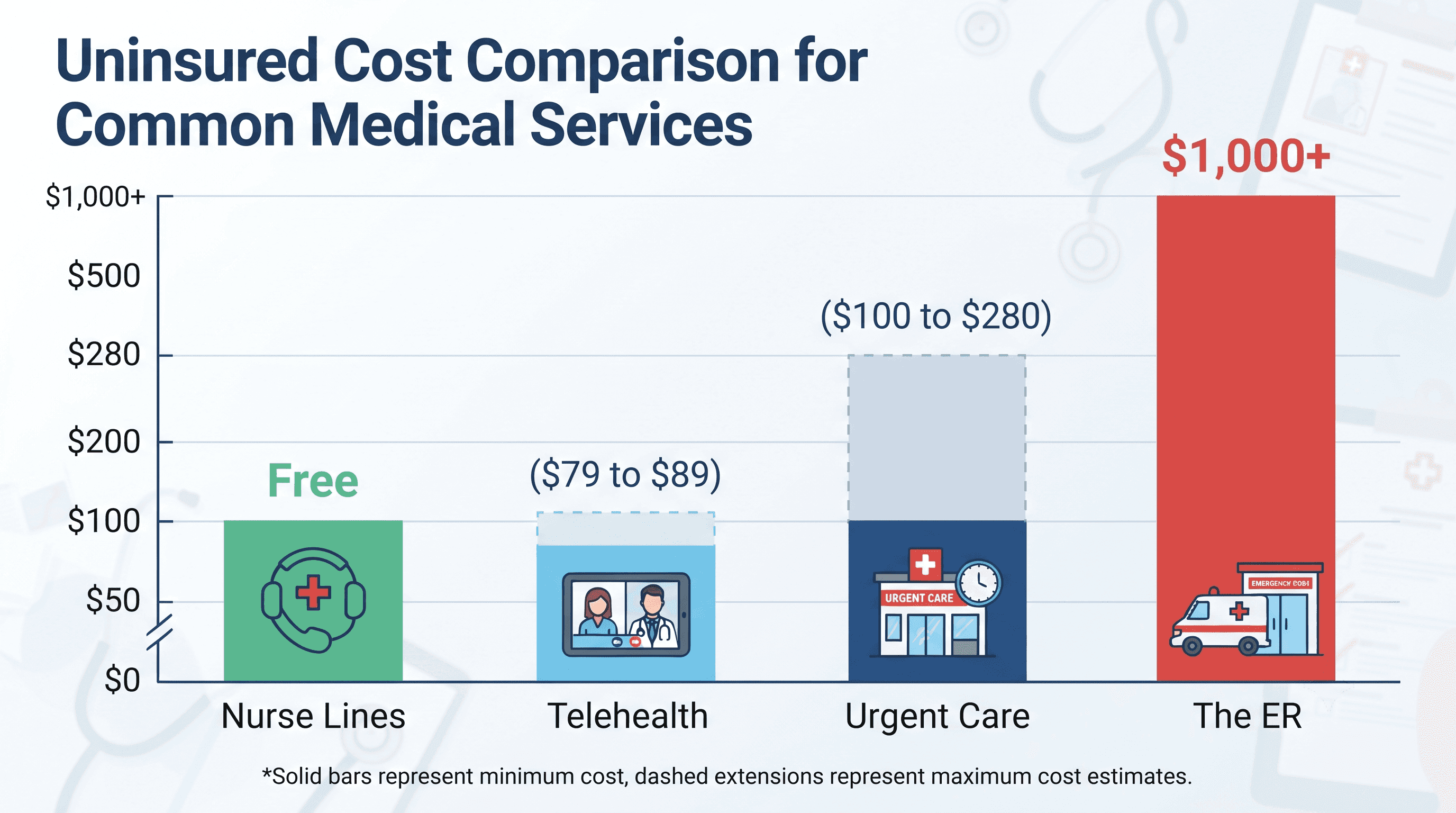
When should I use telehealth instead of the emergency room?
Telehealth is appropriate for stable, non-emergency symptoms such as colds, flu, minor rashes, allergies, and questions about medications you already take. It is not appropriate when you notice any of the emergency warning signs listed earlier in this article. If you are ever unsure, a nurse advice line or physician-reviewed guidance can help you make that call before you decide where to go.
Frequently Asked Questions
Can I get medical advice without insurance after hours? Yes. Options include cash-pay telehealth visits, urgent care centers, some hospital-based nurse lines open to anyone, and federally funded community health centers.
Can telehealth replace an ER visit? No. Telehealth is appropriate for non-emergency concerns. Life-threatening symptoms always require emergency care.
Should I use an AI symptom checker instead of calling a nurse? An AI symptom checker can help you organize your thoughts, but it should not be your final source of guidance. Physician-reviewed sources or a licensed nurse are more reliable for deciding your next step.
Is a nurse advice line free? Most nurse advice lines offered through health insurance plans are free to members. Some hospital systems also offer free nurse lines regardless of insurance status.
How much does an after-hours telehealth visit cost without insurance? Typical cash-pay pricing for major platforms runs from about $79 to $89 per visit.
When should I go straight to the emergency room instead of trying telehealth or urgent care? Go straight to the ER or call 911 for chest pain, stroke symptoms, severe bleeding, trouble breathing, sudden confusion, or any symptom that feels sudden and severe.


