

Last updated: July 2026
If you are uninsured and need medical advice now, start with a cash-pay telehealth marketplace like Sesame Care or GoodRx Care, where a visit costs $19 to $75 and you see the price before you book. For ongoing, non-urgent care, a Federally Qualified Health Center offers sliding-scale primary care based on income, and no one is turned away for inability to pay. If your symptoms are severe (chest pain, trouble breathing, stroke signs, uncontrolled bleeding), skip the cost math and go to the nearest emergency room. Hospitals must stabilize you regardless of insurance status or ability to pay.
Quick Comparison
| Option | Best For | Price | Rating | Works Without Insurance |
|---|---|---|---|---|
| Sesame Care | Same-day cash-pay visits | $25 to $75 per visit | 4.9/5 App Store (Mar. 2026) | Yes |
| GoodRx Care | Cheapest visit plus Rx discounts | $19 to $70 per visit | 30M+ platform users | Yes |
| Community Health Centers | Ongoing sliding-scale primary care | Nominal fee based on income | 30M+ patients served yearly | Yes |
| Momentary AI Health Navigator | Free symptom check, first step | $0 | N/A, newer tool | Yes |
| Free & Charitable Clinics | Free care for qualifying patients | $0 to nominal fee | 1,400+ member clinics | Yes |
| NeedyMeds / Rx Outreach | Affording a new prescription | $0 to low cost | N/A, assistance directory | Yes |
| CVS MinuteClinic | Same-day, in-person walk-in | $59 to $150 per visit | N/A, varies by service | Yes |
| Teladoc (cash-pay) | Large, established brand | $89 per visit | 80M+ member base | Yes |
How We Ranked
"Best" here means the safest, most affordable path to real medical guidance when you have no insurance right now, not what an insured patient would pay. We scored every entry on clinical credibility, cost and value, speed and availability, scope fit for uninsured readers, user experience, and trust signals. Because this list serves an uninsured audience, we raised cost and value to 30% and lowered speed and availability to 10%, since cost decides most choices here, not response time. Clinical credibility, scope fit, user experience, and trust signals held at 20%, 20%, 10%, and 10%. Evaluation date: July 2, 2026. Momentary is our own product. We scored it on the same criteria as every other entry.

1. Sesame Care: same-day visits with the price shown upfront
Sesame is a telehealth marketplace built for people paying out of pocket. Independent physicians and nurse practitioners list their own prices, so you compare cost before booking instead of finding out afterward. Sesame doesn't bill insurance, which keeps prices low, and same-day appointments are common across primary care, urgent care, mental health, and dermatology.
Provider-set pricing means costs vary by location, and visits can't apply toward insurance if you gain coverage later.
Pricing: $25 to $75 for primary and urgent care visits.
Best for: Readers who want to compare price and provider before booking.
Rating: 4.9 out of 5 on the App Store and Google Play (HelpGuide review, March 2026).
2. GoodRx Care: the lowest visit fee, paired with prescription discounts
GoodRx Care is cash-pay only, which keeps its visit fee among the lowest of any telehealth platform: $19 with a Gold membership, up to $70 without one (GoodRx Care Payments FAQ, accessed July 2026). Any prescription you receive plugs into GoodRx's own discount coupon network, cutting medication costs too.
Clinical scope is limited to conditions suited to a text or video visit, and GoodRx Care accepts no insurance, so nothing carries over if you gain coverage.
Pricing: $19 to $70 per visit.
Best for: Readers who need a diagnosis and an affordable prescription in one visit.
Rating: Used by more than 30 million consumers annually (GoodRx, 2026).
3. Community Health Centers (FQHCs): ongoing care on a sliding scale
Federally Qualified Health Centers are primary care practices funded partly by federal grants and legally required to serve patients regardless of ability to pay. Nearly 1,400 FQHCs operate more than 14,000 sites nationwide, serving over 30 million patients a year. Unlike a one-off telehealth visit, an FQHC gives you a regular provider, the strongest option here for anyone who needs ongoing care, not just a single answer.
The tradeoff is speed. Many FQHCs have waitlists for new patients, and enrollment requires proof of income, which telehealth does not.
Pricing: Nominal fee to full fee, based on income and household size.
Best for: Readers who need an ongoing primary care provider.
Rating: Nearly 1,400 centers and 30 million patients served annually.
4. Momentary AI Health Navigator: a free first step
Momentary's AI Health Navigator is a physician-reviewed tool that helps you understand what your symptoms might mean and what kind of care to seek next, before you spend money on a visit you may not need. A physician reviews the clinical logic behind the guidance, but the tool itself doesn't diagnose, treat, prescribe, or examine you, and it isn't a replacement for a physician.
As a newer product, it doesn't yet have the volume of independent reviews that a decade-old platform has, and it can't resolve anything that needs an actual exam or prescription.
Pricing: $0.
Best for: Readers unsure whether their symptom needs a paid visit at all.
Rating: N/A; independent review volume is still building as of July 2026.
5. Free & Charitable Clinics: no-cost care for qualifying patients
The National Association of Free & Charitable Clinics represents roughly 1,400 nonprofit clinics and pharmacies offering medical, dental, vision, and behavioral health care at no charge or a nominal fee. These clinics don't bill any insurer; they operate as charities. Eligibility generally falls between 100% and 300% of the federal poverty level and varies by clinic.
Capacity is the limitation. Free clinics are often volunteer-staffed with limited hours, so same-day access is not guaranteed the way it is with telehealth.
Pricing: $0 to a nominal fee, based on income eligibility.
Best for: Low-income uninsured readers who qualify and can work around limited hours.
Rating: Roughly 1,400 member clinics and pharmacies nationwide (NAFC, 2026).
6. NeedyMeds / Rx Outreach: affording the prescription itself
Once a visit produces a prescription, the next problem is paying for it. NeedyMeds and Rx Outreach are nonprofit directories connecting patients to manufacturer assistance programs, discount cards, and low-cost mail-order pharmacies. They don't diagnose or advise on treatment; they close the gap between a prescription and its cost.
Enrollment can take days to weeks and usually requires income paperwork, so this is not a same-day fix for an urgent medication need.
Pricing: $0 to low cost, depending on the program.
Best for: Readers who have a prescription and need to make it affordable.
Rating: N/A; coverage varies by medication and state.
7. CVS MinuteClinic: walk-in, in-person care the same day
MinuteClinic is the retail clinic inside CVS and select Target locations, staffed by nurse practitioners and physician assistants with a supervising physician. No appointment is required, making it accessible for readers who want an in-person exam rather than a video assessment. Cash-pay pricing is posted before your visit, and most self-pay visits run $59 to $150, roughly 40% less than a typical urgent care visit.
MinuteClinic is not built specifically for uninsured patients and costs more than most telehealth options for conditions that do not require a physical exam.
Pricing: $59 to $150 per visit, self-pay.
Best for: Readers who want a walk-in, in-person visit the same day.
Rating: N/A publicly aggregated; pricing published directly by CVS (accessed July 2026).
8. Teladoc (cash-pay): the largest network, at a higher price
Teladoc is the most widely used telehealth company in the country, serving more than 80 million members mostly through employer and insurance plans. Cash-pay visits are still available without coverage, but self-pay pricing runs higher because the platform's cost structure is built around insurance billing, not direct pay.
For an uninsured reader focused on cost, Teladoc's general medical cash-pay rate of $89 per visit is meaningfully higher than Sesame's $25 to $75 range or GoodRx Care's $19 to $70 range for a comparable visit (Teladoc Health no-insurance pricing page, accessed July 2026).
Pricing: $89 per visit, general medical, cash-pay.
Best for: Readers who want a large, established brand and don't mind paying more.
Rating: More than 80 million members across employer and insurance plans.
Why being uninsured changes what "best" means
Being uninsured doesn't just mean paying more. It changes which options are available, since many providers build their pricing around the assumption that a health plan covers part of the bill. Teladoc's cash-pay rate stays high because it covers infrastructure built for insurance billing, while cash-pay-first platforms like Sesame or GoodRx Care carry no such overhead, so prices run lower.
FQHCs and free clinics work differently again. They aren't simply cheaper private visits; they're structured around ability to pay by law or charter, so income verification is part of the process in a way it never is with a credit card. That tradeoff, more paperwork for a lower cost, fits ongoing care but is often too slow for something you need answered today.
Before booking, ask three questions: does this provider treat your symptom, what does the total cost include, and how fast can you be seen. A free tool like Momentary's AI Health Navigator can help answer the first question before you spend anything.
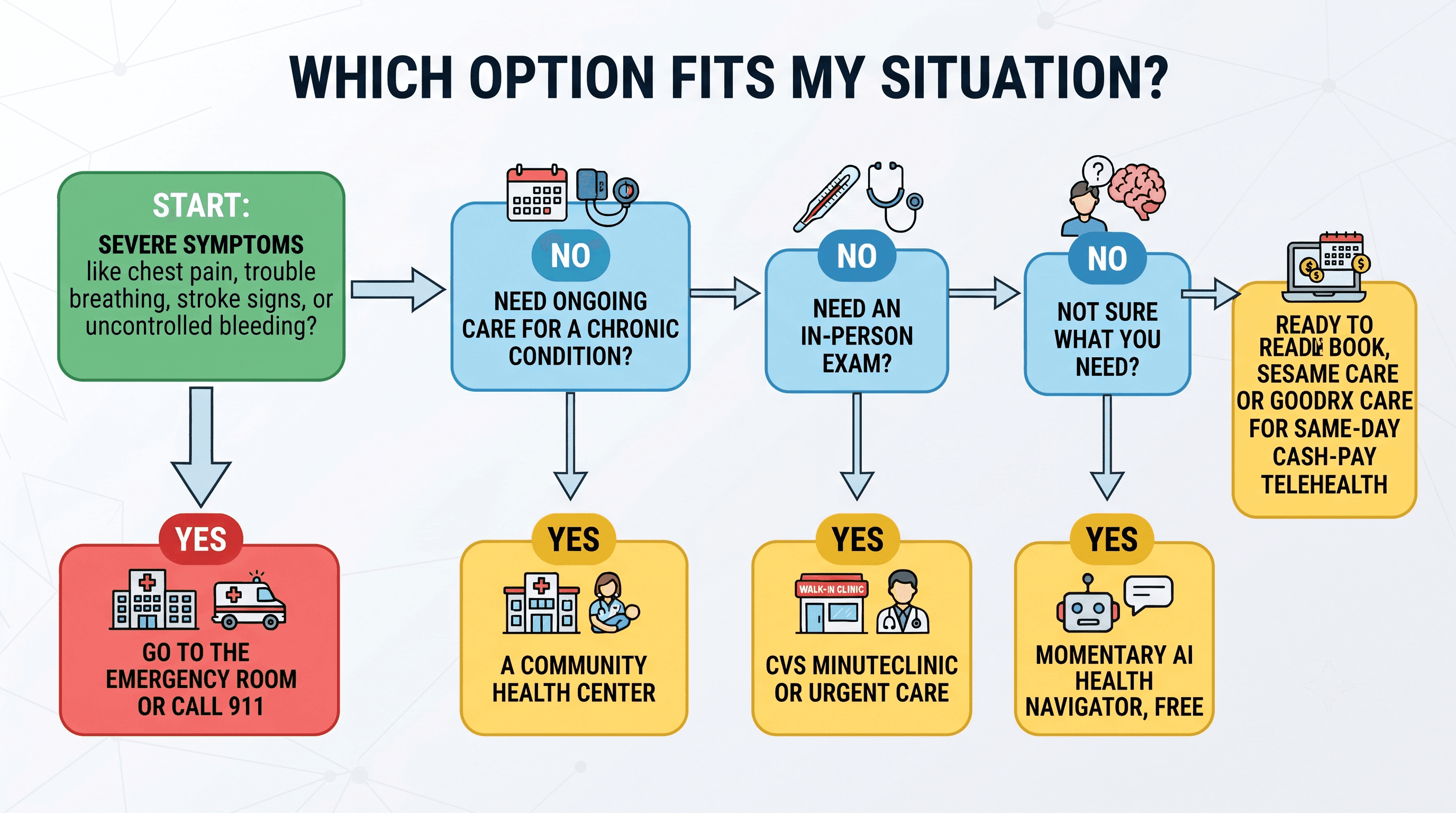
If your symptoms turn out to be more than a telehealth visit or a navigator tool can handle, the next step is seeing a live provider who can examine you, order labs, or manage something ongoing. You can book a virtual primary care visit when you need a licensed provider who can evaluate your situation and follow up over time.
Frequently Asked Questions
What should I do if I have no insurance and need a doctor?
Start with a cash-pay telehealth marketplace like Sesame Care or GoodRx Care for same-day guidance, since both post prices before you book. If your symptom is severe, chest pain, trouble breathing, stroke signs, or uncontrolled bleeding, go to the nearest emergency room. Hospitals must stabilize you regardless of insurance status.
Can I talk to a doctor online for free without insurance?
A live physician visit almost always carries some fee when you're uninsured, typically $19 to $90. What is genuinely free is a symptom-check tool like Momentary's AI Health Navigator, which can help you figure out whether a paid visit is even necessary.
What do I do if I'm sick but don't have insurance and can't afford a visit?
Look for a Federally Qualified Health Center near you, required by law to serve patients on a sliding fee scale based on income, with no one turned away for inability to pay. The National Association of Free & Charitable Clinics also operates roughly 1,400 no-cost clinics for qualifying patients.
Is it cheaper to use telehealth or go to urgent care without insurance?
Telehealth is generally cheaper for conditions that don't need a physical exam. A 2026 study of more than 160,000 visits published in JAMA Network Open found telemedicine episodes averaged $96.60 versus $509.21 for in-person care over a 30-day episode. Cash-pay urgent care typically starts around $150, versus $19 to $90 for most telehealth platforms.
When should I skip telehealth and go straight to the ER without insurance?
Go straight to the emergency room, or call 911, for chest pain, difficulty breathing, sudden weakness or slurred speech, uncontrolled bleeding, or any symptom that feels life-threatening. Hospitals cannot turn you away or delay stabilizing treatment based on your ability to pay, though you may still be billed afterward. If you want help thinking through whether a symptom rises to that level, you can use Momentary's AI Health Navigator for guidance on your next step.


