


Last updated: June 2026
When you need a doctor's guidance but can't or don't want to go in person, you have more options than most people realize. The clearest first step is to use a physician-reviewed AI health tool to understand your symptoms right now, then move to a live virtual visit if you need a diagnosis or prescription. Whether the barrier is cost, convenience, time, or access, this guide walks through the seven best pathways, scored and ranked for this specific situation.
| Option | Best For | Price | Rating | Works Without In-Person Visit |
|---|---|---|---|---|
| Momentary AI | Immediate symptom guidance, any time | Free | Physician-reviewed | Yes, always |
| GoodRx Care | Low-cost conditions + same-visit prescription | $49 / visit (no membership) | Cash-pay platform | Yes |
| Amazon One Medical On-Demand | Fast async care with Amazon Prime | $29 msg / $49 video | 96% satisfaction | Yes |
| Teladoc | Broadest insurance compatibility | $75 / visit (no insurance) | App Store 4.5+ | Yes |
| Nurse Advice Line | Free triage, medication questions | Free (insured or regional) | RN-staffed | Yes, by phone |
| MDLive | Insurance-covered urgent and behavioral care | $82 / visit (no insurance) | Broad insurer network | Yes |
| Pharmacist Consultation | Medication questions, OTC guidance | Free (at pharmacy) | RPh-licensed | Yes, in-store or phone |
How We Ranked
For this list, "best" means the fastest, most accessible path to clinically credible medical advice for someone who cannot or prefers not to see a doctor in person. Six criteria drove the scoring: clinical credibility, cost and value, speed and availability, scope fit, user experience, and trust signals. Because the situation is the entire premise of this piece, scope fit was weighted at 25%, matching clinical credibility at 25%. Speed was weighted at 20%, cost at 15%, user experience at 10%, and trust signals at 5%. Momentary is our own product. We scored it on the same criteria as every other entry. Evaluation date: June 2026.
1. Momentary AI Health Navigator -- Immediate physician-reviewed guidance before you even need a visit
When you need medical advice without seeing a doctor in person, the most immediate option available is Momentary, a physician-reviewed AI health tool you can use right now, at no cost, before deciding whether a live visit is necessary.
Momentary is not a replacement for a physician. It is a first step for someone in your situation: you have a question or concern, and you want to understand your options before committing to a visit. Physician review is built into how Momentary works, so the guidance reflects medical oversight, not just pattern matching.
Pros: Available 24/7 with no signup required, making it faster than any live telehealth service when you need a starting point. Cost is $0, which removes the barrier entirely for people comparing options before spending $49 to $89 on a virtual visit. Scope fit for this situation is exact: Momentary is designed specifically for people who want credible health guidance without an in-person encounter.
Cons: Momentary provides guidance and information, not diagnoses or prescriptions. For conditions that require a clinical assessment or a prescription, a live telehealth visit is the appropriate next step. Momentary should not be used as a substitute for emergency care.
Pricing: Free.
Best for: Anyone who wants to understand their symptoms or health question before deciding whether to book a live virtual visit.
2. GoodRx Care -- Most affordable live visit with same-visit prescription access
GoodRx Care is a telehealth service from GoodRx, the prescription discount platform, offering flat-rate virtual visits with licensed clinicians for people who are not using insurance. For someone who needs advice without seeing a doctor in person and also needs a prescription, GoodRx Care's integrated pricing model handles both in one step.
Pros: Visit fees start at $49 without a membership ($19 with a GoodRx Gold membership at $9.99 per month), which is among the lowest published rates for live telehealth in the US as of June 2026. GoodRx's prescription discount coupons apply automatically after the visit, so the total cost of care and medication is often lower than competing services even where visit fees are comparable. Available in all 50 states through async messaging or video depending on condition.
Cons: GoodRx Care does not accept insurance for visits, so insured patients may pay less through their own plan's telehealth benefit. Scope is limited to common acute conditions and is not a substitute for ongoing chronic disease management.
Pricing: $49 per visit without membership; $19 per visit with GoodRx Gold ($9.99 per month). Medication costs are separate.
Best for: Cash-pay patients or uninsured adults who need an affordable live visit and a prescription for a common condition.
Rating: GoodRx is used by more than 25 million Americans monthly per GoodRx's own disclosures.
3. Amazon One Medical On-Demand -- Fastest async care with no appointment needed
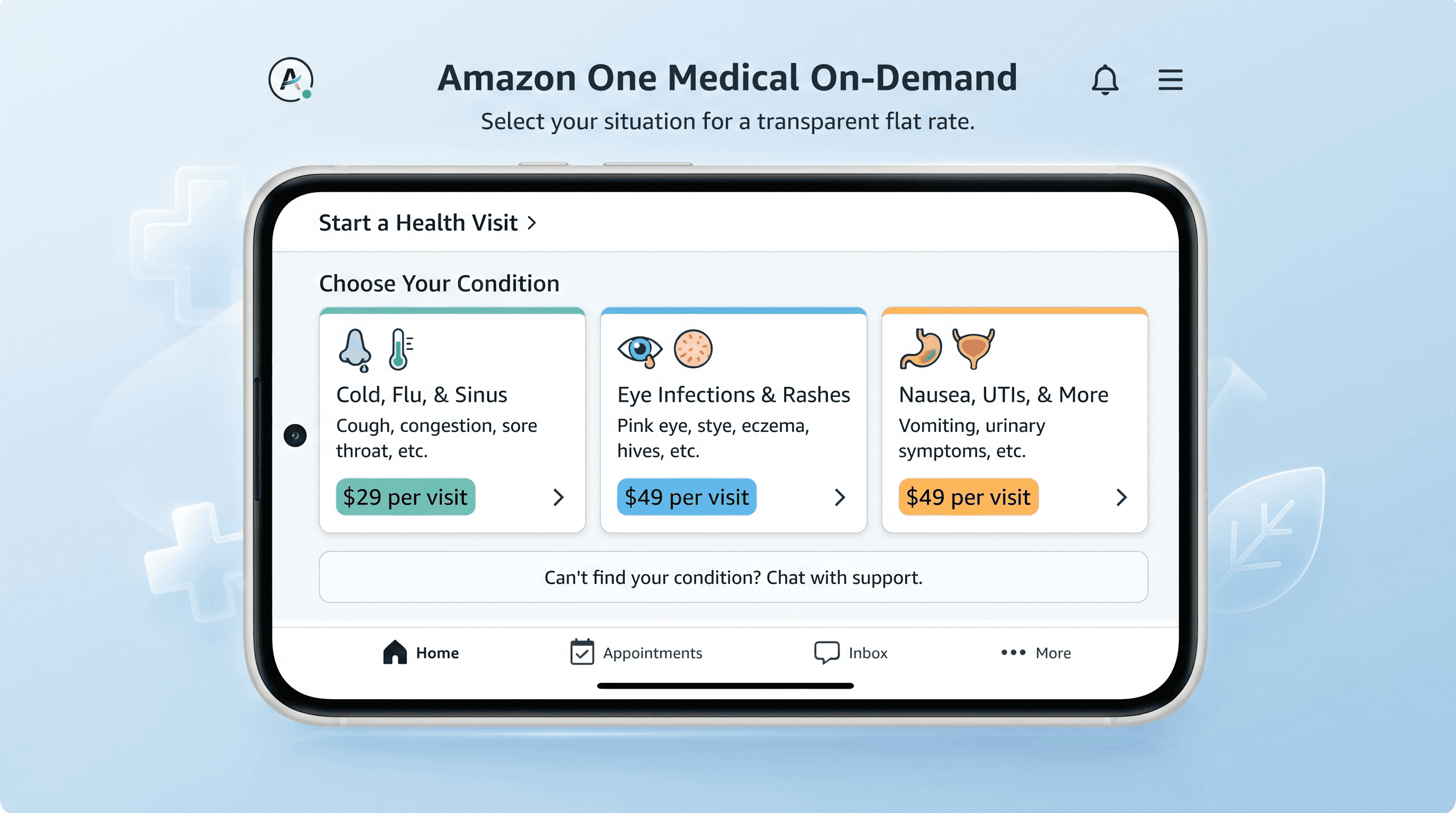
Amazon One Medical On-Demand (formerly Amazon Clinic) offers message-based and video telehealth for 30-plus common conditions with transparent flat-rate pricing and no insurance or membership required. For someone who needs medical advice without an in-person visit, On-Demand covers conditions from UTIs to pink eye to sinus infections in minutes rather than hours.
Pros: $29 for a message-based consultation is one of the lowest verified prices for any live clinician visit in the US (June 2026, Amazon One Medical pricing page). No appointment is needed, the platform is available 24/7, and prescriptions can be sent to any pharmacy including Amazon Pharmacy for free delivery. The former Amazon Clinic carried a 96% customer satisfaction rating before its merger into One Medical.
Cons: Insurance is not accepted for On-Demand Care visits, only for scheduled in-person or video visits. Coverage is limited to 30-plus common conditions; complex or multi-system concerns require a different pathway. Messaging-based care is not available in every state.
Pricing: $29 for direct message care; $49 for video care (no insurance, no membership required). Prices subject to change.
Best for: Amazon customers who want the lowest available price for a fast, async virtual visit for a common acute condition.
Rating: 96% customer satisfaction rating (Amazon, 2023; original Amazon Clinic launch data).
4. Teladoc -- Strongest insurance coverage with 24/7 access
Teladoc is the largest telehealth network in the US and the most likely to be included in your existing employer or health plan benefits. For someone getting medical advice without seeing a doctor in person, Teladoc is the strongest choice if you have insurance and want to confirm coverage before paying out of pocket.
Pros: Teladoc works with the majority of major US insurance plans, and visits can cost as little as $0 when covered. The network includes board-certified internists, family doctors, nurse practitioners, dermatologists, psychiatrists, and pediatricians. Available 24/7, the platform covers general medical care, mental health, dermatology, and back and joint care.
Cons: Without insurance, a general medical visit costs $75 per Teladoc's FAQ (June 2026). The platform uses random provider assignment, which limits continuity of care across visits. User satisfaction ratings are mixed: 51% positive based on 99 verified software reviews per SelectHub (June 2026).
Pricing: $0 per visit with eligible insurance coverage; $75 per visit without insurance (general medical). Pricing confirmed Teladoc Health FAQ, June 2026.
Best for: Insured patients whose employer or health plan includes Teladoc as a benefit.
Rating: Available in all 50 US states; serves tens of millions of covered members through employer plans.
5. Nurse Advice Line -- Free real-person triage, available 24/7
A nurse advice line connects you to a registered nurse by phone at no cost, typically through your health plan or a regional hospital system. For someone who cannot see a doctor in person and wants clinical guidance rather than a formal visit, a nurse line provides the human element of care without any cost or appointment.
Pros: Free, requires no technology beyond a phone call, and is available around the clock. Registered nurses assess symptoms, help you decide whether emergency care is needed, answer medication questions, and direct you to appropriate next steps. Most Medicare Advantage and Medicaid managed care plans include a nurse advice line as a standard benefit. Regional hospital systems including Memorial Hermann (Houston) and HCA Florida Healthcare offer free lines open to anyone in their area regardless of insurance status.
Cons: Nurses cannot diagnose or prescribe. If your situation requires a clinical assessment or a prescription, the nurse will direct you to a live provider visit. Lines through health plans are member-only benefits; regional free lines are geographically limited.
Pricing: Free for members through most insurance plans. Memorial Hermann Nurse Health Line (713-338-7979) is free to all Texas residents regardless of insurance. HCA Florida Healthcare's Consult-A-Nurse (1-844-706-8773) is free to all Florida residents regardless of insurance (source: HCA Florida Healthcare newsroom, January 2026).
Best for: Anyone who wants a real-time clinical conversation to triage a symptom before deciding on the next step, at no cost.
Number: Memorial Hermann Nurse Health Line handled calls in Harris County and the greater Houston region 24/7, bilingual in English and Spanish (Memorial Hermann, 2025).
6. MDLive -- Best for behavioral health without an in-person visit
MDLive offers telehealth for urgent care, general care, mental health, and dermatology. It accepts a broad range of insurance plans, making it a strong option for someone whose plan covers behavioral health telehealth and who wants to see a provider without going to a clinic.
Pros: MDLive accepts most major insurance plans including Cigna, Humana, Blue Cross Blue Shield, and Aetna, with copays averaging $0 to $30 for insured patients. The platform is available 24/7 and covers a wide spectrum of care. Providers average 10 years of clinical experience per MDLive's own disclosures. 88% of therapy users rated MDLive good or very good value for care received (HelpGuide survey, May to June 2025, n=200+).
Cons: Without insurance, general care visits run approximately $82 per visit and mental health visits run $140 to $299 per initial visit, which is among the higher out-of-pocket costs on this list. Around 22% of therapy users reported a surprise charge in HelpGuide's survey.
Pricing: $0 to $30 copay with eligible insurance; $82 per general care visit without insurance; $140 per initial therapy session without insurance (HelpGuide, 2026; MDLive FAQ, June 2026).
Best for: Insured patients who want behavioral health or urgent care without going to a clinic.
Rating: 88% of therapy users rated MDLive good or very good value (HelpGuide survey, 2025, n=200+).
7. Pharmacist Consultation -- Free expert guidance on medications, OTC products, and side effects
A pharmacist is a licensed medication expert who can be reached in person at any pharmacy or by phone, without an appointment, at no charge. For someone who needs medical advice about a drug interaction, dosing question, or over-the-counter treatment without seeing a doctor in person, a pharmacist consultation is underused and immediately available.
Pros: No appointment, no cost, no app, no insurance required. Pharmacists are trained to identify drug interactions, clarify dosing for prescription and OTC medications, advise on side effects, and recommend when a physician visit is appropriate. In-person consultations are available at chain pharmacies including CVS, Walgreens, and Rite Aid daily.
Cons: Pharmacists cannot diagnose conditions or prescribe medications. Their scope is strongest for medication-related questions rather than new symptoms without a prior diagnosis. Chain pharmacy pharmacists are often busy during peak hours, which can limit consultation time.
Pricing: Free at point of service. No insurance or membership required.
Best for: Anyone with a medication question, drug interaction concern, or OTC product question who wants immediate professional guidance.
Number: Walgreens operates more than 8,700 US pharmacy locations as of 2026.
Why Not Having a Doctor Appointment Changes Your Options
The situation of needing medical advice without seeing a doctor in person covers a wide range of circumstances: no local provider availability, high costs, time pressure, mobility limitations, distance, or simply preferring the speed of virtual care. The right pathway depends on where you are in that situation.
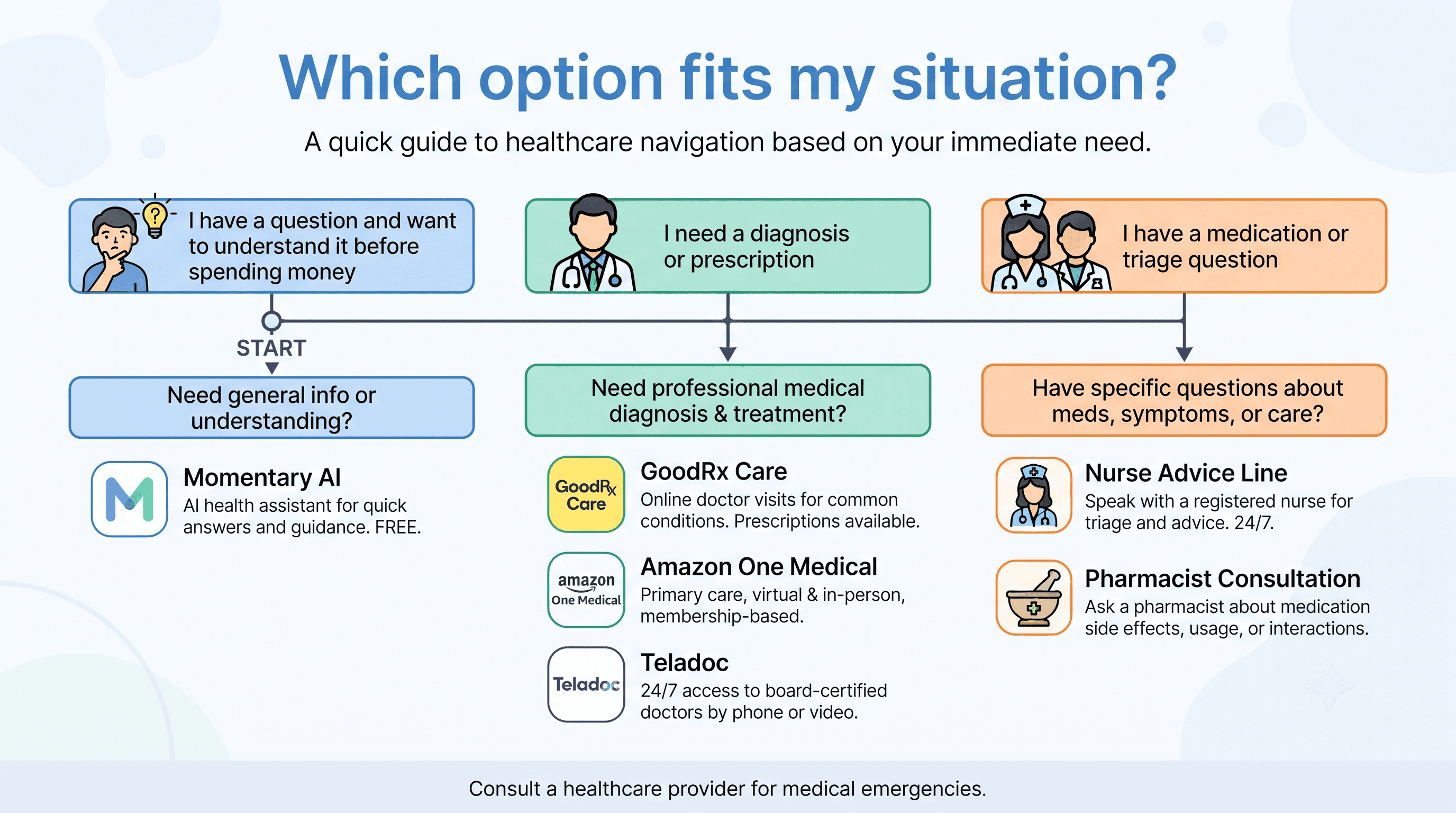
For questions and symptom clarity, no-cost tools including AI health navigators and nurse advice lines handle the immediate need without any cost or commitment. These options exist specifically for the gap between "I'm not sure what's happening" and "I need a live clinician." They are not a workaround; they are a legitimate first step that most clinical guidelines now acknowledge as appropriate triage.
For diagnoses and prescriptions, a live telehealth visit is necessary. Telehealth providers in all 50 states are legally permitted to evaluate, diagnose, and prescribe for a wide range of conditions through video or messaging, without the patient ever entering a clinic. Prescribing authority through telehealth covers most non-emergency acute conditions including UTIs, sinus infections, strep throat, pink eye, and prescription refills. Controlled substances require additional requirements and most telehealth platforms do not prescribe them.
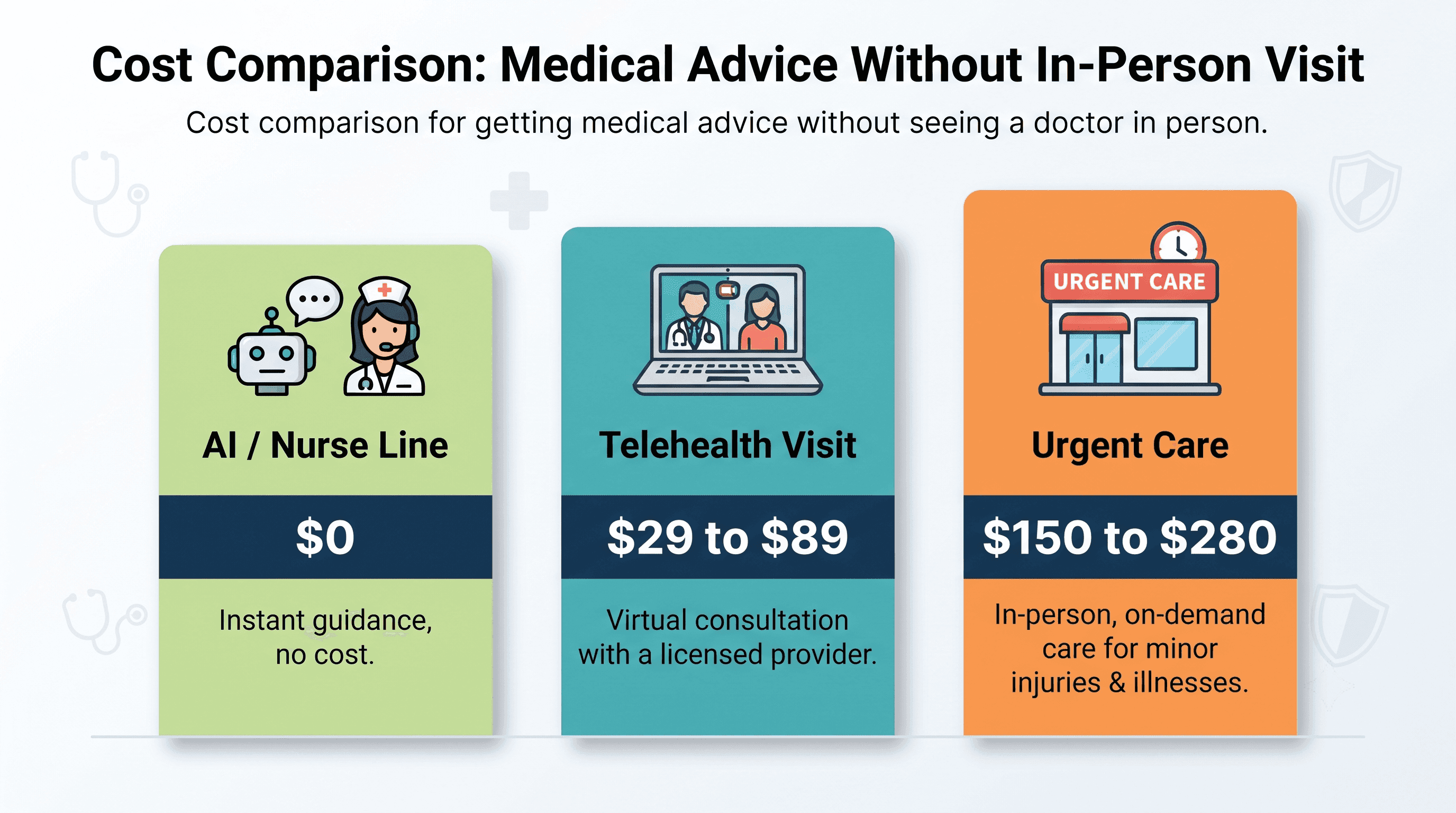
The cost difference between options in this situation is substantial. A nurse advice line or pharmacist consultation costs nothing. An AI navigator costs nothing. A live telehealth visit with insurance can cost $0. Without insurance, visits run from $29 to $89 for the options on this list, compared to $150 to $280 at urgent care and an average of over $2,700 for an uninsured ER visit for a non-emergency condition per 2026 cash-pay data. Knowing which option fits the urgency and type of your question is most of the decision.
When to Move to a Live Provider
An AI health tool or nurse advice line covers a lot of ground, but some situations require a clinician who can assess, diagnose, and prescribe. If you have symptoms that have not improved after a few days, if you need a prescription, if you are managing a new or changing chronic condition, or if you want a professional opinion before deciding whether to go to an in-person facility, a live virtual visit is the right next step.
You can see a doctor online through Momentary Virtual Care for a telehealth appointment with a primary care provider, without leaving home.
Frequently Asked Questions
Is there a ChatGPT for medical questions?
Momentary is a physician-reviewed AI health tool designed specifically for health questions. Unlike general-purpose AI tools, Momentary's guidance reflects physician oversight and is built for medical context. You can explore your symptoms with Momentary's AI health navigator to understand your situation before deciding on next steps. General AI tools like ChatGPT can provide information but are not clinically reviewed and should not be used as a substitute for medical guidance.
What do I do if I can't see a doctor?
Start with a free option: a physician-reviewed AI tool like Momentary or a nurse advice line through your insurance. If you need a diagnosis or prescription, a live telehealth visit through GoodRx Care ($49 cash-pay), Amazon One Medical ($29 to $49), or Teladoc ($0 with eligible insurance; $75 without) lets you see a licensed clinician today without an in-person appointment. For medication questions, a pharmacist at any chain pharmacy can help at no cost.
Can I talk to a doctor online for free?
Nurse advice lines through most insurance plans and regionally through hospital systems (such as Memorial Hermann in Texas and HCA Florida Healthcare in Florida) connect you to a registered nurse at no cost, 24/7. AI health tools like Momentary are also free. A live physician visit through telehealth is typically not free, but starts as low as $29 through Amazon One Medical or $49 through GoodRx Care without insurance, and may cost $0 with eligible insurance through plans that cover Teladoc or MDLive.
What to do if I can't see a GP?
If your primary care provider is unavailable, telehealth gives you same-day access to a licensed clinician through platforms like Teladoc, GoodRx Care, or Amazon One Medical, all available without an appointment. For non-urgent questions, a pharmacist consultation or nurse advice line can help you triage the situation and determine whether a live visit is necessary. If your situation feels urgent but is not an emergency, a virtual visit is appropriate for most acute conditions including infections, rashes, and prescription refills.
What conditions can telehealth providers treat without an in-person visit?
Telehealth providers can evaluate and prescribe for most common acute conditions including UTIs, sinus infections, strep throat, pink eye, cold and flu, acne, eczema, and prescription refills for stable chronic conditions. They cannot prescribe most controlled substances, conduct physical exams that require hands-on assessment, order imaging, or treat emergencies. If your symptoms suggest a situation that requires a physical exam, imaging, or emergency intervention, an in-person visit or emergency room is appropriate.


