


Last updated: September 2026
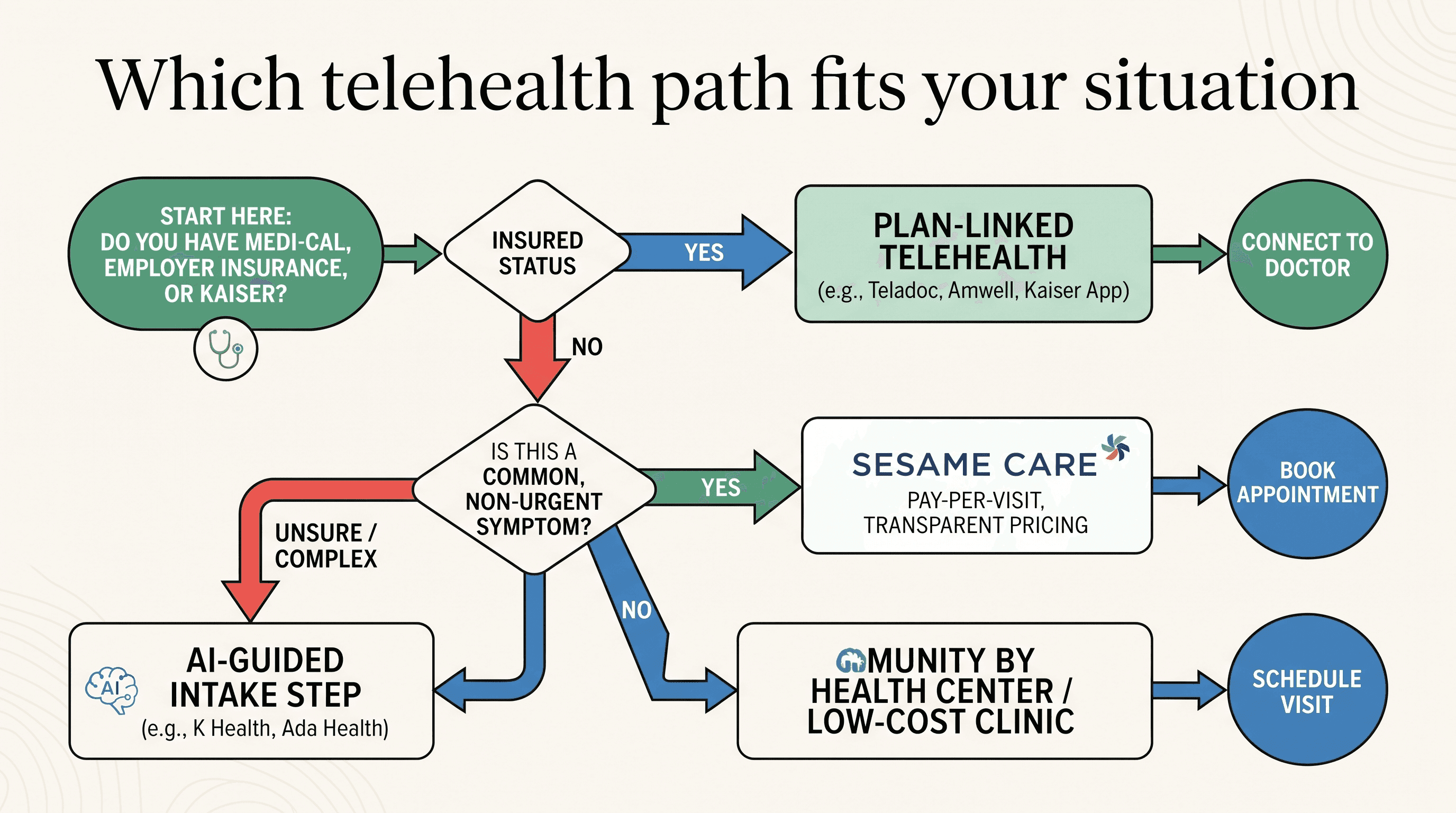
If you need medical advice today and want to avoid a trip to a clinic, match your situation to the right pathway first. A cash-pay marketplace like Sesame Care gets you a same-day video visit for common issues like a UTI, cold, or rash. If you have Medi-Cal or an employer health plan, that coverage usually already includes a telehealth benefit at little or no cost, so check there before paying cash. If you are not sure whether your symptom even needs a live visit, an AI-guided check can help you figure out the right next step first.
| Option | Best For | Price | Rating | Works Without Insurance |
|---|---|---|---|---|
| Sesame Care | Fast, cash-pay same-day visits | $29 to $47 per visit | 4.7 stars, App Store, 45,000+ ratings (July 2026) | Yes |
| Rocket Doctor | California-specific virtual and Medi-Cal-linked care | $0 to $175 per visit depending on plan | Not independently rated at volume | Partial, Medi-Cal plans and cash pay |
| Momentary | Ongoing primary care by text; prescriptions, labs, and referrals | $19.99/month membership (HSA/FSA eligible); no per-visit fees | Newer service; limited third-party reviews | Yes; flat $19.99/month, no insurance needed |
| Medi-Cal managed care telehealth (MDLIVE via plan) | Medi-Cal members needing after-hours advice | $0 for enrolled members | Plan-dependent, not independently rated | No, requires Medi-Cal enrollment |
| Teladoc | Employer or insurance-covered general visits | $0 to $50 with coverage, $89 cash pay | 4.7 stars, App Store, 400,000+ ratings (July 2026) | Yes, at cash-pay rate |
| Kaiser Permanente Video Visits | Existing Kaiser members | Included in plan, typical $0 to $20 copay | Not separately rated from main Kaiser app | No, members only |
| Talkspace | Ongoing mental health support | $276 per month for messaging therapy | 4.5 stars, App Store, 20,000+ ratings (July 2026) | Yes, cash pay available |
| Community health center telehealth | Sliding-scale primary and preventive care | $0 to $50 based on income | Not centrally rated, varies by clinic | Yes, sliding scale |
How We Ranked
For this list, "best" means the fastest, most legitimate path to a real medical answer today without physically going into a clinic. We scored every entry on clinical credibility, cost and value, speed and availability, scope fit, user experience, and trust signals, evaluated as of July 2026. Because this situation is defined by needing care now, we weighted speed and availability at 30% and scope fit at 25%, above the default 20% each, and reduced user experience and trust signals to 5% each to compensate. Clinical credibility stayed at 20% and cost and value at 15%. Momentary is our own product. We scored it on the same criteria as every other entry.
1. Sesame Care: Same-day cash-pay visits for common symptoms without insurance
Sesame Care is a nationwide marketplace of independent, licensed physicians and nurse practitioners who set their own cash prices for telehealth and in-person visits. In this situation, a reader with a cold, UTI, rash, or prescription refill need can browse providers, see the price before booking, and get a video visit the same day without billing insurance.
Pros: Providers are typically available within hours, sometimes minutes, and the app shows exact pricing before checkout. It also covers dermatology, psychiatry, and women's health from one account.
Cons: Sesame does not accept any insurance, so a reader with a $0-copay telehealth benefit elsewhere will usually pay more here. It also has no in-app therapist-matching tool for mental health visits.
Pricing: Telehealth visits start at $29 to $47 depending on specialty and provider, with an optional $10.99 per month Sesame Plus membership that knocks $10 off most visits.
Best for: Uninsured or high-deductible patients who want a same-day visit for a common, non-emergency symptom.
Rating: 4.7 stars on the App Store (July 2026, over 45,000 ratings).

2. Rocket Doctor: California-built virtual care that works with several Medi-Cal plans
Rocket Doctor is a telehealth platform built specifically for California, and it is directly integrated into the virtual care options offered by some California Medi-Cal managed care plans. In this situation, a reader enrolled in one of these plans, or paying cash, can call in and speak with a California-licensed physician the same day, without needing an existing primary care relationship.
Pros: It is licensed specifically for California and is one of the few options here directly linked into Medi-Cal plan telehealth benefits, lowering or eliminating cost for enrolled members.
Cons: Booking is phone-first rather than app-first, and there is not yet a large volume of independent third-party reviews to compare against bigger national platforms.
Pricing: $0 for eligible Medi-Cal managed care members through their plan, cash-pay rates otherwise typically in the $80 to $175 range depending on visit type.
Best for: California Medi-Cal members or cash-pay patients who specifically want a California-licensed same-day physician.
Rating: Not yet independently rated at meaningful volume as of July 2026.
3. Momentary — An ongoing California doctor you can text, for $19.99 a month
Why it's included: Momentary is the only option on this list built as an ongoing relationship rather than a one-off visit. Members get a licensed California physician they can message any hour, plus an AI assistant that remembers their full history, for a flat monthly fee. Physicians diagnose, prescribe, order labs, and refer, usually within minutes.
Best for: Californians who want a personal doctor in their pocket for everyday primary care: refills, new symptoms, lab work, and follow-up questions, without booking an appointment for each one.
Pricing: $19.99 a month, HSA/FSA eligible. No per-visit fees and no insurance billing.
Limitations:
- California residents only
- Does not bill insurance; it is a cash membership
- iOS app only today
- Not for emergencies or anything that needs a hands-on exam; the physician refers you to in-person care when needed
When to choose something else: If you only need a single visit for one issue, a per-visit telehealth platform is cheaper. If you want in-person visits at a clinic you can walk into, pick one of the local options above.
4. Medi-Cal managed care telehealth (MDLIVE and similar plan-linked services): No-cost after-hours advice for Medi-Cal members
Most California Medi-Cal managed care plans now include a telehealth benefit, often delivered through a partner like MDLIVE, at no cost to the member. In this situation, a Medi-Cal enrollee who cannot reach their assigned doctor, especially after hours, can call or log in and reach a licensed clinician for common conditions at no charge.
Pros: The service costs enrolled members nothing and typically includes both a 24-hour nurse advice line and video visits with a doctor.
Cons: It is only available to people enrolled in a qualifying Medi-Cal managed care plan, so it fails the eligibility test for uninsured readers, and it cannot write prescriptions for controlled substances.
Pricing: $0 for enrolled members.
Best for: Medi-Cal enrollees who need after-hours advice and cannot get in with their assigned doctor.
Rating: Plan-dependent; not centrally rated as a standalone app.
5. Teladoc: The largest employer and insurance-linked telehealth network
Teladoc is the largest telehealth platform in the country by visit volume and is included as a benefit by many employers and health plans in California. In this situation, a reader whose insurance or job already includes Teladoc can typically get a same-day general medical visit for a copay close to $0.
Pros: If your plan includes it, visits can cost as little as $0, and the network operates 24 hours a day. It also covers mental health, dermatology, and nutrition beyond general medicine.
Cons: Without insurance or an employer benefit, cash-pay pricing is noticeably higher than dedicated cash-pay marketplaces, and it functions more like an on-demand clinic than an ongoing relationship with one doctor.
Pricing: $0 to $50 per visit with qualifying insurance or an employer benefit; $89 per general medical visit cash pay.
Best for: Readers who already have Teladoc through an employer or health plan.
Rating: 4.7 stars on the App Store (July 2026, over 400,000 ratings).
6. Kaiser Permanente Video Visits: Built-in virtual care for existing Kaiser members
For Kaiser Permanente members in California, video visits are built directly into the same app used for scheduling, messaging a doctor, and viewing lab results. In this situation, an existing Kaiser member with a mild symptom can often get a same-day video appointment with a provider who already has their full medical record.
Pros: Because it is tied to your existing record, the provider already has your history and medications in view, and cost is typically limited to your normal plan copay.
Cons: It is only available to existing Kaiser Permanente members, so it fails the eligibility bar for uninsured readers or those on other plans, and same-day video slots can be more limited than on-demand cash-pay marketplaces.
Pricing: Included in Kaiser Permanente membership; typical copay $0 to $20 depending on plan.
Best for: Existing Kaiser Permanente members who want to stay within their own medical record system.
Rating: Not separately rated from the main Kaiser Permanente app.
7. Talkspace: Ongoing mental health support by video and messaging
Talkspace connects users with a licensed therapist or psychiatric provider through scheduled video sessions and ongoing text messaging. In this situation, a reader dealing with anxiety, low mood, or another mental health concern who wants to avoid an in-person intake can start messaging a matched therapist within a couple of days instead of waiting weeks for a local opening.
Pros: Messaging access is available five days a week rather than a single weekly slot, and the platform accepts many major insurance plans, which can bring the copay close to $0.
Cons: Cash-pay pricing runs higher than other online therapy platforms, and initial matching happens quickly, so some users need to switch therapists once or twice before finding a good fit.
Pricing: $276 per month ($69 per week) for messaging-only therapy paid out of pocket; higher tiers add live video sessions.
Best for: Readers who want ongoing mental health support rather than a one-time visit.
Rating: 4.5 stars on the App Store (July 2026, over 20,000 ratings).
8. Community health center telehealth: Sliding-scale care for the uninsured and underinsured
Federally funded community health centers across California, often called FQHCs, increasingly offer telehealth visits with the same sliding-scale fee structure they use in person, based on household income rather than a flat rate. In this situation, an uninsured reader who wants an ongoing provider relationship, not just a one-off visit, can call their local center to ask about phone or video appointments.
Pros: Fees scale to what you can afford, sometimes reaching $0 for the lowest-income patients, and centers are built around continuity of care rather than a rotating pool of providers.
Cons: Same-day availability is inconsistent and depends on the individual clinic's scheduling, and most centers require calling in rather than booking instantly through an app.
Pricing: $0 to $50 per visit based on a sliding income scale; exact fees vary by center.
Best for: Uninsured readers who want a lower-cost, ongoing provider relationship rather than a single same-day visit.
Rating: Not centrally rated; quality and access vary by individual clinic.
Why Your Situation Changes Which Option Actually Works
This list is organized around avoiding a clinic visit rather than just naming the biggest telehealth brands, because not every option is actually reachable in every situation. If you have Medi-Cal or an employer plan, that coverage usually already includes a telehealth benefit at little or no cost, so paying cash for a marketplace visit is often the more expensive path, not the necessary one. If you are uninsured, the calculation flips: a cash-pay marketplace or a sliding-scale community health center will usually beat what an insurance-linked platform charges without coverage.
Real-world data on how telehealth visits get resolved supports starting with the lowest-friction option first. In an early national analysis of telehealth encounters, most patients were managed entirely at home, while only a small share were referred onward to an emergency department or urgent care setting (CDC). That pattern is a reason not to default to an ER trip out of caution alone, and a reason a triage step, like a nurse advice line or a quick message to a doctor, can be a useful first move before you pay for anything. Telehealth also has documented value beyond one-off symptoms: public health guidance points to telehealth interventions helping patients manage conditions like high blood pressure, diabetes, and asthma over time (CDC), worth knowing if your situation is less about tonight's symptom and more about ongoing chronic condition management from home.
Before booking anything, ask a provider or platform directly whether they treat your specific symptom, whether they bill insurance or require cash, and whether they can send a prescription to your regular pharmacy.
If your situation turns out to need more than a single virtual visit, such as an ongoing condition, a new diagnosis, or symptoms that do not improve, the next step is usually to connect with a primary care provider for a fuller virtual primary care visit rather than repeating one-off telehealth visits with different providers each time.
Frequently Asked Questions
What should I do if I need to see a doctor today in California but don't want to go to a clinic? Check whether your insurance, Medi-Cal plan, or employer benefit already includes telehealth, since that is usually the lowest-cost path. Otherwise, a cash-pay marketplace like Sesame Care can typically get you a same-day video visit at a posted, upfront price.
Is telehealth covered by insurance in California? Most commercial plans, Medi-Cal managed care plans, and Medicare Advantage plans in California include some telehealth coverage, though the copay and platform depend on your individual plan. Check your member portal before booking elsewhere.
Can I get telehealth in California without insurance? Yes. Cash-pay marketplaces like Sesame Care do not require insurance and publish prices upfront, and community health centers offer sliding-scale telehealth visits based on income.
What conditions can telehealth treat, and what can't it treat? Telehealth suits common, non-emergency issues like colds, allergies, UTIs, rashes, and prescription refills, plus ongoing management of conditions like high blood pressure or diabetes. It is not appropriate for chest pain, difficulty breathing, severe injury, or symptoms needing in-person examination. If you're unsure which category applies, you can use an AI health tool to understand your symptoms and reach a physician for diagnosis before deciding where else to book.
How do I get same-day telehealth in California after normal office hours? Cash-pay marketplaces and Medi-Cal plan-linked services like MDLIVE typically operate evenings, weekends, and holidays. Check your plan's after-hours nurse line first, since many Medi-Cal and commercial plans include one at no cost.
Can I get a prescription refilled through telehealth in California? Yes, for most non-controlled medications, sent electronically to your regular pharmacy during or shortly after a visit. Controlled substances usually still require additional verification or an in-person visit under California and federal rules.


