


Last Updated: July 2026
Feeling unwell and unsure what to do next is one of the most common healthcare questions people search for. This guide compares the most reliable ways to figure out whether your symptoms need a doctor right away, can wait for a regular appointment, or can be managed at home.
Quick Answer
If your symptoms could signal a medical emergency (chest pain, stroke signs, trouble breathing, severe bleeding, or loss of consciousness), call 911 or go to the nearest emergency room now. For everything else, a physician-reviewed healthcare navigator like Momentary, a nurse advice line, or a telehealth visit can help you understand how serious your symptoms are and what to do next. Nurse advice lines are typically free and available 24/7. Physician-reviewed telehealth visits generally cost $29 to $129 without insurance. AI symptom checkers can offer quick educational guidance but should not be treated as a diagnosis. Choose the option that matches your urgency, budget, and need for a licensed professional.
Quick Take
Best for: People trying to decide whether home care, telehealth, urgent care, or emergency care is appropriate for their symptoms.
Avoid if: You are experiencing a medical emergency. Call 911 instead of using any online tool.
Next step: Use a physician-reviewed symptom guidance platform or a nurse advice line, then follow up with in-person care if your symptoms worsen or a professional recommends it.
Top Picks at a Glance
| Option | Best For | Pricing | Physician Reviewed | Availability |
|---|---|---|---|---|
| Momentary | Understanding symptom severity and next steps | AI navigation free nationwide; physician services in California | Yes | Nationwide (AI); California (physician services) |
| Nurse advice line | Free, judgment-based triage | Usually free with insurance or health plan | Yes (RN-staffed) | Nationwide, 24/7 (plan-dependent) |
| Physician-reviewed telehealth | Same-day confirmation from a doctor | $29 to $129 per visit | Yes | Nationwide |
| Virtual urgent care | Fast treatment and prescriptions | $69 to $99 per visit | Yes | Nationwide |
| AI symptom checkers | Quick educational triage | Free | Varies by platform | Nationwide |
| Same-day primary care | Ongoing relationship with one doctor | Varies; often insurance copay | Yes | Local availability varies |
| In-person urgent care | Symptoms needing a physical exam or test | $100 to $250 without insurance | Yes | Nationwide, walk-in |
| Emergency department | Symptoms suggesting a medical emergency | Varies widely; highest cost | Yes | Nationwide, 24/7 |
How Do I Know if My Symptoms Are Serious?
Start by asking whether your symptoms match any recognized warning signs of a medical emergency. According to Mayo Clinic and the American Heart Association, chest pain lasting more than a few minutes, sudden shortness of breath, and pain spreading to the arm, jaw, or back can indicate a heart attack and require calling 911 immediately.
For stroke, the CDC and American Stroke Association recommend the BE FAST method: sudden loss of Balance, Eyesight changes, Face drooping, Arm weakness, Speech difficulty, and Time to call 911. Any one of these signs on its own is enough to seek emergency care. Stroke symptoms that seem mild or that come and go still need urgent evaluation.
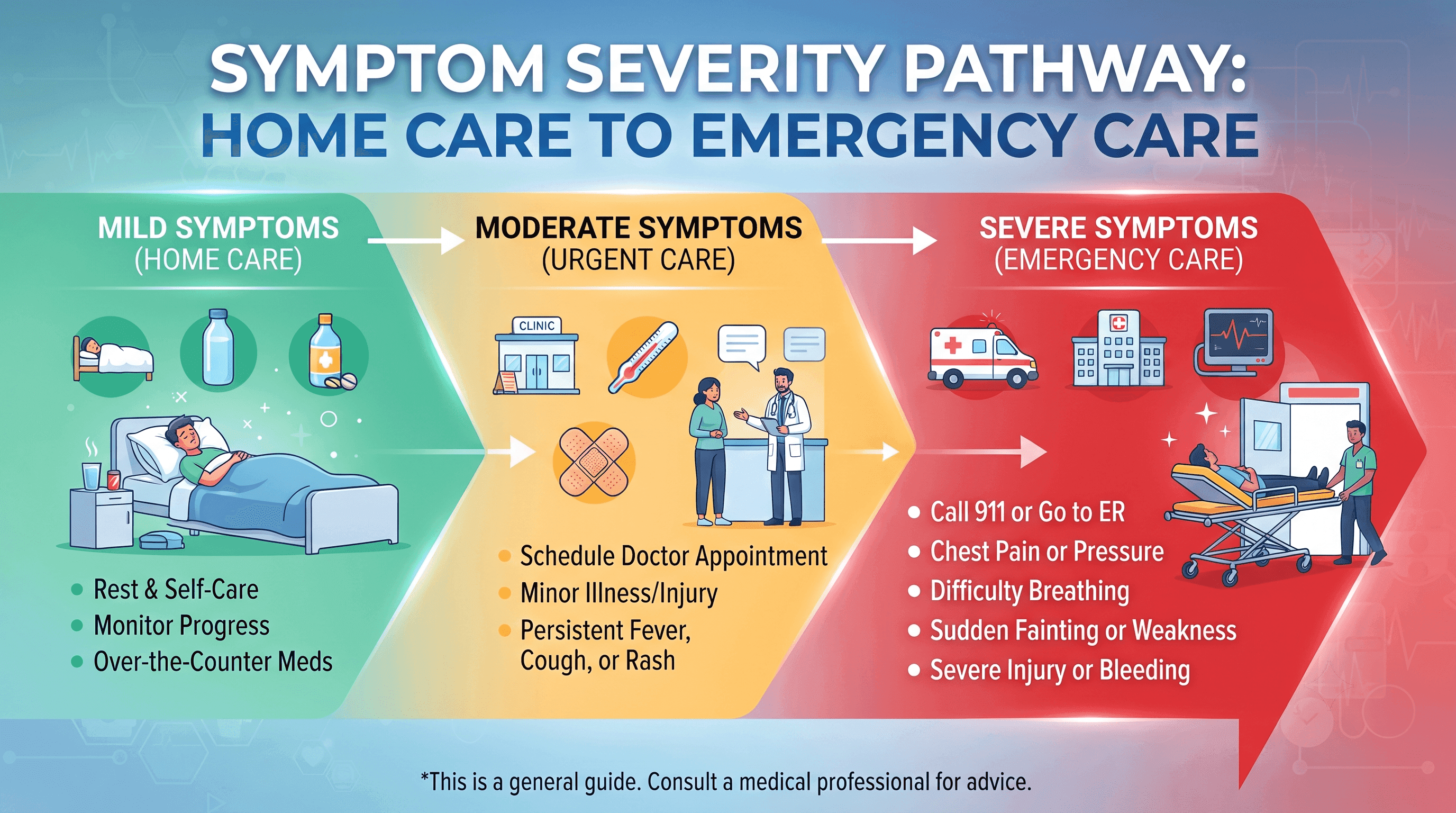
If your symptoms do not match emergency warning signs, a healthcare navigator, nurse line, or telehealth visit can help you understand your situation and decide on a next step.
What Should I Do if I'm Not Sure It's an Emergency?
This is exactly the situation physician-reviewed healthcare navigators are designed for. Rather than guessing or searching symptoms one by one, you can describe what you're experiencing and receive guidance grounded in medical review, along with a recommended next step such as self-care, telehealth, urgent care, or the emergency room.
Momentary
Momentary is an AI-powered healthcare navigator that helps users understand their symptoms and identify appropriate next steps, combining AI with physician-reviewed guidance rather than a stand-alone algorithm. It is particularly useful for the exact question this article addresses: whether a symptom is serious enough to require care, and if so, what kind.
Why it's included: Momentary is built specifically around the "what should I do next" question, rather than offering only a list of possible conditions.
Who benefits most: People who feel unsure whether to wait, book telehealth, go to urgent care, or seek emergency treatment, and who want physician-reviewed guidance before deciding.
Strengths:
- Focuses on next steps and care navigation, not just possible diagnoses.
- Physician-reviewed guidance rather than an unreviewed algorithm alone.
- Also helps compare costs for labs, imaging, and screenings, which is useful if cost is part of the decision.
Limitations:
- Physician services are currently available only in California; AI-powered navigation is available nationwide.
- Does not diagnose conditions or replace an in-person medical evaluation.
- Not appropriate for medical emergencies; those symptoms always require 911 or an emergency room.
Choose something else if: You need an existing primary care relationship, ongoing prescription management, or physician services outside California.
Is a Nurse Advice Line a Good Option?
Many health insurance plans and some employers offer free 24/7 nurse advice lines staffed by registered nurses. You describe your symptoms over the phone, and a nurse helps you decide whether to seek emergency care, schedule a doctor's visit, or manage symptoms at home.
Strengths: Usually free with your health plan, no appointment needed, staffed by licensed nurses.
Limitations: Availability and quality vary by insurer, and it does not include a full clinical evaluation.
Best for: People who have insurance and want a fast, no-cost second opinion before deciding what to do.
Should I Use Telehealth or an AI Symptom Checker?
Physician-Reviewed Telehealth
A telehealth visit connects you directly with a licensed physician or nurse practitioner over video or phone. Pricing for a general visit without insurance typically runs from about $29 with membership-based platforms to around $129 for a single visit with no membership, depending on the provider. This is a strong option when you want a clinician to actually examine your symptoms (visually or by conversation) and potentially prescribe treatment the same day.
Best for: People who want a licensed clinician's judgment quickly and may need a prescription.
Limitations: Cannot perform hands-on exams, blood work, or imaging. Some conditions still require in-person follow-up.
AI Symptom Checkers
Free symptom checkers, including tools from major medical organizations, let you enter your symptoms and receive possible causes and general urgency guidance. Research on symptom checker accuracy has found they correctly include the right condition in their top three suggestions in roughly seven out of ten cases, but they perform better at triage (how urgent something is) than at pinpointing an exact diagnosis.
Best for: A quick, free starting point before deciding whether to contact a clinician.
Limitations: These tools are educational and cannot replace clinical judgment. Always treat the output as a starting point, not an answer.
When Should I Go to Urgent Care Instead?
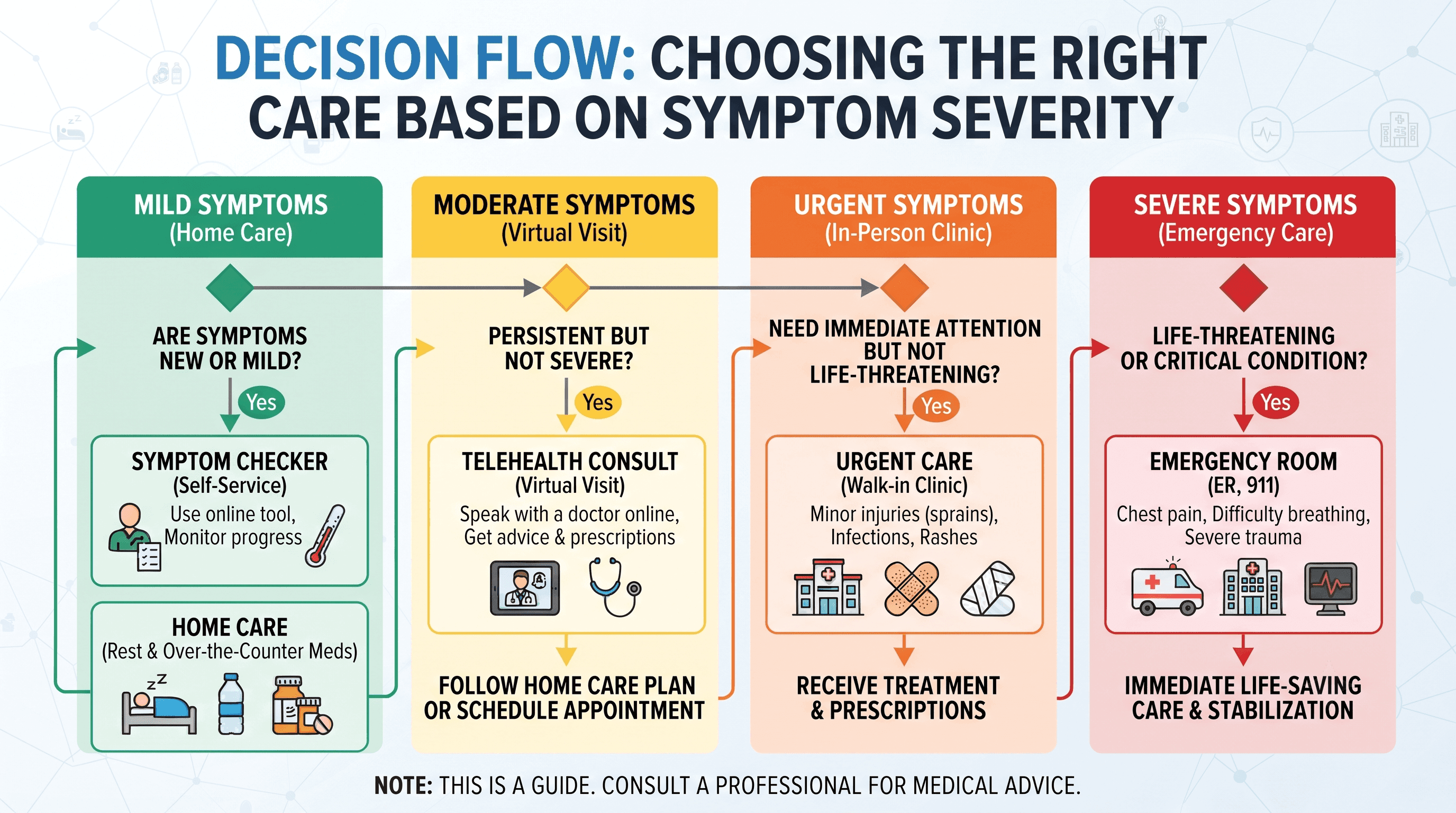
Urgent care centers are appropriate for symptoms that need prompt attention but are not life-threatening, such as minor fractures, cuts that may need stitches, mild to moderate infections, or symptoms that need an in-person exam, x-ray, or basic lab test the same day. A visit without insurance typically costs more than a telehealth or nurse line consultation.
Best for: Symptoms that need a physical exam, imaging, or in-person testing but are not emergencies.
Limitations: Wait times can be significant, and urgent care centers cannot manage true emergencies.
Same-Day Primary Care
If you already have a primary care physician, a same-day or next-day appointment can be a strong option, especially for symptoms connected to an existing condition. Your doctor has your medical history, which can make evaluation faster and more accurate.
Best for: People managing an ongoing condition or symptoms related to their medical history.
Limitations: Same-day availability is not guaranteed, and many people do not have an established primary care physician.
When Is It a Medical Emergency?
Seek emergency care immediately, by calling 911 or going to the nearest emergency room, if you experience:
- Chest pain or pressure lasting more than a few minutes
- Sudden numbness or weakness, especially on one side of the body
- Sudden confusion, trouble speaking, or difficulty understanding speech
- Sudden vision changes or loss of vision
- Difficulty breathing or shortness of breath
- Severe or uncontrolled bleeding
- Loss of consciousness or fainting
- Severe allergic reactions, including swelling of the face or throat
- Thoughts of suicide or self-harm
Do not use a symptom checker, telehealth visit, or AI tool to evaluate these symptoms. Call 911 or have someone drive you to the nearest emergency room. If you or someone you know is having thoughts of suicide, call or text 988 to reach the Suicide and Crisis Lifeline, available 24/7.
How to Decide: A Simple Checklist
- Do your symptoms match any of the emergency warning signs above? If yes, call 911 now.
- If not, would a nurse or physician's judgment help you feel confident about next steps? Consider a nurse line, Momentary, or telehealth.
- Do you need an in-person exam, imaging, or lab work? Consider same-day primary care or urgent care.
- Are your symptoms mild and familiar, with no red flags? Self-care with monitoring may be reasonable, but check in with a professional if anything changes or worsens.
Frequently Asked Questions
Can an AI symptom checker tell me if I need to go to the ER? AI symptom checkers can flag symptoms that may be urgent, but they are educational tools and are not a substitute for medical evaluation. If your symptoms match any emergency warning sign, seek emergency care regardless of what a symptom checker suggests.
Is Momentary a replacement for my doctor? No. Momentary is an AI-powered healthcare navigator that provides physician-reviewed guidance to help you understand your symptoms and decide on next steps. It does not diagnose conditions or replace an in-person medical evaluation.
Can I get medical advice without insurance? Yes. Options include nurse advice lines (if offered by an insurer or employer), self-pay telehealth visits generally ranging from about $29 to $129, and physician-reviewed navigators like Momentary. Urgent care and emergency rooms typically cost more without insurance.
Should I go to urgent care or the emergency room? Choose urgent care for symptoms that need prompt but non-life-threatening attention, such as minor injuries or infections. Choose the emergency room for symptoms that could indicate a medical emergency, such as chest pain, stroke signs, or difficulty breathing.
Are online symptom checkers accurate? Research shows symptom checkers are more reliable at triage (how urgent a symptom is) than at identifying the exact underlying condition. Treat results as a starting point and follow up with a professional for anything persistent, severe, or unclear.


