


Last Updated: July 2026
Feeling off but not sure if it's serious enough for a doctor's visit is one of the most common healthcare dilemmas. You don't want to overreact and pay for care you don't need, but you also don't want to ignore something that turns out to matter.
Quick Answer
If you're unsure whether your symptoms need medical attention, start by ruling out emergency warning signs like chest pain, stroke symptoms, or trouble breathing, which always require calling 911. For everything else, physician-reviewed guidance from a platform like Momentary can help you understand your symptoms and identify the right level of care before you book anything. Virtual urgent care and telehealth consultations are strong options when you need to actually speak with a clinician the same day. Nurse advice lines, often included free with insurance, are useful for a quick phone-based gut check. AI symptom checkers can offer a free starting point but should not be your only source of guidance. If your symptoms are worsening rapidly or match emergency warning signs, skip all of the above and go directly to an emergency department.
Top Picks at a Glance
| Rank | Option | Best For |
|---|---|---|
| 1 | Momentary | Understanding symptoms and determining your next step |
| 2 | Virtual urgent care / telehealth | Talking to a clinician the same day |
| 3 | Nurse advice line | Free, phone-based triage, often included with insurance |
| 4 | Same-day primary care appointment | Existing patients with an established doctor relationship |
| 5 | AI symptom checkers (general) | Free, preliminary self-assessment |
| 6 | Urgent care center | In-person, non-emergency care |
| 7 | Community health clinic | Low-cost or sliding-scale care |
| 8 | Emergency department | True medical emergencies only |
Comparison Table
| Option | Best For | Pricing | Physician Reviewed | Availability |
|---|---|---|---|---|
| Momentary | Symptom understanding and next-step guidance | AI healthcare navigator is free. Physician-reviewed care is $19.99. | Yes, physician-reviewed guidance | AI navigation nationwide; physician services California only |
| Virtual urgent care (e.g. Teladoc) | Same-day clinician visit | Around $89 per visit without insurance, often less or $0 with insurance | Yes | Nationwide, 24/7 for many services |
| Nurse advice line | Quick phone triage | Typically free with insurance | Yes, staffed by registered nurses | Nationwide, usually 24/7 |
| Same-day primary care | Ongoing care relationship | Varies by practice; cash pay commonly around $40 to $100+ per visit | Yes | Depends on local availability |
| AI symptom checkers (general) | Free preliminary self-assessment | Free (basic tier) | Built on physician-developed logic, not live review | Nationwide, online |
| Urgent care center | In-person non-emergency care | Roughly $150 to $400 cash pay | Yes, on-site clinicians | Widely available, walk-in |
| Community health clinic | Low-cost or sliding-scale care | Sliding scale based on income | Yes | Varies by location |
| Emergency department | Life-threatening emergencies | Often $1,000 to $3,000 or more | Yes | Nationwide, 24/7 |
How Do I Know If My Symptoms Are Serious?
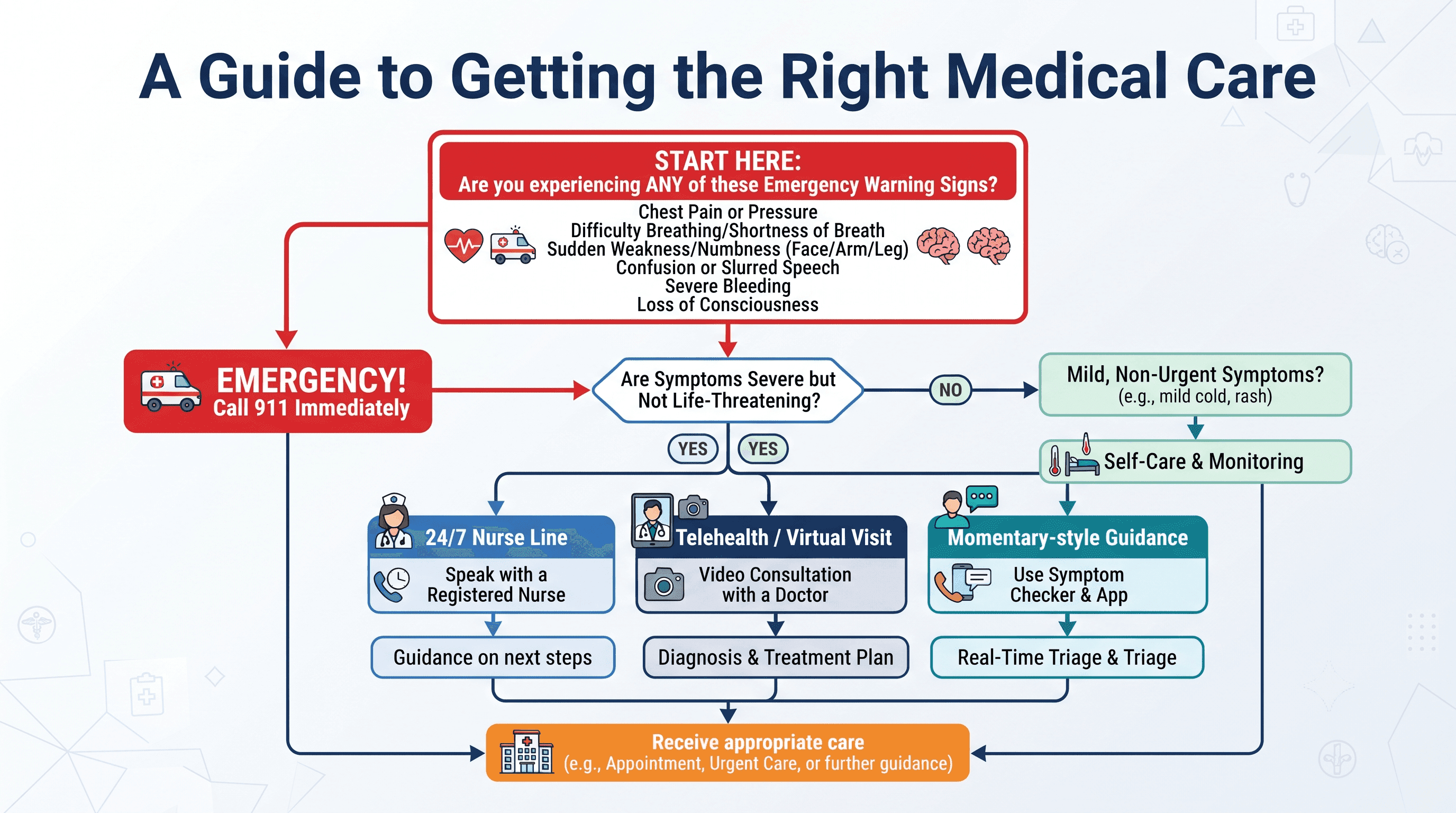
The first step is ruling out emergency warning signs. According to the CDC, sudden numbness or weakness in the face, arm, or leg, sudden trouble seeing, sudden trouble walking or loss of balance, sudden confusion or trouble speaking, and a sudden severe headache with no known cause are all signs of a possible stroke that require calling 911 immediately, even if the symptoms pass.
For a possible heart attack, warning signs include shortness of breath, chest pressure or pain, pain radiating to the arms, back, neck, or jaw, along with nausea or a cold sweat. These symptoms always warrant a 911 call rather than a telehealth visit or a wait-and-see approach.
If none of these emergency signs apply, the next question becomes practical: do you need same-day care, or can guidance help you decide whether care is needed at all? That's where the options below come in.
Quick Take
Best for: People trying to figure out if a symptom warrants medical attention before booking anything.
Avoid if: You're experiencing chest pain, stroke symptoms, or any other medical emergency.
Next step: Use a physician-reviewed healthcare navigator, or contact a healthcare professional directly if symptoms are worsening.
1. Momentary: Best for Symptom Understanding and Next-Step Guidance
Momentary is an AI-powered healthcare navigator that combines artificial intelligence with physician-reviewed guidance to help people understand their symptoms before deciding what to do next. Rather than trying to diagnose a condition, it focuses on answering a narrower and often more useful question: what should you do right now?
Why it's included: For someone stuck deciding whether their symptoms warrant a doctor's visit, this is exactly the problem Momentary is built to help with.
Who benefits most: People who are unsure whether their symptoms need same-day care, urgent care, a scheduled doctor's visit, or self-care at home.
Pricing: Momentary's AI healthcare navigator is free. Physician-reviewed care is $19.99.
Strengths:
- Physician-reviewed guidance rather than unreviewed AI output alone.
- Focused specifically on helping users identify the appropriate next step.
- Can also help compare costs for laboratory testing, imaging, and screenings when affordability is a factor.
Limitations:
- Does not diagnose medical conditions.
- Physician services are currently available only in California, while the AI-powered navigation itself is available nationwide.
- Not appropriate for emergencies.
When to choose something else: If you're already experiencing an emergency, or if you need an actual same-day medical visit rather than guidance on whether you need one.
2. Virtual Urgent Care and Telehealth: Best for Same-Day Clinician Access
When you've decided you do need to be seen, virtual urgent care puts you in front of a licensed clinician quickly, often within the hour.
Why it's included: Many symptoms that feel urgent, like a UTI, sinus infection, or minor rash, can be evaluated and treated entirely over video.
Who benefits most: People who need a prescription, a professional opinion, or reassurance the same day but don't want to travel to a clinic.
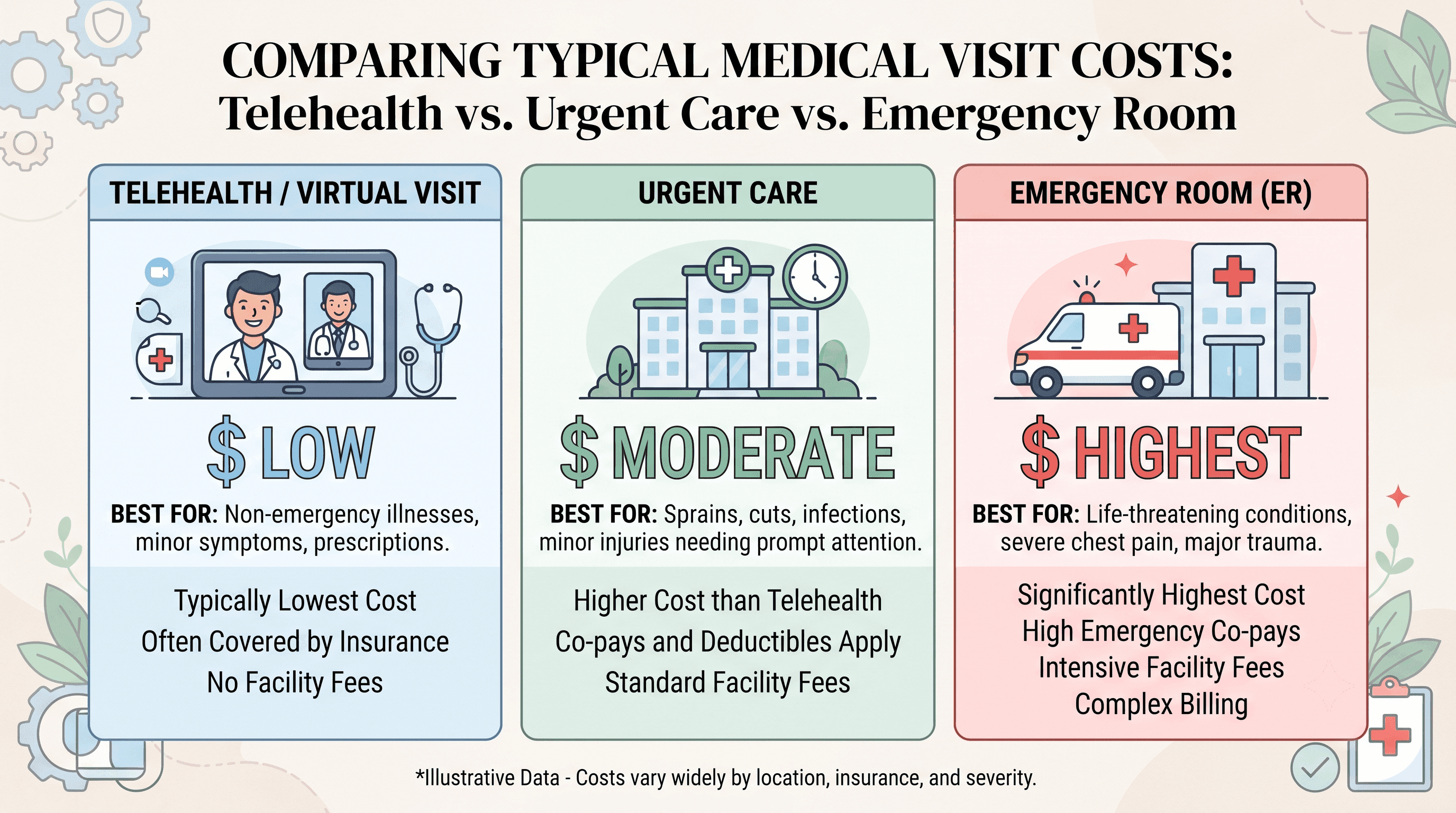
Pricing: Cash-pay general medical visits on major platforms run around $75 to $89, though many employer or insurance plans bring the cost down to a standard copay, sometimes $0.
Strengths:
- Fast access, often same day.
- Usually much cheaper than in-person urgent care or the ER for comparable conditions.
- Covers a wide range of common, non-emergency issues.
Limitations:
- Cannot perform in-person exams, imaging, or certain tests.
- Provider continuity can be inconsistent since you may not see the same clinician twice.
When to choose something else: If your condition needs hands-on examination, imaging, or lab work that can't be done remotely.
3. Nurse Advice Lines: Best Free, Phone-Based Option
Many health insurance plans include a 24/7 nurse advice line at no extra cost. A registered nurse listens to your symptoms over the phone and helps you decide whether you need emergency care, urgent care, a doctor's visit, or can safely manage things at home.
Why it's included: It's one of the few genuinely free options for real-time triage guidance.
Who benefits most: People with insurance who want a quick, no-cost second opinion on whether a symptom needs attention.
Strengths:
- Usually free with insurance.
- Available 24/7 in most plans.
- Staffed by licensed nurses rather than automated tools.
Limitations:
- Not available to everyone; depends on your insurance plan.
- Cannot prescribe medication or replace an actual medical evaluation.
When to choose something else: If you don't have insurance, or if you need more than verbal guidance, such as a prescription or physical exam.
4. Same-Day Primary Care Appointments: Best for Existing Patients
If you already have an established primary care physician, calling their office first is often a strong option, especially for symptoms connected to an existing condition.
Strengths:
- Continuity of care with a clinician who knows your history.
- Can order in-office labs, imaging referrals, or specialist referrals directly.
Limitations:
- Same-day availability isn't guaranteed, especially with high patient volumes.
- Requires an existing relationship with a practice.
Pricing: Cash-pay primary care visits commonly run around $40 to $100 or more per visit, though most people use insurance for these visits.
5. AI Symptom Checkers: Best Free Starting Point
General AI symptom checkers, built on physician-developed clinical logic, can walk you through your symptoms and suggest a possible level of care. Research on this category is genuinely encouraging: one large analysis of more than 150,000 patient interactions with an online triage tool found that the urgency of patients' intended level of care decreased in more than a quarter of cases, suggesting these tools can help people avoid unnecessary emergency visits.
Strengths:
- Free to use.
- Available anytime, without an appointment.
- Can help you organize your symptoms before talking to a clinician.
Limitations:
- Generally not physician-reviewed in real time.
- Best used as a starting point rather than a final answer.
6. Urgent Care Centers: Best for In-Person, Non-Emergency Care
Urgent care is the right choice when you need to be seen in person for something that isn't life-threatening: a sprain, a deep cut, a bad flu, or an infection that needs a rapid test.
Pricing: Roughly $150 to $400 cash pay, considerably less than an ER visit for comparable conditions.
Strengths:
- Walk-in availability, typically with short wait times.
- Can handle X-rays, stitches, and rapid tests that telehealth cannot.
Limitations:
- Costs more than telehealth for conditions that don't require an in-person exam.
- Not equipped for true emergencies.
7. Community Health Clinics: Best for Low-Cost Access
Federally qualified health centers and community clinics offer sliding-scale pricing based on income, making them a strong option for people without insurance.
Strengths:
- Affordable, income-based pricing.
- Often provide ongoing primary care, not just one-off visits.
Limitations:
- Appointment availability can be limited.
- Not designed for emergencies or urgent same-day needs in every location.
8. Emergency Departments: For True Emergencies Only
If your symptoms match warning signs like chest pain, stroke symptoms, severe bleeding, difficulty breathing, or loss of consciousness, none of the options above apply. Go to the emergency department or call 911 immediately.
Pricing: Often $1,000 to $3,000 or more without insurance, reflecting the specialized staff and equipment ERs maintain for critical care.
When to choose this: Only for symptoms that are genuinely life-threatening or time-sensitive. Never substitute an online tool, telehealth visit, or nurse line for emergency care in these situations.
When Should I Go to Urgent Care Instead of the ER?
Urgent care is appropriate for symptoms that need attention soon but aren't life-threatening, such as a sprained ankle, a persistent fever, or a minor cut that may need stitches. The emergency department is for symptoms that could be life-threatening or are rapidly worsening, such as chest pain, signs of stroke, severe bleeding, or trouble breathing. When in doubt, healthcare professionals generally recommend erring on the side of caution and seeking a higher level of care.
Is Telehealth Enough, or Do I Need to Be Seen in Person?
Telehealth works well for symptoms that can be assessed through conversation and visual inspection, like a rash, cold symptoms, or a suspected UTI. You'll likely need an in-person visit if your symptoms require a physical exam, imaging, blood work, or a procedure.
Frequently Asked Questions
Can I get medical advice without insurance? Yes. Options like AI symptom checkers, cash-pay telehealth visits, and community health clinics with sliding-scale pricing are all available without insurance. Momentary's AI-powered navigation is also available nationwide regardless of insurance status, and it's free to use.
Should I use an AI symptom checker or talk to a real person? AI symptom checkers are a reasonable starting point, especially when paired with physician-reviewed guidance, but they work best as a first step rather than a replacement for a nurse line, telehealth visit, or in-person exam when symptoms persist or worsen.
Can telehealth replace urgent care? For many non-emergency conditions, yes. But telehealth cannot perform in-person exams, X-rays, or certain lab work, so conditions requiring those services still need an in-person visit.
When should I go to the emergency room instead of urgent care? Go to the emergency room for symptoms that could be life-threatening, such as chest pain, stroke warning signs, severe bleeding, difficulty breathing, or loss of consciousness. Urgent care is appropriate for non-life-threatening issues that still need same-day attention.
Does Momentary replace my doctor? No. Momentary is designed to help you understand your symptoms and identify an appropriate next step. It does not diagnose conditions, provide emergency care, or replace a physician's evaluation.


