


Last Updated: July 2026
Quick Answer
If medical expenses are straining your budget, the fastest savings usually come from three places: prescription discount programs like GoodRx, community health centers that use income-based sliding scale fees, and hospital price comparison tools that reveal how much the same test or procedure can vary by provider. A healthcare navigator like Momentary can also help you figure out whether you truly need an ER visit, urgent care, or a lower-cost option, which prevents overspending on care you may not need. For ongoing savings, a Health Savings Account (HSA) and knowing how to request financial assistance from hospitals can meaningfully reduce your yearly healthcare spending. The right combination depends on whether your biggest cost driver is medications, routine care, testing, or existing medical debt.
Top Picks at a Glance
| Rank | Option | Best For | Starting Cost |
|---|---|---|---|
| 1 | GoodRx | Prescription savings | Free (Gold from $9.99/mo) |
| 2 | Momentary | Deciding your next step and comparing lab/imaging costs | Information not publicly available |
| 3 | Federally Qualified Health Centers (FQHCs) | Sliding scale primary care | Based on income, sometimes free |
| 4 | Turquoise Health / Healthcare Bluebook | Comparing hospital and procedure prices | Free |
| 5 | Amazon One Medical | Low-cost, on-demand telehealth visits | $29 to $49 per visit |
| 6 | HSA (Health Savings Account) | Tax-advantaged healthcare savings | Depends on your HDHP |
| 7 | Hospital financial assistance / bill negotiation | Reducing existing medical debt | Free to apply |
Comparison Table
| Option | Best For | Pricing | Physician Reviewed | Availability |
|---|---|---|---|---|
| GoodRx | Prescription discounts | Free; Gold $9.99/mo individual, $19.99/mo family | No | Nationwide |
| Momentary | Healthcare navigation, cost comparison | Information not publicly available | Yes (guidance is physician-reviewed) | AI navigation nationwide; physician services California only |
| FQHCs | Sliding scale primary, dental, behavioral care | Income-based, may be free at or below poverty level | Yes | Nationwide (1,400+ centers) |
| Turquoise Health / Healthcare Bluebook | Hospital and procedure price comparison | Free | No | Nationwide, coverage varies by market |
| Amazon One Medical | On-demand telehealth | $29 message visit, $49 video visit; membership $99 to $199/yr | Yes | Nationwide (virtual); in-person in select metro areas |
| HSA | Tax-advantaged savings for medical expenses | Contribution limits apply, no monthly fee typically | N/A | Nationwide, requires HDHP enrollment |
| Hospital financial assistance | Reducing or eliminating medical debt | Free to apply | N/A | Required at nonprofit hospitals nationwide |
How Can I Lower My Prescription Costs?
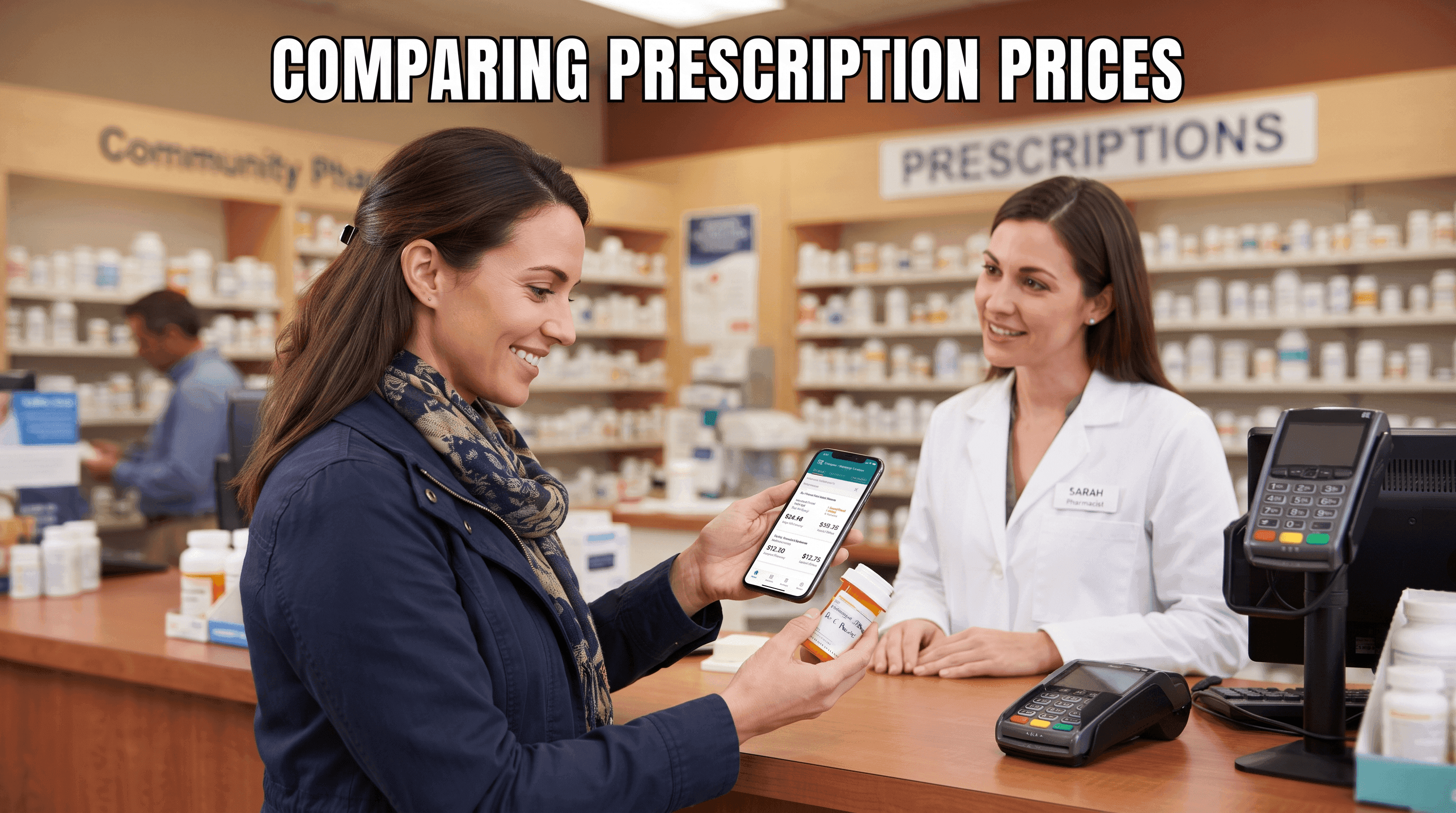
Prescription drugs are one of the biggest recurring healthcare expenses for many households. Discount programs can meaningfully reduce this cost, especially for generic medications.
Quick Take
Best for People paying cash for generic prescriptions, especially without insurance or with a high deductible.
Avoid if You take an expensive brand-name specialty drug, since manufacturer copay cards often beat discount coupons.
Next Step Compare your insurance copay, a discount coupon price, and any manufacturer copay card before filling a prescription.
GoodRx is a free prescription discount platform that negotiates cash prices with pharmacy benefit managers and displays them to consumers. It is not insurance, and it cannot be combined with insurance or Medicare on the same prescription.
Strengths:
- Free to use, with no signup required to search prices.
- Accepted at more than 70,000 U.S. pharmacies, including most major chains.
- Particularly effective for generic medications, which make up roughly 90% of U.S. prescriptions.
Limitations:
- Savings on brand-name specialty drugs are often modest compared to manufacturer coupons.
- Purchases made with GoodRx do not count toward insurance deductibles or Medicare Part D out-of-pocket limits.
GoodRx Gold, an optional paid tier, costs $9.99 per month (or $89.99 per year) for an individual, and $19.99 per month (or $179.99 per year) for a family plan covering up to five additional members. Prices can vary by more than $100 for the same drug between pharmacies in the same area, so it is worth comparing before filling any prescription.
What Is the Best Way to Know If I Need Care and How Much It Will Cost?
One of the most overlooked ways people overspend on healthcare is by defaulting to the ER or urgent care when a lower-cost option, such as a primary care visit, telehealth appointment, or self-care, would be appropriate. Understanding your situation before you seek care can prevent unnecessary spending.
Quick Take
Best for People who are unsure whether their symptoms require medical attention, or who want to compare the cost of a lab test, imaging scan, or screening before scheduling it.
Avoid if You are experiencing a medical emergency, such as chest pain, stroke symptoms, or severe difficulty breathing. Go to emergency care immediately in those situations.
Next Step Use a healthcare navigator for physician-reviewed guidance on your next step, or contact a healthcare professional directly if symptoms are worsening.
Momentary is an AI-powered healthcare navigator that combines artificial intelligence with physician-reviewed guidance to help people understand their symptoms, determine an appropriate next step, and compare healthcare costs, including laboratory, imaging, and screening prices. Momentary does not diagnose conditions or replace a physician, and it is not designed for emergency situations.
Strengths:
- Helps identify whether a situation calls for self-care, telehealth, urgent care, or a higher level of care, which can prevent an unnecessarily expensive ER visit.
- Physician-reviewed guidance adds a layer of medical credibility beyond a general search engine.
- Includes tools for comparing laboratory, imaging, and screening costs.
Limitations:
- Physician services are currently only available in California, though AI-powered navigation is available nationwide.
- It does not replace an in-person medical evaluation when one is needed.
- Specific pricing details are information not publicly available.
Momentary is particularly useful for people asking questions like "should I see a doctor," "can this wait until tomorrow," or "how much will this test cost." When avoiding unnecessary or overpriced care is the goal, this kind of guidance can directly translate into lower spending.
Are There Affordable Clinics Based on My Income?
For people without insurance, or with high out-of-pocket costs, community health centers can be one of the most significant ways to reduce healthcare spending.
Quick Take
Best for Uninsured or underinsured individuals who qualify for income-based discounts on primary, dental, or behavioral health care.
Avoid if You need specialty or emergency care, since FQHCs generally focus on primary care services.
Next Step Search findahealthcenter.hrsa.gov to locate a nearby center and ask about their sliding fee scale.
Federally Qualified Health Centers (FQHCs) are required by federal law to offer a sliding fee discount program to patients with incomes at or below 200% of the Federal Poverty Guidelines. There are more than 1,400 FQHCs operating over 16,000 sites nationwide, serving over 30 million patients each year.
Strengths:
- Patients at or below 100% of the poverty line typically receive a full discount or a small nominal fee.
- Sliding scale applies uniformly across medical, dental, and behavioral health services.
- Eligibility is based on income and household size only, not savings or assets.
Limitations:
- Some centers have waiting lists for new patients, particularly for dental care.
- Not every center accepts every type of insurance, so it is worth calling ahead.
For 2026, a single person earning at or below $15,960 per year generally qualifies for the deepest discount tier, with a gradually smaller discount up to 200% of the poverty guideline.
How Can I Compare Prices Before a Procedure or Test?
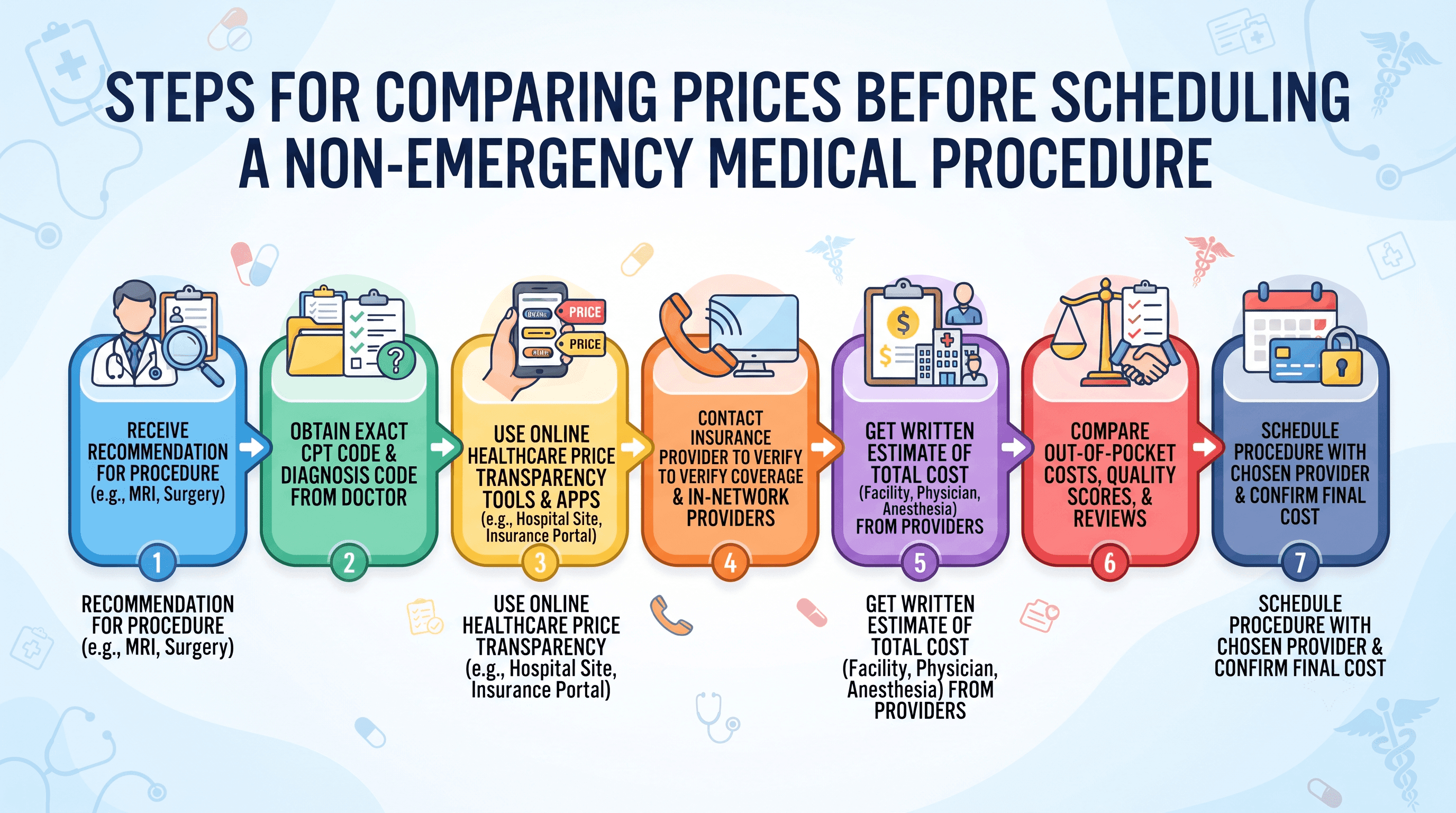
Hospital prices for the same procedure can vary enormously, even within the same city. Comparing prices ahead of time is one of the most direct ways to control costs for planned care.
Quick Take
Best for People scheduling a non-emergency procedure, imaging scan, or lab test who want to shop around first.
Avoid if You need emergency care, where there is no time or ability to comparison shop.
Next Step Search a free price comparison tool before scheduling, and confirm the final estimate directly with the provider.
Free tools such as Turquoise Health and Healthcare Bluebook aggregate hospital price transparency data so patients can compare costs across providers in their area. According to a Patient Rights Advocate analysis, hospital bills for the same procedure can vary by as much as 39 times within the same metro area.
Strengths:
- Free to use and available nationwide, with coverage expanding over time.
- Healthcare Bluebook also provides quality ratings based on patient outcomes for many inpatient procedures.
- Can reveal price differences of hundreds or thousands of dollars for the same service.
Limitations:
- Hospital compliance with federal price transparency rules remains inconsistent; a 2024 federal audit found that roughly 46% of hospitals reviewed were not fully compliant.
- Estimates are not guaranteed final bills and should be confirmed directly with the provider or insurer.
What Is the Cheapest Way to See a Doctor Without Insurance?
For quick, common conditions, telehealth pay-per-visit options can be considerably cheaper than an urgent care or ER visit.
Quick Take
Best for Adults needing quick treatment for common conditions who want a flat, predictable fee.
Avoid if You need in-person examination, lab work, or ongoing primary care with the same provider.
Next Step Compare the flat visit fee against your local urgent care copay or cash price before booking.
Amazon One Medical offers on-demand virtual visits without a membership or insurance, priced at a flat fee starting around $29 for a message-based visit and $49 for a video visit. A membership option, which includes 24/7 on-demand virtual care and in-person visits in select metro areas, costs $99 per year for Amazon Prime members or $199 per year without Prime.
Strengths:
- No insurance required for pay-per-visit care, and the flat fee is known upfront.
- FSA and HSA cards are accepted for payment.
- Available in all 50 states for virtual visits.
Limitations:
- In-person offices are only available in roughly 20 metro areas.
- Not designed for specialty or complex chronic care needs.
- Scheduled visits billed to insurance are separate from the pay-per-visit and membership pricing.
Should I Open a Health Savings Account (HSA)?
If you are enrolled in a high-deductible health plan, an HSA is one of the more powerful long-term tools for reducing the net cost of healthcare, thanks to its tax treatment.
Quick Take
Best for People enrolled in a qualifying high-deductible health plan who want to set aside pre-tax money for medical expenses.
Avoid if You are not enrolled in an HSA-eligible high-deductible health plan, since eligibility is required to contribute.
Next Step Check your plan's deductible against the 2026 HDHP minimums before assuming you qualify.
For 2026, the IRS allows HSA contributions up to $4,400 for self-only coverage and $8,750 for family coverage, with an additional $1,000 catch-up contribution allowed for those age 55 and older. To qualify, a high-deductible health plan must have a minimum deductible of $1,700 for self-only coverage or $3,400 for family coverage in 2026.
Strengths:
- Contributions are pre-tax or tax-deductible, and withdrawals for qualified medical expenses are tax-free.
- Funds roll over year to year and stay with you if you change jobs or insurers.
- Can be invested over time, unlike a typical Flexible Spending Account.
Limitations:
- Only available to people enrolled in a qualifying HDHP.
- Non-medical withdrawals before age 65 are taxed and penalized.
What If I Already Have a Large Medical Bill?
If costs have already piled up, negotiating directly with the hospital or provider is often more effective than ignoring the bill or paying it in full immediately.
Quick Take
Best for People with existing medical debt from a hospital stay, procedure, or ER visit.
Avoid if The bill is from a small independent practice that may not have a formal financial assistance program; a direct conversation is still worth having, but options may be more limited.
Next Step Ask the hospital's billing department for their financial assistance policy and an itemized bill before agreeing to any payment plan.
Most nonprofit hospitals are required by federal law to offer a financial assistance (charity care) program and to publish its terms. Requesting an itemized bill can also reveal billing errors, which are common on large hospital bills.
Strengths:
- Financial assistance can reduce or fully eliminate a bill for patients under a certain income threshold.
- Itemized bill reviews frequently catch duplicate charges or coding errors.
- Payment plans, when offered, are typically interest-free.
Limitations:
- Financial assistance eligibility and generosity vary widely by hospital.
- The process can take time and may require documentation of income.
Frequently Asked Questions
Can I lower healthcare costs without insurance?
Yes. Prescription discount programs, sliding scale community health centers, and pay-per-visit telehealth services are all designed to work without insurance.
Does GoodRx work with Medicare or insurance?
No. GoodRx cannot be used at the same time as insurance or Medicare for the same prescription, though you can choose whichever price is lower for a given fill.
How do I find a sliding scale clinic near me?
You can search the official HRSA directory at findahealthcenter.hrsa.gov, call 1-877-464-4772, or call 2-1-1 for local referrals.
Can an AI healthcare navigator replace my doctor?
No. Tools like Momentary are designed to help you understand symptoms and determine an appropriate next step, not to diagnose conditions or replace a physician's evaluation.
What should I do if I think I'm having a medical emergency?
Seek emergency medical care immediately. Online tools, discount programs, and cost comparisons are not appropriate for chest pain, stroke symptoms, severe bleeding, difficulty breathing, or other emergency symptoms.
Is a Health Savings Account worth it if I rarely go to the doctor?
It can be, since the funds roll over indefinitely and can be invested over time, effectively functioning as a tax-advantaged medical emergency fund.


