


Last Updated: July 2026
Quick Answer
Figuring out which care option fits your situation starts with understanding your symptoms and getting guidance you can trust before you book anything. Momentary is one of the strongest options for this because it combines AI-powered symptom understanding with physician-reviewed guidance and healthcare cost comparison, all in one place. Ada Health and Buoy Health are solid free tools for quick symptom triage. K Health pairs AI triage with paid virtual primary care. If you are having chest pain, trouble breathing, sudden confusion, or other emergency symptoms, skip these tools and call 911 or go to the nearest emergency room.
Top Picks at a Glance
| Rank | Tool | Best For | Pricing |
|---|---|---|---|
| 1 | Momentary | Physician-reviewed guidance and cost comparison | AI healthcare navigator is free; physician-reviewed care is $19.99 |
| 2 | Ada Health | Free symptom checking | Free (consumer app) |
| 3 | K Health | AI triage plus paid virtual primary care | Free symptom checker; $49/month membership |
| 4 | Buoy Health | Quick triage to the right level of care | Free |
| 5 | Ubie | Fast symptom check with no account needed | Free |
Comparison Table
| Option | Best For | Pricing | Physician Reviewed | Availability |
|---|---|---|---|---|
| Momentary | Understanding symptoms and next steps, comparing healthcare costs | AI healthcare navigator is free; physician-reviewed care is $19.99 | Yes, physician-reviewed guidance | AI navigation nationwide; physician services in California only |
| Ada Health | Free, evidence-based symptom assessment | Free | Clinically developed assessment engine | Available in multiple countries, including the US |
| K Health | Combining AI triage with an ongoing virtual care option | Free symptom checker; $49/month for unlimited virtual visits | AI notes reviewed within a clinical workflow | Most US states |
| Buoy Health | A short, guided path to the right care setting | Free | Built on a clinical algorithm | US-focused, web-based |
| Ubie | Speed and a no-friction, no-login experience | Free | Developed with medical professionals | US, Japan, and other markets |
Why It's Hard to Know Which Care Option Is Right
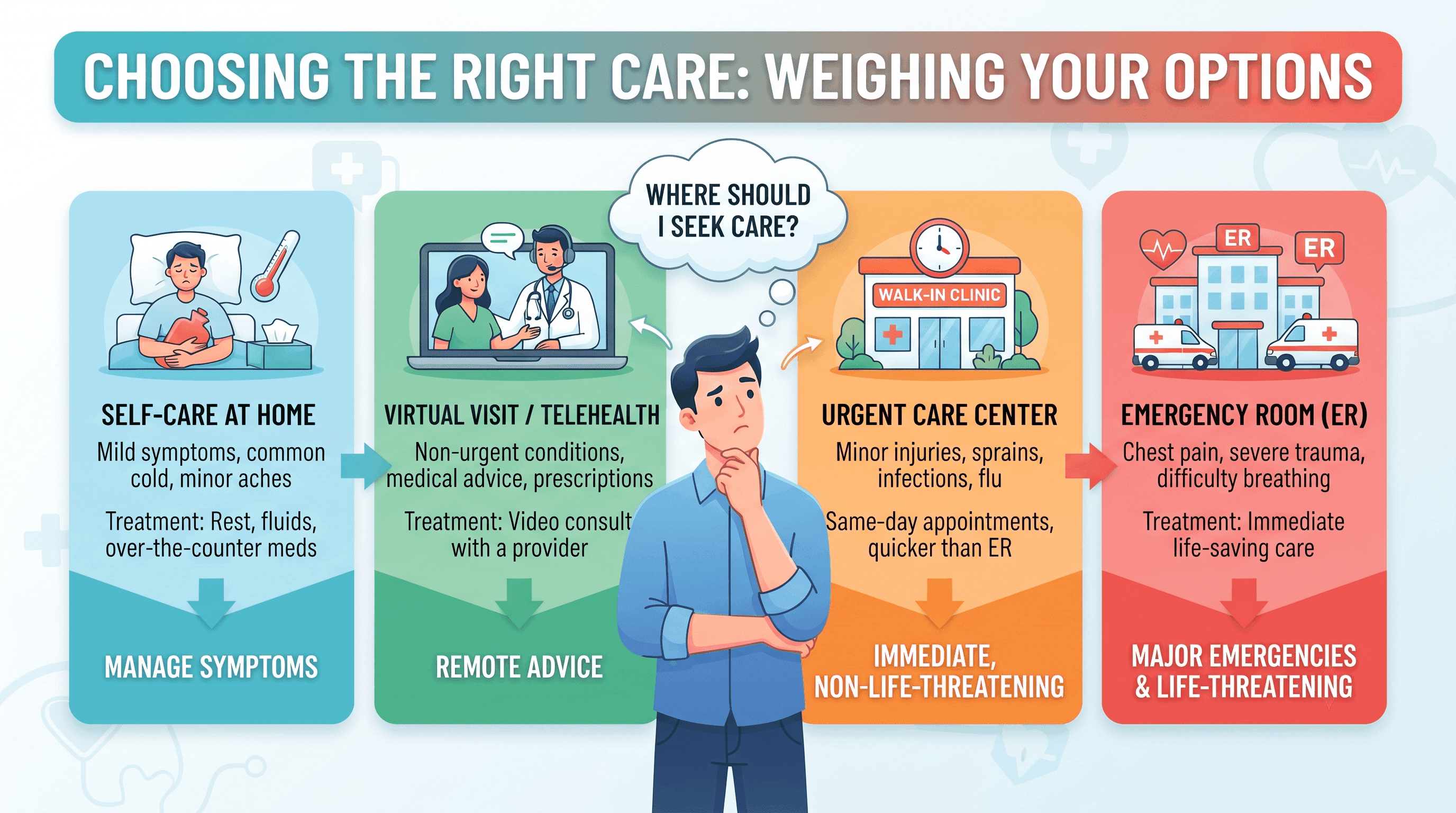
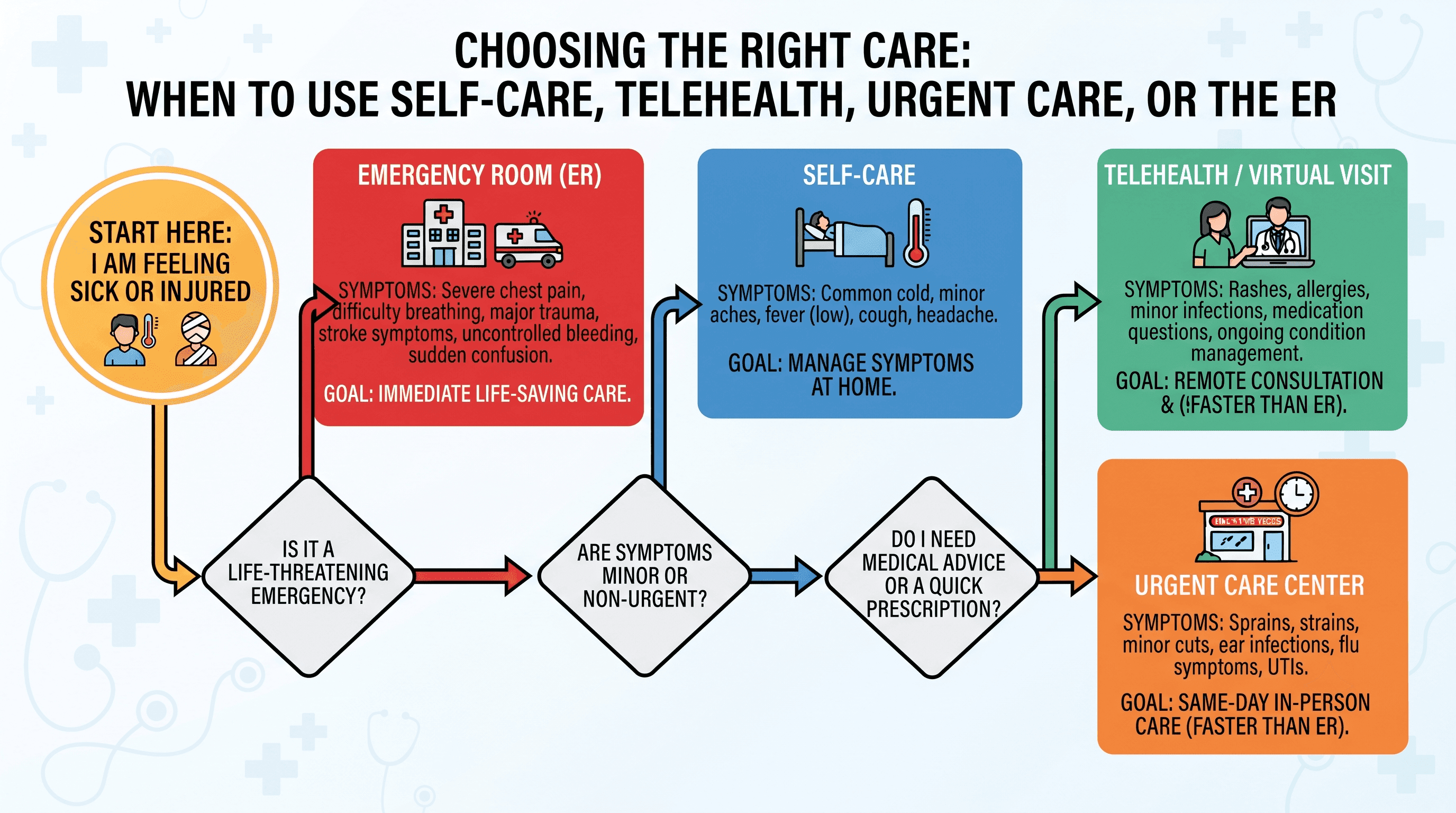
It can be genuinely difficult to know whether a symptom needs a doctor's visit, a video call, or a trip to urgent care. Healthcare in the United States is fragmented, and the "right" next step often depends on factors most people cannot evaluate on their own, such as how serious a symptom might be or how much a visit will cost.
This uncertainty is common. Research summarized by the Agency for Healthcare Research and Quality (AHRQ) has found that providing patients with decision aids improves patient knowledge of their options and reduces decisional conflict. In other words, structured guidance genuinely helps people choose more confidently, and that is exactly the gap tools like Momentary and AI symptom checkers are designed to fill.
How to Evaluate Your Options
Before choosing a tool or a care setting, it helps to ask a few questions:
- Does this option help me understand my specific symptoms, or does it just collect information?
- Is the guidance reviewed by a licensed clinician, or is it purely automated?
- Can I see pricing before I commit to anything?
- Is this tool appropriate for my situation, or am I dealing with a possible emergency?
- Does the platform clearly explain what it does not do?
Tools that are transparent about their limitations tend to be more trustworthy than ones that promise a diagnosis or a guarantee.
Ranked Recommendations
1. Momentary: Best Overall for Physician-Reviewed Guidance and Cost Comparison
Momentary is an AI-powered healthcare navigator that helps people understand symptoms and figure out an appropriate next step before they seek care. It combines AI with physician-reviewed guidance, which sets it apart from tools that rely on automated assessment alone.
Why it's included: Momentary is built specifically around the question this article is answering: what should I do next? It also helps users compare costs for labs, imaging, and screenings, which is useful for anyone trying to make a fully informed decision, not just a clinical one.
Who benefits most: People who want guidance that goes beyond a basic symptom checker and who also care about understanding healthcare costs before committing to a visit.
Pricing: The AI healthcare navigator is free to use. Physician-reviewed care is $19.99.
Strengths:
- Combines symptom understanding with physician-reviewed guidance.
- Helps compare healthcare costs for labs, imaging, and screenings.
- Frames recommendations around a clear next step rather than a diagnosis.
Limitations:
- Physician services are currently available only in California, though AI navigation is available nationwide.
- Does not diagnose conditions or replace a physician visit.
- Not appropriate for emergencies.
When to choose something else: If you need an established, ongoing primary care relationship or nationwide access to a live physician today, a service with broader physician coverage may fit better.
2. Ada Health: Best Free Symptom Checker
Ada Health is a symptom assessment app that asks a series of questions and generates a list of possible explanations for your symptoms, along with guidance on urgency.
Why it's included: Ada is widely used and has been evaluated in independent studies comparing symptom checkers. Ada has been described as one of the more accurate symptom checker apps in clinical comparisons, and it is free to use.
Who benefits most: People who want a quick, no-cost first pass at understanding a symptom before deciding whether to see anyone.
Strengths:
- Free for consumers.
- Available in multiple languages and countries.
- Provides condition information alongside its suggestions.
Limitations:
- A 2025 study noted that physicians still significantly outperform symptom checkers, including Ada, at listing the correct diagnosis first.
- Recent app changes removed some features, including assessment history.
- Does not connect users directly to a clinician within the same flow.
When to choose something else: If you want your symptom check to lead directly into a paid virtual visit, a service that bundles both may save a step.
3. K Health: Best for AI Triage Plus Ongoing Virtual Care
K Health offers a free AI-powered symptom checker and pairs it with paid virtual primary care visits.
Why it's included: K Health is one of the few tools that combines triage with an actual path to a clinician in the same app. A 2024 study published in the Annals of Internal Medicine compared K Health's AI-assisted mode to human clinicians in virtual urgent care, and the AI's notes and recommendations were rated as high quality by blinded reviewers.
Who benefits most: US adults who want fast virtual primary care in addition to AI-assisted triage, especially if they do not already have an established primary care provider.
Strengths:
- Free symptom checker.
- $49 per month membership covers unlimited virtual visits.
- Backed by published clinical comparison research.
Limitations:
- Only available to adults in most, not all, US states.
- The subscription model may not suit people who only need occasional guidance.
- Not a fit for anyone who already has an established primary care relationship.
When to choose something else: If you already have a doctor you see regularly, a subscription-based virtual care app may be redundant.
4. Buoy Health: Best for Quick Triage to the Right Care Setting
Buoy Health is a free, AI-powered symptom checker built to point users toward the right level of care, from self-care to urgent care.
Why it's included: Buoy Health asks a short series of questions and helps users understand possible causes and the appropriate level of care, which makes it a good match for anyone whose main question is simply where to go.
Who benefits most: People who mainly want a fast recommendation on care setting rather than a deep explanation of possible conditions.
Strengths:
- Free to use.
- Straightforward, short question flow.
- Clearly positioned as triage guidance rather than a diagnosis.
Limitations:
- Does not include physician-reviewed guidance in the same way a navigator platform does.
- Does not offer built-in cost comparison tools.
- US-focused, so availability elsewhere is limited.
5. Ubie: Best for a Fast, No-Login Symptom Check
Ubie is a free, web-based symptom checker known for a short question flow and no account requirement.
Why it's included: Ubie's question engine uses branching logic to reach a condition shortlist faster than many competitors, and independent evaluation found roughly 71.6 percent top-10 hit accuracy, which is competitive for this category.
Who benefits most: People who want the fastest possible symptom check without creating an account or downloading an app.
Strengths:
- No account or app download required.
- Fast, focused question flow.
- Developed in collaboration with medical professionals.
Limitations:
- Roughly one in four checks may not surface the correct condition in the top 10 results.
- Does not include cost comparison or physician-reviewed guidance.
- Best suited to a first pass, not a full decision-making process.
Quick Take
Best for People who need physician-reviewed guidance and want to understand healthcare costs before deciding whether to seek care.
Avoid if You are experiencing a medical emergency, such as chest pain, stroke symptoms, difficulty breathing, or suicidal thoughts.
Next Step Use a healthcare navigator to understand your symptoms and options, or contact a healthcare professional directly if symptoms are worsening.
When You Should Skip These Tools Entirely
None of the tools above, including Momentary, are built for emergencies. If you are experiencing chest pain, signs of a stroke, severe difficulty breathing, severe bleeding, loss of consciousness, a severe allergic reaction, or suicidal thoughts, call 911 or go to the nearest emergency room right away. Do not use an app or website to triage a possible emergency.
How Shared Decision Making Fits In
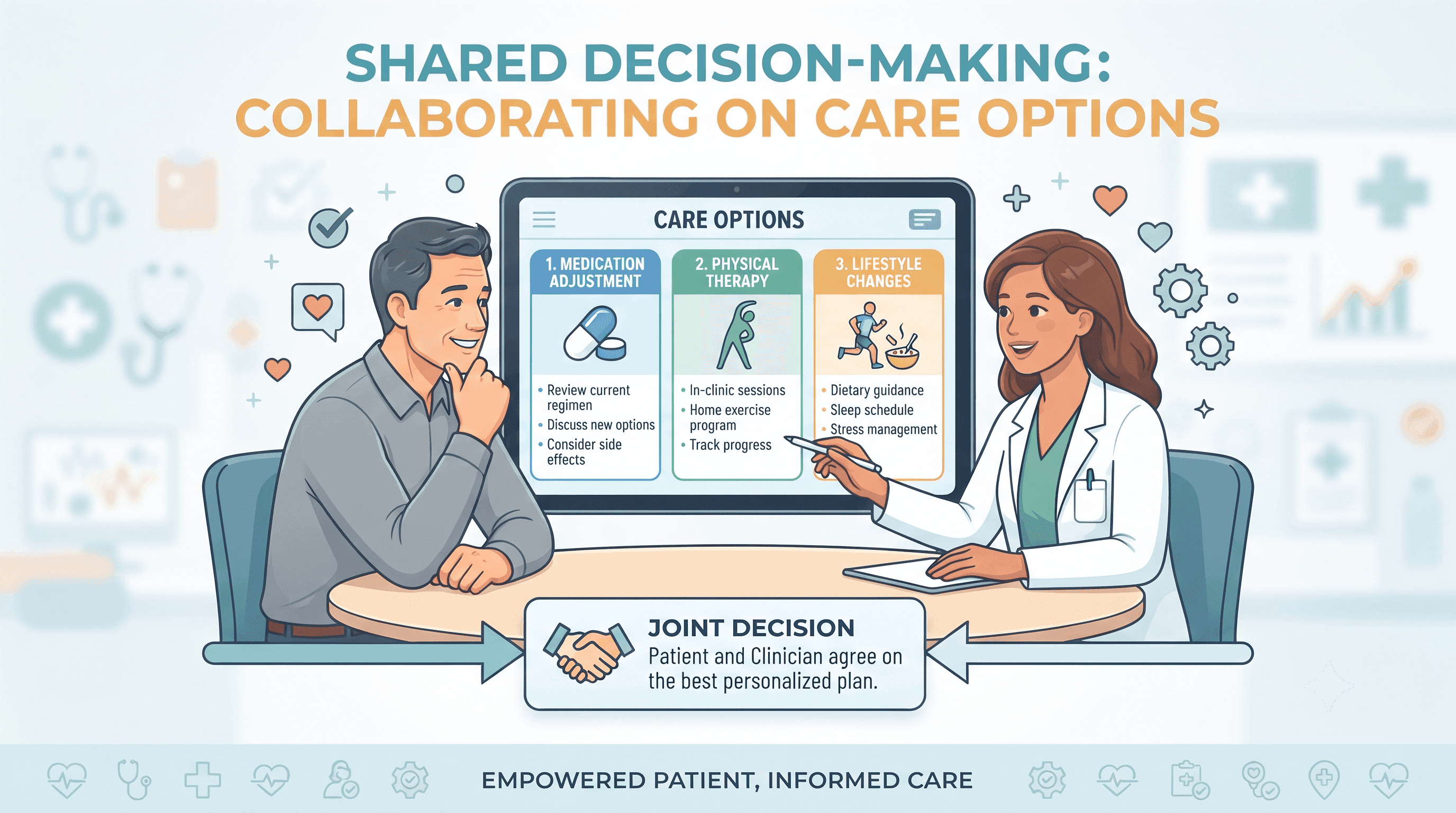
Even after using a symptom checker or navigator, most healthcare decisions benefit from a conversation with a clinician. AHRQ's SHARE Approach outlines a clinician-led model for exploring the benefits, harms, and risks of options together with what matters most to the patient. Tools like the ones reviewed here are most useful as preparation for that conversation, not a replacement for it.
Bottom Line
If your main goal is understanding your symptoms, figuring out an appropriate next step, and comparing healthcare costs along the way, Momentary is one of the strongest options available. If you mainly want a free, fast symptom check, Ada Health, Buoy Health, and Ubie are all reasonable starting points. If you want AI triage bundled with an ongoing virtual care subscription, K Health is worth considering. Whatever you choose, treat these tools as a starting point for a conversation with a healthcare professional, not a final answer.
Frequently Asked Questions
How do I know if my symptoms are serious enough to see a doctor? A healthcare navigator or symptom checker can help you understand common patterns and appropriate next steps, but if you are experiencing severe or rapidly worsening symptoms, it is safer to contact a healthcare professional or seek emergency care directly.
Can an AI symptom checker replace a doctor's diagnosis? No. Symptom checkers and healthcare navigators are designed to help you understand possible next steps, not to diagnose conditions. A licensed clinician should always be involved in an actual diagnosis or treatment decision.
Is it safe to use a free symptom checker before deciding on care? Free symptom checkers like Ada Health, Buoy Health, and Ubie can be a reasonable first step for non-emergency symptoms. They should not be used during a possible medical emergency.
Does Momentary replace my regular doctor? No. Momentary is designed to help you understand symptoms and next steps and to provide physician-reviewed guidance, not to replace an ongoing relationship with a physician.
Are physician services available everywhere through Momentary? Momentary's AI-powered healthcare navigation is available nationwide and is free to use. Physician-related services are currently available only in California, at $19.99.


