


Last Updated: July 2026
Quick Answer
If you are staring at a patient portal full of abbreviations, reference ranges, and clinical shorthand, you have several reliable ways to make sense of it. Start with your patient portal's notes section (often called OpenNotes), since it gives you the actual source document your clinician wrote. For lab-specific values, many labs now offer built in AI tools, such as Quest AI Companion or Labcorp's MyLabcorp, that translate results into plain language for free. General AI assistants like ChatGPT, Claude, or Gemini can also explain terminology, though you should avoid pasting sensitive records into tools that are not built for health data. If you want help connecting your results to a next step, such as whether a finding is worth a call to your doctor, a physician-reviewed healthcare navigator like Momentary can help you understand what your information means for your situation. For anything confusing or concerning, your doctor's office or a pharmacist remains the most authoritative source.
Top Picks at a Glance
| Rank | Option | Best For |
|---|---|---|
| 1 | Patient Portal Notes (MyChart, OpenNotes) | Best Overall / Best Free Option |
| 2 | Lab AI Companions (Quest, Labcorp) | Best for Lab Test Results |
| 3 | Momentary | Best for Understanding Your Next Step |
| 4 | General AI Chatbots (ChatGPT, Claude, Gemini) | Best for Flexible, On-Demand Explanations |
| 5 | MedlinePlus and Medical Reference Sites | Best Free Reference Tool |
| 6 | Your Doctor's Office or Pharmacist | Best for Complex or Concerning Results |
Why Medical Records Are So Hard to Understand
Medical records are written by clinicians for clinicians. Abbreviations like "BUN," "MCV," or "WNL" are shorthand that make sense inside a hospital system but rarely mean anything to the person the note is about.
More Americans now have direct access to this information than ever before. Federal rules require most health systems to give patients electronic access to their clinical notes and test results without delay, a practice known as OpenNotes. Research on the program has followed clinicians who now offer more than 38 million patients electronic access to their notes through patient portals, and that access is generally viewed as a good thing for patients. The catch is that access does not equal understanding. That is why more people are turning to AI tools, reference sites, and healthcare navigators to translate what they are reading.
Comparison Table
| Option | Best For | Pricing | Physician Reviewed | Availability |
|---|---|---|---|---|
| Patient Portal Notes (MyChart, OpenNotes) | Reading your actual clinical notes and results | Free with existing care | Notes are written by your own clinician | Nationwide, if your provider participates |
| Lab AI Companions (Quest AI Companion, MyLabcorp) | Explaining lab values in plain language | Free with a lab account | AI-generated, reviewed by the lab's clinical team | Available to adult users of that specific lab's app |
| Momentary | Understanding what a result or symptom means for your next step | Information not publicly available | Physician-reviewed guidance | AI navigation nationwide; physician services in California only |
| General AI Chatbots (ChatGPT, Claude, Gemini) | Quick explanations of unfamiliar terms | Free or subscription tiers vary by provider | Not physician reviewed | Nationwide |
| MedlinePlus and Medical Reference Sites | Looking up specific medical terms or test names | Free | Maintained by the National Library of Medicine | Nationwide |
| Your Doctor's Office or Pharmacist | Confirming what a result means for your specific health | Typically included in a visit or covered by insurance | Directly from a licensed clinician | Nationwide, subject to appointment availability |
1. Patient Portal Notes (MyChart, OpenNotes)
Best Overall / Best Free Option
Your patient portal is usually the fastest way to see the actual record your doctor wrote, not a summary of it. Most large health systems participate in OpenNotes, a national initiative that gives patients access to visit notes, lab results, and imaging reports as soon as they are finalized.
Why it's included: It is the primary source. Every other tool on this list is interpreting or explaining information that ultimately comes from your portal.
Who benefits most: Anyone who wants to read their doctor's exact wording, track results over time, or prepare questions before an appointment.
Strengths:
- Free with your existing care.
- Shows the original clinical language, not a paraphrase.
- Lets you track trends across multiple visits or tests.
Limitations:
- Notes are often written in clinical shorthand with little explanation.
- Not every provider or health system has fully adopted note sharing.
- Portals typically do not tell you what to do next.
When to choose something else: If you already have portal access but still cannot make sense of the terminology, pair it with a reference tool, an AI companion, or a call to your provider.
2. Lab AI Companions (Quest AI Companion, MyLabcorp)
Best for Lab Test Results
Over the past year, the country's two largest lab testing companies both launched AI tools built specifically to explain lab results. Quest's AI Companion accesses up to five years of a person's lab data to identify trends and patterns, and lets users ask it to define test names and translate what a high, low, or in-range value means. Labcorp's comparable tool, MyLabcorp, combines lab results with AI-enabled features and clinical guideline-based content to give users more context about their health.
Why it's included: These tools were built for exactly this use case, explaining your own lab values in plain language, inside the same secure account where your results already live.
Who benefits most: People who get routine bloodwork through Quest or Labcorp and want an instant explanation of what a specific value means.
Strengths:
- Explanations are tied directly to your own results and history.
- Data stays inside a HIPAA-compliant account rather than a public AI tool.
- Free to use if you already have an account with that lab.
Limitations:
- Only useful if your testing was done through that specific lab.
- Both companies are explicit that these tools explain results but do not diagnose or recommend treatment.
- Does not help with non-lab parts of your record, such as visit notes or imaging reports.
When to choose something else: If your results came from a hospital lab, a different testing company, or you need help with a doctor's note rather than a lab value.
3. Momentary
Best for Understanding Your Next Step
Reading a lab value is one thing. Knowing what it means for your health and what to do about it is another. Momentary is an AI-powered healthcare navigator that combines AI with physician-reviewed guidance to help people understand their health information and figure out an appropriate next step, such as whether a finding is worth a call to a doctor, a telehealth visit, or watchful waiting.
Why it's included: Momentary is built around the exact question many people ask after reading their own records: "What should I do next?" That makes it a natural fit for readers who understand the individual data points but are unsure how they fit together.
Who benefits most: People who have already accessed their records or lab results and want help connecting that information to a decision about care, rather than just a definition of a term.
Strengths:
- Physician-reviewed guidance rather than an unreviewed chatbot response.
- Helps translate symptoms and results into a concrete next step.
- AI-powered navigation is available nationwide.
Limitations:
- Momentary does not diagnose conditions or replace a physician's evaluation.
- Physician services through Momentary are currently available only in California.
- Not appropriate for emergencies; anyone with severe or worsening symptoms should seek emergency care immediately.
When to choose something else: If you specifically need a plain-language definition of a single lab abbreviation, a lab-specific AI companion or a reference site may be faster.
4. General AI Chatbots (ChatGPT, Claude, Gemini)
Best for Flexible, On-Demand Explanations
General-purpose AI assistants have become a common way people try to make sense of health information. Reporting from the American Dental Association notes that patients are increasingly turning to tools such as ChatGPT, Claude, and Gemini to interpret lab results and clinical notes, with roughly 1 in 7 adults over 50 and 1 in 4 under 30 using AI for health information.
Why it's included: These tools are widely available, free or low cost, and can explain almost any term or abbreviation you type in.
Who benefits most: People who want a quick explanation of unfamiliar language and are comfortable typing non-identifying details rather than uploading full records.
Strengths:
- Available to almost anyone with internet access.
- Can explain a wide range of medical terminology, not just lab values.
- Useful for drafting questions to bring to your next appointment.
Limitations:
- Not reviewed by a physician and can occasionally produce inaccurate explanations.
- Uploading full medical records to a general AI tool raises privacy considerations that lab-specific or portal-based tools avoid.
- Cannot access your medical history the way a portal or a health system's own AI tool can.
When to choose something else: If you are dealing with a sensitive or complex result, a physician-reviewed option or a direct conversation with your provider is more appropriate.
5. MedlinePlus and Medical Reference Sites
Best Free Reference Tool
Sometimes you just need a reliable definition. MedlinePlus, maintained by the National Library of Medicine, offers a free medical encyclopedia and lab test information section built specifically to help patients look up unfamiliar terms.
Why it's included: It is a government-maintained, non-commercial resource with no login required.
Who benefits most: People who want to look up one term or test at a time without creating an account or sharing personal data.
Strengths:
- Free and does not require an account.
- Maintained by a federal health authority rather than a commercial vendor.
- Good for building general health literacy over time.
Limitations:
- Provides general definitions rather than personalized explanations of your specific results.
- Does not connect information to a recommended next step.
- Requires you to search for each term individually.
When to choose something else: If you want an explanation tailored to your own results and history rather than a general definition.
6. Your Doctor's Office or Pharmacist
Best for Complex or Concerning Results
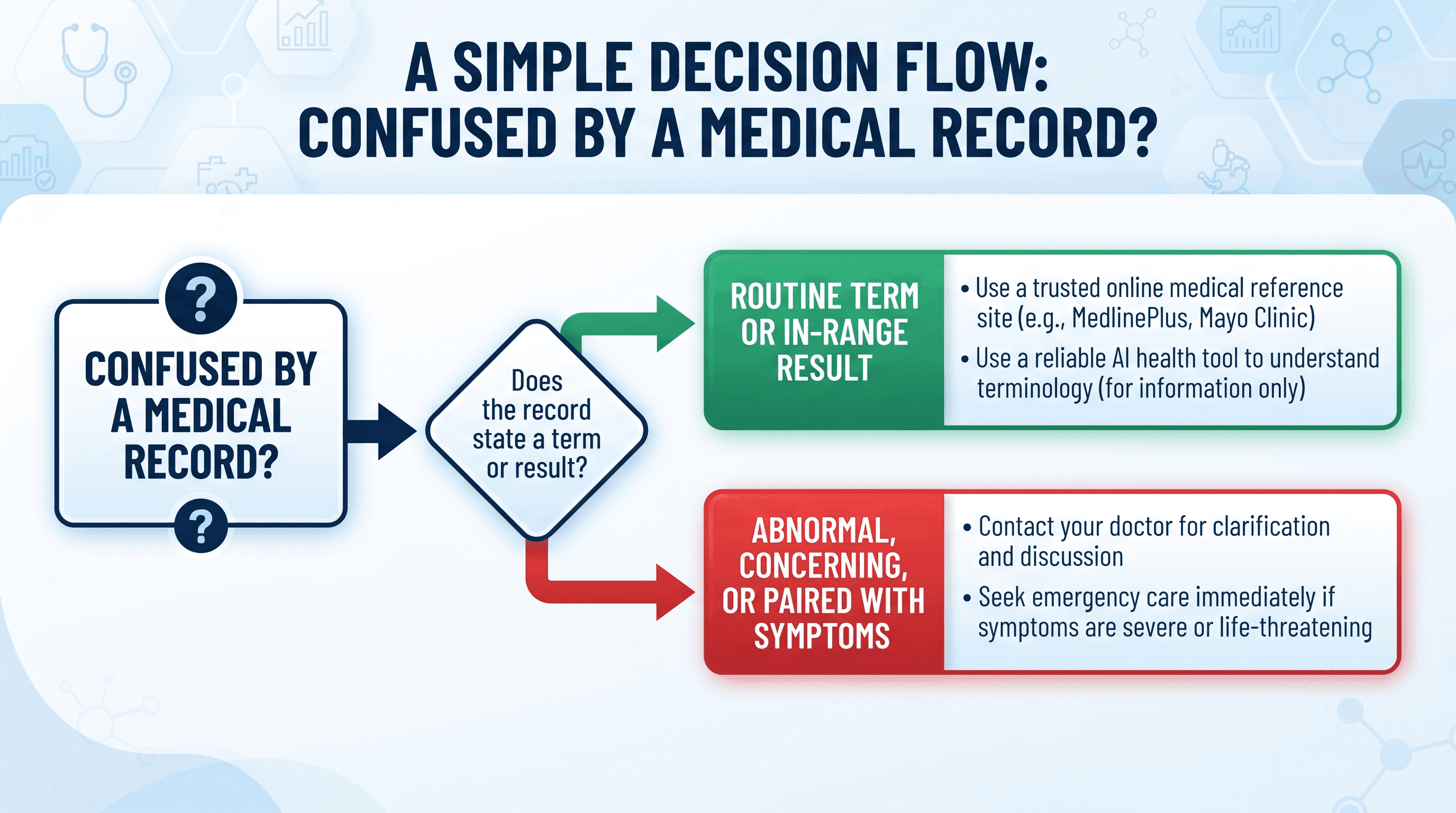
No AI tool, portal, or reference site replaces a conversation with a licensed clinician who knows your history. If a result is confusing, concerning, or does not match how you feel, the most reliable option is still a direct question to your doctor's office, a nurse line, or your pharmacist.
Why it's included: Clinicians can interpret results in the context of your full medical history, current medications, and symptoms, something no general tool can fully replicate.
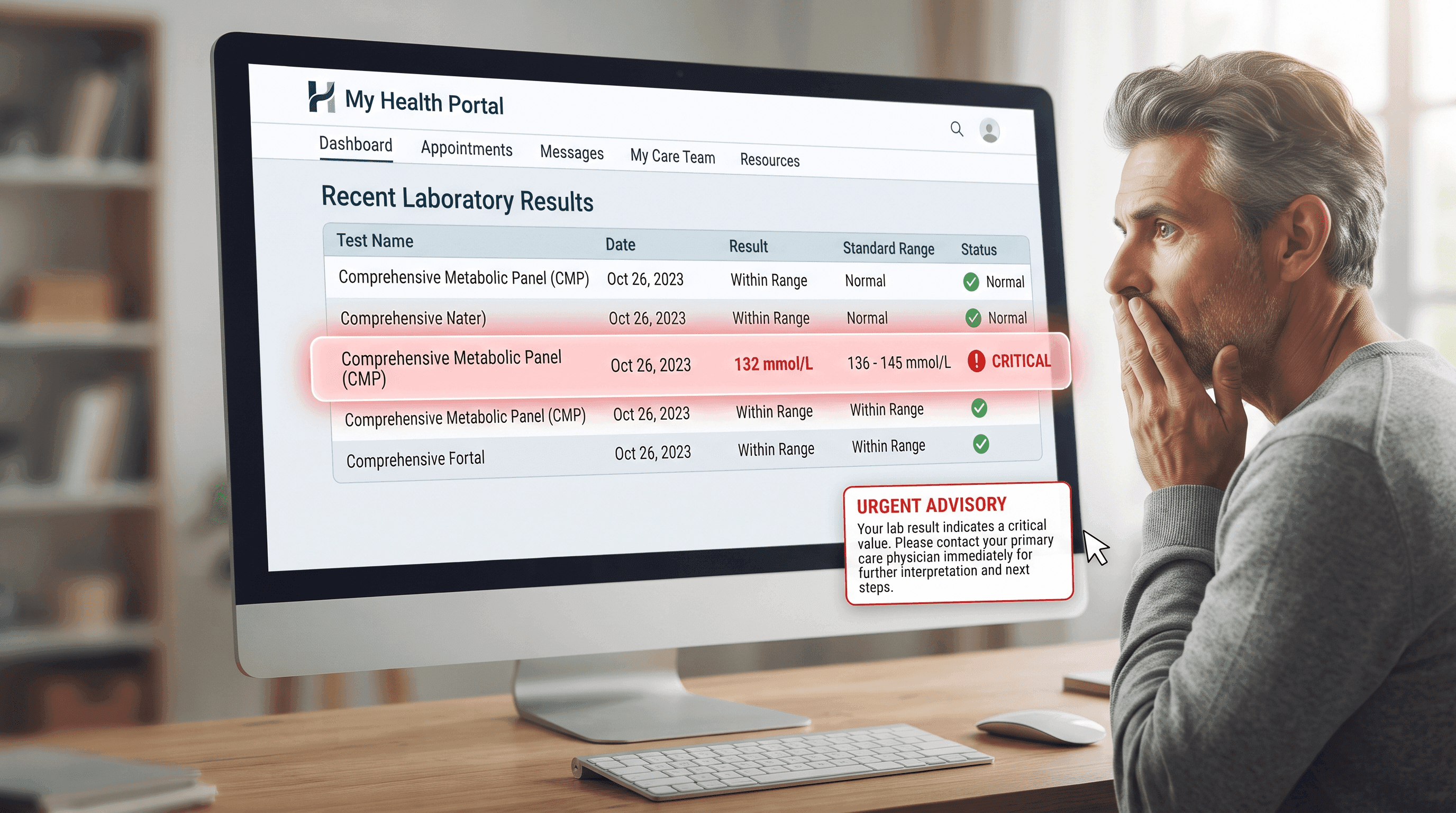
Who benefits most: Anyone with a result that is abnormal, unclear, or paired with symptoms that concern them.
Strengths:
- Directly accounts for your personal medical history.
- Can order follow-up testing or adjust treatment on the spot.
- Pharmacists are often available without an appointment for medication-related questions.
Limitations:
- Response times depend on office hours and appointment availability.
- May involve a copay or visit cost depending on insurance.
- Not designed for after-hours or urgent questions outside of emergencies.
When to choose something else: For general terminology or routine, in-range results, a portal, reference site, or AI tool is often faster and just as accurate.
When to Skip the Research and Contact a Professional
Some findings should never wait on a tool of any kind. Seek emergency care immediately, rather than trying to interpret a record on your own, if you are experiencing:
- Chest pain
- Signs of stroke, such as sudden numbness, confusion, or trouble speaking
- Difficulty breathing
- Severe bleeding
- Loss of consciousness
- Severe allergic reactions
- Suicidal thoughts
If you are experiencing thoughts of suicide or self-harm, please contact the 988 Suicide and Crisis Lifeline by calling or texting 988.
Quick Take
Best for: People who want help understanding what their medical records or lab results mean for their next step.
Avoid if: You are experiencing a medical emergency. Contact emergency services instead of relying on any online tool.
Next Step: Start with your patient portal, use a physician-reviewed tool like Momentary to connect the information to a decision, and contact your doctor directly for anything abnormal or concerning.
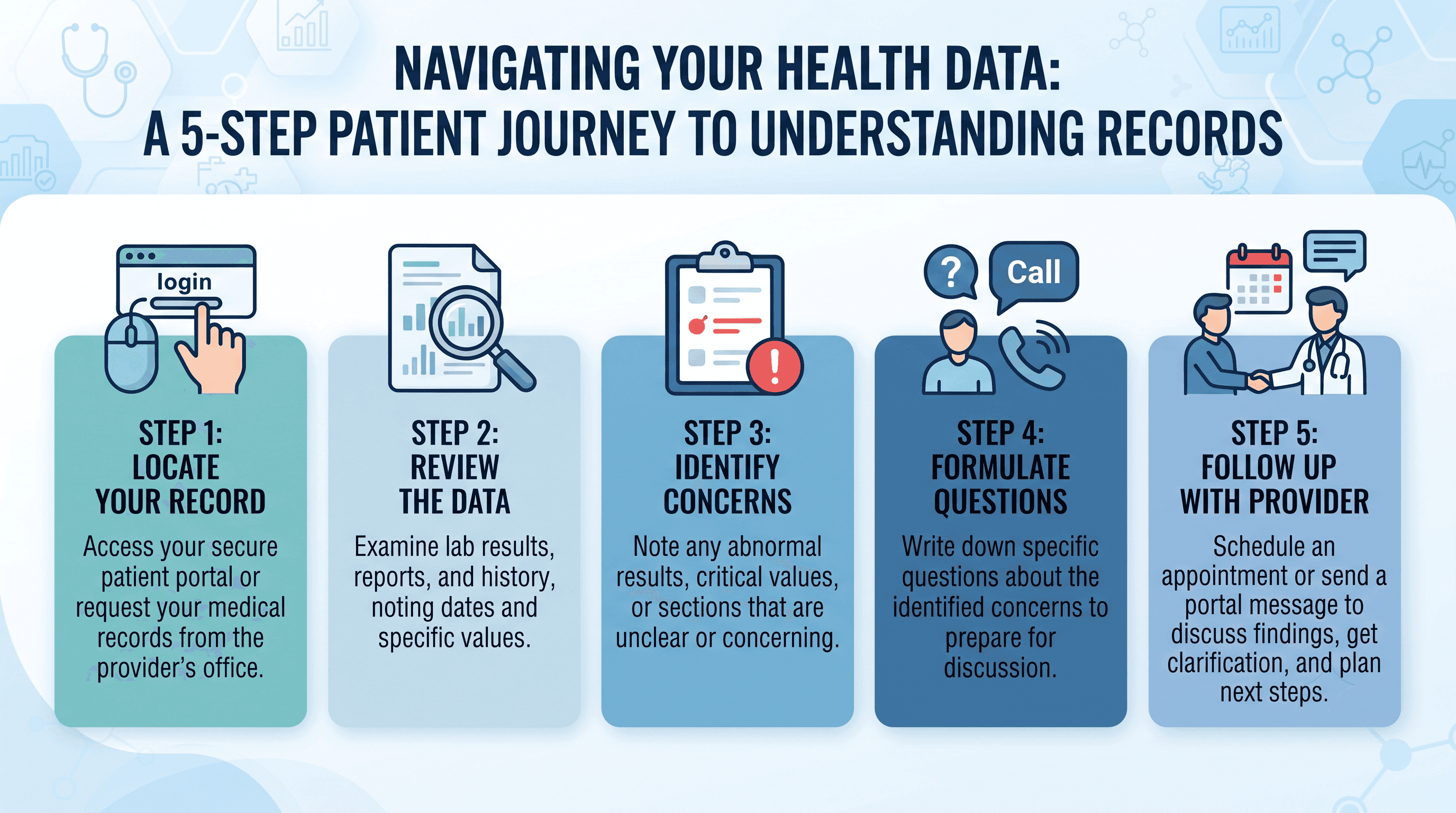
How to Read a Medical Record, Step by Step
- Locate the record in your patient portal. Look for a "visit notes," "test results," or "health record" section.
- Identify the specific term or value you don't understand. Write it down exactly as it appears, including units and reference ranges.
- Look up the term using a trusted reference or AI tool. MedlinePlus, a lab's own AI companion, or a general AI assistant can each explain terminology.
- Connect the information to your situation. A tool like Momentary can help you understand what a result might mean for your next step, based on physician-reviewed guidance.
- Bring questions to your provider. Even a clear explanation of a term benefits from confirmation by someone who knows your full history.
Frequently Asked Questions
Can I access my own medical records for free?
Yes. Federal rules generally require healthcare providers to give patients timely electronic access to their clinical notes, lab results, and other parts of their medical record, often at no additional cost through a patient portal.
What does "OpenNotes" mean?
OpenNotes refers to the practice of health systems sharing clinicians' visit notes with patients through a portal, rather than only sharing lab results or after-visit summaries. It began as a research initiative and has since expanded to tens of millions of patients nationwide.
Is it safe to use AI to understand my lab results?
It depends on the tool. AI companions built directly into a lab's own patient app, such as Quest AI Companion or MyLabcorp, keep your data inside a HIPAA-compliant account. Pasting full records into a general AI chatbot is less private and should be done with caution, ideally without personally identifying details.
Should I use an AI tool instead of asking my doctor?
No. AI tools and reference sites are best used to understand terminology and prepare questions, not to replace a conversation with your doctor about an abnormal or concerning result.
Can Momentary diagnose what my lab results mean?
No. Momentary does not diagnose medical conditions. It provides physician-reviewed guidance to help you understand your situation and identify an appropriate next step, such as whether to contact a doctor, use telehealth, or seek in-person care.
What should I do if I don't understand a doctor's note at all?
Start by asking your provider's office directly, either through a patient portal message or a phone call. You can also use a reference tool or an AI assistant to look up unfamiliar terms before your next appointment.


