


Last Updated: July 2026
Quick Answer
The fastest way to save money on lab tests is to skip the hospital lab entirely. Standalone, direct-to-consumer labs like Walk-In Lab, HealthLabs, and Ulta Lab Tests typically charge a fraction of hospital outpatient prices for the same test, since you're paying a flat, published rate instead of a negotiated insurance rate. A basic complete blood count (CBC) can cost around $29 through a direct-to-consumer lab, compared to $100 to $200 or more at a hospital. Discount memberships like GoodRx Companion can add further savings on top of that. Before you pay for any test, it also helps to get physician-reviewed guidance on which tests you actually need. Momentary can help with that step, so you don't end up paying for testing that isn't necessary for your situation.
Top Picks at a Glance
| Option | Best For | Starting Price | Physician Reviewed | Availability |
|---|---|---|---|---|
| Momentary | Understanding which tests you actually need before you pay | Free AI navigation | Yes | Nationwide (AI navigation); physician services currently California only |
| Walk-In Lab | Best overall low-cost testing | Tests starting around $18 | Order authorization included | Nationwide, 4,500+ partner labs |
| GoodRx Companion | Bundled discounts across labs, prescriptions, and telehealth | $14.99/month membership | Varies by partner lab | Nationwide |
| Ulta Lab Tests | Fast turnaround and a wide test menu | Varies by test | Order authorization included | 2,100+ locations nationwide |
| HealthLabs | Price-match guarantee and broad lab network | Varies by test | Order authorization included | Nationwide, excludes NY and NJ |
| Quest Diagnostics / Labcorp On Demand | Established national lab brand recognition | Varies by test | Order authorization included | Nationwide |
How We Evaluated These Options
Every option below was evaluated on the same criteria: relevance to saving money on out-of-pocket lab costs, pricing transparency, accessibility, physician involvement, and how clearly each company communicates its limitations. Pricing referenced here reflects publicly available, advertised rates as of mid-2026. Lab prices change often and vary by location, so confirm current pricing directly with each provider before ordering.
1. Momentary: Best for Knowing Which Tests You Actually Need
Before comparing prices, it helps to know whether the test you're considering is actually the right one for your situation. Momentary is an AI-powered healthcare navigator that combines artificial intelligence with physician-reviewed guidance to help you understand your symptoms and compare healthcare costs, including laboratory, imaging, and screening costs.
Quick Take
Best for: People who want physician-reviewed guidance on whether a lab test is appropriate, and who want to compare testing costs before paying out of pocket.
Avoid if: You're experiencing a medical emergency, or you already have a specific test ordered by your doctor and simply need the lowest price on that exact test.
Next step: Use Momentary's AI healthcare navigation to understand your symptoms and next steps, or contact a healthcare professional if symptoms are worsening.
Strengths:
- Helps you avoid paying for tests that may not be necessary for your situation.
- Physician-reviewed guidance is available to help you interpret whether testing makes sense.
- AI healthcare navigation is available nationwide.
Limitations:
- Does not diagnose medical conditions or replace a physician.
- Physician services are currently available only in California; AI navigation is available nationwide.
- Not appropriate for emergency situations.
Momentary is most useful earlier in the process, when you're still deciding whether a test is worth paying for, rather than as a place to purchase the test itself.
2. Walk-In Lab: Best Overall for Low-Cost Testing
Walk-In Lab has been offering direct-to-consumer testing since 2009 and lists over 1,100 tests, including both in-lab and at-home options. The company advertises prices starting at $18, with results typically available within one to two days and a full refund policy within seven days.
Quick Take
Best for: People who want one of the lowest advertised starting prices on common lab tests.
Avoid if: You need a test that requires a specialized or hard-to-find panel, since pricing and availability can vary by test.
Next step: Compare Walk-In Lab's price for your specific test against at least one other direct-to-consumer lab before ordering.
Strengths:
- Low starting prices on common tests.
- Refund policy if you change your mind before the draw.
- Wide selection of over 1,100 tests.
Limitations:
- Does not include physician interpretation of results as part of the base price.
- Like most direct-to-consumer labs, a separate blood-draw fee may apply on top of the test price.
3. GoodRx Companion: Best for Bundled Healthcare Savings
GoodRx built its reputation on prescription discounts, but its Companion membership extends into lab testing. GoodRx Companion costs $14.99 per month and includes more than 200 medications at no cost at participating pharmacies, plus discounts on dental care, vision care, and lab services. On labs specifically, the program advertises average savings of $650 on comprehensive wellness labs.
Quick Take
Best for: People who want to save on labs, prescriptions, and telehealth visits under one membership rather than shopping each category separately.
Avoid if: You only need a single lab test and don't expect to use the other membership benefits, since a standalone direct-to-consumer lab may be cheaper for that one test.
Next step: Compare the Companion membership cost against your expected annual testing and prescription needs to see if it pays for itself.
Strengths:
- Combines lab discounts with prescription and telehealth savings.
- New members can try Companion free for seven days.
- No insurance required to use the discounts.
Limitations:
- Requires a monthly membership fee to access full savings.
- Savings vary by test and location, so advertised averages may not match your specific order.
4. Ulta Lab Tests: Best for Fast Results and a Wide Menu
Ulta Lab Tests offers online lab testing at over 1,000 tests through more than 2,100 locations nationwide, with results typically available within 12 to 48 hours.
Quick Take
Best for: People who want fast turnaround and a large selection of tests in one place.
Avoid if: You're specifically looking for the single lowest price on a common test, since other labs sometimes undercut Ulta on individual tests.
Next step: Check Ulta's price and turnaround time for your specific test against Walk-In Lab or HealthLabs.
Strengths:
- Large test menu with over 1,000 options.
- Fast results, often within one to two days.
- 60-day refund policy.
Limitations:
- Draw fees and total cost can vary by location.
- Physician interpretation of results is not automatically included.
5. HealthLabs: Best for a Price-Match Guarantee
HealthLabs has offered online lab testing since 2015, with more than 500 tests available without needing a doctor or insurance, through a network of over 4,500 CLIA-certified partner labs across the country. The company backs its pricing with a 110% price match guarantee and reports a 4.8-star average on Trustpilot.
Quick Take
Best for: People who want price-match assurance and don't mind a slightly smaller test menu than some competitors.
Avoid if: You live in New York or New Jersey, since HealthLabs' partner network excludes those states.
Next step: If you find a lower price for the same test elsewhere, ask HealthLabs about its price match policy before ordering.
Strengths:
- Price match guarantee.
- Large partner lab network.
- Strong customer satisfaction ratings.
Limitations:
- Not available in New York or New Jersey.
- Smaller overall test menu than some competitors.
6. Quest Diagnostics and Labcorp On Demand: Best for Brand Recognition
Quest and Labcorp are the two largest reference labs in the country, and both now offer direct-to-consumer ordering (Quest Health and Labcorp OnDemand) alongside their traditional physician-ordered testing. Pricing between the two shifts based on regional markets and local competition, and urban areas with multiple lab options often see more competitive pricing than rural regions with limited access.
Quick Take
Best for: People who want to use a nationally recognized lab brand and don't mind comparing prices by region.
Avoid if: You're specifically prioritizing the lowest possible price, since bundled pricing through direct-to-consumer services frequently undercuts traditional providers by 40 to 70 percent for identical test combinations, according to industry analysis.
Next step: Get a location-specific quote from both Quest and Labcorp before assuming either is cheaper.
Strengths:
- Extensive network of patient service centers nationwide.
- Standard blood work typically returns results within one to three business days.
- High brand familiarity for patients and providers alike.
Limitations:
- Self-pay prices are not always the lowest available option.
- Pricing can vary significantly by region.
Other Ways to Save on Lab Tests
Beyond choosing a lower-cost lab, a few additional strategies can reduce what you pay out of pocket.
- Ask for a Good Faith Estimate. Federal price transparency rules allow uninsured and self-pay patients to request a written estimate of costs before testing.
- Use your FSA or HSA. Flexible spending and health savings account funds can typically be used for eligible lab tests, which can reduce your effective cost through pre-tax savings.
- Check community health centers. Many offer sliding-scale fees based on income for basic lab work.
- Bundle tests into one visit. Most labs charge a single blood-draw fee per visit regardless of how many tests you order, so combining tests into one order can lower your per-test cost.
- Ask about financial assistance programs. Many testing facilities offer financial assistance programs for qualifying patients, with discounts that can reach up to 100 percent in some cases.
[IMAGE SUGGESTION: A simple side-by-side graphic showing average hospital lab pricing versus direct-to-consumer lab pricing for a CBC, CMP, and lipid panel.]
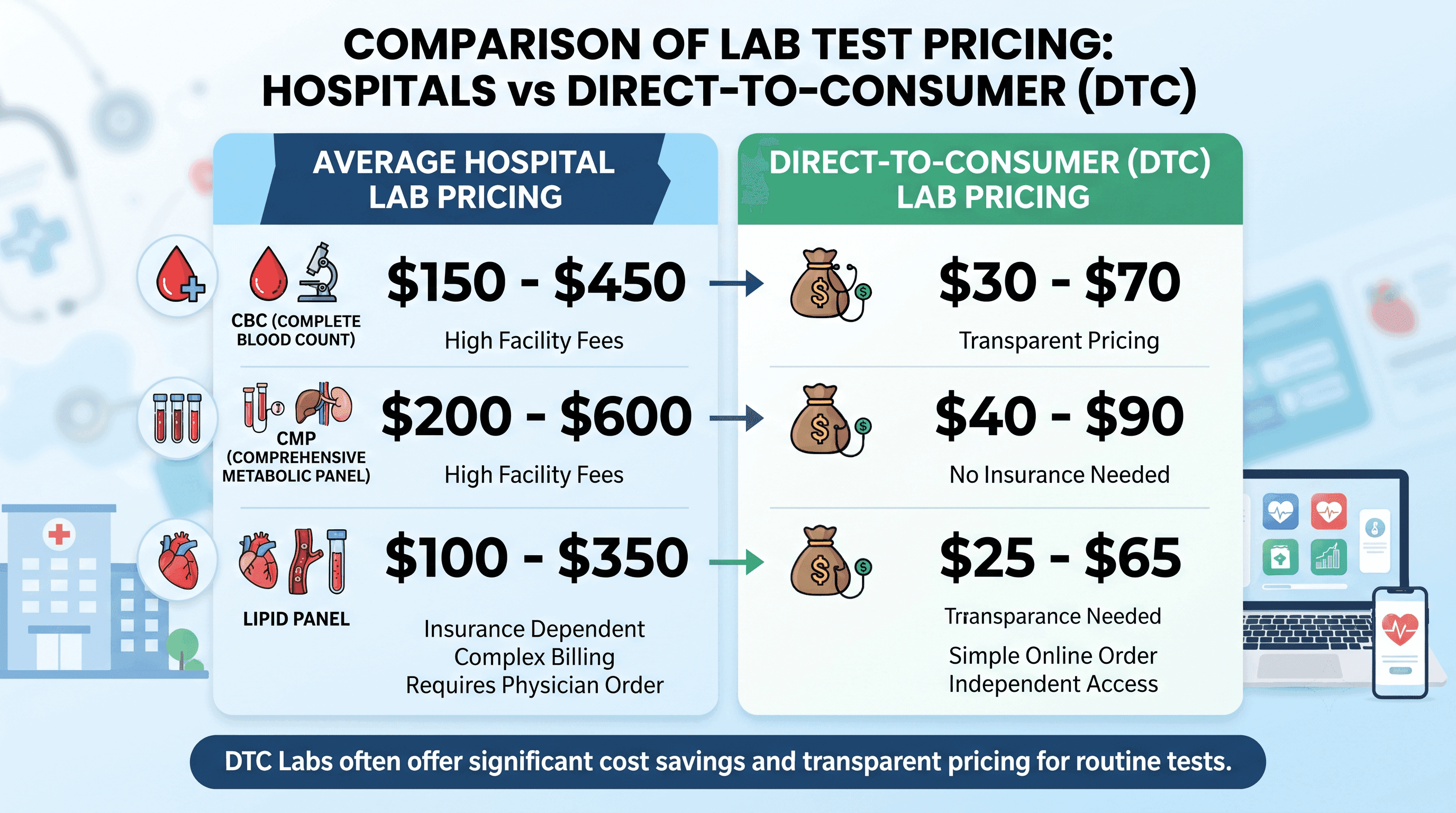
Hospital-based labs tend to be the most expensive option by a wide margin. One analysis found that prices at hospital outpatient labs were 246 percent higher for a lipid panel, 402 percent higher for a complete blood count, and 531 percent higher for a metabolic panel compared to a standalone lab facility. This is one of the main reasons direct-to-consumer labs and discount memberships have become popular among people paying out of pocket.
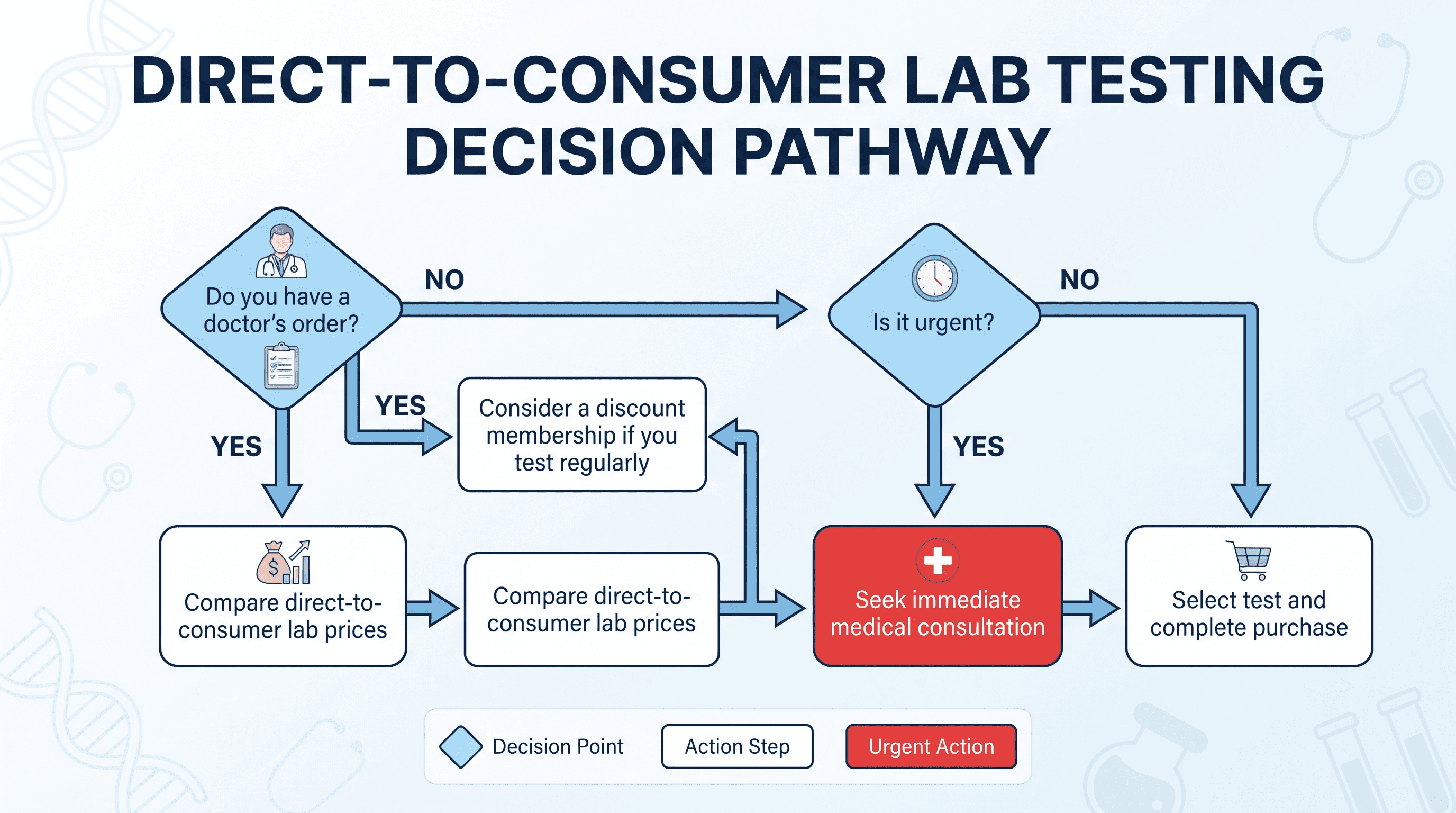
When a Lab Test Alone Isn't Enough
Comparing prices only solves part of the problem. If you're not sure whether you need a particular test in the first place, or what your results mean once you have them, that uncertainty can lead to either overtesting or undertesting. This is where physician-reviewed guidance is most useful. Momentary can help you think through your symptoms and understand whether testing is an appropriate next step before you spend money on it, and can also help you compare costs across laboratory, imaging, and screening services.
If your situation involves symptoms like chest pain, difficulty breathing, severe bleeding, loss of consciousness, or a severe allergic reaction, seek emergency medical care immediately. Lab test cost comparison tools, including Momentary, are not appropriate for emergency situations.
Frequently Asked Questions
Can I get lab tests without a doctor's order? Yes. Most direct-to-consumer labs, including Walk-In Lab, HealthLabs, and Ulta Lab Tests, include an authorized test order as part of the purchase, so you typically don't need your own physician's requisition.
Are direct-to-consumer lab tests covered by insurance? Usually not. These services are generally cash-pay and are not billed to insurance, which is part of how they keep prices lower and more predictable.
Is it cheaper to get lab tests done through a hospital or a standalone lab? Standalone, direct-to-consumer labs are typically less expensive than hospital outpatient labs for the same test, sometimes significantly so, since hospital pricing includes facility fees that standalone labs don't charge.
Can I use my FSA or HSA to pay for lab tests? In many cases, yes. Eligible lab tests can often be paid for using flexible spending account or health savings account funds, which can reduce your effective cost.
How do I know which lab test I actually need? A healthcare professional can help you determine which tests are appropriate for your symptoms or health goals. Momentary can help you understand your situation and identify appropriate next steps before you decide to order a test.
What if I can't afford a lab test even at the lowest price? Look into community health centers with sliding-scale fees, ask the lab directly about financial assistance programs, or ask your healthcare provider's office whether a charity care discount can be applied.


