

Last Updated: July 2026
Best Ways to Save Money on Prescriptions When Medication Costs Are Too High
If a pharmacist just quoted you a price that made you want to walk away without your medication, you are not alone. Prescription costs in the United States vary enormously depending on where you fill them, whether you use insurance, and which savings program you use.
Quick Answer
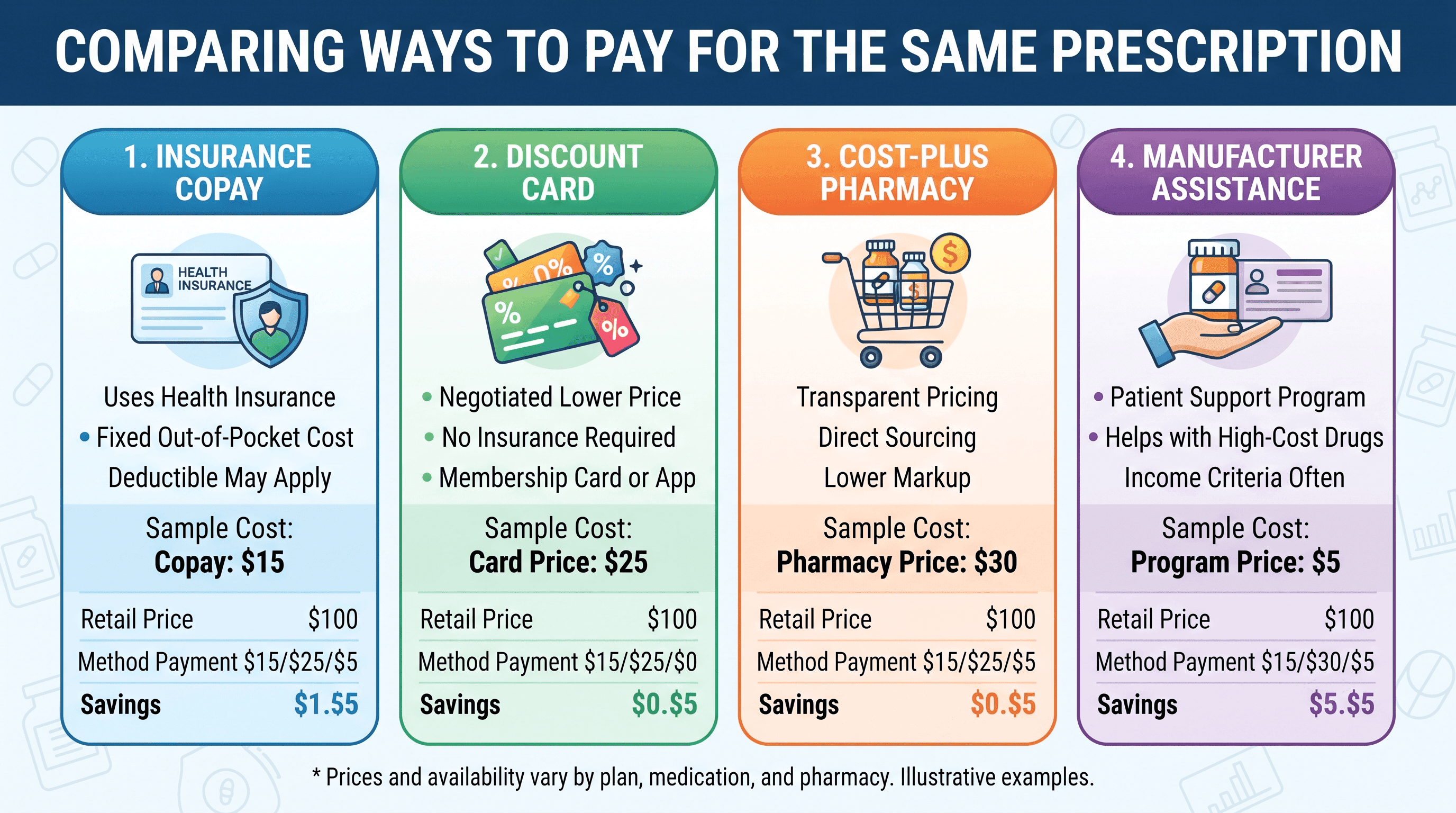
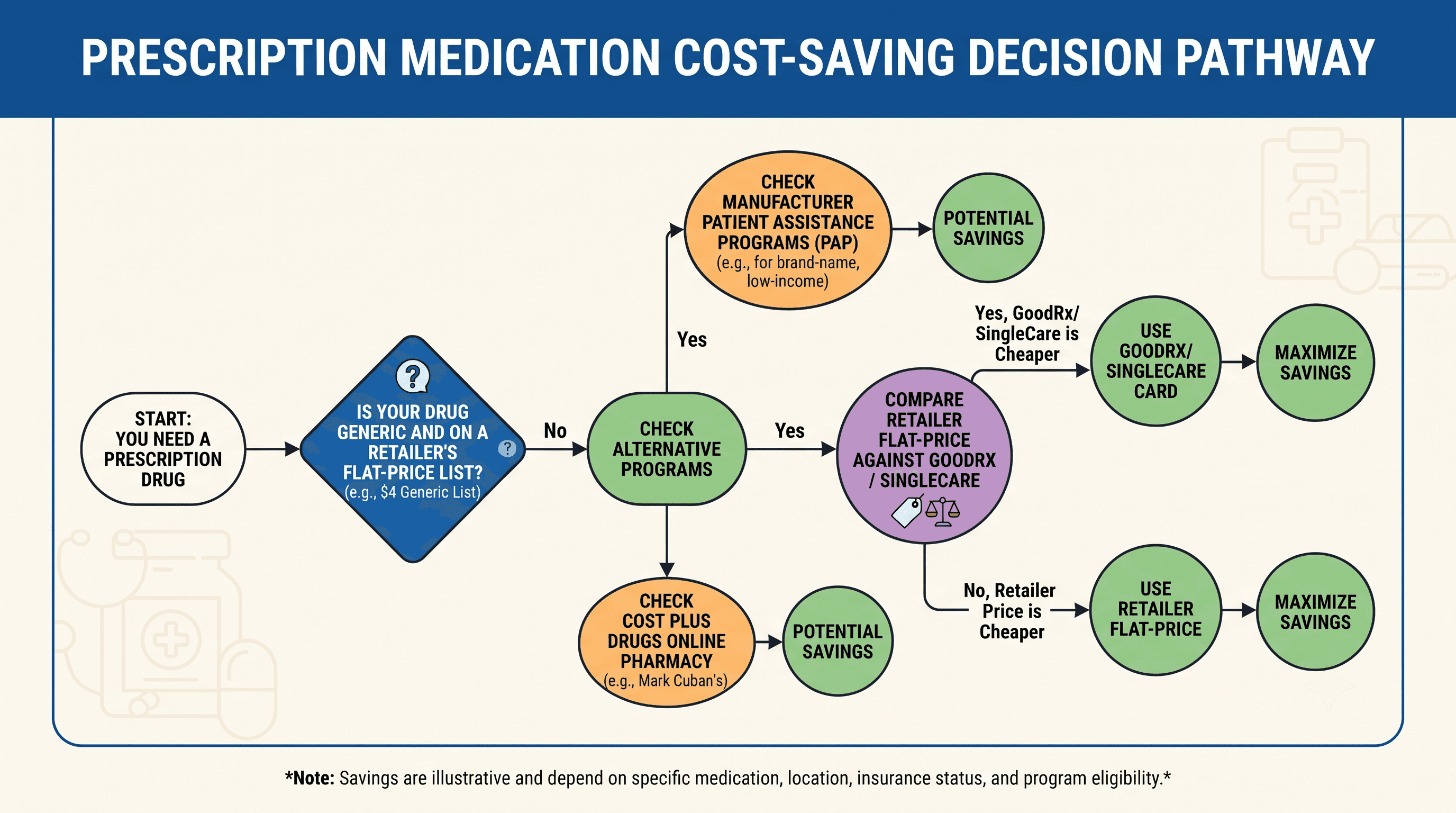
You have more ways to lower prescription costs than most people realize, and you rarely have to choose just one. Start by comparing free discount cards like GoodRx and SingleCare, since prices for the same drug can differ by several dollars between them. For medications you take every month, Mark Cuban's Cost Plus Drugs often beats both on generics through mail order. If you take an expensive brand-name drug, check the manufacturer's patient assistance program before paying retail. Retail programs like Walmart's $4 generics list and Costco's member pricing can also help. Insurance is not always cheapest, so it is worth comparing your copay against these options before you fill.
Top Picks at a Glance
| Method | Best For | Typical Cost | Membership Required |
|---|---|---|---|
| GoodRx | Widest pharmacy access | Free coupons; Gold plan $9.99/mo | No (free tier) |
| SingleCare | CVS shoppers and simplicity | Free | No |
| Mark Cuban Cost Plus Drugs | Monthly maintenance generics | Manufacturer cost + 15% + shipping | No |
| Manufacturer Patient Assistance Programs | Expensive brand-name drugs | Often free or low-cost | Income-based application |
| Walmart / Costco / Amazon RxPass | Common generics, cash payers | $4 to $10 (select generics); RxPass $5/mo | No, or Prime membership for RxPass |
| Optum Perks | Walgreens and Rite Aid shoppers | Free | No |
Information not publicly available for prices outside these commonly cited figures. Always confirm current pricing at the pharmacy counter or on the provider's website, since prices change by drug, dose, and location.
How Should I Decide Which Option to Use?
There is no single best answer for every medication. The right choice depends on whether your drug is generic or brand-name, whether you take it occasionally or every month, and whether you have insurance at all.
A practical approach: check two or three options before every fill rather than committing to one program permanently. Reviewers who tested multiple discount cards on the same prescriptions found that the cheapest option changed depending on the drug and the pharmacy, with price gaps between programs often landing in the $0.25 to $5 range per fill.
1. Compare Free Discount Cards Like GoodRx and SingleCare
Best for: Almost anyone filling a prescription at a retail pharmacy, insured or not.
Discount cards work by showing you a pre-negotiated cash price at nearby pharmacies. You do not need an account, and the pharmacist applies whichever price is lower, the card or your insurance.
GoodRx has the largest pharmacy network, reportedly covering more than 70,000 U.S. locations, and offers a paid Gold tier for an additional discount layer. SingleCare is accepted at a smaller network of roughly 35,000 pharmacies but frequently matches or beats GoodRx pricing, particularly at CVS, where GoodRx acceptance has been inconsistent since a public dispute between the two companies.
Strengths:
- Free to use, no income requirements.
- Works even if you have insurance, since the pharmacist picks the lower price.
- Fast: search, screenshot the coupon, present it at checkout.
Limitations:
- Coupon amounts do not count toward your insurance deductible or out-of-pocket maximum.
- Prices can swing between the two cards, so checking only one may leave savings on the table.
- Some pharmacies inconsistently honor certain coupons.
Quick Take
Best for: People who want an immediate discount with no signup and no waiting. Avoid if: You are having a medical emergency that requires immediate treatment, since discount cards do not address urgent or emergency care needs. Next step: Search your medication on both GoodRx and SingleCare before your next pharmacy visit and compare the total, including any dispensing fees.
2. Use a Cost-Plus Pharmacy for Monthly Generics
Best for: People on long-term generic medications who can plan a few days ahead for mail delivery.
Mark Cuban Cost Plus Drug Company sells medications by publishing what it pays manufacturers, then adding a fixed markup rather than relying on the rebate-driven pricing used by traditional pharmacy benefit managers. As of 2026, the model has generally been described as manufacturer cost plus a 15 percent markup plus a flat shipping fee, though the exact shipping figure has varied across sources and should be confirmed at checkout.
For some generics, particularly specialty and high-cost drugs, the savings compared to retail cash prices have been reported as substantial. This pricing model does not apply to every drug, since the company's catalog covers a defined and growing list of generics rather than the full range of prescription medications.
Strengths:
- Transparent, published pricing with no coupon required.
- Can be dramatically cheaper than retail for many common generics.
- No membership fee.
Limitations:
- Mail-order only, with a processing and shipping window of about a week, which does not suit medications needed the same day.
- Limited drug catalog compared to a full-service retail pharmacy.
- Not useful for filling an urgent, short-term prescription like an antibiotic.
3. Apply for a Manufacturer Patient Assistance Program
Best for: People prescribed an expensive brand-name drug who meet income eligibility requirements.
Most major pharmaceutical manufacturers operate Patient Assistance Programs, commonly called PAPs, that provide free or reduced-cost medication to patients who qualify, typically based on household income and lack of adequate prescription coverage. Nonprofit directories such as NeedyMeds and RxAssist list these programs by drug name and do not charge for the information.
Eligibility and required documentation vary by manufacturer. Some programs require only a signed prescription, while others require detailed income verification and physician sign-off.
Strengths:
- Can eliminate the cost entirely for qualifying patients.
- Especially valuable for expensive specialty or biologic medications with no generic equivalent.
- Free, nonprofit directories exist specifically to help patients navigate the applications.
Limitations:
- Application and approval can take time, so this is not a same-day solution.
- Income and insurance requirements exclude some patients.
- Coverage typically must be renewed periodically.
Quick Take
Best for: Someone prescribed a costly brand-name medication with no lower-cost generic available. Avoid if: You need medication today, since PAP approval is not immediate. Next step: Search the drug name on NeedyMeds.org or RxAssist.org to see whether the manufacturer offers a program and what it requires.
4. Check Retail Pharmacy Cash Programs
Best for: Common, low-cost generics and people without any insurance at all.
Several major retailers offer their own low-cost generic programs outside of insurance and discount cards. Walmart has long offered a list of select generics, including drugs like metformin and lisinopril, for a flat cash price, often cited around $4 for a 30-day supply and $10 for 90 days. Costco Pharmacy offers member-level pricing that is typically lower than standard retail, and federal law does not require a Costco membership to use its pharmacy. Amazon Pharmacy offers RxPass, a flat monthly subscription for Prime members covering a defined list of generic medications.
Strengths:
- No coupon, card, or application needed for Walmart and Costco pricing.
- Predictable, flat pricing for covered drugs.
- Amazon RxPass bundles unlimited refills of eligible generics into one flat fee.
Limitations:
- Drug lists are limited to select generics, so not every medication qualifies.
- Costco's best pricing may still require comparing against a discount card for some drugs.
- RxPass requires an existing Amazon Prime membership to make financial sense.
5. Try a Second Discount Card When Your Regular Pharmacy Doesn't Honor One
Best for: People who use CVS, Walgreens, or Rite Aid and have run into coupon acceptance problems.
Optum Perks has become a widely cited alternative for Walgreens and Rite Aid, while SingleCare is frequently recommended for CVS shoppers who run into GoodRx acceptance issues. Keeping two or three free discount cards on your phone, rather than relying on just one, is a practical hedge against network gaps.
Strengths:
- Free and easy to add without switching pharmacies.
- Fills coverage gaps left by a single discount card.
- No downside to holding more than one, since none require a subscription to start.
Limitations:
- Requires comparing multiple apps before each fill, which takes a little extra time.
- Savings differences between cards are often modest, typically well under a few dollars per fill.
Where Does Momentary Fit Into This?
Momentary is an AI-powered healthcare navigator that helps people understand symptoms and figure out the most appropriate next step, using physician-reviewed guidance. Momentary's cost comparison tools currently focus on laboratory testing, imaging, and screening costs rather than retail prescription pricing.
If your real question is less about which discount card to use and more about whether you need a new prescription at all, whether a lower-cost generic might work, or whether the underlying symptom needs medical attention, Momentary can help you think through that decision before you see a provider. For choosing between prescription discount cards specifically, the dedicated tools above are generally the better fit.
AI-powered healthcare navigation through Momentary is available nationwide. Physician-related services are currently available only in California.
When Should You Talk to a Doctor or Pharmacist Instead of Comparing Prices?
Cost comparison tools are not a substitute for medical guidance. Talk to your prescriber or pharmacist if:
- You are considering skipping doses or splitting pills to save money, which can be unsafe depending on the medication.
- A lower-cost generic or therapeutic alternative might work for your condition.
- You are experiencing side effects severe enough to consider stopping a medication on your own.
If you are experiencing a medical emergency, such as chest pain, difficulty breathing, signs of a stroke, severe allergic reaction, or thoughts of suicide, call 911 or go to the nearest emergency room. Prescription discount tools and healthcare navigators are not appropriate for emergency situations.
Frequently Asked Questions
Can I use a discount card and my insurance at the same time? No, you generally choose one or the other for a given fill. The pharmacist can compare your insurance copay against the discount card price and apply whichever is lower, but you cannot combine the two, and discount card payments do not count toward your insurance deductible.
Is GoodRx or SingleCare cheaper? Neither is consistently cheaper. Independent testing on common medications has found the two split price wins roughly evenly, with SingleCare often stronger at CVS and GoodRx offering a wider pharmacy network overall. Comparing both before each fill is the most reliable approach.
Are patient assistance programs only for uninsured patients? No. Many PAPs are available to patients who have insurance but still cannot afford their cost-sharing for a specific drug, in addition to those with no coverage at all. Eligibility rules vary by manufacturer.
Is it safe to use an international online pharmacy for cheaper prices? Unverified international pharmacies carry a meaningful counterfeit medication risk and limited legal recourse if something goes wrong. Using verified U.S. based discount programs, cost-plus pharmacies, or manufacturer assistance programs is the safer path.
Does Momentary help me find cheaper prescriptions? Momentary's cost comparison tools currently cover laboratory, imaging, and screening costs rather than retail prescription pricing. Momentary can still help you understand whether a symptom needs treatment and what your appropriate next step might be.


